
As an Amazon Associate I earn from qualifying purchases.
Most people who search for a shower pump cannot have one. That is the single most useful thing this page can tell you, and it is the thing every page currently ranking for this term leaves out. If your hot water comes from a combi boiler, or from an unvented cylinder fed at mains pressure, a shower pump of the kind sold on this page is not an option, and no amount of comparing bar ratings will change that.
So this guide runs in the order that actually saves you money. First, whether you can fit a pump at all. Then, if you can, the two questions that decide which pump: positive or negative head, and single or twin impeller. The products come after that, because picking a pump before you know those two answers is how people end up returning them.
I spent sixteen years running plumbers merchants across the south of the country. Shower pumps came back across the trade counter more often than almost anything else we sold, and the reason was nearly always the same: the pump was fine, the house was wrong for it. I am not a plumber and have never held Gas Safe registration, so everything below is based on manufacturer documentation, published specification and what the returns door taught me, not on fitting these myself.
Can you actually fit a shower pump?
A shower pump is a gravity-fed device. It sits below a hot water cylinder and a cold water storage tank, takes water that is already arriving under the gentle pressure of a tank in the loft, and pushes it harder. It needs stored water to draw from. If your house does not store water, there is nothing for the pump to take.
Why you cannot pump a combi boiler
Two reasons, one physical and one legal, and they both matter.
The physical one is that a combi holds no hot water. It heats cold mains water as it passes through a plate heat exchanger, and the amount it can heat per minute is fixed by the boiler's output. Putting a pump on the outlet does not create hot water that the boiler has not made. What it does is try to pull water through the appliance faster than the boiler can raise its temperature, so you get more water at a lower temperature, and on many boilers the flow switch simply stops behaving. Fitting a pump to a combi will also usually void the boiler warranty.
The legal one is about the incoming main. Under the Water Supply (Water Fittings) Regulations 1999, installing "a pump or booster drawing more than 12 litres per minute, connected directly or indirectly to a supply pipe" is notifiable work. Regulation 5(1) is explicit that a person proposing such an installation "shall give notice to the water undertaker that he proposes to begin work" and "shall not begin that work without the consent of that undertaker, which shall not be withheld unreasonably". The wording appears at item 4(d) of the Table in Regulation 5(1) of the Regulations as made, on legislation.gov.uk.
Separately, Schedule 2 paragraph 6 of the same Regulations states that "no water fitting shall be installed, connected or used which is likely to have a detrimental effect on the quality or pressure of water in a water main or other pipe of a water undertaker". Water Regs UK, the body run by the water companies themselves, confirms the notification threshold and says it "applies to all pumps capable of delivering any flow rate greater than 12 litres per minute".
The accurate version of the rule
It is not that boosting the mains is flatly banned. It is that anything drawing more than 12 litres per minute off the supply pipe needs your water company's consent before the work starts. In practice water companies do not consent to a domestic shower pump hanging off the main, which is why every mains booster sold for houses, including the Salamander HomeBoost, is deliberately capped at 12 litres per minute. That is the number the product is designed around, not a coincidence.
What works instead if you have a combi or an unvented cylinder
You have two realistic routes, and which one you need depends on whether your problem is pressure or flow. Pressure is how hard the water pushes. Flow is how much of it arrives per minute. Most weak combi showers are a flow problem, and people buy pressure solutions for it.
- An inline mains booster. A small pump fitted just after the stop tap that lifts incoming flow up to the 12 litres per minute ceiling. It only helps if your incoming main is genuinely weak. If the main already delivers 12 litres per minute or more, it will do nothing at all. Our Salamander HomeBoost review covers how to measure your incoming flow before you spend anything.
- An accumulator, with or without a pump. A pressure vessel that fills slowly from the main and then releases a large volume quickly, so the shower gets a burst of decent flow even though the main is feeble. This is the only thing that genuinely fixes a house where the incoming main is both low pressure and low flow. It is bulky and it is not cheap.
- Change the shower rather than the plumbing. Often the cheapest fix by a wide margin. See the best showers for combi boilers and how to increase shower water pressure with a combi boiler.
Of those three routes, only the inline booster is a single product you can buy and have fitted, so it is worth naming. It is capped at the same 12 litres per minute the Regulations use as their threshold, which is the whole reason it is legal to fit to a house without a consent application.

Best mains booster for a weak incoming main
Salamander HomeBoost Mains Booster
- Inline mains booster, fitted just after the stop tap
- Lifts incoming flow to a ceiling of 12 litres per minute
- For mains fed systems only: combi boilers and unvented cylinders
- Quiet Mark certified
- Three year manufacturer warranty
Pros
- The one buyable product that helps a combi or unvented house whose incoming main is genuinely weak
- Capped at 12 litres per minute, which is what keeps it below the notification threshold in Regulation 5(1)
- Quiet Mark is an independent acoustic accreditation rather than a manufacturer's own claim
Cons
- Does nothing at all if your main already delivers 12 litres per minute or more, so measure before you buy
- It raises flow, not pressure, so it will not fix a house whose problem is pressure alone
- Not a shower pump, and it cannot be fitted to a gravity fed system
This is the honest answer for the combi and unvented readers the rest of this page turns away. Measure your incoming flow with a bucket and a stopwatch first, because on a main that is already healthy this will change nothing.
If you are not sure whether you have a pressure problem or a flow problem, our guide to diagnosing water pressure problems has the bucket test that separates the two in about a minute.
Positive or negative head: the question people get wrong
Assuming you do have a gravity-fed system, this is the next gate, and it is the one that causes most of the returns. Head means the vertical distance between the water level in your cold water tank and the shower outlet. Gravity needs that distance to push water down to the pump in the first place.
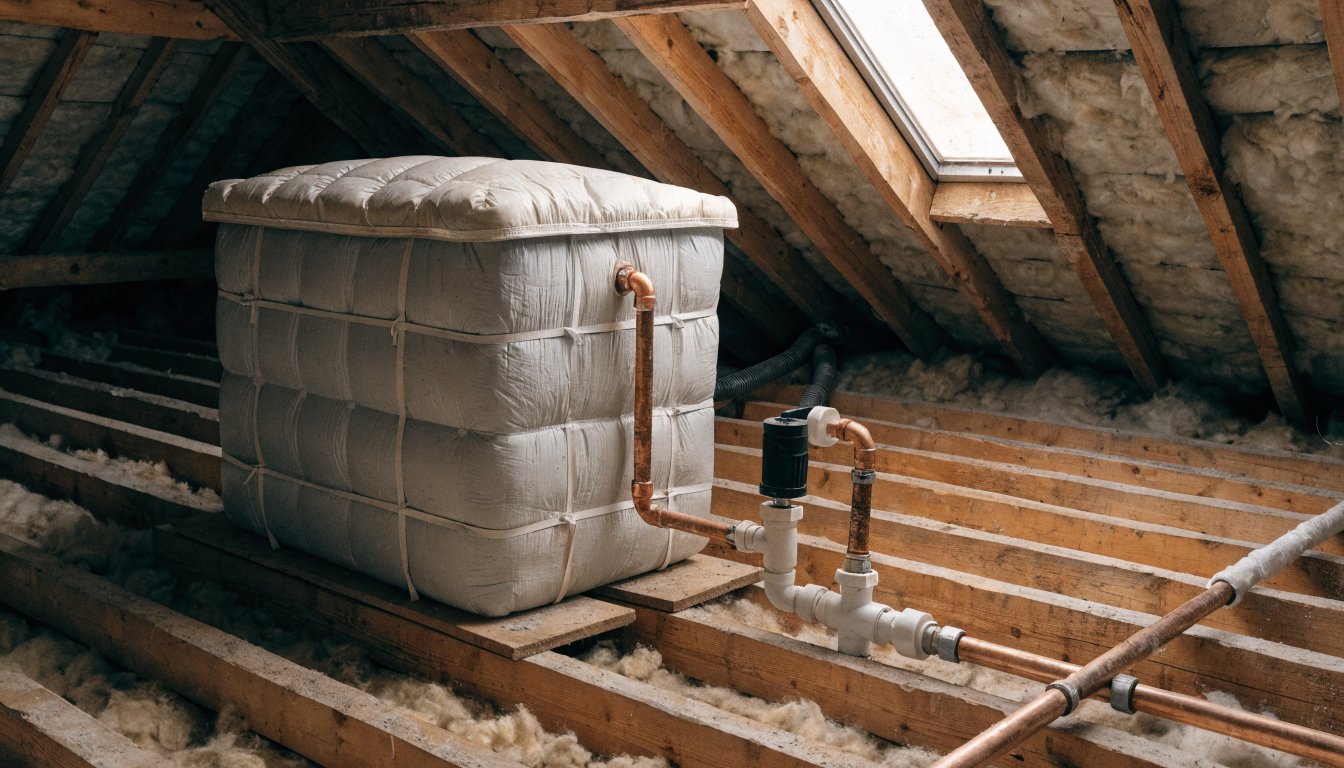
The rule of thumb is that you need roughly a metre of drop from the bottom of the tank to the shower head for positive head. The rule of thumb is not the test, though, and the test takes thirty seconds.
Loft conversions are the classic trap. The bathroom goes in upstairs, the tank stays where it was, and the shower head ends up level with or above the water. Every merchant I worked at had a run of these, and the customer had always bought the cheaper positive head pump first.
Single or twin impeller
An impeller is the spinning part that does the pushing. The number of them tells you how many water supplies the pump can boost.
- Twin impeller pumps boost hot and cold together. This is what you want for an ordinary mixer shower fed from the cylinder and the tank, because both supplies need lifting by the same amount or the temperature wanders every time someone flushes a toilet.
- Single impeller pumps boost one supply only, usually the hot. They suit a setup where the cold is already strong, most commonly an electric or mains-cold shower valve, or a bath tap where only the hot side is gutless.
If you are in any doubt, buy twin. A single impeller pump fitted to a mixer shower gives you a boosted hot supply meeting an unboosted cold one, and the mixer cannot balance that. The result is a shower that scalds, then goes cold, then scalds again. Our full explainer on how shower pumps work goes deeper on regenerative versus centrifugal designs if you want the engineering detail.
What bar rating do you need?
Bar ratings are the spec everyone shops on and the spec that matters least, because a pump cannot deliver water your tank cannot supply. Buying a 3.0 bar pump to serve a small loft tank and a 15mm feed is the most common expensive mistake in this category. It will draw the tank down faster than the ball valve can refill it, then cavitate, then get noisy, then fail.
| Rating | Realistically suits | What it needs from the house |
|---|---|---|
| 1.5 bar | One shower, ordinary handset or a modest fixed head | Standard tank, 22mm feed to the pump. The safe default for most houses. |
| 2.0 bar | One shower with a larger head, or a shower plus a basin used at the same time | Full-size tank, 22mm feed, reasonable cylinder capacity. |
| 2.6 to 3.0 bar | Two bathrooms, body jets, or a genuinely large rain head | A big tank with a fast-refilling valve, 22mm throughout, and a cylinder that will not run cold in four minutes. |
| Above 3.0 bar | Multiple simultaneous outlets in larger properties | Almost always needs the storage upgrading at the same time. Get it designed, do not guess. |
Two practical checks before you pick a rating. Look at the pipe feeding the cylinder and the tank: if it is 15mm, a high bar pump will starve. And look at the tank itself: a small header tank sized for a gravity system will not keep up with a 3.0 bar pump serving two showers.
Where the pump goes, and why it will be louder than you expect
Noise generates more regret than any other aspect of owning a shower pump. People research bar ratings for a fortnight and then discover the thing sounds like a washing machine on spin at six in the morning, in a cupboard that shares a wall with a bedroom.
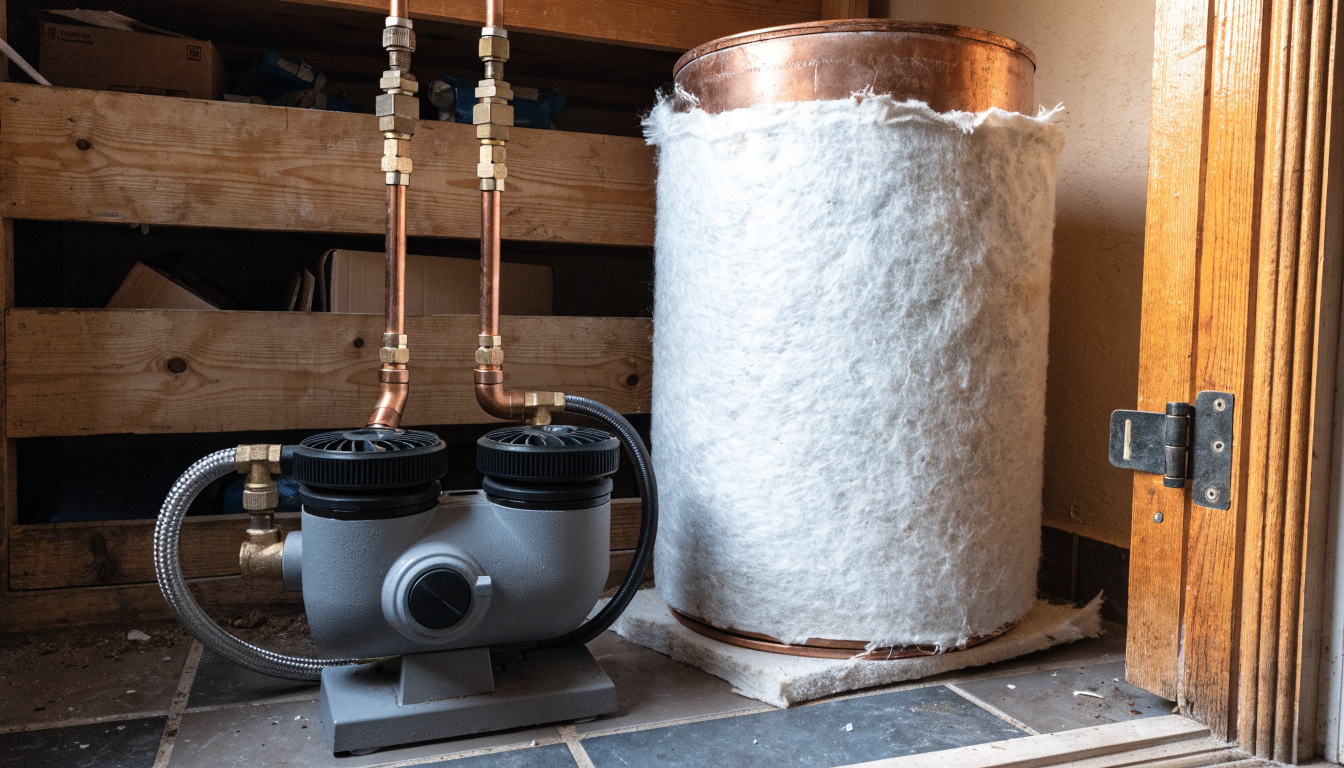
- Below the cylinder. The pump must sit lower than the base of the hot water cylinder so it stays flooded. A pump mounted level with or above the cylinder will draw air and run dry.
- On a solid, level base. Not on floorboards that drum, and not on a shelf. A concrete slab or a thick board bedded on a rubber mat is the difference between a hum and a resonance through the whole house.
- Connected with flexible hoses. They come with the pump for a reason. Solid copper straight into the pump body transmits vibration into the pipework, which then carries it everywhere.
- Accessible. You will need to get to it for isolating valves, filters and eventually replacement. Boxing a pump in permanently is something people regret within about three years.
- Dry, and near a fused spur. It is an electrical appliance in a wet part of the house. The electrical connection is a job for a qualified electrician.
If the cupboard backs onto a bedroom, pay the premium for a pump carrying a Quiet Mark certification. It is an independent acoustic accreditation rather than a manufacturer's own adjective, which is rare enough in this category to be worth paying for.
The best shower pumps for each type of system
A note on brands before the list. Stuart Turner and Salamander dominate this list because they dominate what is actually buyable in the UK at sensible money. Grundfos build excellent pumps and turn up constantly in the Google Shopping results, but their UK retail availability is patchy and prices swing wildly between sellers, so they are harder to recommend with confidence. The picks below are grouped by the decision you have already made above: head type first, then impeller count, then rating.
Selection here is based on published specification, manufacturer documentation and trade experience of what came back through the returns door. These are not pumps I have fitted or tested.
At a glance
- Positive head, one shower: Stuart Turner Monsoon Standard Twin 1.5 bar
- Positive head, quietest: Salamander Right Pumps RP50PT 1.5 bar
- Positive head, lowest price: Stuart Turner Showermate TP Standard 1.5 bar Twin
- Positive head, two showers: Stuart Turner Showermate Standard S2.6 bar Twin
- Positive head, highest output: Stuart Turner Monsoon Standard Twin 3.0 bar
- Negative head, most widely stocked: Stuart Turner Monsoon Universal Twin 2.0 bar
- Negative head, quietest: Salamander Right Pumps RP50TU 1.5 bar
- Single impeller, hot side only: Stuart Turner Showermate Standard S2.0 bar Single
| Product | Head type | Impellers | Rating | Best for | Buy |
|---|---|---|---|---|---|
 Best for one shower Stuart Turner Monsoon Standard Twin 1.5 Bar | Positive | Twin | 1.5 bar | A single ordinary shower | Check price on Amazon |
 Quietest positive Salamander Right Pumps RP50PT 1.5 Bar Twin | Positive | Twin | 1.5 bar | Cupboards next to bedrooms | Check price on Amazon |
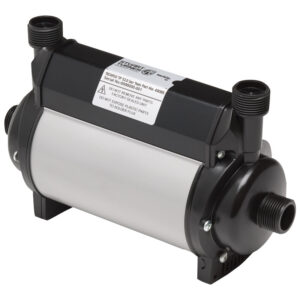 Lowest price Stuart Turner Showermate TP Standard 1.5 Bar Twin | Positive | Twin | 1.5 bar | Tight budgets | Check price on Amazon |
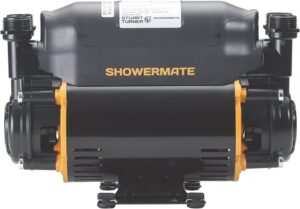 Two showers Stuart Turner Showermate Standard S2.6 Bar Twin | Positive | Twin | 2.6 bar | Two bathrooms or a large head | Check price on Amazon |
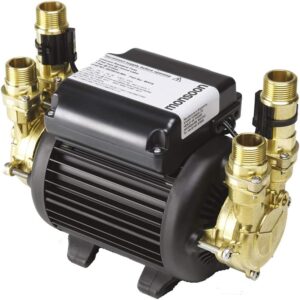 Highest output Stuart Turner Monsoon Standard Twin 3.0 Bar | Positive | Twin | 3.0 bar | Multiple outlets, large storage | Check price on Amazon |
 Best negative head Stuart Turner Monsoon Universal Twin 2.0 Bar | Positive or negative | Twin | 2.0 bar | Loft conversions, shower above the tank | Check price on Amazon |
Quietest negative Salamander Right Pumps RP50TU 1.5 Bar Twin | Positive or negative | Twin | 1.5 bar | Negative head, one shower, noise matters | Check price on Amazon |
 Single impeller Stuart Turner Showermate Standard S2.0 Bar Single | Positive | Single | 2.0 bar | Boosting the hot supply only | Check price on Amazon |
If you have positive head
Water already reaches the shower under gravity, so the pump only has to make it harder. These are the cheaper, simpler units and there are far more of them.

#1 Best for one shower
Stuart Turner Monsoon Standard Twin 1.5 Bar (46506)
- 1.5 bar twin impeller
- Positive head, gravity fed systems only
- Boosts hot and cold together
- Supplied with flexible connecting hoses
Pros
- The safe default rating for a single shower on a standard tank
- Twin impeller keeps the mixer temperature stable
- Widely stocked, so spares and replacements are easy to get
Cons
- Positive head only, so useless if your shower is level with or above the tank
- Not the quietest option in this list
- Warranty terms are conditional on the installation meeting Stuart Turner's requirements, so read them before you fit it
If you have positive head, one bathroom and an ordinary shower head, this is the pump to start from. Going bigger is where people waste money.
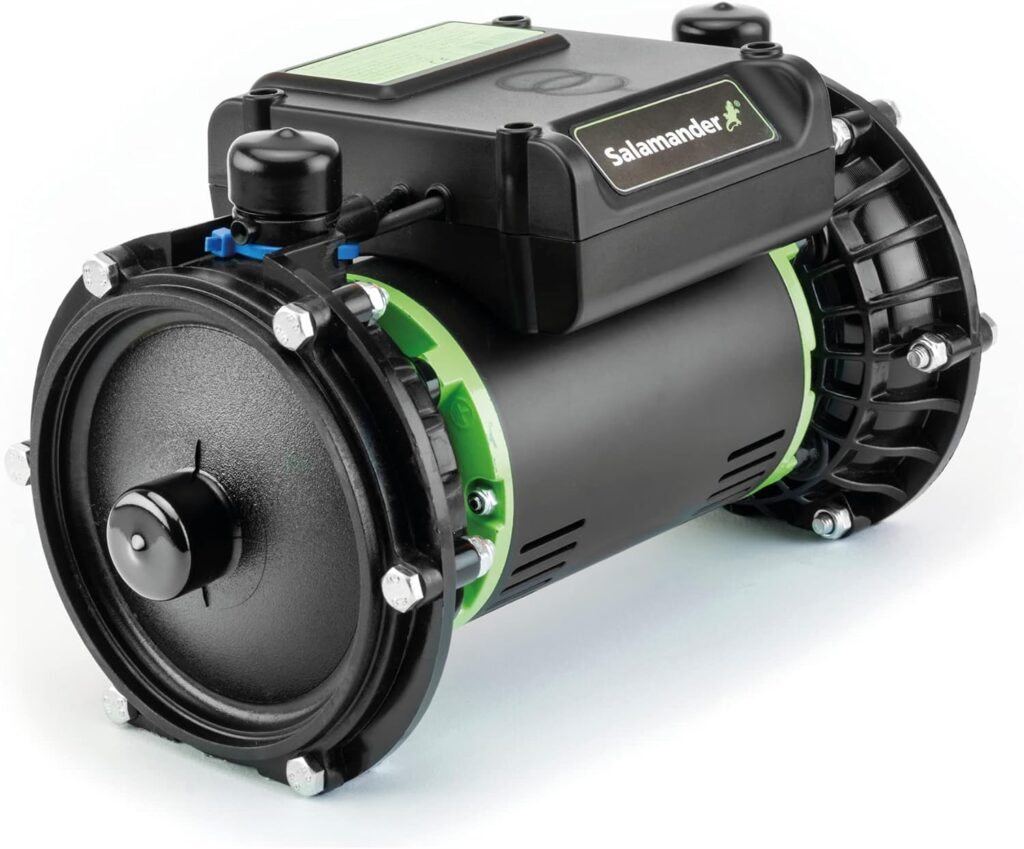
#2 Quietest positive head pump
Salamander Right Pumps RP50PT 1.5 Bar Twin
- 1.5 bar twin end
- Positive head, gravity fed systems only
- Quiet Mark certified
- Centrifugal design
Pros
- Quiet Mark is an independent acoustic accreditation, not a manufacturer's adjective
- Same rating as the Monsoon above, so it is a direct alternative
- Sensible choice where the airing cupboard shares a wall with a bedroom
Cons
- Positive head only, despite the near-identical RP50TU sitting next to it on the shelf
- Quiet does not mean silent, and siting still matters more than the pump
- Costs more than the plainest 1.5 bar pumps
Buy this instead of a standard 1.5 bar pump if noise is the thing you will regret. Check the part number carefully, because the universal version is one letter different.

#3 Lowest price twin impeller
Stuart Turner Showermate TP Standard 1.5 Bar Twin
- 1.5 bar twin impeller
- Positive head, gravity fed systems only
- Boosts hot and cold together
Pros
- The cheapest way into a proper twin impeller cylinder pump
- Same 1.5 bar output as pumps costing noticeably more
- Straightforward replacement for an existing positive head pump
Cons
- Noisier than the Quiet Mark alternatives
- No negative head capability at all
- Budget end of the range, so treat the siting and the feed pipe as non-negotiable
Right choice when the pump is going somewhere nobody sleeps near and the budget is tight. It does the same job as the others at this rating.
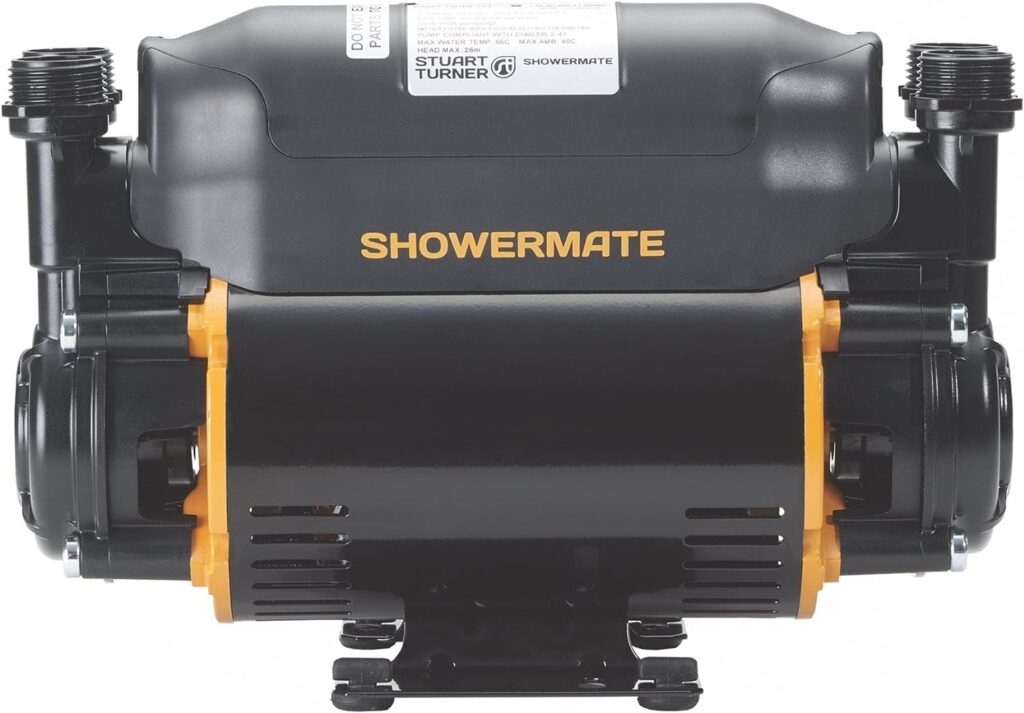
#4 Best for two showers
Stuart Turner Showermate Standard S2.6 Bar Twin (47344)
- 2.6 bar twin impeller
- Positive head, gravity fed systems only
- Anti-vibration mounting feet
- Induction motor
Pros
- Enough output for two bathrooms or a large rain head
- Anti-vibration feet included rather than sold separately
- A genuine step up from 1.5 and 2.0 bar rather than a marketing number
Cons
- Will drain a small loft tank faster than the float valve refills it
- Needs 22mm pipework throughout to work properly
- Overkill, and potentially self-destructive, on a single ordinary shower
Only buy this if your storage can feed it. On the right house it is the pump that finally makes two showers usable at once. On the wrong one it will cavitate.

#5 Highest output positive head
Stuart Turner Monsoon Standard Twin 3.0 Bar (46416)
- 3.0 bar twin impeller
- Positive head, gravity fed systems only
- Boosts hot and cold together
Pros
- The most output you can sensibly fit to a domestic gravity system
- Suits body jets, multiple outlets or a genuinely large head
- Widely stocked across trade and retail
Cons
- Demands a large tank and a fast-refilling float valve, or it will run itself dry
- The most likely pump on this page to be bought by mistake
- Louder simply because it is doing more work
This is a specification decision, not a shopping one. If nobody has checked your tank capacity and feed pipe sizes, do that before buying a 3.0 bar pump.
If you have negative head
These pumps contain a sensor that detects a drop in pressure rather than waiting for water to flow through them, so they start even when gravity cannot begin the process. They cost more. Both of the pumps below are described by their manufacturers as suitable for positive and negative installations, so if your house is borderline, either will cover you.

#6 Best negative head pump
Stuart Turner Monsoon Universal Twin 2.0 Bar (46480)
- 2.0 bar twin impeller
- Universal: works on positive or negative head
- Flow and pressure sensing start
- Boosts hot and cold together
Pros
- Solves the loft conversion problem, where the shower sits level with or above the tank
- Universal, so it also covers you if your head is borderline
- The most widely stocked negative head pump in the UK
Cons
- Costs meaningfully more than the equivalent positive head pump
- 2.0 bar is the only rating in this exact configuration, so there is no cheaper step down
- Warranty conditions are strict on installation, particularly the feed arrangement
If the head test gave you a dribble rather than a flow, this is the default answer. Buying the cheaper positive head version instead is the single most common mistake in this category.
#7 Quietest negative head pump
Salamander Right Pumps RP50TU 1.5 Bar Twin Universal
- 1.5 bar twin end
- Universal: suitable for any positive or negative gravity fed system
- Quiet Mark certified
- Centrifugal design
Pros
- Negative head capability with independent Quiet Mark acoustic certification
- 1.5 bar, so it suits a single shower without over-drawing a modest tank
- The gentler alternative where the 2.0 bar Monsoon would be too much pump
Cons
- 1.5 bar will not serve two bathrooms
- Less widely stocked than the Stuart Turner equivalent
- Easily confused with the positive-head-only RP50PT, which is one letter different
The pick for a negative head house with one shower and a bedroom the other side of the cupboard wall. Check you are ordering the TU and not the PT.
If you only need to boost the hot supply
Single impeller pumps are a narrow use case, but where they fit they are cheaper and take up less room.

#8 Best single impeller pump
Stuart Turner Showermate Standard S2.0 Bar Single (47340)
- 2.0 bar single impeller
- Positive head, gravity fed systems only
- Boosts one supply, normally the hot
Pros
- Cheaper and physically smaller than a twin
- Correct answer where the cold is already mains fed and strong
- Useful for a gutless hot supply to a bath tap
Cons
- Wrong for an ordinary gravity mixer shower, where it will cause temperature swings
- Positive head only
- Narrow use case, so check twice that it is yours
A good pump in the specific situation it is designed for, and a bad one everywhere else. If both your hot and cold come from storage, buy a twin instead.
What shower pumps cost
Screwfix list their shower pump range at £45 to £680, which brackets the category neatly: the bottom of that range is inline micro-boosters rather than cylinder pumps, and the top is multi-bathroom equipment. The realistic band for a twin impeller pump for one bathroom is about £130 to £180.
| Pump | Retailer | Price |
|---|---|---|
| Grundfos Twin Impeller Shower Pump | Screwfix | £134.99 |
| Salamander CT50+ Xtra 1.5 bar twin positive | Screwfix | £149.99 |
| Stuart Turner TP Bar Twin Shower Pump | Toolstation | £157.99 |
| Stuart Turner Showermate Standard Regenerative Twin 1.5 bar (44924) | Screwfix | £159.99 |
Fitting is on top. That is a plumber for the pipework plus, in most cases, an electrician for the fused spur, and the pipework is rarely a straight swap unless you are replacing an existing pump in the same position.
One thing that is not on any spec sheet: no manufacturer in this category publishes a meaningful running cost figure, and the honest answer is that it does not matter much. A shower pump runs only while the shower runs, so a household taking two ten minute showers a day is running a few hundred watts for twenty minutes. It is not a number worth optimising around, and anyone quoting you a precise annual cost has made it up.
Shower pump not working? What actually goes wrong
Shower pumps fail in a small number of predictable ways, and three of the four are caused by the installation rather than the pump. Work down this table before you buy a replacement, because a pump that has been killed by an airlock will be killed again by the same airlock.
The pattern behind nearly all of it is that shower pumps do not tolerate being asked for water that is not there. Get the feed right and they last. Our guide to how long a shower pump should last covers the maintenance side and the signs that one is on the way out.
Frequently asked questions
Can I put a pump on my shower?
Only if the shower is fed from stored water: a hot water cylinder and a cold water tank. If you have a combi boiler or an unvented mains-pressure cylinder, you cannot, and if the shower is electric you cannot either. Run the system check at the top of this page first.
Is it worth getting a shower pump?
On a gravity-fed system with a genuinely weak shower, yes, it is usually the most effective single change you can make. On any other system it is the wrong product, and the money is better spent on the shower itself or on mains boosting. The other honest caveat is noise: if the only place the pump can go is next to a bedroom, factor that in before you commit.
Where should a shower pump be installed?
Below the level of the hot water cylinder, on a solid and level base, somewhere you can still reach it, connected with the flexible hoses supplied and near a fused spur. The airing cupboard floor is the usual answer. Lofts are a poor choice because the pump ends up above the cylinder and because of the freezing risk.
Do I need a plumber or an electrician to fit a shower pump?
Usually both. The pipework is plumbing and the connection is electrical work in a location with specific requirements. Many plumbers will do the pipework and leave the final electrical connection to an electrician. If the installation also involves anything on an unvented cylinder, that part legally requires an engineer holding the relevant unvented hot water qualification.
What is the difference between a 1.5 and a 2.0 bar shower pump?
Roughly, how hard it pushes and how much it can supply at once. 1.5 bar is enough for one shower with a normal head. 2.0 bar suits a bigger head or a second outlet running at the same time. The practical limit is not the pump, it is whether your tank and feed pipes can keep it supplied.
Can a shower pump be too powerful?
Yes, and it is a common and expensive mistake. An oversized pump drains the tank faster than the float valve refills it, then runs on air. That causes cavitation, noise and eventually seized impellers. Match the pump to what the storage can actually deliver rather than to the biggest number you can afford.
How much does a plumber charge to fit a shower pump?
It depends entirely on the pipework, so any figure quoted without someone looking at the cupboard is a guess. A straight replacement of an existing pump in the same position is a short job. A first-time installation that needs a new feed taken from the cylinder, a new cold draw-off from the tank and a fused spur run in is a substantially bigger one. Get two quotes from people who have actually seen it.
What is an alternative to a shower pump?
For a gravity system, replacing the shower with one designed for low pressure is often enough and always cheaper. See the best mixer showers for low water pressure. For a combi or unvented system, mains boosting or an accumulator. And if you are weighing up the whole approach, electric showers versus mixer showers is worth reading, because an electric shower sidesteps the pressure problem altogether.
Related guides
- Shower pumps explained, for the engineering behind regenerative and centrifugal designs and how to read a performance curve.
- Salamander HomeBoost review, if the system check told you a shower pump is not an option and your incoming main is weak.
- How long should a shower pump last, for what shortens their life and how to tell when one is failing.
- Best power showers, which put the pump inside the shower unit and can be simpler than a separate pump on a gravity system.
- Troubleshooting water pressure, to work out whether you have a pressure problem or a flow problem before spending anything.




0 Comments