
As an Amazon Associate I earn from qualifying purchases.
If you want to know how to stop condensation on windows, the first useful thing to say is that the window is not the problem. Glass is the coldest surface in the room, so it is where the water shows up first. The water itself came from somewhere else in the house, and in most homes that somewhere is the bathroom, the kitchen, or a clothes airer in the spare room.
That distinction decides what you should buy. Look at who currently ranks for this question and you find window companies, glazing trade bodies, insurers and retailers selling dehumidifiers. None of them has much reason to point out that the cheapest effective fix is usually an extractor fan in a room you were not even looking at.
Three things on this page that the others leave out. Condensation on the inside, the outside and between the panes are three separate problems with three different answers, and only one of them is about household moisture. A typical UK household puts about 12 litres of water into the air every day, and over 20 litres if washing is dried indoors. And running a bathroom fan for an hour a day costs roughly 48p a year at the current price cap, while running a dehumidifier eight hours a day through a winter costs somewhere between £38 and £147 depending on which type you bought.
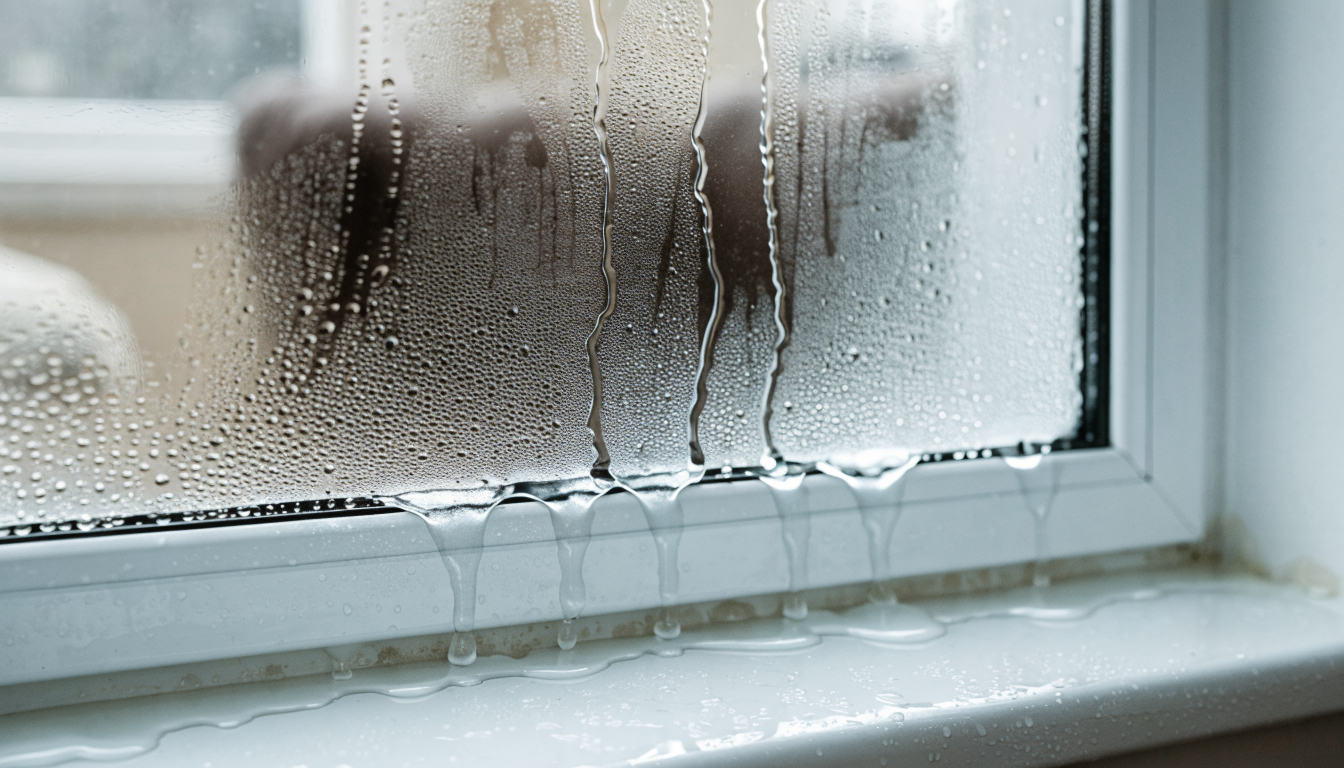
First work out which of the three condensation problems you have
Before you buy anything, put your hand on the glass. Which side the water is on tells you which problem you are dealing with, and the three have almost nothing in common. Most pages on this subject blur them together, which is how people end up buying a dehumidifier for a failed double glazing unit.
If you are in case two or case three, you can stop here. The rest of this page is about case one, which is far and away the most common, and the only one where what you do inside the house makes any difference.
What causes condensation on windows
Warm air holds more water vapour than cold air. That is the whole mechanism, and everything else on this page follows from it.
Air at 20°C can hold roughly twice as much water vapour as air at 10°C. The vapour is invisible and stays suspended as long as the air is warm enough to carry it. Cool that same parcel of air down and its capacity falls, so at some temperature it becomes completely full. That temperature is the dew point. Cool it any further and the air cannot hold what it is carrying, and the surplus has to come out of the air as liquid water.
Glass is the coldest surface in a normal room by a wide margin. A wall has insulation and depth behind it. A window is a few millimetres of glass with the November night on the other side. So the layer of air actually touching the pane gets chilled well below the temperature of the rest of the room, drops under its dew point, and dumps its water onto the glass. The same air two metres away, sitting at room temperature, holds on to its moisture quite happily and looks perfectly dry.
Two things follow from that, and they are the two levers you have. You can reduce how much water is in the air, so the dew point sits lower than the glass temperature. Or you can raise the temperature of the glass, so it stays above the dew point. Better glazing does the second. Everything cheap and effective does the first.
Why it starts in November and not in January
People search for this in November far more than any other month, and it is not because November is the coldest. It is because November is when the gap opens up. The heating goes on, so indoor air gets warm enough to carry a lot of vapour, and windows and doors stop being opened, so that vapour stays in. Meanwhile outdoor temperatures have fallen far enough for the glass to get genuinely cold overnight. By January the house has often dried out somewhat and habits have adjusted. November is the collision.
Why brand new windows can make it worse, not better
This comes up constantly and it catches people out. Old, draughty windows leaked air continuously, and that leakage was quietly removing moisture around the clock. Fit a modern sealed unit and you stop the draughts, which is what you paid for, but you also stop the accidental ventilation. The same amount of water goes into the air and far less of it leaves. The new windows did not create the moisture. They removed the escape route it had been using.
Where the moisture in your house actually comes from
Here is the figure worth knowing, and it comes from local authority damp guidance rather than anyone selling anything. South Kesteven District Council and City of Lincoln Council both publish the same numbers: the average UK household puts about 12 litres, or roughly 20 pints, of moisture into the air every day. In homes where clothes are dried indoors, that total goes to over 20 litres, about 36 pints, a day.
Read that again, because it is the single most useful fact on this page. Drying washing indoors adds roughly eight litres a day, which is more than two thirds again on top of everything else the household does put together. That is nearly a bucket of water a day being evaporated into rooms you then close up for the night.
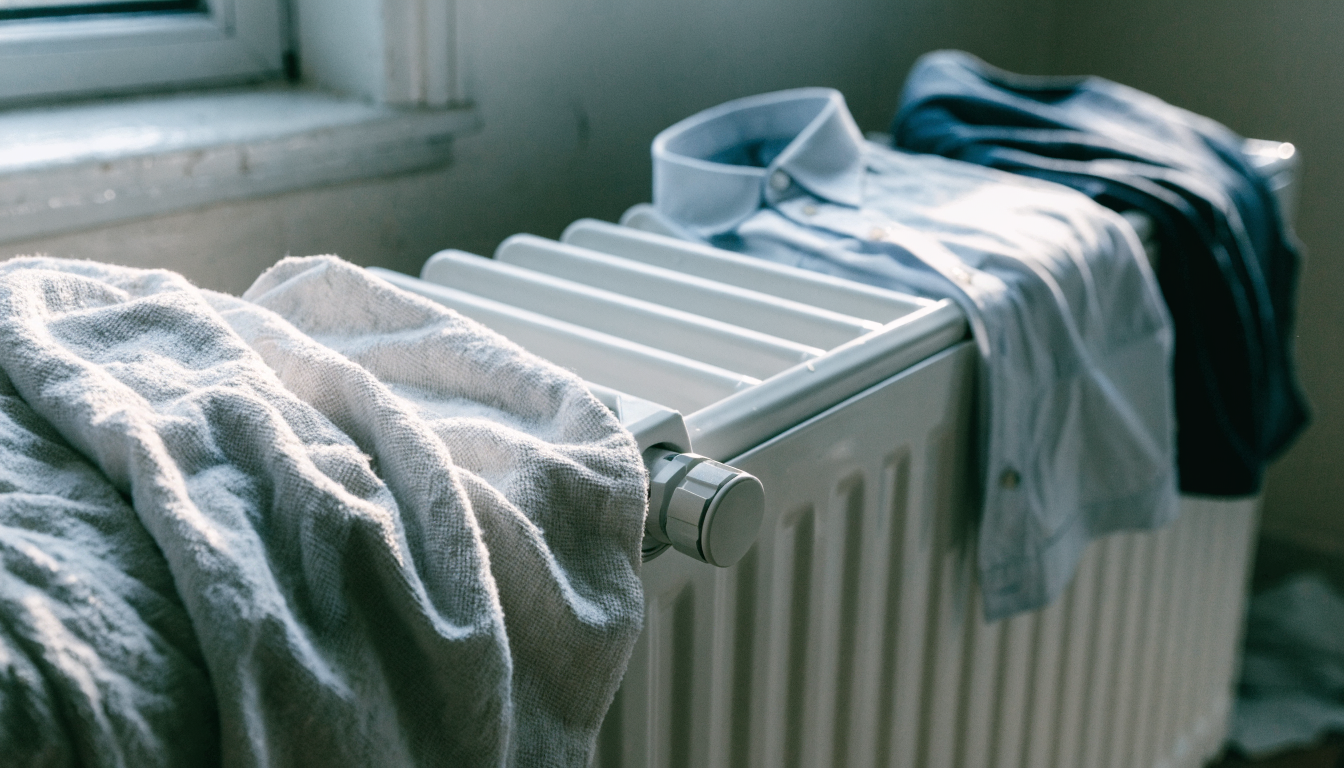
Drying washing on radiators is worth singling out because it is both the biggest single source and the one people are most reluctant to give up. It also quietly costs you twice. The water evaporating off the fabric absorbs heat from the radiator, so the room warms more slowly and the boiler runs longer, and then the moisture you paid to evaporate condenses on your windows a few hours later. If you have no choice but to dry indoors, dry in one room with the door shut and the window open a crack, or with a dehumidifier running in there. Do not spread it across the house.
How to stop condensation on windows, in order of what actually works
These are ordered by effect on the underlying problem, not by how satisfying they feel. The first three are where nearly all the benefit sits, and they are also the cheapest.
The extractor fan is the fix, and most of them are not moving enough air
Every page on this subject tells you to use an extractor fan. Almost none of them tells you what the fan has to achieve, which is the part that decides whether yours is doing anything.
Building Regulations Approved Document F, Volume 1: Dwellings, 2021 edition, sets minimum intermittent extract rates by room in Table 1. These are the numbers to hold your fan against.
| Room | Minimum intermittent extract rate | Minimum continuous high rate |
|---|---|---|
| Bathroom (with or without WC) | 15 l/s | 8 l/s |
| Sanitary accommodation (separate WC) | 6 l/s | 6 l/s |
| Utility room | 30 l/s | 8 l/s |
| Kitchen, cooker hood extracting to outside | 30 l/s | 13 l/s |
| Kitchen, no hood extracting to outside | 60 l/s | 13 l/s |
A typical 100mm bathroom fan is quoted somewhere between 15 and 21 l/s, so the headroom over the bathroom minimum is thin to begin with. Then consider how yours is actually installed. A fan quoted at 21 l/s in free air, connected to four metres of sagging flexible duct with two bends in it, is not delivering 21 l/s. Nobody publishes what it is delivering instead, and that unmeasured shortfall is exactly where household damp problems live.
The kitchen figure is the one that surprises people. 60 l/s with no hood is a serious amount of air, roughly three times what a bathroom needs, and the little recirculating hood over the hob that filters air and blows it straight back into the room is extracting precisely nothing. If your kitchen hood is not ducted to outside, it is not part of the solution.
Three practical checks. Does it run on a timer for long enough after you leave the room, because the moisture is still in there when you switch the light off. Is it ducted to outside rather than into a loft void. And is the duct short, rigid and reasonably straight. If you are replacing one, our guide to the best extractor fans for bathrooms covers the Part F rates, the BS 7671 zones that decide where a fan can legally go, and which specific units clear 15 l/s with room to spare.
Trickle vents, and why yours are probably taped shut
Trickle vents are the small closable slots in the top of a window frame. They provide the slow, continuous background air change that keeps humidity from creeping up overnight while everyone is asleep with the doors closed.
They are also the first thing people shut. Someone feels a draught in February, slides them closed, and forgets. If you have condensation every morning, go around the house and check every vent is open, particularly in bedrooms. It costs nothing and it is the most commonly missed step in this whole subject. If your windows have no vents at all, retrofit units are cheap, though fitting them to a sealed unit frame is a job worth handing to a glazier rather than attacking with a drill.
Steady heat beats blasting the heating
Condensation forms on the coldest surfaces, so anything that lifts the temperature of those surfaces helps. A house heated steadily to a moderate temperature has warmer glass, warmer external wall corners and warmer floor voids than one heated hard for two hours and then allowed to drop away overnight.
Even heating across the house matters as much as the total. The classic pattern is one cold spare room with the radiator turned off and the door shut, which becomes the room where mould appears, because damp air from the rest of the house drifts in and meets the coldest walls in the building. If some radiators run hot while others barely warm up, balancing the radiators spreads the output properly and costs nothing but an afternoon. For a room with no radiator at all, or one where the heating simply will not reach, an oil-filled radiator on a low setting with a thermostat is a reasonable way to hold a floor above dew point without heating it like a living room.
In bathrooms specifically, a heated towel rail earns its place here for a reason people rarely state. It is not mainly about warm towels. It is that a wet towel hanging in a cold bathroom is a small laundry airer evaporating water into the room all day, and a rail that actually dries it removes that source. Our guide to the best electric towel rails covers sizing and running costs.
What each fix costs to buy
Prices below are non-Amazon retail prices, checked on 18 September 2026. Screwfix and Toolstation block automated price checks, so their figures here are taken from live search listing data rather than fetched from the page, and are worth confirming before you buy. There are no Amazon prices anywhere on this page, because Amazon only permits prices published through its own API.
| Fix | Typical price | Where | Fitting |
|---|---|---|---|
| Open the trickle vents you already have | £0 | Your own windows | None |
| Stop drying washing on radiators | £0 | Habit | None |
| Retrofit trickle vent, single | £7.80 | B&Q, Simon Framevent | Glazier, or careful DIY on a timber frame |
| Bathroom extractor fan, axial with timer | £22.99 to £42.00 | Screwfix (Manrose XF100T), B&Q and Wickes (Manrose QF100T) | Electrician. Bathroom zones are notifiable work |
| Dehumidifier, domestic | See the product section below | Amazon and high street | Plug in |
| PIV unit, no heater | £339.98 | Screwfix, Vent-Axia Pure Air Home | Loft fitting plus an electrician |
| PIV unit with integral heater | £649.25 | B&Q, Nuaire Drimaster Eco Heat | Loft fitting plus an electrician |
Worth sitting with those two ends of the table for a moment. A £30 fan and an afternoon opening trickle vents addresses the cause. A £649 PIV unit plus an electrician addresses the same cause with more machinery. The PIV is a genuinely good product for a house that is still damp after the cheap fixes are done, and a waste of money in a house where nobody has yet shut the bathroom door.
What a dehumidifier actually costs to run
Nobody publishes this, and it is the number that should decide which type you buy. The arithmetic below uses the Ofgem price cap electricity unit rate of 26.32p per kWh for 1 October to 31 December 2026, checked against Ofgem directly rather than recalled. The standing charge over that period is 54.83p a day, but that applies whether the dehumidifier is on or not, so it is excluded.
The working is: rated power in kilowatts, multiplied by hours run, multiplied by 26.32p. Wattages are the manufacturers' own published figures. The 120-day figure is roughly November to the end of February, which is the season this matters.
Two things fall out of that. The extractor fan costs so little to run that the number is barely worth printing, which is the single strongest argument for fixing the cause rather than the symptom. And the choice between a compressor and a desiccant dehumidifier is not a detail, it is a difference of roughly £100 across one winter.
The honest trade-off is this. Compressor units are far cheaper to run but lose efficiency as the room gets colder, because they work by chilling a coil and condensing water onto it, which is hard to do when the air is already cold. Desiccant units use a moisture-absorbing wheel and keep working properly down to a few degrees, which is why they suit unheated garages, conservatories and cold utility rooms. For a normally heated house, a compressor unit is the right answer and the running cost reflects that.
What to buy, and one thing not to bother with
These are judged on published specification, manufacturer documentation and what sold and came back through the counter over sixteen years in plumbers merchants, rather than on hands-on testing. Every product here was checked as available before it went on the page.
Measure before you buy anything
A cheap hygrometer is the most useful thing on this list and the least exciting. It tells you the relative humidity in the room, which turns the whole problem from a guess into a number you can act on. Below about 50% you will get very little condensation on modern glazing. Sustained above 65% in a bedroom and you have a problem that no amount of wiping is going to solve.
It also tells you whether anything you changed worked, which matters, because the alternative is spending £649 on a PIV unit and having no idea whether it helped.
#1 Buy this first
TempPro TP49 Digital Hygrometer and Room Thermometer
- Displays relative humidity and room temperature
- Small enough to sit on a windowsill or bedside table
- Battery powered, no wiring or app
Pros
- The cheapest way to turn condensation from a guess into a measurement
- Lets you compare rooms, which is how you find the bad one
- Shows whether a change you made actually did anything
Cons
- Budget sensors drift over time and are not laboratory accurate
- No logging, so you only see the reading when you look at it
- You will want more than one to compare rooms properly
Buy one before you buy anything else. Knowing that the back bedroom sits at 72% while the rest of the house is at 50% tells you where to spend your money, and that information costs less than a takeaway.
The dehumidifier for a normally heated house
#2 Best for most homes
MeacoDry Arete One 12L Dehumidifier and HEPA Air Purifier
- 12 litres a day extraction
- 151 W rated power consumption
- 2.5 litre tank
- Laundry mode for drying washing in one room
- Five year warranty
Pros
- 151 W is genuinely low for a 12 litre unit, and that is what the running cost turns on
- Five year warranty is unusually long in this category
- Laundry mode targets the single biggest moisture source in most houses
- Quoted at 35 to 38 dB, which is liveable in a bedroom
Cons
- Compressor units lose efficiency in a cold room, so this is the wrong choice for an unheated garage
- The 12 litres a day figure is a rating, not what you will collect in a normal house
- Still has a real running cost over a winter, as the arithmetic earlier on this page shows
- Bulkier than the small desktop units people expect
The right dehumidifier for a heated house, and the running cost is the reason. At 151 W it costs roughly half what a desiccant unit costs to run over a winter. If your problem is a laundry room or a persistently damp bedroom in an otherwise warm house, this is the one.
The dehumidifier for a cold room
#3 Best for garages and cold rooms
EcoAir DD1 Simple MK3 Desiccant Dehumidifier
- 7.5 litres a day at 20°C and 60% relative humidity
- 300 W on low, 580 W on high
- 34 dB(A) on the low setting
- 6 kg, so it carries easily between rooms
- Three year warranty
Pros
- Desiccant technology keeps working in cold rooms where a compressor unit gives up
- Genuinely light, which matters if you move it between a garage and a utility room
- Puts out slightly warmed air, which helps in an unheated space
- Simple rotary dial, nothing to configure
Cons
- Running cost is the real drawback: it draws twice the power of the compressor unit above on its low setting, and nearly four times on high
- Lower extraction rate than the compressor unit above despite drawing twice the power
- Noisier on high at 47 dB(A)
- Rotary dial only, so no humidistat to shut it off automatically
Buy this for a garage, conservatory, boat or unheated utility room, and only for those. In a normally heated house it does the same job as a compressor unit for around twice the electricity, and the running cost table earlier on this page shows what that adds up to over a winter.
Clearing the glass in the morning
Clearing water off the glass does nothing whatever about the cause. It does stop the water sitting in the bottom of the frame and on the sill all day, which is where the staining, the perished sealant and eventually the mould come from. So it is worth doing, as long as you are clear that it is housekeeping rather than a fix.
#4 Best for clearing the glass
Kärcher WV 6 Plus Cordless Window Vacuum
- 100 minute battery run time
- 280mm suction nozzle
- Sucks water off the glass into a tank rather than pushing it around
- Supplied with a spray bottle and microfibre cover
Pros
- Genuinely faster than a cloth on a house with a lot of glass
- Collects the water instead of transferring it to a towel you then hang up indoors
- 100 minutes is far more run time than a domestic session needs
- Doubles as a window cleaner the rest of the year
Cons
- Treats the symptom completely, and will not reduce humidity by a single percentage point
- Expensive relative to a squeegee, which does the same job on one window
- Another thing to store and charge
- Fiddly on small Georgian-bar panes
Useful and pleasant to use, but be honest with yourself about what you are buying. This is a tool for managing the water once it has already formed. If you buy this and nothing else, you will be doing the same job every morning next November.
Moisture traps, and why they will not fix your house
This is the one to be straight about, because moisture traps sell extremely well every November and most of the pages recommending them will not do the arithmetic.
A refillable moisture absorber uses a tab of hygroscopic salt that pulls water out of the air and drips it into a reservoir. The standard refill tab weighs 450 g. Now set that against the verified figure from earlier on this page: your household is putting about 12 litres of water into the air every day, and over 20 litres if you dry washing indoors. A 450 g tab, working over the several weeks or months it is designed to last, is simply not operating at the scale of the problem.
Where they genuinely earn their keep is a small, sealed, unventilated space with no moisture being generated in it: a caravan over winter, a wardrobe, a boat, a cupboard with a musty smell, a spare room that is shut up and unused. In a family bathroom, or a bedroom where laundry is drying, a moisture trap is close to useless and the refill tabs are a recurring cost for that uselessness.
#5 Only for small sealed spaces
UniBond AERO 360 Moisture Absorber
- Refillable device supplied with one 450 g tab
- No power supply required
- Collects water in a reservoir you tip away
Pros
- Costs nothing to run because it uses no electricity
- Silent, so it suits a bedroom where a dehumidifier would not
- Genuinely effective in a caravan, wardrobe or shut-up cupboard
Cons
- A 450 g tab is not at the scale of a household producing 12 litres of moisture a day
- Refill tabs are a recurring cost, so the cheap purchase price is not the whole price
- Does nothing at all about the source of the moisture
- Widely bought as a fix for whole-house damp, which it is not
Fine for what it is, which is a passive absorber for a small sealed space nobody ventilates. If you have condensation on your windows every morning because four people live in the house and the washing dries on the radiators, this will not touch it, and saying so is more useful than selling you three of them.
When condensation turns into mould
Water sitting in the bottom of a window frame does not stay water. It soaks into the sealant joint, the frame gasket and the paint, and after a few weeks of being wet every morning black spotting appears along the bead and in the corners of the reveal. The same thing happens behind wardrobes on external walls and in the corner of the coldest bedroom.
Practically, once mould is established you have two separate jobs and they must be done in that order. Remove the mould that is there, and stop the surface getting wet again, because cleaning it off without fixing the moisture just resets the clock. Everything above this section is the second job. For the first, our guide to getting rid of black mould in the bathroom covers what actually shifts it from painted walls, grout and plaster. Where it has got into the silicone around a bath, shower tray or window, black mould in sealant is a different job again, because the growth is under the surface rather than on it, and removing black mould from silicone sealant explains when it can be cleaned and when the bead has to come out and be replaced.
Questions people ask about window condensation
How do you stop condensation on windows overnight?
Overnight is the hardest case, because the room is sealed, the heating is off and two people are breathing into it for eight hours. In practice: open the trickle vents in that bedroom, leave the door ajar so the moisture is not concentrated in one cold room, do not dry anything in there, and do not let the room go completely cold. If the room still fogs up every morning after all of that, a dehumidifier running in it overnight is the reliable answer, and a compressor unit is the one that will not punish you on the electricity bill.
Can you put fairy liquid on windows to stop condensation?
You can, and it does something, but understand what. Rubbing neat washing up liquid on dry glass leaves a surfactant film that changes how water behaves on the surface. Instead of beading into droplets that scatter light, it spreads into a thin transparent sheet. The window looks clearer. The same amount of water is still condensing onto it, and it still runs down into the frame.
So it is a cosmetic trick that has to be redone regularly and leaves a smeary film. It has no effect on the humidity in the room, which is the actual problem. It is not a fix and it should not be the headline advice, which is exactly what it has become.
Does condensation on windows mean the house is too cold?
Not necessarily, and this is a common misreading. Condensation means the glass is below the dew point of the air in the room. You can reach that state in a warm house with very humid air, or a cool house with fairly dry air. A warm, steamy kitchen will fog its windows solid while a cool, well-ventilated hallway stays clear.
What it does reliably indicate is that humidity and surface temperature are out of balance. Turning the heating up is one way to change that balance, and usually the most expensive one. Getting the moisture out is the cheaper lever.
Why are my brand new windows wet with condensation every morning?
Because the old ones were ventilating your house by accident. Draughty frames leaked air continuously, taking moisture with it. New sealed units stop that, which is what you wanted, but the moisture your household produces has not changed and now has nowhere to go. It is not a fault with the windows, and the installer is right when they tell you so. The fix is deliberate ventilation replacing the accidental sort: trickle vents open, extractor fans doing their job, and the bathroom door shut when the shower is running.
Is it normal to have condensation inside double glazing, between the panes?
No. That is the one case that is definitively a fault. The cavity between the panes is sealed and contains a desiccant in the spacer bar to absorb the small amount of trapped moisture. Water appearing in there means the seal has failed and the desiccant is saturated. You cannot wipe it, ventilate it away or dry it out. The sealed unit needs replacing, though in most cases that is just the glass unit rather than the frame, which is far cheaper than a whole new window. Check whether the installation is still within its guarantee before paying for it.
What can I put on my windows to prevent condensation?
Nothing applied to the glass prevents condensation, because condensation is not caused by the glass. Anti-condensation sprays and washing up liquid films change how the water sits on the surface. Secondary glazing and window insulation film work differently and genuinely can help, because they raise the temperature of the surface facing the room, which is one of the two real levers. But they treat one window, while the humidity is a whole-house condition. The most cost-effective thing you can put on your window is an open trickle vent.
How much condensation on windows is normal?
A light misting on a bathroom window straight after a shower, or on a kitchen window while something is boiling, is normal and clears within the hour. So is condensation on the outside of the glass on a clear autumn morning. What is not normal is water running down bedroom or living room windows every morning, pooling on the sill, or persisting through the day. That is a signal that humidity is sitting too high across the house, and it is worth acting on before the sills and sealant start to suffer.
Is a window sill condensation absorber worth buying?
The small sausage-shaped absorbers sold to lie along a window sill collect a surprising amount of water, which is why people rate them. What they are actually doing is soaking up the water after it has condensed, which stops it sitting on the sill. That is genuinely worth something for protecting the frame and the paintwork. It is not dehumidifying the room in any meaningful sense, and it will not stop the glass fogging tomorrow. Treat it as sill protection, not as a fix.
Related guides
- The best extractor fans for bathrooms: the Part F extract rates your fan has to hit, the BS 7671 zones that decide where it can go, and which units clear 15 l/s with real headroom.
- Getting rid of black mould in the bathroom: what actually removes it from paint, grout and plaster, and what just bleaches it pale for a fortnight.
- Removing black mould from silicone sealant: when the bead can be saved and when it has to come out, because mould in silicone grows under the surface.
- How to balance radiators: how to stop one room running cold while another cooks, which is usually where the mould appears.
- The best oil-filled radiators: for holding a cold spare room or a home office above dew point without running the whole heating system.




0 Comments