
As an Amazon Associate I earn from qualifying purchases.
Almost every guide on how to balance radiators opens at step one, which is turning the heating off. This one opens a step earlier, because balancing is the wrong job for a good proportion of the people who go looking for it, and there is no point following eight careful steps to fix something that was never your fault.
Balancing fixes one specific symptom: every radiator in the house gets warm, but at very different rates, and the ones furthest from the boiler lag a long way behind the ones nearest to it. If that is what is happening in your house, this is the right page. If a radiator is cold at the bottom, cold at the top, or stone cold while the rest are fine, balancing will not touch it and you will spend an afternoon proving that.
Sixteen years running plumbers merchants across the south of England gave me a fairly clear view of why so many British houses are out of balance in the first place. Balancing is the last job on an installation, done when the system is full and hot, and it is the first thing that gets dropped when a fitter is running late on a Friday. A lot of systems were simply never balanced. I am not a plumber and have never held Gas Safe registration, so where this job crosses into work that legally needs a registered engineer, that is marked plainly.
Before you balance radiators, check that is actually the problem
Run the heating for a good twenty minutes, then walk round the house and feel each radiator properly: the top corner, the middle, and low down near the valves. What you are looking for is the pattern, not the temperature. The pattern is the diagnosis, and it routes you to one of five completely different jobs.
The ones near the boiler are hot in ten minutes, the far bedroom takes an hour and never quite catches up. Whole floors or whole ends of the house behave differently. This is the symptom balancing exists to fix, and the rest of this page is for you.
Air has collected in the top of the panel where hot water should be. Two minutes with a bleed key. Balancing does nothing for it.
Magnetite sludge has settled across the bottom waterway and hot water is flowing over the top of it. The panel needs flushing, not throttling.
A seized pin under the thermostatic head, or a lockshield somebody closed and never reopened. Fix the valve first, then balance.
Nothing is being sent to them. Look at the controls, the system pressure, the pump and the boiler. Adjusting valves cannot help.
The three middle boxes are separate jobs with their own pages. If yours is a cold top, go to how to bleed a radiator. If it is a cold bottom or a single dead radiator, the full symptom by symptom breakdown is in working out why a radiator is not heating up. Come back here afterwards, because a system worth balancing is one where every radiator already works.
Why the near radiators steal the heat
Your pump does not decide where the water goes. It pushes a fixed volume round the system and that volume divides itself between the radiators according to how much resistance each route offers. Water, like electricity, takes the path of least resistance.
The radiator nearest the boiler sits at the end of a short pipe run with few bends. Its route is easy, so it takes more than its fair share of the flow. The radiator in the back bedroom is at the end of twelve metres of pipe and a dozen elbows, all of which resist flow, so it gets whatever is left over. Nothing is broken. The system is doing exactly what physics tells it to.
Balancing is simply the act of making the easy routes harder. You partly close the lockshield valve on the greedy radiators, which raises the resistance of their route, and the flow that can no longer get through them goes round to the starved ones instead. You are not throwing heat away. You are redistributing it.
That is worth being clear about, because balancing does not make your boiler produce more heat and it will not warm a house that is simply short of radiator output. If every room is cold at once, you have an undersized or underfired system, not an unbalanced one. What balancing does is stop the lounge cooking while the back bedroom sulks.
The two valves, and which one you are allowed to touch
Every radiator has a valve at each end and they do different jobs. At one end is the control valve, either a manual wheelhead or a thermostatic radiator valve with numbers on it. That one is for the occupant and it is not the balancing valve.
At the other end is the lockshield, usually hidden under a push-on plastic cap. It was set once when the system was commissioned and is not meant to be adjusted day to day, which is exactly why it is the one you use for balancing. Lift the cap and you will find a small spindle, generally a square or a flatted shaft, that takes a lockshield key or a small adjustable spanner. The same mechanics in reverse are covered in how to turn a radiator off.
Caps go missing, and a bare spindle chews up quickly if you attack it with pliers. Screwfix list a plain brass radiator valve key at £0.99 including VAT (checked on 18 September 2026), and a radiator valve key or a four way radiator and services key is the difference between a clean adjustment and a rounded-off spindle you then cannot move at all.
How you measure matters more than what you buy
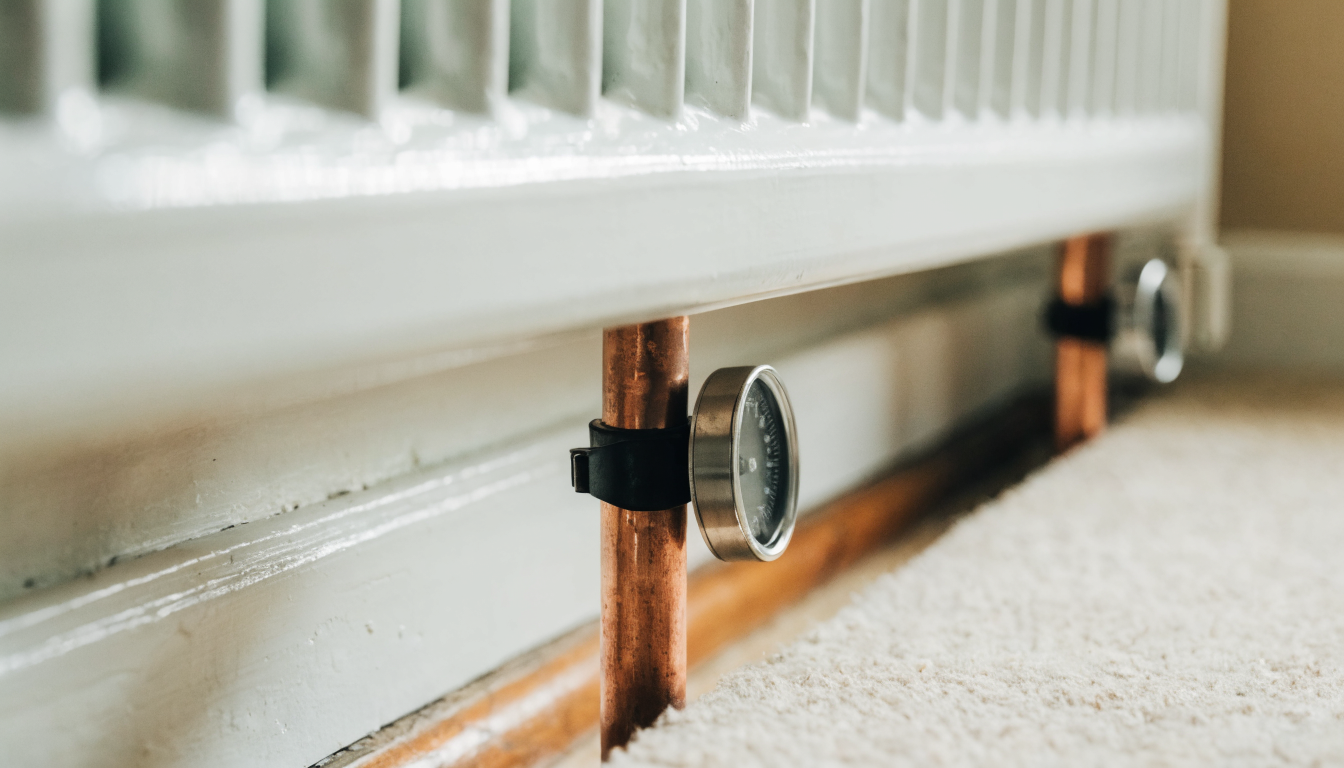
Balancing by hand is possible and it is how most people do it, but you are trying to detect an eleven or twelve degree difference between two hot pipes, and the human hand cannot do that. Above about fifty degrees everything simply reads as hot. This is one of the few household jobs where a measuring tool genuinely changes the outcome rather than just making you feel professional.
| Method | How well it works | The catch |
|---|---|---|
| By hand | Good enough to rank radiators fastest to slowest | Cannot resolve a 12 degree gap between two hot pipes. You are guessing at the target |
| Infrared thermometer | Instant, non-contact, reads any accessible pipe or valve body | Reads the surface, so bare shiny copper reflects and reads low. Needs a matt surface or an emissivity adjustment |
| Clip-on pipe thermometers, used in pairs | The most reliable way to do it, because both pipes are read at the same moment | Slower to move between radiators, and you really want two of them |
That emissivity problem is worth understanding before you buy anything. An infrared thermometer measures radiated heat, and polished copper radiates poorly, so it will report a pipe as far cooler than it is. The fix is either to read a painted or oxidised part of the pipe, stick a small square of matt tape on it and read that, or use a thermometer whose emissivity setting you can adjust. The ThermoPro TP30 is one of the cheaper guns that lets you change emissivity rather than assuming 0.95 and lying to you.
Fastest way round the house
ThermoPro TP30 Infrared Thermometer
- Non-contact infrared reading with laser pointer, range -50°C to 550°C
- Adjustable emissivity, which is the setting that matters on bare copper pipe
- Max measure function, useful when the reading drifts as the pipe settles
- Reads in under a second, so a whole house is quick to survey
Pros
- Adjustable emissivity is unusual at this price and it is the difference between a real reading and a wrong one
- Quick enough to re-check every radiator several times without losing an afternoon
- Also useful for checking flow temperature at the boiler and finding draughts
Cons
- Reads surfaces, not water, so a poorly insulated or shiny pipe still needs care
- Not designed for human body temperature and should not be used for it
- A single gun means reading one pipe then the other, so the system moves between readings
Judged on published specification and manufacturer documentation rather than hands-on testing. If you want one tool that does the whole job quickly, this is it, as long as you use the emissivity setting or read a matt section of pipe rather than pointing it at bright copper.
The alternative, and the one heating engineers tend to own, is a pair of clip-on pipe thermometers. They are dial gauges rather than digital, which sounds like a downgrade until you realise the point: you clip one on the flow pipe and one on the return, and you can watch both needles at once while your other hand is on the valve. A single instrument makes you read one pipe, then the other, by which time the first has moved.
Buy two, not one
Brannan Clip-On Pipe Thermometer
- Spring clip fixes directly to the pipe, reading the pipe surface by contact rather than infrared
- Dial gauge, so no batteries, no emissivity setting and nothing to go flat mid-job
- Sold as a single unit, so balancing properly means buying a pair
- Also usable on the boiler flow and return to check the system-wide differential
Pros
- Contact reading sidesteps the shiny-copper problem that catches out infrared guns
- A pair lets you watch the differential change live as you turn the lockshield
- Nothing to configure, which removes the most common source of user error
Cons
- Needs a few minutes on the pipe to settle, so it is slower round a large house
- Analogue dial, so you are reading to the nearest couple of degrees rather than a decimal
- You need two for the job to work as intended, which doubles the outlay
Judged on specification and manufacturer documentation rather than hands-on testing. Engineers buy these in pairs for a reason. If you only ever balance your own house once, the infrared gun is the more versatile purchase. If you want the reading you can actually trust while your hand is on the valve, buy two of these.
How to balance radiators, step by step
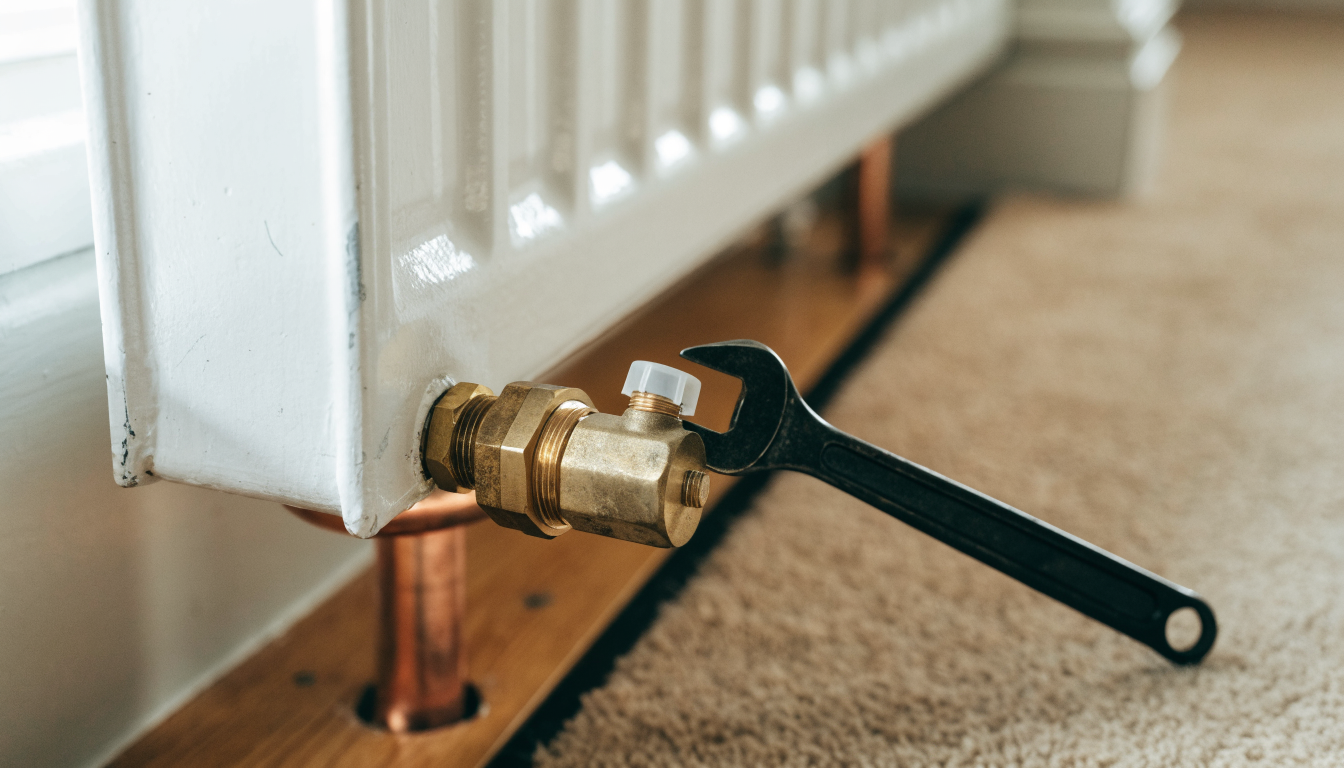
Set aside most of a day. The actual valve turning takes minutes; the waiting for a system to cool and reheat is what eats the time. Do it on a cold day, because a system that is barely working at all gives you nothing to measure.
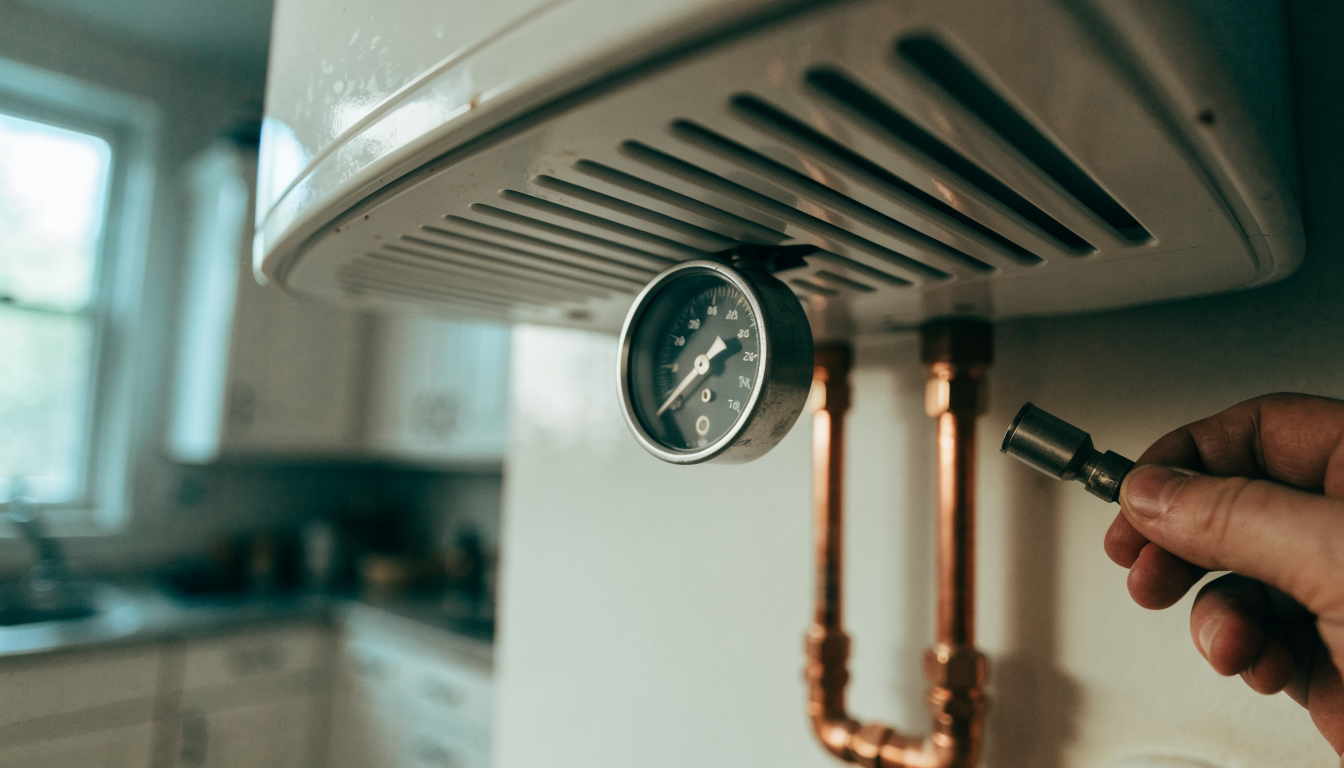
If you bled a lot of radiators in step one on a sealed system, check the pressure gauge before you go any further, because letting air out drops the pressure and a system that has fallen too low will not circulate properly. That is a two minute job with the filling loop, set out in how to repressurise a boiler.
Where the 11 to 12 degree target comes from
The figure everyone quotes is worth checking rather than repeating. Screwfix publish it plainly in their own balancing guide: "A 12 degree loss of temperature at each radiator is ideal for good heat distribution, efficient heat transfer and efficient boiler operation." Checkatrade and Ageas give the same number, and Google's own AI Overview for this search repeats it. So 11 to 12 degrees is the settled UK working target, and it is the one to aim for.
What almost nobody mentions is that this is not the same as the differential your boiler is designed around. Gas training provider Logic4Training states that condensing boilers have a recommended difference of 20 degrees between flow and return, because the return water has to drop below roughly 55 degrees before the boiler can condense and reach its advertised efficiency. Those two numbers are measuring different things and it is worth knowing which one you are chasing.
Balance each radiator to 11 or 12 degrees and you will even out the house, which is what you came here for. If you want a cooler return for condensing, the lever is the boiler's flow temperature setting, not the lockshields. Throttling a radiator hard enough to force a 20 degree drop across it will leave the far end of the panel cold and the room short of heat.
One consequence of that is worth spelling out. If your boiler flow temperature has been turned down, as it is on a lot of modern condensing installations, every radiator is running cooler and the drop across each one will naturally be smaller. Do not chase the number by closing valves further than they want to go. The outcome you are after is rooms that warm at the same rate, and the differential is only the instrument you use to get there.
When balancing will not fix it
Balancing has a narrow job description, and there are several common situations where a full day of careful valve turning changes nothing at all.
- The system is sludged. If several radiators are cold along the bottom, the restriction is silt, not valve settings, and moving flow around simply starves a different room. Clean the system first, then balance, because the flow pattern changes completely once the sludge has gone. Afterwards it wants dosing with central heating inhibitor and, ideally, a magnetic filter to catch what forms next.
- The radiator is too small for the room. A panel that runs hot along its whole length in a room that never gets warm is not being starved, it is simply not big enough. No valve setting adds watts.
- The pump is weak or set too low. If nothing has enough flow, redistributing it just moves the complaint to a different room. A pump on its lowest speed in a large house is a common and easily missed cause.
- The boiler flow temperature is low. Radiators that are warm but never hot across the whole house point at the flow setting rather than the balance. Check that first, because it is free.
- There are microbore or one-pipe complications. Older one-pipe systems feed each radiator from the same loop, so the water reaching the last one has already given up its heat. That is a design limitation and balancing can only soften it, never cure it.
- A radiator has an air lock that keeps returning. If the same panel needs bleeding every few weeks, air is getting in somewhere. Find that instead.
Where this stops being a DIY job
Turning lockshield valves is householder work. Some of what sits around it is not, and two of those limits are law rather than caution.
- Anything on a gas appliance or its flue must be done by a Gas Safe registered engineer. Under the Gas Safety (Installation and Use) Regulations 1998 it is illegal for anyone not on the Gas Safe Register to work on gas fittings and appliances. Reading the flow temperature off the boiler's display is fine. Opening it up is not.
- Unvented hot water cylinders need someone holding the relevant qualification. The safety devices on an unvented cylinder are not something to adjust while you are in a valve-turning mood.
- If every radiator is cold, stop. That is not a balancing problem and no lockshield will improve it. Check the controls and the pressure gauge, then call someone.
- If a valve weeps once you move it, the gland packing has dried out. A nip up on the gland nut sometimes cures it. If it does not, that valve needs replacing and the system needs draining down.
Frequently asked questions
Can you balance radiators yourself?
Yes. Balancing involves no gas work, no draining down and no dismantling, so there is nothing about it that legally requires a registered engineer. What it requires is patience, because the waiting for a system to cool and reheat takes far longer than the adjustments. The realistic barriers are having somewhere to measure the pipe temperature and being willing to go round the house twice.
How do I know if radiators need balancing?
The signature is uneven timing rather than uneven temperature. Turn the heating on from cold and watch: if some radiators are hot within ten minutes while others are still cool after forty, and none of them has a cold patch anywhere on the panel, the system is out of balance. If a radiator has a cold top, a cold bottom, or is cold all over while its neighbours work, that is a fault in that radiator and balancing is the wrong job.
Should the lockshield be fully open?
On one radiator, usually yes, and on the rest, no. A properly balanced system has the radiator furthest from the boiler left fully or almost fully open, with each one closer to the boiler throttled progressively further. If every lockshield in your house is wide open, the system is by definition unbalanced, because nothing is restraining the radiators that sit on the easiest pipe runs.
How much does it cost to have your radiators balanced?
There is no published fixed price for this and anyone quoting one without asking how many radiators you have is guessing. It is charged as labour time, and the time is driven by the number of radiators, how accessible the valves are, and how long the system takes to cool and reheat between passes. It is frequently added onto an annual service visit rather than booked on its own, which is usually the cheapest way to get it done. Ask for it to be quoted as time rather than as a job price, and ask whether a second pass is included, because a single pass is not balancing.
What is the 30 minute heating rule?
It is a rule of thumb, not a standard or a regulation, and it has nothing to do with balancing. The usual version is that you set the heating to come on around thirty minutes before you need the house warm and to switch off around thirty minutes before you leave or go to bed, on the basis that a house holds its heat for a while after the boiler stops. How well it works depends entirely on how well insulated your house is, which is why no official body publishes it as guidance. A well balanced system makes it more reliable, because rooms reach temperature at similar times rather than one room arriving an hour late.
How do you balance radiators without a thermometer?
You can get most of the benefit by feel, as long as you accept it is approximate. Follow the same sequence, but instead of measuring a differential, close the lockshield on the fastest radiator to roughly a quarter turn open, the next one a little more, and so on, leaving the slowest radiator fully open. Then run the heating from cold and see whether the order has evened out. Repeat, opening or closing a quarter turn at a time. It takes more passes than the measured method and you will never know whether you overshot, but a house balanced roughly is a long way better than a house not balanced at all.
How do you balance radiators that have TRVs?
Exactly the same way, with one addition: the thermostatic heads have to be taken out of the equation while you work. Turn every head to its maximum setting, or better still lift the heads off the valve bodies entirely, so that no valve can start closing partway through the job as its room warms up. A TRV quietly throttling itself while you are trying to read a differential is the most common reason a careful balancing job produces confusing numbers. Refit the heads once the lockshields are set.
Do you need to rebalance after changing a radiator?
Yes, and after a system clean too. Anything that changes the resistance of one route changes the flow through every other route, so a new radiator, a power flush, or a removed and refitted panel all move the balance. This is also why a newly fitted radiator sometimes appears to make a different room worse: nothing has broken, the flow has simply redistributed itself.
Related guides
- Why a radiator is not heating up: the full symptom by symptom breakdown, for when the problem is a cold patch rather than slow flow.
- How to bleed a radiator: the job that comes before balancing, and what it means when no air comes out.
- Thermostatic radiator valves explained: what the numbers mean, and why the pin seizes over summer.
- How to remove a radiator: isolating and draining a panel without emptying black water onto the carpet.
- How to repressurise a boiler: what to do when bleeding has pulled the system pressure down.



0 Comments