
As an Amazon Associate I earn from qualifying purchases.
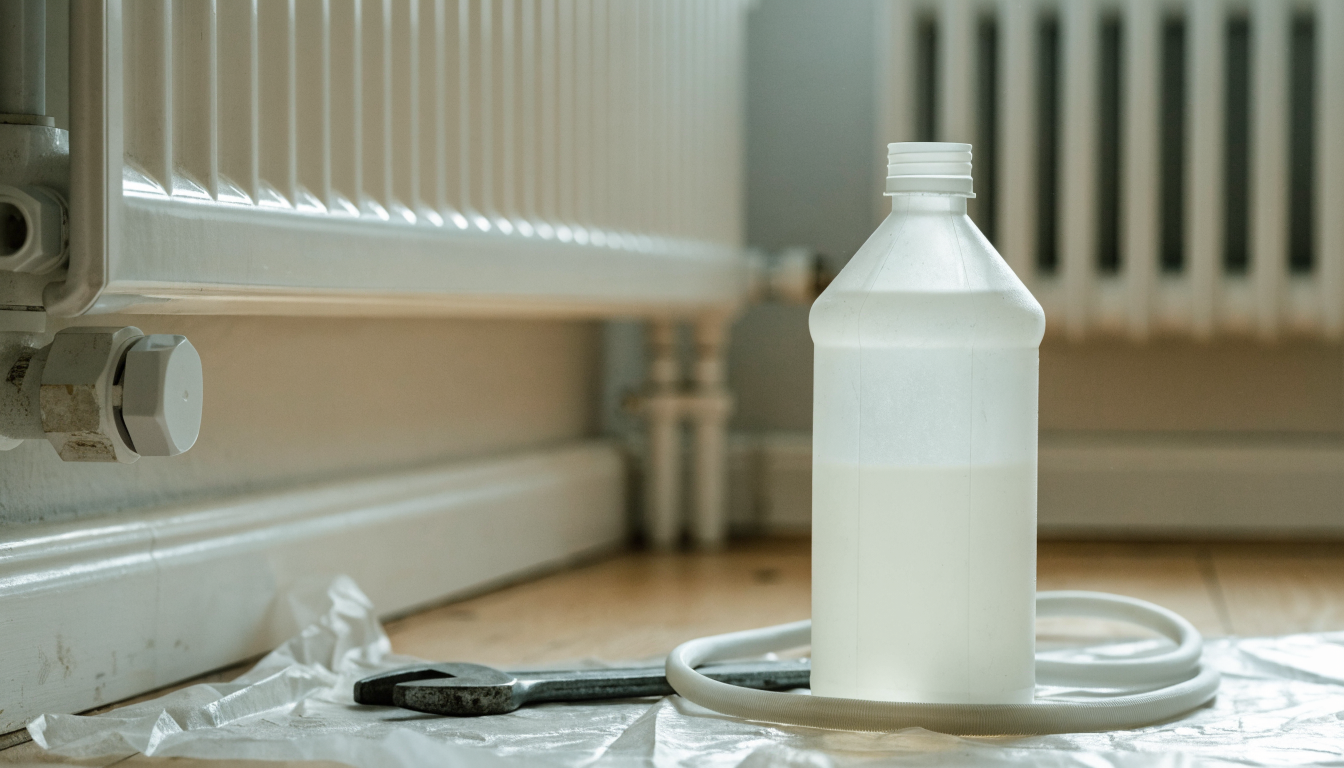
Central heating inhibitor is a chemical you add to the water inside your radiators and pipework to stop the system corroding itself. Every page on the first results screen for this product is a retailer or a manufacturer, and none of them answer the question that actually matters when you are standing in the aisle: how much do you need, and is the bottle in your hand enough?
Three things came out of checking the manufacturers' own documentation rather than the retailer listings.
- The big three brands do not dose at the same rate. A 500ml bottle of Fernox F1 is sold as treating a 130 litre system. A 500ml bottle of standard Sentinel X100 treats 50 litres, because X100 doses at 1% where F1 doses at 0.5%. Buying "a 500ml bottle" without checking the brand is the single most common way people under-dose a system.
- The cost of protecting a litre of system water ranges from about 7p to about 24p depending on which bottle you pick, for chemicals doing broadly the same job. That is a three and a half times spread on the same shelf.
- At least one major boiler manufacturer makes it an explicit guarantee condition, and the wording is more specific than "use an inhibitor". Worcester Bosch require the strength checked every two years, not annually, and they ban a category of water supply outright.
I ran plumbers merchants across the south of England for sixteen years. Inhibitor was the product people got wrong most often, usually by buying one bottle for a house that needed two, or by buying a cleaner when they wanted a protector. This page is written to stop both of those.
What central heating inhibitor actually does
A heating system is a sealed loop containing steel radiators, copper pipe, brass fittings, an aluminium or stainless heat exchanger and a few litres of ordinary tap water. Water plus dissimilar metals plus oxygen produces corrosion, and corrosion in a heating system produces black iron oxide sludge, better known as magnetite.
Inhibitor is a blend of corrosion inhibitors and scale inhibitors that coats the internal metal surfaces and holds the water chemistry in a range where that reaction largely stops. It is a preventative. It protects a clean system rather than rescuing a dirty one, which is the distinction that trips most people up.
Inhibitor, cleaner and leak sealer are three different products
These sit next to each other on the shelf in near-identical bottles, and they do completely different jobs. Putting cleaner in and leaving it there is not protection. Putting inhibitor into a sludged system does not clean it.
Fernox state that F3 Cleaner should be circulated for a minimum of one hour at normal operating temperature on a new system, or up to a week on an older system with heavy deposits, then drained and flushed at least twice, until the water runs clear, before F1 goes in. If you skip the flush you leave the cleaner in the system, and cleaner is not a protector.
How much central heating inhibitor do you need?
This is arithmetic, not guesswork, and it has two steps. Work out roughly how much water your system holds, then check the dose rate printed on the brand you are buying. The second step is the one people skip.
Step one: estimate your system volume
Sentinel's own technical guidance treats a typical ten radiator system as holding 100 litres, which is 10 litres per radiator including the boiler and all the pipework. Fernox and Adey work to a slightly tighter figure of roughly 8 litres per radiator, but they count a double panel radiator as two.
For a domestic system, counting 10 litres per radiator is the safer of the two and it is the one I would use. Ten radiators, 100 litres. Fifteen radiators, 150 litres. If your house is mostly double panel radiators or you have underfloor heating on a zone, assume more rather than less.
Step two: check the dose rate, because it is not the same across brands
Here is where the money is lost. These are the manufacturers' own published coverage figures, not retailer copy.
Worked example: a three bedroom house with ten radiators
Ten radiators at 10 litres each gives an estimated system volume of 100 litres. Against that:
- Fernox F1: one 500ml bottle, with headroom. Rated for 130 litres.
- Adey MC1+: one 500ml bottle, with headroom. Rated for 125 litres.
- Sentinel X100 standard: the full 1 litre bottle. Not half of it.
- Sentinel X100 Super Concentrate: one 500ml bottle, exactly.
A sixteen radiator house, or a ten radiator house where most of them are doubles, needs two bottles of F1 or MC1+, or two litres of standard X100. Sentinel put this plainly in their own guidance: larger domestic systems should be dosed with twice the standard amount.
One honest caveat about the Fernox figure
Fernox publish two numbers that do not quite agree. The UK product page for F1 500ml says it treats a 130 litre system. The technical specification sheet for the same product gives the recommended in-use concentration as 0.5%, and 500ml at 0.5% works out at 100 litres, not 130.
I cannot resolve that from the outside, so I am flagging it rather than picking a side. If you want certainty, dose to the 0.5% figure and treat a 500ml bottle of F1 as covering 100 litres. Fernox themselves state that overdosing is not harmful to the system and that the important thing is having enough inhibitor present, so erring high costs you a few pounds and nothing else.
What protection actually costs per litre of system water
Comparing bottle prices tells you nothing when the bottles cover different volumes. The only fair comparison is cost per litre of system water protected, which is simply the price divided by the published coverage. Nobody publishes this, so here it is.
| Product | Price | Treats | Cost per litre protected |
|---|---|---|---|
| Flomasta Inhibitor 500ml (Screwfix own brand) | £6.99 | 100 litres | 7.0p |
| Adey MC1 500ml | £15.49 | 125 litres | 12.4p |
| Fernox F1 Protector 500ml | £19.49 | 130 litres | 15.0p |
| Sentinel X100 1 litre | £16.99 | 100 litres | 17.0p |
| Sentinel X100 Rapid-Dose aerosol 250ml | £23.75 | 100 litres | 23.8p |
Two things fall out of that table. The Screwfix own-brand Flomasta is less than half the cost per litre of the branded liquids, and the aerosol formats carry a substantial premium for convenience. The Sentinel Rapid-Dose costs about 40% more than the same protection in the 1 litre bottle.
That premium is not automatically bad value. An aerosol doses a pressurised sealed system through a radiator bleed point in about twenty seconds with no draining, which for a lot of people is the difference between doing the job and not doing it. But pay it knowingly.
What it costs per year
Inhibitor is not consumed on a schedule the way boiler salt or a filter cartridge is. In a sealed system that is not losing water, the chemical stays in there and depletes slowly. BS 7593:2019 is the reference point: check the concentration annually, and re-dose after five years unless a test shows it is still up to strength.
So on a 100 litre system, the arithmetic is one bottle every five years. Fernox F1 at £19.49 works out at £3.90 a year. Flomasta at £6.99 works out at £1.40 a year. Add a few pounds for test strips and it is still comfortably under a fiver a year to protect a heating system worth thousands.
The real driver of consumption is not time, it is drain-downs, and that is the next section.
When you need to top up inhibitor
"Top it up annually" is the standard advice and it is not quite right. Inhibitor leaves the system with the water. If the water has not gone anywhere, neither has the inhibitor. What matters is whether you have lost system water, and how much.
The radiator swap is the one that gets forgotten. If you have just finished taking a radiator off the wall to decorate behind it, you have thrown away a tenth of your corrosion protection and almost nobody puts it back. On a ten radiator system dosed with F1 at 0.5%, replacing 10 litres of water means adding roughly 50ml of inhibitor.
Similarly, if you find yourself repressurising the boiler more than once or twice a year, you have a leak somewhere and you are steadily diluting the inhibitor with fresh, oxygenated mains water. Fix the leak before worrying about the chemistry.
How to test the inhibitor concentration
You do not have to guess, and this is the part almost no retailer page mentions. Inhibitor test strips exist, they cost a few pounds, and they take about a minute.
You draw a small sample of system water, most easily from a radiator bleed valve or from the drain point on a magnetic filter if you have one, dip the strip, and compare the colour against the chart on the packet. It tells you whether the inhibitor is at strength or has dropped below the protective level. Fernox, Sentinel and Adey all produce strips keyed to their own products.
Buying a five pack of strips gives you five years of annual checks for less than the price of a bottle of inhibitor, and it turns "top it up every year just in case" into "test it every year and dose it when it needs it". That is both cheaper and more accurate.
Fernox F1 Express Inhibitor Test Strips (5 pack)
- Colour-change strip keyed to Fernox F1 concentration
- Sample taken from a bleed valve or filter drain point
- Five strips covers five annual checks
Pros
- Removes the guesswork from whether a top-up is actually needed
- Costs a fraction of a bottle of inhibitor
- Gives you evidence of an annual check if a warranty claim is ever questioned
Cons
- Calibrated for Fernox products, so read the chart carefully if your system was dosed with another brand
- A colour chart is a rough band rather than a precise percentage
- Does not tell you anything about sludge already in the system
Anyone following BS 7593:2019 needs to check the concentration annually, not blindly re-dose it. A pack of strips is the cheapest way to do that properly.
Some manufacturers also offer a postal laboratory water test, which BS 7593:2019 explicitly accepts as an alternative to re-dosing at the five year point. That is a more thorough analysis than a strip and worth considering on an older system you have inherited and know nothing about.
What happens if you skip it
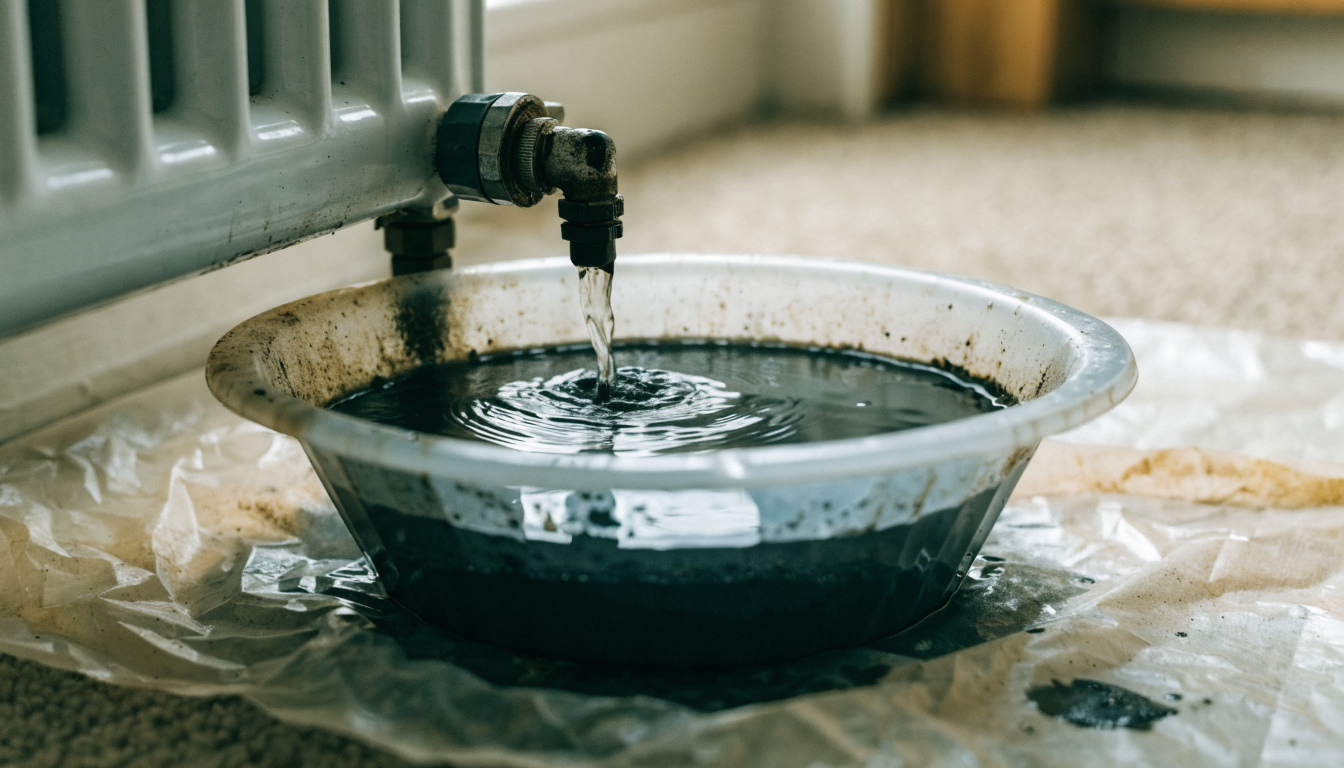
The failure is slow and it is progressive, which is why it is easy to ignore until it is expensive. It runs roughly in this order.
- Cold patches at the bottom of radiators. Sludge is heavier than water and settles along the bottom of the panel. The top gets hot and the bottom stays cold. This is the symptom people misdiagnose most often.
- Rooms that take longer to warm up, and a boiler that fires for longer to achieve the same result, because you are heating less radiator surface area than you paid for.
- A noisy boiler. Deposits on the heat exchanger cause localised overheating and kettling, the rumbling noise people describe as sounding like a boiling kettle.
- A failing circulation pump. Pumping abrasive iron oxide through a pump for years wears the bearings and eventually seizes it.
- A blocked heat exchanger. On a modern condensing boiler the waterways are narrow, and this is the point where the repair bill starts to approach the cost of the boiler.
The diagnostic point worth holding onto: cold at the top of a radiator is air, cold at the bottom is sludge. Air you can fix yourself in five minutes. Sludge you cannot, and no amount of bleeding will touch it. If you are not sure which you have, the diagnosis in our guide to bleeding a radiator separates the two, and the wider list of common radiator problems covers the cases that are neither.
A system that has reached stage one or two needs cleaning before it needs protecting. Dosing a sludged system with inhibitor and leaving it is money spent on preserving the problem.
Fernox F3 Central Heating Cleaner 500ml
- pH neutral, non-foaming cleaner for sludge, scale and debris
- Treats a 130 litre system, up to 16 radiators
- Circulate for a minimum of one hour, or up to a week on a heavily sludged system
Pros
- The correct first step on any system showing cold spots at the bottom of radiators
- Safe on aluminium heat exchangers, being pH neutral
- Also the commissioning product for a brand new system, to remove flux and installation debris
Cons
- Must be drained and flushed at least twice until the water runs clear, which is the laborious part
- Does nothing a power flush would not do better on a badly blocked system
- Not a substitute for inhibitor, you still have to buy the protector afterwards
Use this before inhibitor, not instead of it. Clean, flush until clear, then dose with a protector and the protection actually lands on clean metal.
Is central heating inhibitor a boiler warranty condition?
Often, yes, and the wording is usually more demanding than people expect. This varies by manufacturer, so the only safe answer is to read your own boiler's guarantee terms. But as a worked example of how specific these conditions get, Worcester Bosch publish the following requirements for their primary heat exchanger guarantee:
The system must be flushed and cleansed in accordance with BS7593 [and] a corrosion inhibitor must be introduced into the clean primary water system and the effectiveness or strength of the inhibitor checked every 2 years.
Three details in there catch people out. It requires the system to be cleansed as well as dosed. It requires the strength to be checked every two years, which means someone has to actually test it. And the same terms require annual servicing, with the householder potentially asked to prove the service history.
There is a fourth condition in the Worcester Bosch terms that is worth flagging separately, because it surprises people in hard water areas: the same guarantee conditions state that the system must not be filled with artificially softened water from a base exchange softener, and that pH must not exceed 8. If you have a water softener, the heating system should be filled from an unsoftened supply. That is a plumbing detail worth raising with whoever fits the softener, not something to discover during a warranty claim.
I have quoted Worcester Bosch because their conditions are published and specific. Do not assume every manufacturer words it identically. Check your own documentation, and keep the receipt for the inhibitor and the record of the annual service, because the burden of proof sits with the householder. Our guide to how long a boiler should last covers what else shortens that life, and the heating system maintenance guide covers the annual service itself.
Fernox F1 vs Sentinel X100 vs Adey MC1+
These three dominate the UK market, and honestly there is little to choose between them on performance. All three are established products from established manufacturers, all three satisfy the general requirement in a boiler guarantee for a quality corrosion inhibitor, and all three are judged here on manufacturer documentation and specification rather than on any hands-on testing.
What separates them in practice is dose rate, format and price. That is what the table compares.
| Product | Bottle size | Treats | Dose rate | Formats available | Buy |
|---|---|---|---|---|---|
Most widely stocked Fernox F1 Protector | 500ml | 130 litres / 16 radiators | 0.5% per spec sheet | Liquid, aerosol, concentrate | Check price on Amazon |
Best cost per litre of the big three Adey MC1+ Protector | 500ml | 125 litres / 15 single radiators | Not published as a percentage | Liquid, Rapide aerosol | Check price on Amazon |
Watch the bottle size Sentinel X100 Super Concentrate | 500ml | 100 litres | Concentrated formulation | Liquid, 1L standard, Rapid-Dose aerosol, tube | Check price on Amazon |
#1 Most widely stocked
Fernox F1 Protector 500ml
- Treats a 130 litre system, up to 16 radiators, per the Fernox product page
- 0.5% recommended in-use concentration per the technical spec sheet
- Suitable for all common domestic system metals including aluminium heat exchangers
- Available as liquid, 400ml Express aerosol and a 265ml concentrate
Pros
- Stocked by essentially every merchant and DIY shed in the country, so easy to match later
- The widest range of formats, including an aerosol that doses a sealed system without draining
- Fernox publish clear BS 7593:2019 guidance alongside the product
- Overdosing is stated by Fernox as not harmful, which removes the risk of erring high
Cons
- The most expensive of the three big liquids per litre of system protected
- Fernox publish two coverage figures that do not agree, 130 litres on the product page against 100 litres implied by the 0.5% spec
- Costs nearly three times the Screwfix own-brand for chemistry doing the same job
The safe default. You will find it anywhere, the documentation is the clearest of the three, and if you dose to the conservative 100 litre reading of the 0.5% figure you will not go wrong. Just accept you are paying a brand premium over the own-label alternatives.
#2 Best cost per litre of the big three
Adey MC1+ Protector 500ml
- Treats 125 litres or 15 single panel radiators
- Building Regulations Part L compliant
- Designed to dose through a MagnaClean filter canister, a radiator or an F&E tank
- Rapide aerosol version doses a sealed system in around 20 seconds
Pros
- Noticeably cheaper per litre protected than Fernox F1 at current Screwfix pricing
- If you already have a MagnaClean filter fitted, dosing through the canister is the easiest route there is
- Adey publish clear guidance on topping up after any partial drain-down
Cons
- Adey do not publish a percentage dose rate, only a coverage figure, which makes partial top-up arithmetic harder
- Less widely stocked than Fernox in independent merchants
- The Rapide aerosol carries a steep premium over the liquid
The value pick among the branded inhibitors, and the obvious choice if there is already an Adey magnetic filter on the system, because the dosing point is built in.
#3 Check which bottle you are buying
Sentinel X100 Super Concentrate 500ml
- 500ml treats 100 litres of system water
- For indirect systems only
- Sentinel advise circulating for 15 minutes after dosing to distribute it
- Also sold as a standard 1 litre bottle, a 275ml tube and a Rapid-Dose aerosol
Pros
- Sentinel publish the clearest dose guidance of the three, stating plainly that larger systems need double the standard amount
- The concentrate format means less to carry and store than the 1 litre bottle
- Long-established product that heating engineers know well
Cons
- The single most confusing product line on the shelf, because a 500ml concentrate and a 1 litre standard bottle both treat 100 litres
- Buying a 500ml of the standard formulation for a ten radiator system leaves you half dosed
- Specified for indirect systems only, so check your system type before buying
Good inhibitor, genuinely awkward range. If you buy Sentinel, read the label rather than the bottle size, and if in doubt buy the full litre of the standard product.
What about the own-brand inhibitors?
Screwfix Flomasta, Toolstation Flume, Wickes Pro and B&Q Trident all sell a 500ml inhibitor at a fraction of the branded price. Flomasta states it treats 100 litres, which at £6.99 works out at 7p per litre protected, less than half the cost of Fernox F1.
I am not going to tell you they are identical to the branded products, because I have no laboratory data either way and neither does anybody else writing about this. What I will say is that the own-brands are made to the same broad specification and are widely used. The practical argument for paying more for a named brand is documentation: if you ever need to demonstrate to a boiler manufacturer that the system was treated to BS 7593:2019, a recognised brand name on the receipt is easier to defend than an own-label bottle.
If the boiler is out of warranty, the own-brand is hard to argue with on cost. If the boiler is in warranty and the guarantee hinges on it, spend the extra twelve pounds once every five years. You can buy these direct from the retailers: Screwfix, Toolstation, B&Q and Wickes all stock an own-label version.
Bulk buying
Five litre and multipack containers exist and are genuinely cheaper per litre, but for a single domestic system they are a false economy. You need 500ml to a litre every five years. A five litre container will be past its useful life long before you work through it, and inhibitor is not something you want to find a use for. Buy the bottle you need when you need it.
How inhibitor gets into the system
Briefly, because this determines which format you buy. There are three routes, and the one available to you depends on your system.
- Open vented system with a loft tank: pour it into the feed and expansion cistern in the loft. The easiest case by a distance, and liquid is fine.
- Sealed system, dosing through a radiator: close both valves on a radiator, drain it down partially, and introduce the inhibitor through the bleed point. This is where an aerosol or a dosing vessel earns its price.
- Sealed system with a magnetic filter: most filters have a dosing point built into the canister. If you have one, this is the quickest route and no draining is needed.
After dosing, run the heating for fifteen minutes or so with all radiators open and the thermostatic radiator valves turned up, so the inhibitor circulates properly rather than sitting in one radiator. Sentinel specify fifteen minutes of circulation for exactly this reason.
One legal boundary worth stating plainly. Adding inhibitor to a heating system is not gas work and you can do it yourself. Anything involving the gas appliance itself, the flue, or an unvented hot water cylinder legally requires a registered engineer. I am not a plumber and have never held Gas Safe registration, so treat the boundary as firm.
Frequently asked questions
Is central heating inhibitor worth it?
On cost alone the case is straightforward. Protecting a typical system works out between about £1.40 and £3.90 a year depending on which brand you buy. A seized circulation pump, a blocked heat exchanger or a power flush all cost substantially more than a five year supply of inhibitor. Add that many boiler guarantees require it, and there is no real argument against.
How often should I put inhibitor in a central heating system?
BS 7593:2019 sets the benchmark: check the concentration annually and re-dose after five years, or test the water to confirm it is still at strength. Beyond that schedule, re-dose after any event that loses system water, which means a drain-down, a radiator removal, a power flush, a leak, or repeated repressurising. Worcester Bosch's guarantee conditions ask for the strength to be checked every two years, so check what your own manufacturer requires.
What is the best central heating inhibitor?
There is no meaningful performance gap between Fernox F1, Sentinel X100 and Adey MC1+ that I can demonstrate from published data, so the honest answer is to buy on dose rate, format and price. Fernox F1 is the most widely stocked and has the clearest documentation. Adey MC1+ is the best value of the three. Screwfix Flomasta is less than half the cost per litre if the boiler is out of warranty.
What happens if I don't use inhibitor?
The steel in your radiators corrodes and produces black magnetite sludge. That sludge settles in the bottom of radiators, giving cold patches at the bottom of the panel, and circulates through the pump and heat exchanger. Over years it leads to a noisy boiler, a worn or seized pump and eventually a restricted heat exchanger. It may also invalidate your boiler guarantee.
Can you put too much inhibitor into a heating system?
Fernox state directly that overdosing is not harmful to the system, and that the important thing is ensuring sufficient inhibitor is present. In practice the risk runs heavily in the other direction: under-dosing is common, overdosing is rare and largely harmless. If you are unsure whether your system is 100 or 130 litres, dose for the larger figure.
How much does it cost to put inhibitor in a central heating system?
Doing it yourself, the cost is the bottle: between £6.99 and £23.75 depending on brand and format, at Screwfix prices checked on 18 September 2026. If a heating engineer adds it, it is usually folded into an annual service or a repair visit rather than charged as a separate line. I have not found a manufacturer or national installer publishing a fixed price for the labour, so treat any figure you are quoted as a quote rather than a going rate.
Do I need a magnetic filter as well as inhibitor?
They do different jobs. Inhibitor stops sludge forming; a magnetic filter catches what forms anyway and removes it from circulation. BS 7593:2019 recommends both, dosing with a quality chemical treatment and fitting an inline system filter. A filter also gives you a convenient dosing and sampling point, which makes the annual check considerably easier.
Related guides
- How to bleed a radiator. Work out whether your cold radiator is air at the top or sludge at the bottom before you do anything else.
- Common radiator problems. The full symptom list, including the ones that are neither air nor sludge.
- How to remove a radiator. The job that costs you a tenth of your inhibitor, and how to do it cleanly.
- Maintaining your heating system. Where the annual inhibitor check fits into everything else the system needs.
- How to repressurise a boiler. Because every top-up dilutes what is already in there.



0 Comments