
Bleeding a radiator takes about five minutes and needs one tool that costs under a pound. Every guide on the internet tells you the same seven steps, and they are all broadly right.
What almost none of them tell you is the part that actually matters: how to know whether air is your problem in the first place. A cold radiator gets diagnosed as trapped air by default, and a good proportion of the time it is nothing of the sort. Bleed a radiator that is full of sludge and you will achieve nothing except a slightly lower boiler pressure.
So this guide does the five minutes first, then the bit everyone leaves out. I spent 16 years running plumbers merchants across the south of the UK, and the number of people who came to the counter for a bleed key when what they actually needed was an inhibitor and a filter was considerable.
First: is it actually air?
Put your hand on the radiator with the heating running and feel where the cold is. This takes ten seconds and it tells you almost everything.
| What you feel | What it is | Does bleeding fix it? |
|---|---|---|
| Cold at the top, warm at the bottom | Trapped air. Air rises to the top of the radiator and sits there. | Yes. This is the one bleeding is for. |
| Cold at the bottom, warm at the top | Sludge. Magnetite, which is iron oxide from corrosion inside the system, settling as a heavy black silt in the bottom of the radiator. | No. Bleeding does nothing at all. Needs flushing. |
| Cold in the middle, warm at both ends | Usually sludge again, building up from the bottom of the panel. | No. |
| Cold all over, others are hot | A closed or seized valve, or a TRV with a stuck pin. | No. Check the valves first. |
| Every radiator cold | Boiler, pump or controls, not the radiators. | No. |
If yours is cold at the top, carry on. If it is cold at the bottom, skip ahead to when bleeding is the wrong answer, because you are about to waste your afternoon.
What you need
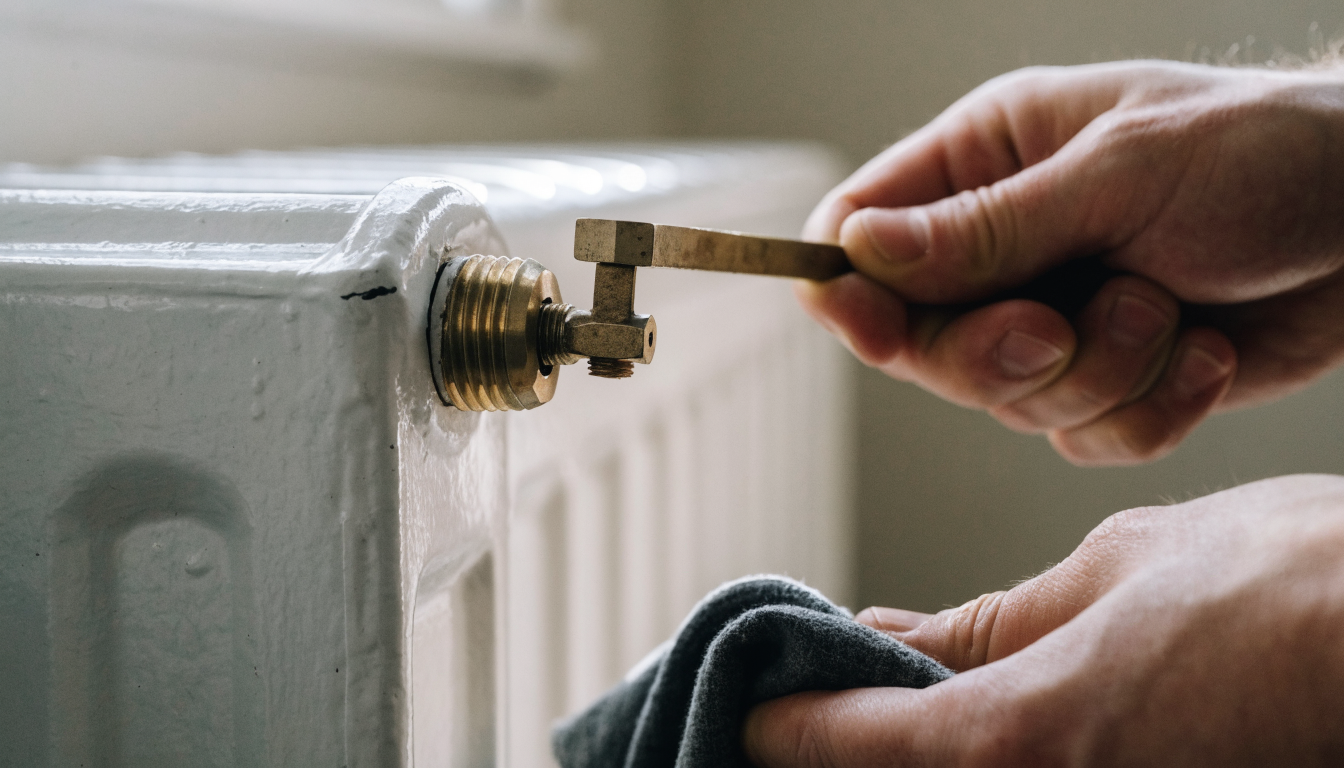
- A radiator bleed key. The standard UK one is a clock-type key with a square socket. They cost pennies and every merchant, DIY shed and hardware shop has them. Buy two, because everyone loses the first one.
- An old towel and a small container. A mug is fine. The water that comes out is black and it stains, so this is not the moment for a good tea towel.
- A flat-head screwdriver if your radiators are newer. Many modern panel radiators and most designer or column rads have a slotted bleed screw rather than a square one.
Some contemporary towel rails and designer radiators use an Allen key or a small hex fitting instead, and the bleed point is sometimes on the back or the side rather than the top corner. If you cannot find it, look for the highest point of the radiator that is not a pipe connection.
Bleeding a radiator, step by step
- Run the heating for ten minutes first, then turn it off. This sounds contradictory but it is the right order. Running it drives the air to the top of each radiator and lets you feel which ones are actually affected. Then turn the system off and let it cool, because bleeding a hot system means scalding water under pressure coming at your hand.
- Wait for the radiators to go cool to the touch. Twenty minutes or so. Do not rush this part.
- Put the towel down and hold the container under the valve. Not beside it, under it. The water tends to run down the radiator rather than drip clear of it.
- Fit the key and turn anti-clockwise, a quarter turn. No more. A quarter turn is enough to let air out, and it means you can shut it again quickly. People who open it a full turn are the people who end up with a jet of black water across a magnolia wall.
- Listen for the hiss and wait for it to stop. You want a steady hiss, then a splutter, then a clean dribble of water with no bubbles in it. That is all the air out.
- Close it as soon as water runs steadily. Snug, not tight. These are small brass fittings and you can strip or crack one by leaning on it. Firm finger pressure on the key is right.
- Wipe the valve dry and look at it again in a minute. If it is weeping, it has not seated. Nip it a fraction tighter. If it still weeps, the valve needs replacing, which is a separate small job.
Which radiator do you bleed first?
This is the question the ranking guides skip, and getting it wrong is why people bleed every radiator in the house twice and still have a cold one.
Start downstairs, with the radiator furthest from the boiler, and work back towards it. Then go upstairs and do the same.
The logic is simple once you see it. Air moves upwards and towards the low pressure points in the system. If you bleed the upstairs radiators first, air still sitting in the downstairs pipework migrates up and you end up bleeding the upstairs ones all over again. Working from the bottom of the system outwards pushes the air ahead of you rather than chasing it.
If your boiler is in the loft or an upstairs airing cupboard, the principle is the same: start at the point furthest from it and work back.
One radiator will usually be the persistent offender, typically the highest one in the house or the one on the longest run. If it is always the same rad, that is worth noting, because it points at where air is getting in.
Check the boiler pressure afterwards. This is the step people miss
Whether this applies to you depends on what sort of system you have, and the guides that mention it rarely make the distinction.
If you have a combi or a sealed system
Your boiler has a pressure gauge on the front, usually reading in bar. Bleeding lets water out, so the pressure drops. Bleed six radiators and it can drop enough that the boiler will not fire at all, which is the classic "I bled the radiators and now I have no heating" phone call.
Look at the gauge when the system is cold. You want roughly 1.0 to 1.5 bar cold. It will rise to somewhere between 1.5 and 2.0 when everything is hot, and that is normal.
If it has dropped below about 1 bar, top it up using the filling loop, which is the braided silver hose underneath the boiler with a valve or two on it. Open it slowly, watch the gauge, and close it the moment you reach 1.2 or so. It fills far faster than you expect. Then close both ends of the loop properly, because leaving a filling loop open is a genuine problem rather than a tidiness issue.
If you overshoot past 2.5 or 3 bar, do not leave it. Bleed a radiator slightly to bring it back down, or the pressure relief valve will discharge outside and you will have a persistent dripping pipe on an outside wall.
If you have an open-vented system
That means a tank in the loft, usually a small one alongside the bigger cold water storage tank. There is no pressure gauge and nothing to repressurise: the system refills itself from the feed and expansion tank by gravity. Bleed away.
If an open-vented system keeps needing bleeding, the usual culprit is the small tank in the loft being empty or its ball valve being seized, so check that first.
How to bleed a radiator without a key
A common enough problem at half past nine on a cold Sunday.
- Try a flat-head screwdriver first. Many bleed valves have a slot cut across the square specifically so a screwdriver works. Look closely before assuming yours does not.
- Small pliers or a mole grip will turn the square, but grip the very tip and turn gently. These fittings are soft brass and rounding one off turns a five minute job into a valve replacement.
- Do not use an adjustable spanner on the whole valve body. You will unscrew the entire valve out of the radiator, and what comes out then is not a dribble.
Honestly, a key is about a pound. If the radiator is cold at the top and you have no key, the radiator will survive until Monday.
When bleeding is the wrong answer
This is the section the rest of the internet is missing, and it is the reason most people who bleed a radiator are still cold afterwards.
Cold at the bottom means sludge, not air
Central heating water corrodes steel radiators from the inside. The result is magnetite, a fine black iron oxide silt, and it is heavy. It settles in the bottom of every radiator and in the bottom of the boiler heat exchanger, and it builds up over years.
A radiator with a layer of sludge in the bottom cannot circulate water through that layer, so the bottom stays cold while the top heats normally. Bleeding the top of it is completely beside the point: there is no air up there.
What it actually needs, in rough order of cost:
- A chemical clean and a fresh dose of inhibitor. A cleaner circulated for a week or so, then drained, refilled and dosed with corrosion inhibitor. Inhibitor is the thing that stops this happening in the first place, and a very large number of UK systems have none in them because nobody topped it up after the last drain-down.
- Taking the radiator off and flushing it outside. Effective for a single bad radiator, messy, and a job for someone comfortable with it. Here is how to remove a radiator if you want to try.
- A power flush. The whole system, machine-driven, done by a heating engineer. This is the expensive option and it is sometimes oversold, so get the cheaper options assessed first.
- A magnetic filter on the return pipe. This does not fix existing sludge but it catches magnetite before it settles, and it is the single most worthwhile preventative fitting on a heating system. If you are having a boiler replaced, one should be part of the job.
If it needs bleeding again and again, something is wrong
Bleeding a radiator once or twice a year is normal. Bleeding the same one every few weeks is not, and it means air is actively getting into a sealed system, which should be impossible. The usual causes:
- A small leak somewhere, letting water out and air in. Look for pressure that keeps dropping as well as air that keeps returning.
- Corrosion producing hydrogen. If the "air" you bleed off smells of rotten eggs or, notoriously, can be lit with a match, it is hydrogen from ongoing corrosion, not air. That system needs cleaning and inhibiting, urgently, because it is eating itself.
- Pump over on an open-vented system, where the pump is pushing water up and out of the vent pipe into the loft tank, which aerates it. A recognised fault with a proper fix.
- A failed expansion vessel on a sealed system, which shows up as pressure that swings wildly between cold and hot.
Repeated bleeding masks all four. It is worth getting someone to look rather than carrying on with the key every fortnight.
Where you should stop and call someone
Bleeding a radiator and topping up a filling loop are both ordinary homeowner jobs. Beyond that, the line is clear: anything involving the gas side of the boiler, the flue, or an unvented hot water cylinder legally requires a Gas Safe registered engineer, or G3 qualification for unvented cylinders. That is not advice, that is the law, and a competent person will also spot the leak or the failed vessel that you are otherwise going to keep bleeding around.
Frequently asked questions
Do you bleed radiators with the heating on or off?
Off, and cooled down. Run the heating first to drive the air upwards and work out which radiators need doing, then switch it off and wait. Bleeding a hot pressurised system risks scalding, and on a sealed system the pressure pushes water out with real force.
What are the signs a radiator needs bleeding?
Cold at the top and warm at the bottom is the definitive one. Gurgling or trickling noises are another good sign. Radiators taking much longer than the rest of the house to warm up can be air too. Cold at the bottom is not air.
What happens if you let too much water out?
On a sealed system the boiler pressure drops, and below roughly 0.5 to 1 bar most boilers refuse to fire on a low pressure lockout. It is not damage, it is a safety cut-out. Top the system back up to 1.0 to 1.5 bar cold using the filling loop and it will restart. On an open-vented system it simply refills itself from the loft tank.
How often should I bleed my radiators?
Once a year is plenty for most systems, and autumn before the heating goes on properly is the sensible time. If you are doing it much more often than that, see the section above, because the bleeding is treating a symptom.
How much does a plumber charge to bleed radiators?
Realistically you are paying for a minimum call-out rather than the work, because the work is five minutes a radiator. Most UK plumbers have a minimum charge covering the first hour. It is not a good use of anyone's money for bleeding alone, though it is entirely reasonable if you want the system looked at properly at the same time. If bleeding has not worked, that call-out is worth having, because then you are paying someone to diagnose the real fault.
Why is the water that comes out black?
That is magnetite, the corrosion product described above. A little discolouration is normal in any older system. Genuinely black, silty water is telling you the system has no effective inhibitor in it and is corroding, which is worth acting on before it blocks the boiler heat exchanger.
Can I bleed a radiator myself?
Yes. It is one of the genuinely straightforward household jobs, it needs one cheap tool, and nothing about it touches the gas side of the system. The only real ways to go wrong are doing it while the system is hot, opening the valve too far, or overtightening it afterwards.



0 Comments