
As an Amazon Associate I earn from qualifying purchases.
Radiators hot at the top and cold at the bottom have magnetite sludge lying across the floor of the panel, and bleeding will not shift a gram of it. The cold band is iron oxide silt sitting in the lower waterway, hot water is running over the top of it, and there is no air anywhere in the fault.
That is the answer for most people reading this, and it belongs in the first two sentences rather than the eighth paragraph. What the rest of this page does is the part the ranking pages skip: how to tell when it is not sludge, which of the three fixes your radiator actually needs, and why a power flush gets sold so often for a job a garden hose would have finished.
Sixteen years running plumbers merchants across the south of England gave me a fairly narrow view of this problem, but a consistent one. Two things came across the counter constantly every autumn: people buying a replacement radiator for a panel that only needed taking outside and hosing through, and people who had been quoted for a power flush on a system with exactly one dirty radiator in it. I am not a plumber and have never held Gas Safe registration, so where a job crosses into work that legally requires a registered engineer, that is marked plainly below.
Why is my radiator cold at the bottom? What the black stuff actually is
Almost every radiator in a British house is pressed steel. Steel, water and dissolved oxygen make iron oxide, and the particular oxide that forms in a sealed heating system is magnetite. It is black, it is magnetic, and critically it is considerably denser than the water carrying it.
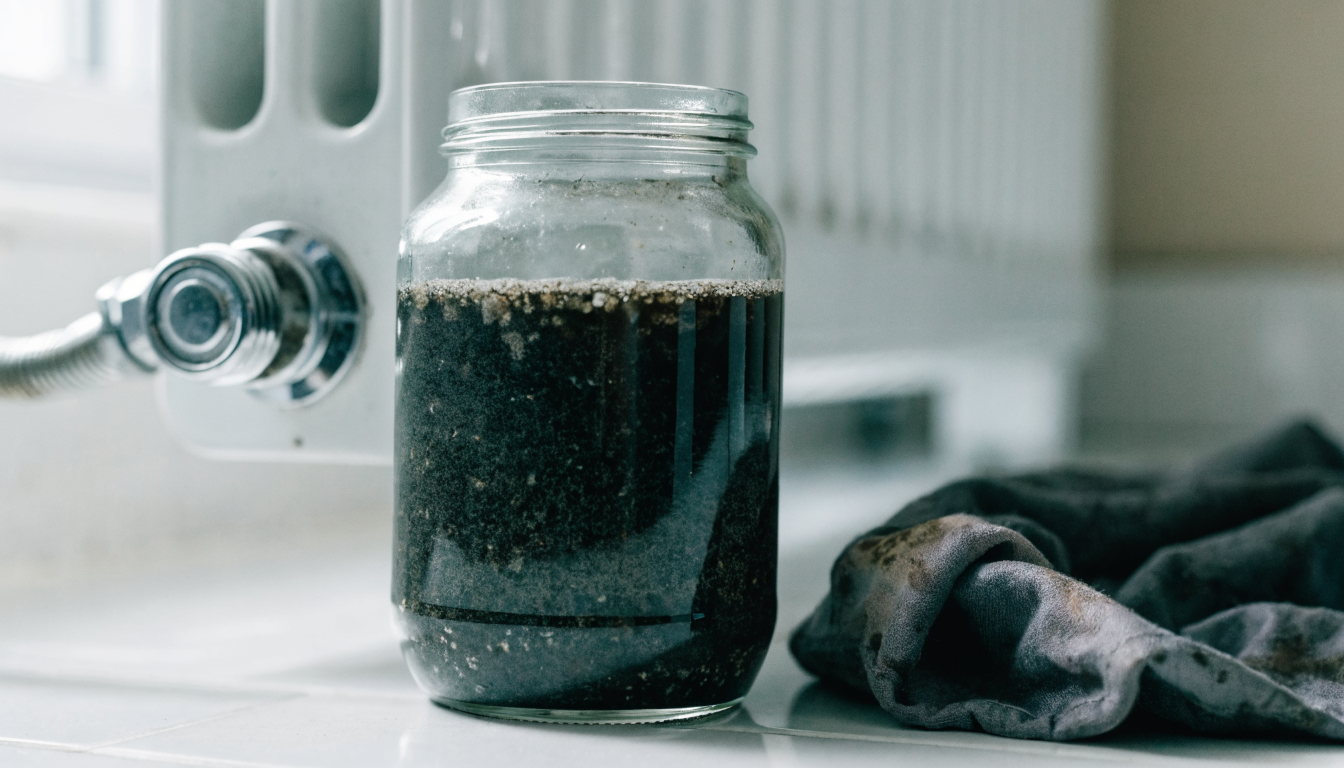
Because it is denser than water, it does not stay in suspension. It drops out wherever the water slows down, and the place water slows down most in your entire heating system is inside a radiator panel. Water arrives through a 15mm tail and immediately enters a chamber several hundred millimetres wide, so its velocity collapses. Anything heavy it was carrying settles on the flat floor of the panel and stays there.
Do that for ten or fifteen winters and you get a silt bed several centimetres deep. Hot water takes the path of least resistance, which is now straight across the top of the silt and out the other end. That is the whole mechanism, and it explains the symptom exactly: hot top, cold bottom, sharp horizontal line between the two.
Check it really is sludge before you spend anything
Sludge is the most likely answer but it is not the only one, and the four checks below cost nothing. Do them with the heating on and the radiator given twenty minutes to get to temperature, because a radiator felt from cold tells you nothing.
- How old is the radiator? A panel that went on the wall this year has not had time to silt up. That single fact redirects most people reading this to the flow section below.
- Feel both pipes at the valves. On a working radiator one tail is hot and the other is noticeably cooler. If both tails are barely warm, the radiator is being starved of flow and sludge in the panel is not your first suspect.
- How many radiators are affected? One is a radiator problem. Three or more is a system problem, and the fix is a different one.
- Open the bleed valve for a second. Not as a fix, as a test. Clear water means the system is reasonably clean and you should look at flow. Black water that stains a cloth confirms magnetite. If air hisses out, deal with that first using the bleeding procedure, then re-check the bottom.
The radiator is more than a few years old, the water from the bleed valve is black or grey, the cold band has a clear horizontal edge, and other radiators are starting to do the same thing.
Go to the three fixes below.
The radiator is new or recently refitted, the water runs clear, both valve tails are lukewarm rather than one hot and one cool, or the cold area fades gradually rather than stopping in a line.
Go to the not sludge section.
The radiator is cold all over rather than cold at the bottom, or every radiator in the house is cold. Those are valve and boiler faults, not silt.
Use the radiator fault finder.
Radiator cold at the bottom but not sludge: five other causes
This is the gap in nearly every page on this subject. Google's own AI Overview for this search names sludge and then stops, and of the pages ranking underneath it, most give flow a single line. If you have already flushed a radiator and it is still cold at the bottom, or the water came out clear, you are in this section rather than the one above.
| Cause | How you spot it | What fixes it |
|---|---|---|
| Lockshield closed too far | Both tails lukewarm, radiator slow to heat everywhere, often follows decorating or a radiator being taken off | Lift the cap, open the spindle anti-clockwise, re-balance afterwards |
| Radiator oversized for the flow it gets | A large or double panel on a long pipe run, warm along the top, never properly hot low down even when clean | Balancing the system, or accepting the panel is bigger than that circuit can serve |
| Flow and return connected the wrong way round | Usually a newly fitted or refitted radiator, top gets hot first and heat never works down the panel | Swap the connections so flow enters at the correct side for the valve arrangement |
| TRV pin partly seized | Radiator responds sluggishly to the valve head, pipe into the valve hotter than the pipe leaving the valve body | Free the pin under the head, or replace the valve |
| Tired circulating pump | Several radiators weak at the bottom at once, worst at the far end of the house, no sludge in the bleed water | Pump speed setting or pump replacement, which is an engineer job |
The lockshield is the one worth checking first because it costs nothing. It sits at the opposite end to the thermostatic valve, usually under a push-on plastic cap, and its job is to throttle how fast water can leave the radiator. Close it too far and water dawdles through the top of the panel, gives up its heat there, and never fills the bottom with anything hot. It gets closed by decorators, by people taking a radiator off the wall, and by whoever balanced the system last. The same spindle is covered in reverse in the guide to turning a radiator off.
The oversized radiator case is the one that gets misdiagnosed most expensively. A big double panel needs a lot of water moving through it to warm its full surface. Put one on the end of a long, thin pipe run competing with eight other radiators and it will be warm across the top and tepid below no matter how clean it is, because the flow rate reaching it cannot carry enough heat to fill it. No amount of flushing adds flow. That one is a balancing job, and a pump and pipework question beyond that.
Reversed flow and return is worth understanding because it is easy to create and easy to miss. A thermostatic valve fitted on the wrong side of the radiator, or tails swapped when a panel went back on the wall, changes how water travels through the panel. Many modern TRVs are bidirectional and do not care, but plenty of older ones are marked with a flow arrow and will behave oddly when fed backwards. If a radiator started misbehaving immediately after work was done on it, check that before you blame the water. What the valve is doing internally is set out in the guide to thermostatic radiator valves.
New radiator cold at the bottom: almost never sludge
If the radiator went on the wall in the last year or two and the bottom is cold, sludge inside that panel is unlikely on the arithmetic alone. Magnetite takes years to build a bed deep enough to block a waterway. A radiator that has been through two winters has not had the time.
What is far more likely, roughly in order:
- The lockshield was never opened after fitting. Radiators go on with the lockshield shut so the system can stay full. Opening it again is a step that gets forgotten, particularly on a self-fit job.
- The system has not been rebalanced. A new radiator changes the resistance of the whole circuit. Everything that was balanced around the old panel is now wrong, and the new one is often the radiator that loses out.
- It is bigger than the one it replaced. People upsize when they replace, quite reasonably, and then feed the bigger panel through the same old pipework at the same old flow rate.
- Debris from the installation. Not years of silt, but swarf, jointing compound or a lump of old sludge dislodged from the pipework when the system was drained and refilled. This one does respond to taking the radiator off and flushing it.
- The tails are on the wrong way round. See above. Worth thirty seconds of checking before anything else.
One genuine exception. If the new radiator went into an old, dirty system that was never cleaned first, it becomes the cleanest and least restrictive route in the circuit, and it will collect magnetite faster than anything else on the wall. That is a system problem showing up in a new panel, and the answer is to clean and protect the system rather than to keep taking the new radiator off.
The three fixes, cheapest first
Assuming you have confirmed it is sludge, there are three real options and they escalate in cost, effort and disruption. Most households need the first or second. The third gets sold far more often than it is needed.
Fix one: put a cleaner in the system
A central heating cleaner is a chemical dispersant. It goes into the system through a radiator, a filling loop or the feed tank, circulates with the heating running normally for as long as the manufacturer specifies, and lifts settled magnetite back into suspension so it can be drained away. Then the system is drained, refilled and dosed with inhibitor.
The two products a merchant will put on the counter are Fernox F3 and Sentinel X400. They do the same job, they are stocked interchangeably, and the dose rate is printed on the bottle. Check it against the size of your system rather than assuming one bottle treats a whole house, because a large or extended system will need more than a single 500ml bottle.
The honest limitation: a cleaner is very good at dirty water and not very good at a solid bed. If one radiator is packed hard enough that the bottom third is stone cold, the cleaner will improve the system around it and leave that panel much as it was, because the liquid cannot get into a waterway that is already full.
Start here if several radiators are affected
Fernox F3 Central Heating Cleaner 500ml
- Chemical cleaner for sealed and open vented central heating systems
- Lifts settled sludge back into suspension so it can be drained out
- Dosed through a radiator, the filling loop or the feed and expansion tank
- Dose rate printed on the bottle, so check it against your system volume first
- Stocked as standard by merchants alongside the Sentinel equivalent
Pros
- The cheapest way to attack a dirty system, by a wide margin
- Works while the heating runs normally, so no disruption while it circulates
- Available on the shelf at most trade counters if you need it the same day
- Pairs directly with inhibitor on the refill, which is what stops it returning
Cons
- Will not clear a radiator already packed solid with a hard silt bed
- The system still has to be drained and refilled afterwards, which is the real work
- One 500ml bottle will not cover a large or extended system
- Does nothing on its own for a radiator whose problem is flow rather than sludge
Judged on specification and manufacturer documentation rather than hands-on testing, since I am not a plumber. This is the right first move when several radiators are going cold at the bottom together, because that is a system that is dirty rather than a panel that is blocked. If only one radiator is affected, save your money and take that one outside with a hose instead.
If you would rather buy it over a counter than wait for a delivery, central heating treatment chemicals are a standard stock line at Toolstation and at the merchants and sheds generally.
Fix two: take the radiator off and flush it outside
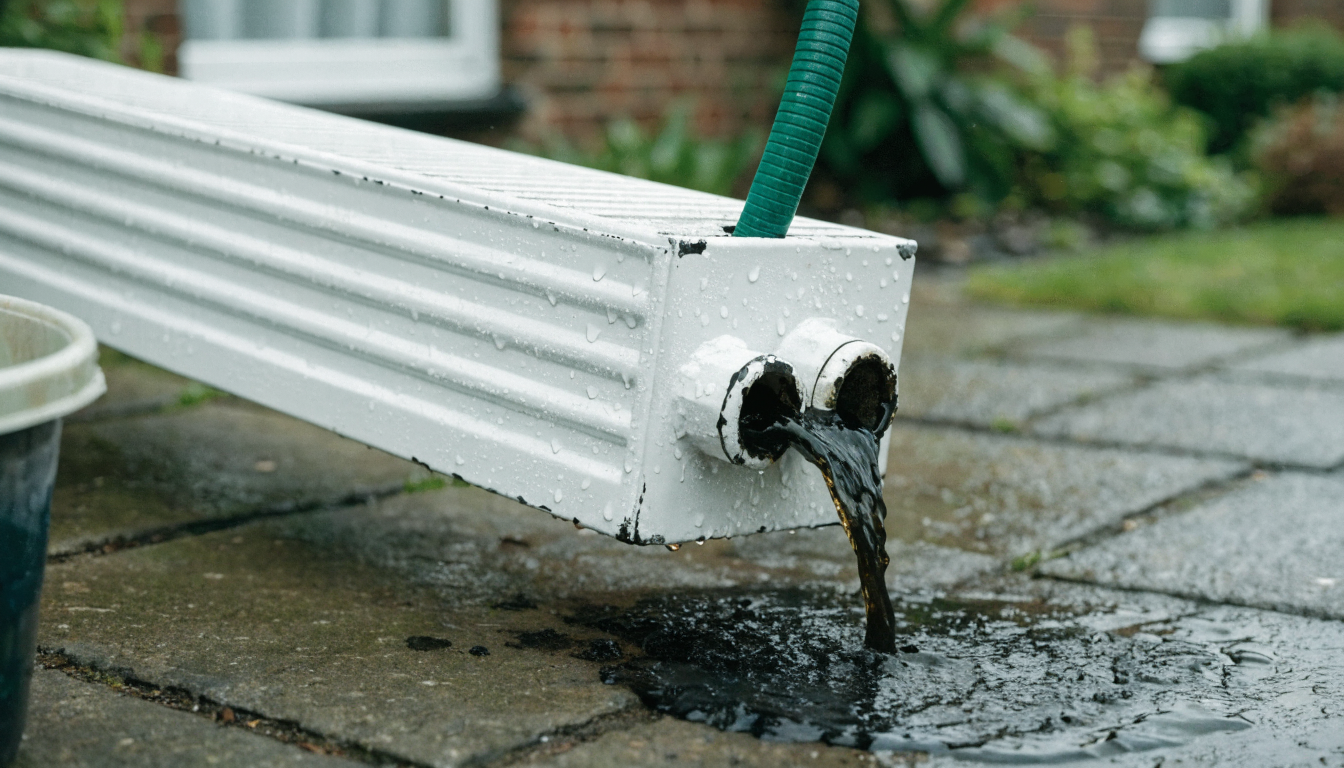
This is the fix nobody selling a service wants to lead with, and it is the one that solves most single-radiator cases. Both valves get closed, the radiator is drained into a tray, the tail nuts are cracked off, the tails are capped or bunged, and the panel is carried outside and flushed through with a garden hose until the water runs clear. It takes an afternoon and it costs almost nothing.
Three things decide whether it goes well. Get the radiator properly drained before you lift it, because a panel full of water is much heavier than it looks and the water in it is black. Cap the tails before the radiator leaves the room. And expect the first water out of the hose to be genuinely filthy, so do it away from anything that will stain. The full sequence, including isolating the valves and counting the turns on the lockshield so you can put it back where it was, is in the guide to removing a radiator.
Afterwards, on a sealed system, you will have lost pressure. Topping back up with the filling loop is a two minute job and it is covered in how to repressurise a boiler. Every time you drain and refill you also introduce fresh oxygenated water, which is exactly what makes magnetite, so the inhibitor step below is not optional.
Fix three: a power flush, and when you are being sold one you do not need
A power flush uses a pump unit connected to the system to drive water and chemicals through it at high velocity, radiator by radiator, until the return runs clear. It is a legitimate and sometimes necessary job. It is also, in my experience of what people brought into the merchants to ask about, the single most over-recommended piece of work in domestic heating.
It is worth paying for when the whole system is heavily sludged, when several radiators are cold at the bottom at once and a chemical clean has already failed, when the boiler is short cycling or kettling because of debris, or when a new boiler installer requires it as a condition of the warranty. That last one is common and is a reasonable request from their point of view, because they do not want your old silt in their new heat exchanger.
Push back on a power flush quote when
- Only one radiator is cold at the bottom and the rest of the house is fine
- Nobody has actually looked at the water, or opened a bleed valve to see what comes out
- The price was given over the phone without anyone seeing how many radiators you have
- It is offered as routine maintenance rather than as the answer to a symptom
- Your system already has a magnetic filter that nobody has thought to check or empty
A second opinion on a quote of this size is normal and nobody reasonable will be offended by it.
There is a real risk to weigh as well. A power flush pushes water through old pipework at pressure and it finds every tired joint and thin spot you have. On a very old system that is an argument for having it done by someone whose insurance covers the outcome, rather than an argument for skipping it, but it is a reason not to treat it as a casual first step.
Stopping it coming back: inhibitor and a magnetic filter
Whichever of the three routes you take, you have removed the symptom and left the cause completely intact. Steel, water and oxygen will make more magnetite, and in a few years you will be reading this page again.
BS 7593:2019, the British Standard covering water treatment in domestic central heating, is clear about the sequence: clean the system, dose it with a corrosion inhibitor, and check the inhibitor concentration every year afterwards. Very few UK households do that annual check. Inhibitor depletes, and once it is gone the corrosion simply restarts. How the brands compare on dose rate and cost per litre is set out in the central heating inhibitor guide.
The filter is the other half, and it does a different job. Inhibitor slows new magnetite forming. A magnetic filter catches what forms anyway, before it reaches the boiler heat exchanger and before it settles into the bottom of a radiator. The constraint that catches people out is height, because these sit on the return pipe by the boiler and need clear space underneath to get the canister off. Sizes, what each one catches and whether one will physically fit your cupboard are covered in the magnetic filter guide.
| Product | What it does | When it goes in | The catch | Buy |
|---|---|---|---|---|
Dose on the refill Fernox F1 Central Heating Protector 500ml | Corrosion and limescale inhibitor that slows the formation of new magnetite | Straight after any clean, flush or drain down, into the refilled system | Depletes over time and needs checking annually, which almost nobody does | Check price on Amazon |
Fit once, empty yearly MagnaClean Professional2 Magnetic Filter, 22mm | Catches circulating magnetite on the return before it reaches the boiler or settles | Fitted to the return pipe at the boiler, ideally at the same time as the clean | Published height of 203mm, so measure the gap under your boiler before ordering | Check price on Amazon |
One point that gets lost. A filter fitted to a system that was never cleaned is a plaster over the problem, because it can only catch what is moving and your sludge is sitting still in the bottom of a radiator. Clean first, then protect. Doing it in that order is the difference between fixing this once and fixing it repeatedly, and it is the thinking behind everything in maintaining your heating system.
When this will not fix it
Some radiators are finished, and it is worth knowing the signs before you spend an afternoon on a panel that is not coming back.
- Still cold at the bottom after a proper flush. If you have hosed it through until the water ran clear and the bottom stays cold when it goes back on the wall, the silt has bonded to the steel and it is not coming out with domestic equipment.
- Rust weeping through the paint, pitting or pinholes. The panel is corroding from the inside out. Flushing does not put metal back, and a radiator that has started to leak will do it again somewhere else.
- Valve tails or threads too corroded to reseal. Once you are fighting to get a joint watertight on reassembly, the labour of persisting has overtaken the cost of a new panel.
- The radiator was undersized for the room all along. If it runs hot along its whole length and the room still never warms up, that is a heat output problem rather than a fault. Cleaning it will not add a single watt.
If you do replace it, do the system first. Drop a clean new panel into a dirty system and it becomes the least restrictive path in the circuit, which means it collects magnetite faster than the radiator you just took out. Clean, dose, fit the filter, then change the radiator.
Where this stops being a DIY job
Closing valves, taking a radiator off the wall, hosing it out, dosing a cleaner and topping the pressure back up are all householder jobs. Some of what surrounds them is not, and two of those limits are law rather than caution.
- Anything on a gas appliance or its flue must be done by a Gas Safe registered engineer. Under the Gas Safety (Installation and Use) Regulations 1998 it is illegal for anyone not on the Gas Safe Register to carry out work on gas fittings and appliances. If a diagnosis ends at the boiler, it ends at the boiler.
- Unvented hot water cylinders require a competent person holding the relevant qualification. Work on an unvented system is notifiable under the Building Regulations.
- Power flushing and pump replacement are not illegal to attempt, but both involve putting stress on pipework you cannot see. Pay someone whose insurance covers the result.
- Pressure that keeps dropping means water is leaving the system somewhere. Topping it up weekly hides a leak and feeds fresh oxygenated water in every single time, which accelerates the exact corrosion that caused your cold bottom in the first place.
Frequently asked questions
Why is my radiator cold at the bottom but hot at the top?
Magnetite sludge in the bottom of the panel. Internal corrosion of the steel produces black iron oxide, it is denser than water, and it settles wherever the flow slows down, which is the flat floor of the radiator. Hot water then runs over the top of the silt bed instead of through it, so the top gets hot and the bottom does not. There is no air in the fault, which is why bleeding changes nothing.
Why is my radiator cold at the bottom even though there is no sludge in it?
Then it is almost certainly flow. The usual candidates are a lockshield valve closed too far, a system that has never been balanced or has not been rebalanced since work was done on it, a radiator physically too large for the flow that circuit can deliver, tails connected the wrong way round, or a pump that is not what it was. The tell is the water: clear water out of the bleed valve and two lukewarm tails point at flow, black water and one hot tail point at silt.
How do you fix a radiator that is hot at the top and cold at the bottom?
In escalating order. If one radiator is affected, close the valves, take it off the wall and flush it through outside with a hose until the water runs clear. If several are affected, dose the system with a chemical cleaner, let it circulate for the period the manufacturer specifies, then drain and refill. If the whole system is heavily sludged or a cleaner has already failed, a power flush by an engineer is the remaining option. Whichever you use, refill with inhibitor and fit a magnetic filter, or it comes back.
Radiator hot at the top and cold at the bottom on a combi boiler: is it different?
The radiator fault itself is identical, because the sludge does not know what is heating the water. What changes is the consequences. A combi has a narrow plate heat exchanger that magnetite blocks readily, so a sludged system on a combi is a boiler repair waiting to happen rather than just a cold room. Combi systems are also sealed and pressurised, so every drain and refill means repressurising afterwards and letting more oxygenated water in. That makes the filter and inhibitor step matter more on a combi, not less.
What happens if you bleed a radiator with the heating on?
The system is hot and pressurised with the pump running, so instead of a hiss of air you can get a jet of scalding water out of the bleed valve, and on a sealed system the pressure drops faster than you expect. Turn the heating off and let the radiators cool first. In the specific case of a cold bottom it makes no difference to the outcome anyway, since bleeding is not the fix.
Why are some of my radiators hot and some cold?
Whole radiators being cold while others are hot is a different fault from a cold band at the bottom of one panel. Cold all over with hot pipes at the valves is usually a seized thermostatic valve pin or a closed lockshield. Whole floors or whole ends of the house running cooler than the rest is a balancing issue, since water takes the easiest route and the radiators nearest the boiler get more of it. Work through the pattern in the radiator fault finder rather than treating them all as the same problem.
How do I know when a radiator needs replacing rather than flushing?
Replace it when the metal has gone rather than when the water is dirty. Rust weeping through the paint, pitting, pinholes, threads too corroded to reseal, or a bottom that stays cold after a proper flush are all end of life. A steel panel radiator has no published service life, because what kills it is the condition of the water inside it rather than its age. Panels in a system that was cleaned and kept dosed with inhibitor outlast panels in a neglected system by a very wide margin.
Will a magnetic filter clear a radiator that is already cold at the bottom?
No, and this is worth being blunt about because filters get sold as a cure. A magnetic filter catches magnetite that is moving through the return pipe. Sludge that has settled into the bottom of a radiator is not moving, which is precisely the problem. Fit a filter to prevent the next silt bed, not to remove this one. Clean the system or flush the radiator first, then fit the filter so it has something useful to do.
Related guides
- Radiator not heating up: the fault finder for every other cold radiator pattern, including cold all over and cold in the middle.
- How to remove a radiator: the step by step for fix two, including capping the tails so you can carry it out without flooding the room.
- Central heating inhibitor: how much your system needs, how the brands compare, and what BS 7593 actually asks for.
- Magnetic filters compared: what they catch, what they miss, and whether one will fit the gap under your boiler.
- How to bleed a radiator: the right fix for the opposite symptom, and what it means when no air comes out.



0 Comments