
As an Amazon Associate I earn from qualifying purchases.
A bathroom extractor fan is one of the few things in a house where the specification on the box tells you almost nothing about whether it will work where you want to put it. Three things decide that, and most pages selling you a fan mention none of them.
The first is the extract rate the Building Regulations actually ask for, which is 15 litres per second for a bathroom and only 6 litres per second for a separate WC. The second is where the fan sits relative to the bath or shower, because BS 7671 divides a bathroom into zones and each zone sets a minimum IP rating. The third, and the one that quietly ruins the most installations, is how far the air has to travel to get outside. An axial fan asked to push air down a five metre loft duct moves very little, however good its free air figure looks.
I spent 16 years running plumbers merchants across the south of the country and a couple more with an independent. Extractor fans came back over the counter for two reasons above all others: they were loud enough that the household stopped switching them on, or they had been wired into a duct run the fan was never going to cope with. Neither fault appears in a product listing. Both are avoidable before you spend anything.
One thing to be straight about. I have not fitted or tested any of these fans, and I am not an electrician. Everything below is judged on published manufacturer specification, retailer listings and the regulations themselves, and where a figure is not published anywhere I could find it, I have said so rather than fill the gap.
At a glance
- Best all round: Manrose QF100T
- Best two-speed axial: Xpelair C4TSR
- Best with a humidistat: Xpelair C4HTSR
- Lowest power draw: VENTS Silenta 100
- Best for a long duct run: Manrose MF100T inline
- Best wall-mounted centrifugal: Xpelair DX200T
| Fan | Type | Quoted extract rate | Quoted noise | Power | Best for | Check it |
|---|---|---|---|---|---|---|
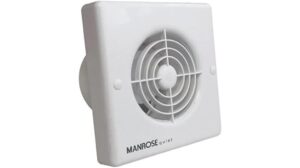 Best all round Manrose QF100T | Axial | 75 m3/h (21 l/s) | 27 dB(A) at 3 m | 4.8 W | Most bathrooms on a short duct | Check price on Amazon |
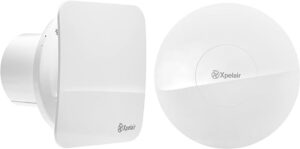 Best two-speed axial Xpelair C4TSR | Axial | 15 or 21 l/s, set at install | 29 dB(A) maximum | 6.3 to 7 W | Matching the rate to the room | Check price on Amazon |
Best humidistat Xpelair C4HTSR | Axial | 15 or 21 l/s, set at install | 29 dB(A) maximum | 6.3 to 7 W | Rooms nobody remembers to ventilate | Check price on Amazon |
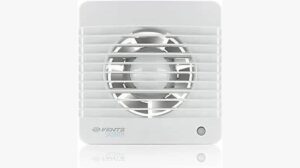 Lowest power draw VENTS Silenta 100 | Axial | 78 m3/h (about 21.7 l/s) | Not published | From 7 W | Keeping the running cost down | Check price on Amazon |
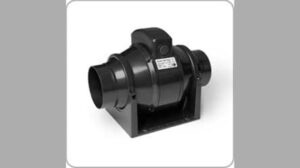 Best for long duct runs Manrose MF100T | Inline mixed flow | 245 m3/h free air, 50 l/s quoted working | 24 dB(A) high, 20 dB(A) low | 20 to 25 W | Loft-mounted runs of several metres | Check price on Amazon |
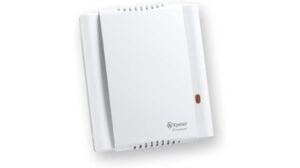 Best wall centrifugal Xpelair DX200T | Centrifugal | Not published | Not published | 34 W maximum | A wall fan facing a long duct | Check price on Amazon |
What size extractor fan a bathroom actually needs
Almost every fan sold for a domestic bathroom in the UK is a 100mm (4 inch) unit, and almost every one of them meets the legal minimum comfortably. The minimum is set out in Approved Document F, Volume 1: Dwellings, 2021 edition, which gives intermittent extract rates by room in Table 1.1.
| Room | Minimum intermittent extract rate | Minimum continuous high rate |
|---|---|---|
| Bathroom (with or without WC) | 15 l/s | 8 l/s |
| Sanitary accommodation (separate WC) | 6 l/s | 6 l/s |
| Utility room | 30 l/s | 8 l/s |
| Kitchen, cooker hood extracting to outside | 30 l/s | 13 l/s |
| Kitchen, no hood extracting to outside | 60 l/s | 13 l/s |
Two things fall out of that table that are worth more than any product recommendation.
The first is that a separate WC only needs 6 l/s, which is less than half a bathroom. People routinely fit the same 21 l/s fan in a downstairs cloakroom that they fit over a shower, then find it noisy and draughty for no useful gain. A quieter, gentler fan is the better answer in a room with no bath in it.
The second is that a typical 100mm fan is quoted somewhere between 15 and 21 l/s, so the headroom over the 15 l/s bathroom minimum is thin. That headroom is what the duct run eats. A fan quoted at 21 l/s in free air and fitted to four metres of sagging flexible duct with two bends is not delivering 21 l/s, and nobody publishes what it is delivering instead. This is why the fan type matters more than the number on the box. It is also why an underperforming fan shows up as condensation on your windows in a bedroom at the other end of the house, because the moisture the fan failed to remove does not stay in the bathroom.
Approved Document F also sets a control requirement that decides which version of a fan to buy. Paragraph 1.51 says that in a room with no openable window, an intermittent extract fan should have controls that keep it running for at least 15 minutes after the room is vacated. In practice that means an internal bathroom needs a timer model, not a standard one. It is not optional.
Where a bathroom extractor fan is allowed to go
This is the part that gets skipped, and it is the part that decides whether a fan can legally go where you want it. BS 7671 Section 701 divides a room containing a bath or shower into zones, and each zone carries a minimum degree of protection against water, expressed as an IP rating. A fan rated for Zone 1 is not the same thing as a fan you can put anywhere, and a fan with no zone rating stated is not a fan to put above a shower.
The bathroom zones, in section
Zone definitions and minimum IP ratings from BS 7671 Section 701, Regulation 701.512.2. Drawn to scale vertically; not a design document.
Put into words, and these are the definitions rather than my paraphrase of them:
- Zone 0 is the interior of the bath tub or shower basin. Minimum IPX7. No extractor fan belongs here.
- Zone 1 circumscribes the bath or shower basin and runs from floor level to 2.25 m above finished floor level, or higher if the fixed shower head sits above that. Minimum IPX4.
- Zone 2 is the 0.6 m band extending horizontally beyond the Zone 1 boundary at the same height. Minimum IPX4. For a shower without a basin, Zone 1 instead extends 1.2 m from the centre of the fixed water outlet and no Zone 2 is created.
- Where equipment is exposed to water jets used for cleaning, the minimum rises to IPX5.
A practical note on reading the IP number. Most bathroom fans are quoted as IPX4, but you will also meet ratings like IP34 and IP44, which some listings then describe loosely as splashproof. The second digit is the one the zones care about. IP34 and IP44 both carry a 4 in the water position, so both satisfy the IPX4 requirement for Zones 1 and 2. The first digit is about solid objects and does not come into it.
The other rule worth knowing before you order anything is Part P. Under Approved Document P, notifiable electrical work in England is the installation of a new circuit, the replacement of a consumer unit, and any addition or alteration to existing circuits in a special location. A room containing a bath or shower is a special location. So swapping a fan for the same thing on the same circuit is one conversation, and running a new fused spur into a bathroom is a different one that either goes through a registered electrician or through building control. That is the law rather than my opinion, and it is the single best reason to get a price from an electrician before you buy the fan rather than after.
Axial, inline or centrifugal: your duct run decides
If you take one thing from this page, take this. The three fan types are not three price points, they are three answers to one question: how far does the air have to travel, and how many bends are in the way?
An axial fan is a propeller. It moves a lot of air when there is nothing in front of it and it generates very little static pressure, which is the force needed to push air along a duct. Put a propeller at one end of four metres of flexible duct with a couple of bends in it and the airflow collapses. The fan still runs, still hums, still lights its little neon, and the mirror still steams up. This is the commonest fault in loft-ducted bathrooms and it is a specification error, not a product fault.
The 3 to 4 metre guide for axial fans is the figure cited in Checkatrade’s bathroom extractor fan guide, which Google’s own AI Overview leans on for the same advice. Manufacturers do not publish a hard cut-off, because it depends on bends, duct type and diameter as much as length.
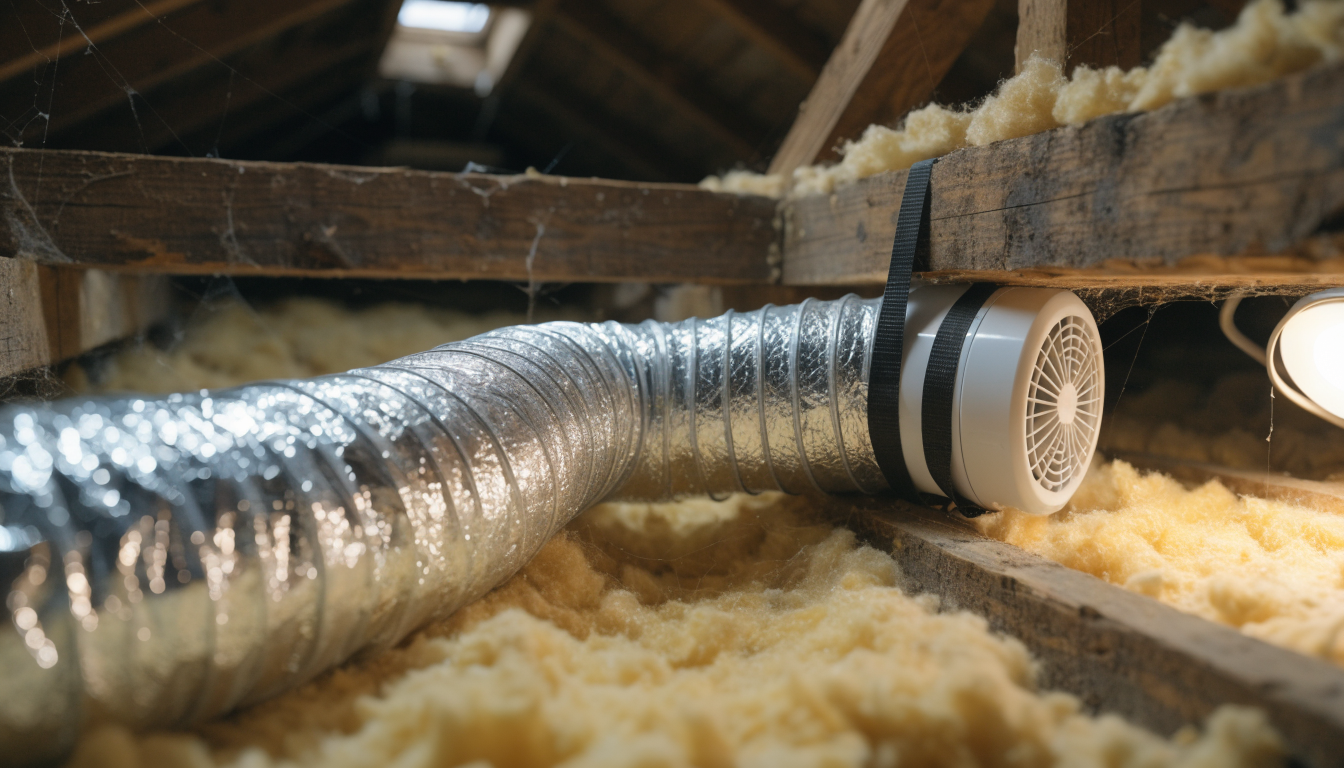
Three things about the duct that cost more airflow than people expect, and that no fan can compensate for:
- Bends, especially at the spigot. A tight 90 degree turn immediately off the back of the fan is the commonest self-inflicted wound. Give the air a straight run first if there is any way to do it.
- Flexible duct versus rigid. Concertina flexible duct has a corrugated inner wall that drags at the airflow the whole way along. Rigid duct with swept bends is a different animal and worth the extra effort on a long run.
- Sag. Flexible duct laid loose between joists sags, and in a cold loft the sag becomes the place condensate collects. A duct with water pooled in the bottom of a dip is a duct with a reduced bore, and eventually a duct with a drip coming back through the ceiling.
Timer, humidistat, pull cord or standard
Every 100mm fan in this guide comes in several control versions of the same body. Which one you buy matters more than which brand you buy.
Here is the observation that should decide it for most people. A standard fan wired to the light switch runs only while somebody is in the room, which is precisely the wrong time. The steam is still in the air when the light goes off, and the moment the fan stops, that steam goes back to condensing on the coldest surface it can find. That is the window reveal, the outside wall, the grout and the sealant round the bath. The fan was on while the room was full of person and off while the room was full of water vapour.
- Timer (overrun). The fan continues for a set period after the light goes off, usually adjustable. This is the version to buy for almost every bathroom, and as noted above it is what Approved Document F effectively requires for a room with no openable window, with a minimum of 15 minutes after the room is vacated.
- Humidistat. The fan starts itself when humidity rises, whether or not anyone touched the light. This is the answer for a household that will not use a fan, for a bathroom used by a teenager with the light off, and for a room that steams up from a bath rather than a shower. It is also the version that gets blamed for running at odd hours, which is usually the humidistat set too sensitive rather than a fault.
- Pull cord. Independent of the lighting. Useful where the fan is serving a room that is not always lit, and the version to avoid if anyone in the house is likely to decide the fan is annoying and simply stop pulling it.
- Standard. On with the light, off with the light. There is a narrow case for it in a downstairs cloakroom on an outside wall, and very little case for it above a shower.
One wiring point worth knowing before an electrician quotes. A timer or humidistat model needs a permanent live as well as a switched live, because it has to keep running after the switch opens. If the existing fan is a standard model there may only be a two-core and earth up there, and that is the difference between a half hour swap and a morning's work with a floorboard up.
How loud is a bathroom extractor fan, really
Noise is the commonest reason a fan gets switched off and never used again, which makes it the commonest reason a bathroom gets damp. It is also the specification most casually abused in listings, because there is more than one way to state it and the two are not comparable.
The Manrose QF100T is a good worked example. B&Q's listing quotes it at 27 dB(A) at 3 metres, which is a sound pressure figure measured at a stated distance. Manrose's own Quiet Fan range data sheet gives the same fan a figure of 47.53 dB, which is a sound power level, an entirely different quantity that does not depend on where you stand. Same fan, two numbers, 20 dB apart, both correct.
| Fan | Quoted noise | Stated distance | Source |
|---|---|---|---|
| Manrose QF100T | 27 dB(A) | 3 metres | B&Q product listing |
| Manrose QF100T (same fan) | 47.53 dB sound power | Not applicable | Manrose Quiet Fan range data sheet |
| Xpelair C4TSR and C4HTSR | 29 dB(A) maximum | Not stated | Retailer specification |
| Manrose MF100T inline | 24 dB(A) high, 20 dB(A) low | Not stated | Retailer specification |
| Vent-Axia 446659B | 12 dB(A) on low | Not stated | Quoted in Google's AI Overview |
So when you see a fan advertised at 12 dB(A), the questions are: at what distance, and at what airflow? A fan is quietest on its lowest speed, and its lowest speed may well be below the 15 l/s the regulations ask of a bathroom. A silent fan that is not shifting enough air is a decoration.
Two installation details affect perceived noise more than the rating does. Screw the fan down properly onto a flat, solid surface, because a body that can buzz against a plasterboard ceiling will. And do not fit a 21 l/s fan into a tiny cloakroom that only needs 6 l/s, because the air rushing through a small grille makes a hiss that has nothing to do with the motor.
What a bathroom extractor fan costs
The useful range for a decent 100mm timer fan is roughly £20 to £60, and the difference between the bottom and the top of that range is mostly noise and control options rather than airflow. Prices below are from live retailer and Google Shopping listings checked on 18 September 2026, and they move.
| Fan | Price | Retailer |
|---|---|---|
| Airvent 100mm low profile, standard | £17.29 | Toolstation |
| Xpelair VX100T 100mm axial, timer | £19.99 | Screwfix |
| Manrose XF100T 100mm axial, timer | £22.99 | Screwfix |
| Xpelair Simply Silent DX100S square, with wall kit | £32.99 | B&Q and Screwfix |
| Xpelair C4TSR Simply Silent Contour, timer | £33.42 | Superlec Direct |
| Xpelair C4HTSR Simply Silent Contour, humidistat and timer | £47.50 | Electrical Wholesalers 4U |
| Manrose Quiet Fan X5 QF100TX5OP | £54.99 | Screwfix |
| Manrose MF100T inline mixed flow, timer | £54.95 | Air Con Centre |
| Vent-Axia Silent Fan 446658B | £62.98 | Toolstation |
It is worth comparing across the trade counters as well as the marketplaces, because the same fan often sits at three different prices. The current ranges are at Screwfix, Toolstation and B&Q.
Running cost barely registers. A 4.8 W fan run for an hour a day uses under 2 kWh in a year. The electrician is the expensive part of an extractor fan, not the electricity.
The best bathroom extractor fans
Every product below was checked as available on Amazon UK on 18 September 2026. Two Manrose and three Xpelair units carry the list, and the honest reason for that is that those two brands dominate what is actually buyable in 100mm at sensible money in the UK. Where a manufacturer does not publish a figure, the entry says so rather than borrowing a number from somewhere else.
Best all round: Manrose QF100T
This is the fan the trade counter sold most of, and for once the popular choice is the right one. It hits 75 m3/h, which is 21 l/s, comfortably over the 15 l/s Part F minimum, on 4.8 watts. B&Q's listing quotes 27 dB(A) at 3 metres, one of the few noise figures in this category that comes with a stated distance attached. The ball bearing motor is warranted for a minimum of 30,000 hours or three years, which is a more meaningful statement than a bare warranty length because it tells you what Manrose expect out of it.

#1 Best all round
Manrose QF100T Quiet Extractor Fan with Timer
- 75 m3/h (21 l/s) quoted extract rate
- 27 dB(A) at 3 metres, per the B&Q listing
- 4.8 W maximum power input
- 100mm (4 inch) duct
- Adjustable run-on timer
- Ball bearing motor warranted for a minimum of 30,000 hours or 3 years
Pros
- The rare fan that publishes a noise figure with a distance attached
- Lowest power draw of any mains fan here at 4.8 W
- Widely stocked, so spares and like-for-like replacements are easy
- Comfortable margin over the Part F bathroom minimum
Cons
- Axial, so it is the wrong fan for a duct run of more than about 3 to 4 metres
- Timer only, no humidistat in this version
- Plain white plastic and nobody would call it handsome
- Needs a permanent live as well as a switched live, which older wiring may not have
If the fan is going on an outside wall or a short ceiling duct, and nothing about the room is unusual, buy this and stop reading. It does the required job on the least electricity of anything here and it tells you honestly how loud it is.
Best two-speed axial: Xpelair C4TSR
The Simply Silent Contour body takes either a round or a square baffle, which solves the commonest fitting headache in a replacement job: the hole in the ceiling is the wrong shape for the fan you liked. More usefully, the extract rate is selectable at installation between 15 and 21 l/s. That is exactly the choice the Part F table implies, and almost no other fan in this bracket offers it.
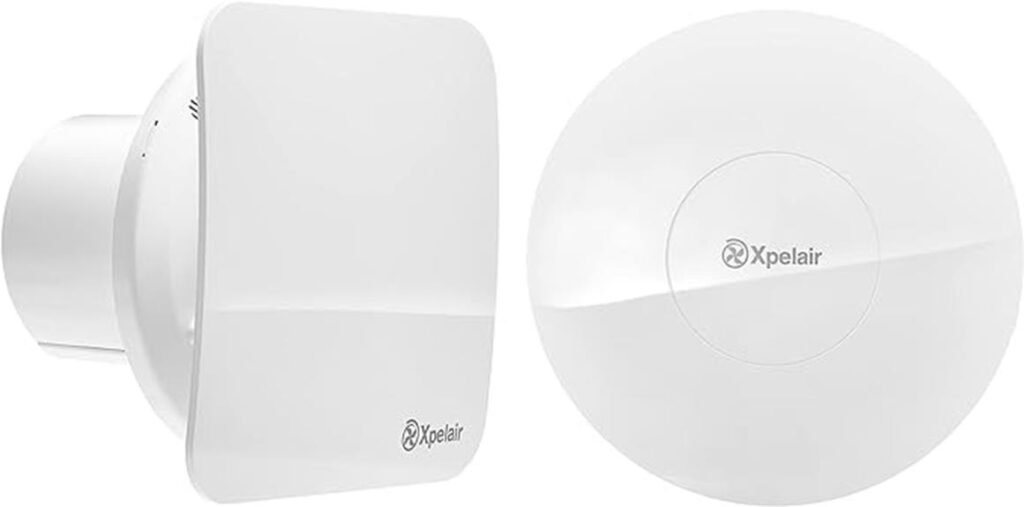
#2 Best two-speed axial
Xpelair C4TSR Simply Silent Contour with Timer
- 15 or 21 l/s, selected at installation
- 29 dB(A) maximum
- 6.3 to 7 W AC motor
- IPX4 rated
- Round or square baffle supplied
- 100mm (4 inch) duct
- 2 year UK guarantee
Pros
- Set the rate to suit the room rather than overventilating a small one
- Round or square baffle covers most existing cut-outs
- IPX4 stated plainly, so Zone 1 and Zone 2 are covered
- One of the cheaper routes into a two-speed fan at the trade counters
Cons
- 29 dB(A) is quoted without a distance, so it cannot be compared with the Manrose figure
- 2 year guarantee, against 3 years on the Manrose motor
- Higher power draw than the QF100T for the same airflow
- Still axial, so the duct length limit applies
The one to choose when the room is small, or when you are replacing an existing fan and cannot be sure what shape hole is behind the old one. Being able to pick 15 l/s rather than 21 l/s is a genuine noise saving in a cloakroom.
Best with a humidistat: Xpelair C4HTSR
Mechanically the same fan as the C4TSR above, with an integral humidistat and a timer adjustable from 30 seconds to 30 minutes. It is the answer to a specific problem: a household that will not reliably use a fan, or a bathroom where the damage is being done by long baths rather than short showers. A humidistat model is also the sensible default in a rented property, because it does not rely on the occupant doing anything.
#3 Best with a humidistat
Xpelair C4HTSR Simply Silent Contour with Humidistat and Timer
- Integral humidistat, starts on rising humidity
- Timer adjustable from 30 seconds to 30 minutes
- 15 or 21 l/s, selected at installation
- 29 dB(A) maximum
- 6.3 to 7 W AC motor
- IPX4 rated, 100mm duct
- 2 year UK guarantee
Pros
- Works whether or not anyone remembers to switch it on
- Same selectable extract rate as the C4TSR
- Long adjustable overrun, up to 30 minutes
- The right default for a let property or a bathroom used by teenagers
Cons
- Costs meaningfully more than the timer-only version for the same airflow
- Humidistats set too sensitive run at odd hours and get blamed for it
- Still needs a permanent live, and stock has been intermittent at UK wholesalers
- No dedicated product image on this page, because the manufacturer images are not ours to republish
Buy this instead of the C4TSR wherever the fan being used is not something you can rely on. It costs a little more and removes the human being from the loop, which is usually where bathroom ventilation fails.
Lowest power draw: VENTS Silenta 100
VENTS publish 78 m3/h for the 100mm Silenta, which works out at roughly 21.7 l/s, from 7 W, with a service life quoted around 40,000 hours and protection rated IP34. That second digit is the one that matters for the zones, so it satisfies the IPX4 requirement despite reading oddly. Worth noting that the standard warranty is 12 months rather than the three years Manrose and Xpelair offer, which is the trade-off for the price.

#4 Lowest power draw
VENTS Silenta 100mm Bathroom Extractor Fan with Run-On Timer
- 78 m3/h (about 21.7 l/s) quoted airflow
- From 7 W power consumption
- IP34 protection rating, so IPX4 for zone purposes
- Service life quoted at approximately 40,000 hours
- Run-on timer
- Suits 100mm ducting
Pros
- Very low power draw for the airflow
- Long quoted service life
- Slim body, 21mm projection, which helps in tight fitting positions
- Cheapest way into a timer fan that meets the Part F rate
Cons
- VENTS do not publish a dB(A) figure on the UK listings I checked, despite the name
- Standard warranty is 12 months, well short of the competition
- The Silent, Silenta and Silenta-S names are used loosely across listings, so check the model you are actually buying
- Axial, with the same duct length limits as the others
A reasonable budget choice on a short duct run, on the understanding that you are buying an airflow figure and a price, not a verified noise figure. If quiet is the point, the Manrose publishes a number and this does not.
Best for a long duct run: Manrose MF100T inline
This is the fan for a bathroom with no outside wall. The motor sits in the loft, in the duct, which does two things: it puts the noise source out of the room, and it gives you a mixed flow impeller that can actually pull air along several metres of ducting.
It is also a useful lesson in reading specifications. The retailer listing quotes 245 m3/h maximum and 180 m3/h minimum, and separately quotes 50 l/s. Those are not contradictory: 245 m3/h is 68 l/s, and that is a free air figure with nothing attached to the fan. The 50 l/s is closer to what you get once there is duct on it. The gap between those two numbers is the duct, and it is the gap that every axial fan on a long run falls into.

#5 Best for a long duct run
Manrose MF100T In-Line Mixed Flow Fan with Timer
- 245 m3/h maximum free air, 180 m3/h minimum
- 50 l/s quoted as the working extract rate
- 24 dB(A) on high, 20 dB(A) on low
- 20 to 25 W
- IP44 rated
- 100mm (4 inch) ducting
- Motor warranted for a minimum of 30,000 hours or 3 years
Pros
- The only sensible answer for a bathroom with no outside wall
- Motor noise sits in the loft rather than the room
- Two speeds, so it can be turned down once the room is clear
- Far more airflow in hand than any axial fan here
Cons
- Four to five times the power draw of the QF100T
- Mounted in the loft, so servicing means a ladder and a crawl
- Needs a condensate trap or a fall on the duct, or water finds its way back
- Noise figures are quoted without a measurement distance
If the air has to cross a loft to get out, this is the fan. Fit it properly, support the duct so it cannot sag, and give the run a fall away from the fan so condensate drains outward rather than back.
Best wall-mounted centrifugal: Xpelair DX200T
The middle answer, for when the duct run is long but there is no accessible loft to put an inline fan into. A centrifugal impeller generates far more static pressure than a propeller, which is why retailers describe this one as being for rooms where longer duct runs are required. The price you pay is in watts: it draws up to 34 W, against 4.8 W for the QF100T.
Xpelair do not publish an extract rate on any of the retail listings I checked, which is a genuine gap in a product whose entire purpose is moving air against resistance. Worth asking the supplier for the performance curve before committing on a difficult run.

#6 Best wall-mounted centrifugal
Xpelair DX200T Premier Centrifugal Extractor Fan with Timer
- Centrifugal impeller for higher static pressure
- 34 W maximum power consumption
- Adjustable electronic timer, delay up to 20 minutes
- Integral back draught shutter and gasket seal
- 100mm (4 inch) ducting
- 3 year UK guarantee
Pros
- Handles duct runs an axial fan cannot, without needing loft access
- Integral backdraught shutter and gasket seal come as standard
- 3 year UK guarantee
- Stays in the bathroom, so no crawling about to service it
Cons
- 34 W, which is seven times the QF100T for the same job on a short run
- No extract rate published on any retail listing I could find
- No noise figure published either, which is a poor look on a fan this size
- Overkill, and needlessly expensive to run, on a short duct
Specify it when the duct run defeats an axial fan and there is nowhere to hide an inline unit. Do not specify it on a two metre run through an outside wall, where you would be paying in electricity and noise for pressure the job does not need.
One fan is missing from that list on purpose. Google's AI Overview currently names the Airflow iCON 15 as its best overall pick, on the strength of its iris backdraught shutter and interchangeable control modules, and it is a genuinely well-regarded unit. I could not get a live availability check to return on the Amazon listing, so it is covered here as editorial rather than recommended. If the design and the shutter appeal, it is worth a look through the retailer ranges linked above.
What goes wrong with a bathroom extractor fan over time
Extractor fans do not usually fail, they fade. The householder notices nothing because the fan still makes a noise, and the noise is what people use to judge whether a fan is working. It is the worst possible test.
Switch the fan on. Hold a single sheet of toilet tissue flat against the grille and let go.
It stays up on its own: the fan is moving air. How much is another question, but the basics are working.
It falls: the fan is moving nothing useful, whatever it sounds like. Something between the impeller and the outside is blocked, stuck or disconnected.
In rough order of how often it happens, here is what has gone wrong when the tissue falls:
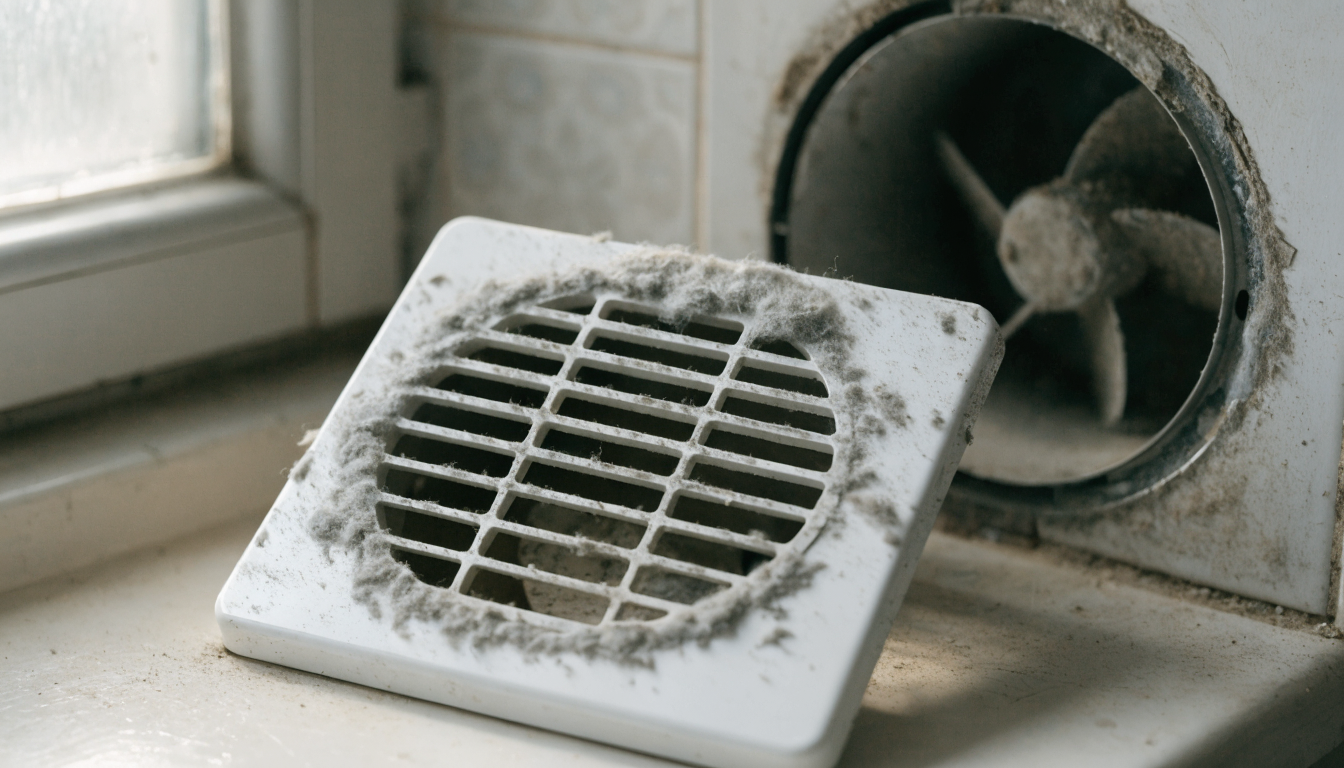
- Dust. Bathroom dust is lint and it felts. It coats the grille and builds on the leading edge of every impeller blade, which changes the blade profile and unbalances the fan. This is the commonest cause by a distance and the only one anyone can fix themselves, with the power off, a vacuum and a damp cloth.
- The backdraught shutter has stuck shut. The spring-loaded flap that stops cold air blowing back in gets gummed with dust, or painted over during decorating, and stops opening. The fan then runs against a closed door.
- The external grille is blocked. Louvres seize with paint or corrosion, or something has nested behind it. Worth looking at from outside with binoculars if it is high up.
- The duct has come off. Flexible duct pushed onto a spigot without a clip works its way loose, and the fan then vents enthusiastically into the loft. That is the version of this fault that does real damage, because all that moisture is now condensing on cold roof timbers instead of leaving the building.
- The duct has a water trap in it. A sag full of condensate in a cold loft is a partial blockage that gets worse through the winter and better in summer, which is why the fault seems to come and go.
- Nothing happens at all. If the fan does not start, it is usually the isolator, the fan's own fuse in the fused spur, or a failed timer module rather than the motor. Anything past checking the switch is electrical work in a special location, so it stops being a DIY job. If that is where you have ended up, the companion guide to diagnosing an extractor fan that is not working goes through each symptom in turn, including the power chain and what the Building Regulations actually say about who is allowed to touch it.
A fan is worth a clean once a year. Five minutes with the cover off is the difference between a fan doing its rated job and a fan doing a quarter of it while sounding identical.
If you arrived here because of mould
Most people reading a page about extractor fans are not shopping. They are looking at black marks in the silicone round the bath or dark speckles creeping along the grout, and somebody has told them the fan is the answer.
That is broadly right, with one important qualification. A fan is the prevention, not the cure. Moisture that has already got into sealant or grout does not leave because you fitted better ventilation, and replacing a fan will not clean anything that is already marked. The jobs are separate and they run in this order.
- Deal with what is there. Our guide to removing black mould from silicone sealant covers what actually shifts it and, more usefully, when the sealant is too far gone to be cleaned and has to come out.
- Work out why it is happening. Mould in the bathroom goes through the causes in order, of which inadequate or unused ventilation is only one.
- Replace what has failed. If the silicone has to come out, the best silicone sealants guide covers which ones carry a fungicide and which do not, and grout removal tools covers getting the old stuff out without wrecking the tiles.
- Then fix the ventilation, using this page, so it does not come back. A timer or humidistat fan running on for 15 minutes after the room is vacated is doing the work the open window was never going to do in February.
Regular cleaning helps too, and our shower cleaners guide covers what is worth using on a weekly basis. But a bathroom that is properly ventilated needs a great deal less of all of this.
Bathroom extractor fan questions
What is the best type of fan for a bathroom?
Whichever type suits the duct run. An axial fan for an outside wall or a ceiling duct of roughly 3 to 4 metres or less, a centrifugal fan for a longer run where the fan must stay in the bathroom, and an inline fan in the loft where the run is long or the bathroom has no outside wall. Fitting an axial fan to a long duct is the single commonest reason a new fan fails to make any difference.
Do I need an electrician to replace a bathroom extractor fan?
Under Approved Document P, notifiable work in England is a new circuit, a consumer unit replacement, or any addition or alteration to existing circuits in a special location, and a room containing a bath or shower is a special location. Swapping an existing fan for a like-for-like replacement on the same circuit is not an alteration to the circuit. Running a new spur, or upgrading a standard fan to a timer model that needs a permanent live it does not currently have, is. Given the room it is in, and that I am not an electrician, the sensible course for most people is to have it done and certified.
How much would an electrician charge to fit an extractor fan?
It depends almost entirely on two things nobody can see from a photograph: whether there is already a suitable supply at the fan position with a permanent live, and whether the ducting run already exists. A like-for-like swap into an existing hole with existing wiring is a short job. Cutting a new hole, running duct across a loft and pulling a new spur is a different order of work. Any figure quoted without someone looking at the ceiling void is a guess, and it is worth saying so when you ask.
What is the average lifespan of a bathroom extractor fan?
The manufacturers give you a better answer than an average does, because they publish motor life. Manrose warrant the QF100T and MF100T motors for a minimum of 30,000 hours or three years, and VENTS quote a service life of around 40,000 hours for the Silenta. At an hour a day, 30,000 hours is a very long time. In practice fans get replaced long before the motor dies, because they have clogged with dust and been written off as broken.
Does a bathroom fan have to be vented outside?
Yes, and venting one into a loft is actively harmful rather than merely useless. All the moisture you just removed from the bathroom is now condensing on cold roof timbers and the top of the insulation. If the duct has come adrift from its spigot in the loft, which is common, that is exactly what is happening now.
How do you vent a bathroom fan with no outside access?
Every bathroom has outside access, it is just further away than you would like. An internal bathroom is the classic case for an inline fan in the loft ducted to a roof tile vent or out through a gable wall. There are recirculating units sold as an alternative, and they filter odour rather than removing moisture, which for a bathroom is solving the wrong problem.
Why should a bathroom fan run on after you leave?
Because that is when the moisture is still airborne. The steam does not leave with you, and a fan switched off at the light stops working at the exact moment it is most needed. Approved Document F puts a number on it: in a room with no openable window, the controls should keep an intermittent fan running for at least 15 minutes after the room is vacated.
What is the most powerful bathroom extractor fan?
Of the fans here, the Manrose MF100T inline, which is quoted at up to 245 m3/h free air. But raw airflow is the wrong thing to shop for. A 68 l/s free air figure means nothing once the fan is fighting a duct, and a domestic bathroom only needs 15 l/s delivered. Getting 15 l/s to actually leave the building beats a large number on a box every time.
Related guides
- How to remove black mould from silicone sealant, for the marks a fan will not clean.
- Mould in the bathroom, for working out which of the causes applies to your room.
- The best silicone sealants, for when the old bead has to come out and go back.
- The best grout removal tools, for getting stained grout out without damaging tiles.
- The best shower cleaners, for keeping on top of it week to week.





0 Comments