
As an Amazon Associate I earn from qualifying purchases.
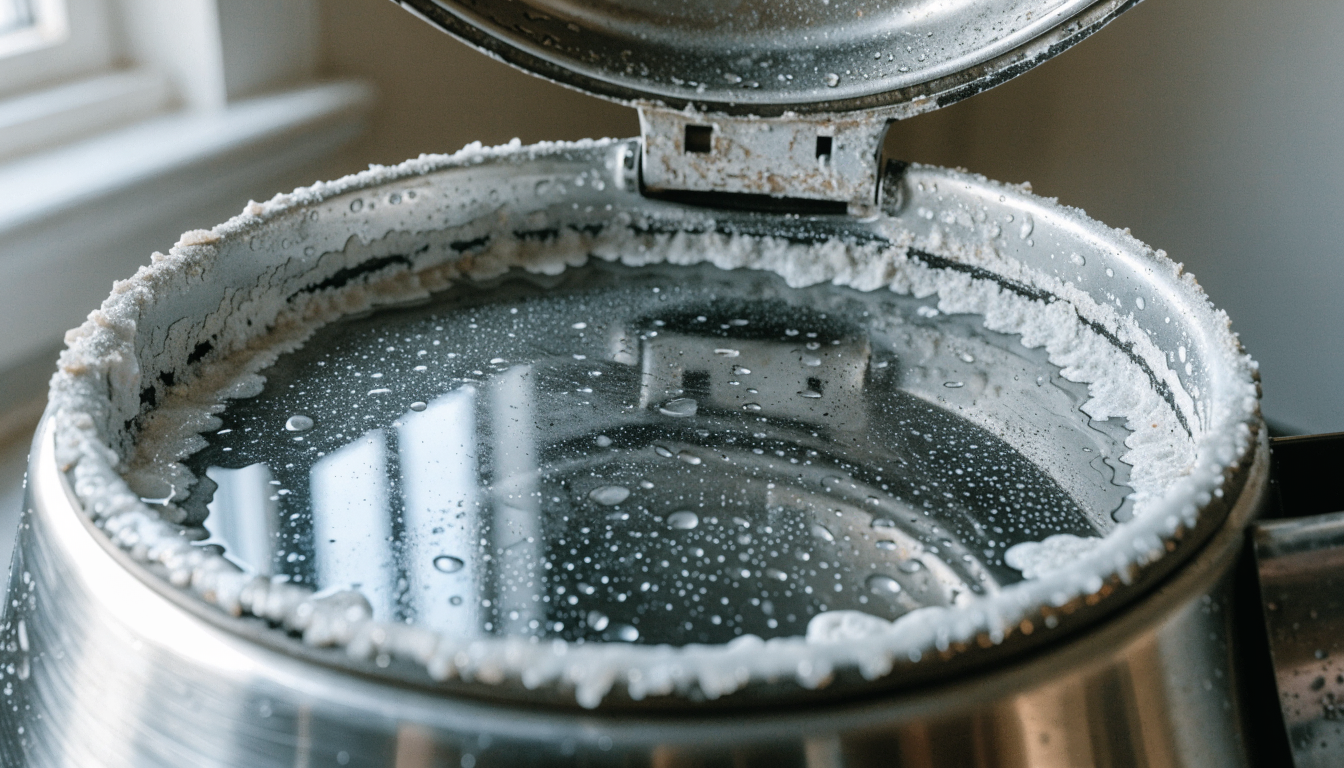
Here is how to descale a kettle, before anything else. Fill it to about half with a 50/50 mix of white vinegar and water, or with a litre of water and a heaped tablespoon of citric acid powder. Boil it, switch it off, and leave it to stand for thirty minutes to an hour. Pour it away, rinse three times, then boil a full kettle of fresh water and tip that away too.
That is the whole job, and it works every time because it is chemistry rather than elbow grease. The rest of this page is the part the manufacturer blogs leave out: which of the four methods is actually cheapest per descale, the one thing you must never mix your descaler with, why a concealed element hides scale you cannot see, and why your kettle furs up in a fortnight when the same kettle in Manchester would go six months.
I spent sixteen years running plumbers merchants across the south of the UK, which is limescale country. Scale inhibitors, shower heads and softener salt were steady counter business for one simple reason: nobody in a hard water area only has a kettle problem.
Why acid removes limescale and nothing else does
Limescale is calcium carbonate. Hard water carries dissolved calcium bicarbonate, which is stable while it is cold and stops being stable the moment you heat it. Boiling drives off carbon dioxide and leaves the calcium behind as a solid carbonate crust, which is why it forms in kettles, boilers and shower heads rather than in the cold tap.
Calcium carbonate is insoluble in water and readily soluble in acid. Put any acid on it and you get a soluble calcium salt, water and carbon dioxide, which is the fizzing you see. That single reaction is the reason white vinegar, citric acid powder, lemon juice and branded descaler sachets all work. They are the same trick at different strengths.
Understanding that one mechanism is more useful than memorising one method, because it tells you what will not work. If you want the longer version of how the deposit forms in the first place, our guide to what limescale actually is covers the water chemistry properly.
Bicarbonate of soda does not descale a kettle
This one is worth stating plainly because it is all over the search results, including on pages published by kettle manufacturers. Bicarbonate of soda is sodium bicarbonate, and it is alkaline, not acidic. It cannot dissolve calcium carbonate, because dissolving calcium carbonate is something acids do.
What bicarb does is act as a very mild abrasive, so a paste of it will scrub loose flakes off a surface you can reach. In a kettle with a flat concealed base you cannot reach most of the scale, so you are scrubbing the bit you can see and leaving the bit that matters.
Worse, the popular trick of tipping vinegar onto bicarb is self defeating. The fizz is the acid being neutralised by the alkali. You started with something that dissolves limescale and ended up with salty water.
Never mix a kettle descaler with bleach
The same rule is why you should not reach for bleach on a stainless steel kettle in the first place. Chlorides attack stainless, and bleach left sitting on it will pit the surface. Scale comes off with acid, so there is never a reason to introduce bleach to a kettle at all.
The four descaling methods, priced per use
Nobody publishes this, which is odd, because it is the only number that separates the methods once you accept they all work. Below is what one descale of a 1.7 litre kettle costs with each, using real shelf prices from UK retailers rather than Amazon listings.
| Method | What it costs to buy | Dose per kettle | Cost per descale |
|---|---|---|---|
| Citric acid powder (Elbow Grease 250g) | £2.29 at Robert Dyas, so £9.16 per kg | About 20g | 18p |
| Citric acid powder (Dri-Pak 250g) | £3.49 at Robert Dyas, so £13.96 per kg | About 20g | 28p |
| Lemon | 89p for four at Morrisons, so 22p each | One lemon | 22p, but see below |
| Branded sachet (Oust All Purpose Descaler) | £1.70 for three sachets at Morrisons | One sachet | 57p |
| White vinegar (Hazlemere distilled, 1 litre) | £1.20 at Morrisons | 500ml in a 50/50 mix | 60p |
White vinegar
Acetic acid, weak, cheap and already in most kitchens. It is the method every ranking page leads with and it is perfectly good. Use distilled white vinegar rather than malt, not because malt will not work but because it is darker, smells stronger and leaves more to rinse out.
The catch is volume. Vinegar is dilute, so you need a lot of it, and 500ml a go makes it the most expensive of the four in practice despite being the cheapest per litre. It also leaves a smell that takes two or three rinses and a boil to shift.
Citric acid powder, the cheapest option and the one that smells of nothing
Citric acid is a solid, so you are not paying to ship water. A heaped tablespoon in a litre of water gives you a stronger acid than a 50/50 vinegar mix at less than a third of the cost, and it has no smell at all. It is the same active ingredient as the lemon method, just concentrated and consistent.
A 250g bag will descale a kettle a dozen times and still have enough left for the shower head and the coffee machine. Larger catering packs bring the price per kilo down further, though the price swings too much between sellers to quote a figure worth trusting.
Cheapest per descale
Dri-Pak Citric Acid 250g
- Food grade citric acid powder in a 250g resealable bag
- About a dozen kettle descales per bag at a 20g dose
- Also works on shower heads, taps, coffee machines and toilets
- No fragrance, no colour and nothing to rinse out but the acid itself
Pros
- The lowest cost per descale of any method on this page
- Completely odourless, unlike vinegar
- One bag covers every scaled item in the house
Cons
- You have to measure it yourself, and the pack gives no kettle dose
- Loose powder cakes solid if the bag is left open in a damp kitchen
- Not stocked in every supermarket, so it tends to be a planned buy
If you descale a kettle more than twice a year, this is the sensible default. It is the cheapest method per descale in the cost table above, it has no smell at all, and the same bag handles every other scaled thing in the house.
Lemon, the method that looks cheap and is not
Lemon juice is citric acid, so of course it works, and at 22p a lemon it looks like the bargain of the four. The problem is how little acid is actually in there.
Lemon juice runs at roughly five per cent citric acid by weight. A good lemon yields somewhere around 40 to 50ml of juice, which puts about two to two and a half grams of citric acid into your kettle. A heaped tablespoon of citric acid powder puts in around twenty. That is a tenth of the acid for a similar price, which makes lemon comfortably the most expensive way to shift a given amount of limescale.
Treat those figures as arithmetic from typical values rather than a published number. The conclusion holds either way: lemon is fine for a light film, and hopeless on a crust.
Branded descaler sachets and solutions
You are paying about double the citric acid price for two genuine conveniences: the dose is measured for you, and the acid is usually stronger, so heavy scale comes off in one go rather than two. For someone who descales twice a year and does not want to think about it, 57p is not a lot to pay.
The choice of acid does matter once you move beyond the kettle, because the aggressive ones will mark chrome, aluminium and some stone. Our guide to limescale removers goes through which acid is in which product and what each one will damage.
| Product | Format | Dose per kettle | Measuring needed | Best for | Buy |
|---|---|---|---|---|---|
Cheapest per descale Dri-Pak Citric Acid 250g | Loose powder | About 20g | Yes | The lowest cost per descale | Check price on Amazon |
Dri-Pak White Vinegar 500ml | Liquid | 250 to 500ml | Roughly | Using what is already in the cupboard | Check price on Amazon |
Oust All Purpose Descaler, 3 sachets | Pre-measured sachets | One sachet | None | Descaling without thinking about it | Check price on Amazon |
Kilrock Big K Descaler 400ml | Concentrated liquid, 5 doses | One measured dose | Yes, a capful | Kettle, shower head and coffee machine | Check price on Amazon |
KitchenCraft Le'Xpress Kettle Descaler Ball | Stainless steel mesh ball | Leave it in the kettle | None | Slowing the build-up between descales | Check price on Amazon |
How to descale a kettle with vinegar, step by step
How to descale a kettle with citric acid
The sequence is identical, only the charge changes. Put a litre of cold water in the kettle, add a heaped tablespoon of citric acid powder, about 20g, and swirl it to dissolve. Boil once, leave it thirty minutes to an hour, then pour, rinse and do the throwaway boil exactly as above.
Add the powder to water rather than tipping water onto powder, or you will get a lump of undissolved acid sitting on the element doing nothing. For a badly furred kettle, use two tablespoons and leave it overnight with the lid open rather than boiling it twice.
Plastic, glass and stainless kettles, and the element you cannot see
This is the section the manufacturer blogs skip, and it is the one that decides whether your descale actually worked. The single biggest variable is not what the kettle is made of, it is whether the heating element is exposed or concealed.
One more hiding place worth checking on any kettle with a water level window. The sight tube is a dead leg with almost no flow through it, so it silts up with scale and goes opaque long before the body does. Acid will clear it if you leave the kettle standing full rather than half full for that soak.
Rinsing properly, and why you throw away the first boil
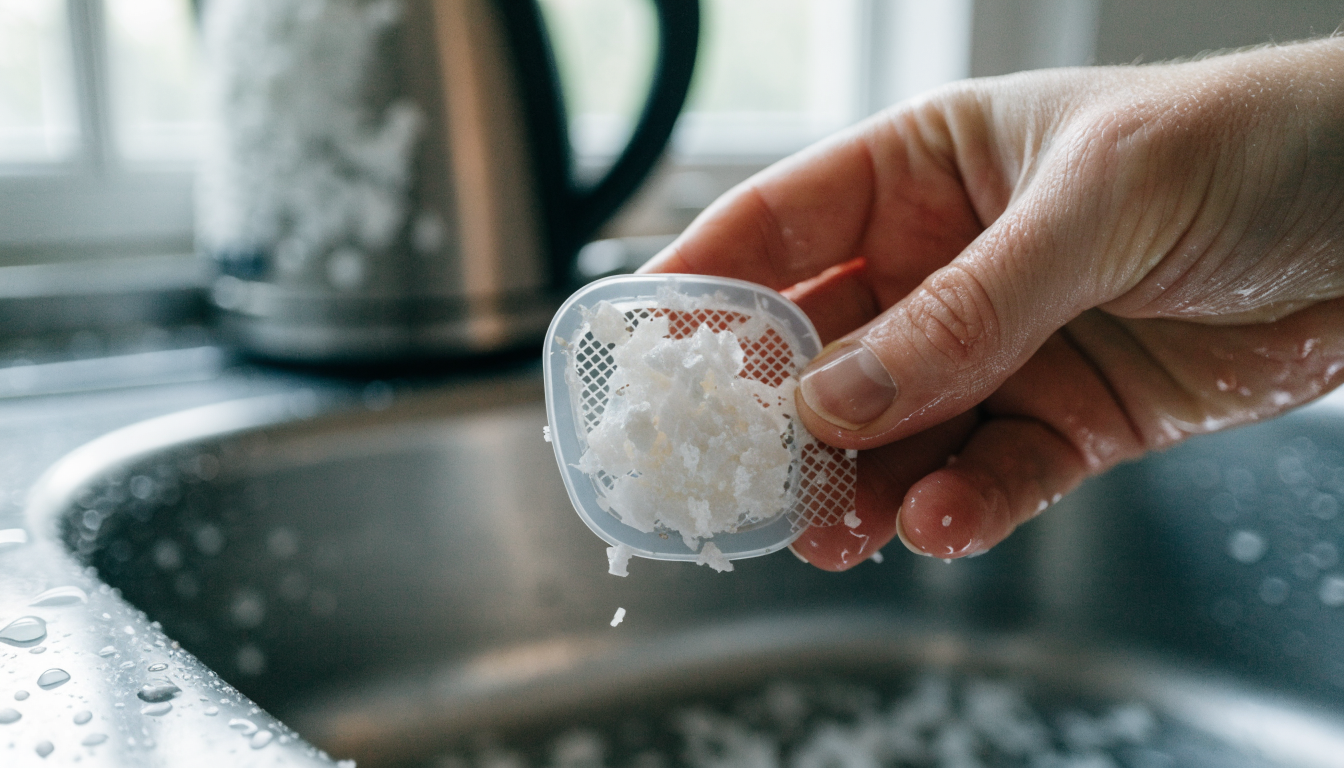
Three rinses is the number, and the reason is taste rather than safety. Residual acid will curdle the milk in a cup of tea and flatten the flavour of coffee, and leftover vinegar makes the whole kitchen smell for a day. Fill, swirl, tip, three times.
Then boil a full kettle of clean water and pour it down the sink. That last boil is doing two jobs: it drives off the last of the acid smell, and it catches the flakes of loosened scale that are still drifting about and would otherwise end up in the first cup. The spout filter catches most of them, which is exactly why you took it out and rinsed it first.
When descaling will not fix it
Descaling is the right answer often enough that people try it on faults that have nothing to do with scale. Here is where to stop.
- It still takes an age to boil after a clean descale. Scale on an element genuinely slows a kettle down, but if the base came up bright and it is still slow, you are looking at a failing element or thermostat rather than a deposit.
- It cuts out before it boils. Heavy scale can cause this by overheating the element, so one descale is worth trying. If it repeats on a clean kettle, the thermal cut-out is going and the kettle is finished.
- Brown or orange staining rather than white. That is iron or manganese from the supply, not limescale. Acid will lift some of it, but it will come straight back because the source is the water, not the kettle.
- Cloudy marks that shrug off acid. Etched or crazed plastic. Permanent.
- Weeping from the base or the handle joint. A failed seal. Replace it.
The stop line is the kettle body itself. A kettle is a sealed mains appliance and the element, thermostat and cut-out are a single non-serviceable assembly. There is nothing inside you are meant to open, replace or rewire. If a descale does not fix it, the job is a new kettle, and at the price of a kettle that is not a hardship.
How often to descale, by your water hardness
This is why the same kettle behaves completely differently in two houses. Water hardness in the UK is measured in milligrams per litre of calcium carbonate, and it varies enormously by region because it is set by the rock the water passes through. Chalk and limestone in the south and east give hard water. Granite and peat in the north and west give soft water.
Your own figure is not a guess. Every water company publishes hardness by postcode on its website, usually to the milligram, and it is worth two minutes of looking up because it settles the argument about whether your kettle is faulty or your water is just hard.
The other thing that speeds it up is habit. Boiling a full kettle for one mug and leaving the rest to cool means the same water gets heated repeatedly, and every heating cycle drops more carbonate out of it. Boiling only what you need genuinely slows the scaling down.
Preventing the scale instead of removing it
If you are descaling every fortnight, you do not have a kettle problem. You have a hard water problem, and the kettle is simply the bit of it you can see. The same water is depositing scale on your shower head, on your washing machine element and inside your boiler's heat exchanger, where you cannot pour vinegar on it.
There are four things people reach for, and they do markedly different amounts of work. It is worth being honest about which is which, because three of them are usually sold as if they were the fourth.
The collector ball is the cheap win
It costs very little, and unlike most of what gets sold as a limescale cure it is endorsed by the water companies themselves rather than only by the people selling them. It will not stop you descaling, but it stretches the interval and the scale it collects is scale that did not go on the element.
Best cheap prevention
KitchenCraft Le'Xpress Kettle Descaler Ball
- Coiled stainless steel mesh ball, sits loose in the kettle
- Scale forms on the wire in preference to the element and the base
- Reusable until it crusts over, then replaced
- Works in both concealed plate and exposed element kettles
Pros
- Costs very little and needs no maintenance at all
- Recommended by water companies, not just by retailers
- Noticeably stretches the interval between descales in hard water
Cons
- Does not remove hardness, it only gives the scale somewhere else to form
- Needs replacing once it has furred up, so it is a small recurring cost
- Rattles around in kettles with a very shallow flat base
Not a substitute for descaling and not sold as one. In a hard water kitchen it still earns its place easily, and it is the one preventative measure here with essentially no downside.
A filter jug helps the kettle and nothing else
Filter jugs are worth having if you do not like the taste of your tap water, and the scale reduction in the kettle is a real secondary benefit. What they are not is a softening solution, and it is worth being clear about that before you buy one expecting it to fix your shower screen.
Best for taste, not for hardness
BRITA Marella Water Filter Jug 2.4L
- 2.4 litre fridge-door jug supplied with a MAXTRA+ cartridge
- Ion exchange resin plus activated carbon in the cartridge
- Cartridge intended to be changed roughly every four weeks
- Reduces chlorine taste as well as some carbonate hardness
Pros
- Genuinely improves the taste of hard, chlorinated tap water
- Cuts the rate at which the kettle furs up
- Cheap to buy and needs nothing plumbed in
Cons
- Does nothing at all for the shower, washing machine or boiler
- Cartridges are a permanent running cost for as long as you use it
- Reduces scale rather than removing hardness, so the kettle still needs descaling
Buy it for the taste of your tea and treat the slower scaling as a bonus. If the reason you are reading this page is that your whole house is furring up, a jug is not the answer to that problem.
When the honest answer is a softener
I am not going to pretend a kettle justifies a water softener. A softener is a four figure decision once you include fitting, and it commits you to buying salt for as long as you own it. Nobody should spend that to save 28p of citric acid a fortnight.
The calculation changes when you add everything else up. In a very hard water area the same water is shortening the life of the washing machine and dishwasher elements, furring the shower, marking the glass, and coating the inside of the boiler's heat exchanger, which is the expensive one. That was the conversation I had across the counter more times than I can count: someone came in for a replacement shower head, and the real problem was the water feeding it.
If you want the numbers rather than the sales pitch, our honest look at whether a water softener is worth it works through the running costs and the cases where the answer is no. If you are weighing up the cheaper alternative first, water conditioners versus water softeners explains exactly what you do and do not get for the lower price, and our water softener buying guide covers what is actually worth fitting in a UK house.
One practical note if you do go that way. Water companies advise keeping a separate unsoftened tap for drinking and cooking, because softened water carries added sodium. That means your kettle can still be fed hard water by choice, and still need descaling.
Is limescale in your kettle bad for you?
No. Dissolved calcium carbonate in UK drinking water is not a health hazard, and Thames Water say as much on their own hard water page: the minerals in hard water are not considered harmful. The flakes floating in your tea are unappetising, not dangerous.
Descale your kettle because scale insulates the element, makes it slower and more expensive to boil, shortens the kettle's life and puts grit in your drink. Anyone selling you water treatment on health grounds is selling you something on a claim that does not hold up.
Frequently asked questions
Can I use bicarbonate of soda to descale my kettle?
Not effectively. Bicarbonate of soda is alkaline and limescale only dissolves in acid, so bicarb can scrub loose flakes off a surface you can reach but cannot dissolve the deposit. Mixing it with vinegar makes things worse, because the two neutralise each other and you lose the acid you needed.
How do you descale the inside of a kettle?
Half fill it with 50/50 white vinegar and water, or a litre of water with a heaped tablespoon of citric acid. Boil once, leave it to stand for thirty minutes to an hour, pour it away, rinse three times, take the spout filter out and rinse that separately, then boil a full kettle of fresh water and throw it away.
Does boiling vinegar in a kettle get rid of limescale?
Yes. Acetic acid dissolves calcium carbonate, and heating speeds the reaction up considerably. The mistake is boiling it and pouring it straight out. Most of the work happens during the soak afterwards, so switch the kettle off and leave the hot vinegar sitting on the scale.
How do I remove heavy limescale from my kettle?
Use a stronger acid and a much longer contact time rather than more scrubbing. Two heaped tablespoons of citric acid in a litre of water, boiled once and left overnight, will shift a crust that a thirty minute vinegar soak barely touches. Repeat rather than scrape, because scratching the element or a glass body causes lasting damage and gives future scale something to grip.
What is the easiest way to descale a kettle?
A pre-measured descaler sachet, because there is nothing to weigh or dilute: tip it into half a kettle of hot water and wait. It costs roughly double what the same descale costs in citric acid, which for two or three descales a year is a fair trade for not thinking about it.
What dissolves thick limescale?
Any acid will, given enough concentration and time: citric, acetic, sulphamic, lactic and formic acids are all used in descalers. Citric acid powder is the cheapest way to get a strong solution at home. Outside the kettle the choice matters more, because the aggressive descalers will mark chrome, aluminium, natural stone and some enamels.
Related guides
- Best limescale remover: which acid is in which product, and what each one will damage outside the kettle.
- Best water softeners: what is genuinely worth fitting in a UK house if the kettle is only the start of it.
- Best water conditioners: the cheaper alternative, and an honest account of what it does and does not do.
- Water softener salt: the running cost nobody mentions before you buy the softener, priced per kilo.
- How to soften hard water: every method from jug to whole-house system, compared.


0 Comments