

As an Amazon Associate I earn from qualifying purchases.
Most water softener guides are five machines with a paragraph of manufacturer copy underneath. This one is different in three specific ways, and they happen to be the three things that actually decide what a softener costs you.
The salt. Feeding a softener costs between £50 and £390 a year depending on which machine you buy. Over fifteen years that gap is bigger than the price of the softener. Almost nobody tells you this before you buy.
The warranty small print. One of the most widely recommended UK ranges carries a seven year parts warranty that is conditional on paying the manufacturer for annual servicing, at £150 a year.
The price spread. The same softener, the same week, sells for £592 from one retailer and £740 from the manufacturer's own shop. A £148 difference on an identical box.
I spent 16 years running plumbers merchants across the south of the UK, then a couple more with an independent merchant. Most of what follows is what I would have told you across the trade counter. Prices were checked on 15 September 2026 and will drift, so treat them as a guide to the gaps between retailers rather than as today's till price.
At a glance
- Best for most households (up to 5 or 6 people) Monarch Midi HE
- Best for a tight cupboard or a small flat Monarch Mini Aqua HE
- Best for six or more people Monarch Master HE
- Best non-electric Monarch Dual Power Ultra
- Best if you can stretch to it Harvey TwinTec S4, for the warranty terms and the 205mm width
- The one to think twice about BWT WS355, the most-sold unit in the UK and the tightest on flow rate
How they compare
| Product | Best for | Peak flow | H x W x D (mm) | Salt | Warranty | Buy |
|---|---|---|---|---|---|---|
Small spaces Monarch Mini Aqua HE | 1 to 3 people | 83 L/min | 485 x 270 x 480 | Tablet or block | 7yr parts, conditional | Check price on Amazon |
Best overall Monarch Midi HE | Up to 5 or 6 | 78 L/min | 555 x 275 x 485 | Tablet or block | 7yr parts, conditional | Check price on Amazon |
Larger homes Monarch Master HE | Up to 7 | 78 L/min | 710 x 275 x 485 | Tablet or block | 7yr parts, conditional | Check price on Amazon |
Non-electric option Monarch Dual Power Ultra | 1 to 10 | 65 L/min | 557 x 269 x 489 | Tablet or block | 7yr parts, conditional | Check price on Amazon |
Monarch Matrix HE | Very large homes | 75 L/min | 1038 x 275 x 485 | Tablet or block | 7yr parts, conditional | Check price on Amazon |
BWT WS355 | Budget, one bathroom | 30 L/min | 602 x 270 x 480 | Tablet or block | Check with retailer | Check price at Screwfix |
Best warranty terms Harvey TwinTec S4 | Up to 6 | 56 L/min | 490 x 205 x 440 | Block only | 10yr parts, unconditional | Dealer price |
What a softener actually costs to run
This is the section that should change your mind about which machine to buy, so it comes before the recommendations rather than after them.
A family of four uses roughly 125 kg of salt a year. That figure is EcoWater's own published number, and it agrees with the arithmetic from Monarch's install guide, which gives the Midi HE a capacity of 2,280 litres at 300 ppm and uses 1.0 to 1.7 kg per regeneration. At typical UK household consumption that is about 91 regenerations a year, so 91 to 155 kg. Two independent methods landing in the same place is about as solid as this gets.
Here is what those 125 kg cost depending on the format your machine takes.
| Salt route | Cost per kg | Cost per year |
|---|---|---|
| 25kg tablet, bought as a pallet of 40 | £0.40 | £50 |
| 25kg tablet, bought in single bags | £0.64 | £80 |
| Spectrum block salt | £1.19 | £149 |
| Harvey block salt, direct | £1.20 | £150 |
| BWT block salt | £1.62 | £203 |
| Kinetico branded block salt | £3.12 | £390 |
There is no chemical difference between the two. The Water Softener Centre, which sells both formats, puts it plainly: there is no difference between brine made from block salt and brine made from tablet salt. The difference is packaging. Tablet salt comes in 25kg bags and on pallets, which is why it is cheap. Block salt comes in pairs of moulded blocks, which is why it is not. There is a fuller breakdown in the water softener salt guide, including how much you actually need and where it works out cheapest.
So buying a block-only machine, which means anything from Harvey or Kinetico, commits you to roughly £70 to £100 a year more in salt for the life of the softener. Over fifteen years that is £1,050 to £1,500, which is comparable to the price of the machine itself. That does not make them bad softeners. It does mean the sticker price is not the price.
Electricity and water
No manufacturer publishes a wattage for any of these units, which is worth saying rather than inventing a figure. Almost all the consumption is standby for the display and flow meter rather than the regeneration motor. At roughly 3W continuous that is about 26 kWh a year, or £6.92 at the current cap. The motor itself works out at around 14p a year.
Which means the real argument for a non-electric softener is that there is no transformer to fail, not that it saves you money. The saving is under £7 a year.
Water use varies more than you would expect. The Kinetico Premier Compact uses 21 litres per regeneration. The BWT WS355 uses up to 80. On a metered supply that is roughly £8 a year against £27. On an unmetered supply it costs you nothing at all.
| Lean | Typical | Expensive | |
|---|---|---|---|
| Salt | £50 | £80 | £390 |
| Water | £0 unmetered | £8 to £27 | £27 |
| Electricity | £0 | £2 to £7 | £7 |
| Servicing | £0 | £0 | £150 |
| Total per year | £50 | £90 to £114 | £574 |
About £90 to £115 a year for a family of four, and it is the salt that decides the number, not the electricity or the water.
Read the warranty before you read the spec sheet
Monarch's seven year parts and two year labour warranty is, in Monarch's own wording, subject to annual servicing charges by Monarch. Their service plan is £12.50 a month, so £150 a year. Over seven years that is £1,050 of servicing to protect a softener that cost around £670.
By contrast the Harvey TwinTec S4 carries ten years on parts and two on labour with no stated servicing condition attached.
So the cheaper machine has the worse warranty terms and the premium machine has the better ones, which is the opposite of what you would assume. I have not seen this published anywhere else, and it is the single strongest argument for spending more. Whether you take the service plan is your call. A softener is not a complicated machine and plenty of people run one for a decade without a service. But you should know that declining it changes what the seven years means.
The recommendations
A note on why this list leans heavily on one brand. Monarch dominate what is actually buyable online in the UK at sensible prices, with published specs and a consistent installation kit. The alternatives are either sold quote-only through dealers, which makes them impossible to recommend to someone who wants to order one this week, or they are budget units with real compromises. Where that is the case I have said so.
Best for most households: Monarch Midi HE

#1 Best overall
Monarch Midi HE
- Suitable for households up to 5 or 6 people
- 555 x 275 x 485mm, fits a standard 600mm cupboard
- 2,280 litres capacity at 300 ppm
- 78 litres per minute peak flow
- Takes standard tablet or block salt
- WRAS approved
Pros
- Highest flow rate of anything at this size, so two showers at once is not a problem
- Takes cheap tablet salt, so about £50 to £80 a year to run
- Genuinely fits a standard kitchen cupboard, which many do not
Cons
- The 7 year parts warranty is conditional on Monarch servicing at £150 a year
- 485mm deep, so measure your clear internal depth before ordering
- Needs a pressure limiter on mains above 3.5 bar static, which is an extra part
The right default for a typical UK family home. It has the flow rate for a busy bathroom, it fits where it needs to fit, and it runs on the cheap salt. Just go in knowing what the warranty actually requires.
At the time of checking this sells for around £670 from Water Softener Direct, and it is worth comparing that against Amazon and Bathquest before you order, because the spread on Monarch units between retailers is routinely £50 or more.
Read the full Monarch Midi HE review.
Best for a tight cupboard: Monarch Mini Aqua HE

Best for small spaces
Monarch Mini Aqua HE
- Suitable for 1 to 3 people
- 485 x 270 x 480mm
- 1,471 litres capacity at 300 ppm
- 83 litres per minute peak flow, the highest here
- Takes standard tablet or block salt
- WRAS approved
Pros
- Shortest unit in the Monarch range, so it clears a low worktop
- Surprisingly high flow rate for the size
- Same cheap salt as the rest of the range
Cons
- Small capacity means it regenerates often, and in a very hard water area that pushes salt use up
- Still 480mm deep, which is the dimension that usually causes the problem
- Same conditional warranty as the rest of the range
Right for a flat, a couple, or a small household where the constraint is height rather than depth. If there are more than three of you, size up rather than making this one work harder.
Read the full Monarch Mini Aqua HE review.
Best for six or more people: Monarch Master HE

Best for larger homes
Monarch Master HE
- Suitable for up to 7 people
- 710 x 275 x 485mm
- 3,420 litres capacity at 300 ppm
- 78 litres per minute peak flow
- Takes standard tablet or block salt
Pros
- Capacity to keep up with two bathrooms in constant use
- Same flow rate as the Midi, so no penalty for going bigger
- Runs on cheap tablet salt
Cons
- At 710mm tall it will not go under a standard worktop, so it needs floor or garage space
- Oversizing is a real risk: a unit that regenerates rarely is more prone to salt bridging
- Conditional warranty, as with the rest of the range
Buy this because you genuinely have six or more people or two bathrooms running at once, not because bigger feels safer. An oversized softener is a softener that sits with damp salt in it for weeks at a time.
Best non-electric: Monarch Dual Power Ultra
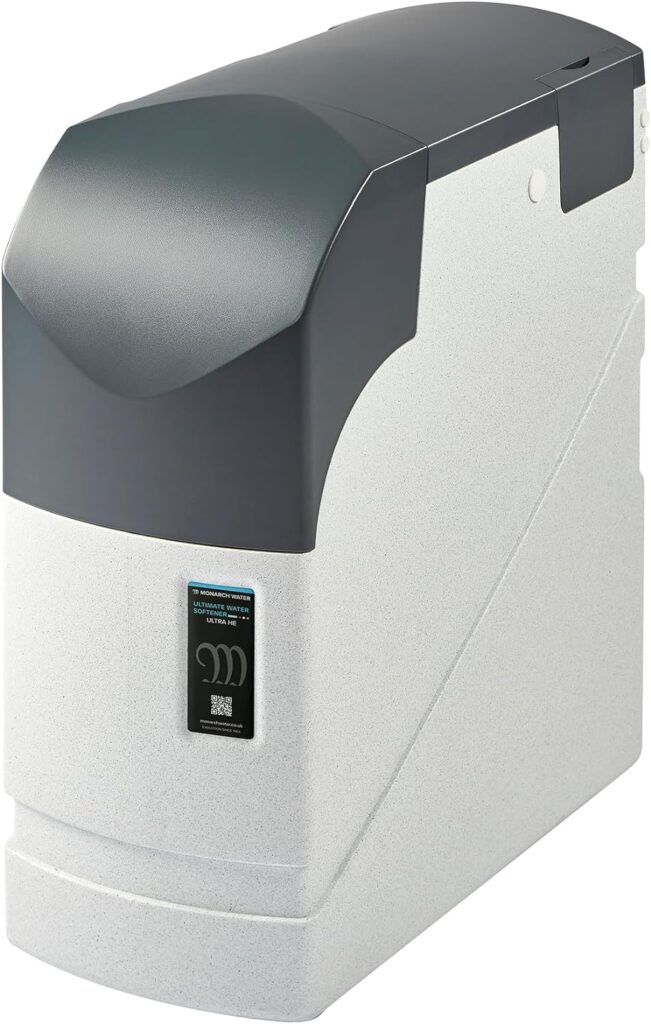
Monarch Dual Power Ultra
- Runs on a 9V battery or on the mains
- Suitable for 1 to 10 people
- 557 x 269 x 489mm
- 1,520 litres capacity at 300 ppm
- Takes standard tablet or block salt
- Supplied for 28mm supplies
Pros
- No transformer to fail, which is the genuine reason to buy non-electric
- Falls back to battery if the mains supply is interrupted
- Standard salt, so cheap to run
Cons
- The electricity saving is under £7 a year, so do not buy it for the running cost
- Capacity is modest for the headline household range quoted
- Conditional warranty, as above
Worth it if your softener is going somewhere without a convenient socket, or if you have had a transformer die on you before. Not worth it for the energy bill, because there is barely one to save.
The most-sold unit in the UK, and why I would think twice: BWT WS355
This is the softener Screwfix sells more of than any other, which makes it the default choice for a lot of people, so it deserves a straight answer rather than being left off the list.
It is a competent machine and it fits a standard 600mm cupboard. The problem is flow. Peak flow is 30 litres per minute, continuous is 25, and at one bar of pressure loss it is 26. Every other unit on this page is between 51 and 83. That is fine for a single bathroom. It is marginal the moment someone runs a shower while the washing machine fills.
The other thing worth knowing is the price spread. At the time of checking it was £592.04 at Trading Depot, £599.00 at Screwfix, and £740.61 from BWT's own online shop. Identical unit, same week, a £148 gap. Buying direct from the manufacturer is the most expensive way to get it, which is not what most people would assume.
Buy it if you have one bathroom and a tight budget. If two outlets ever run at once, spend the extra on the Midi.
Worth paying more for: Harvey TwinTec S4
At around £1,149 supply-only from West London Water Softeners, this is nearly double the price of the Midi. Three things justify it.
- Ten years on parts, with no servicing condition attached. Given what Monarch's warranty requires, that gap is worth real money.
- 205mm wide. That is the narrowest softener you can buy in the UK, and it fits places nothing else will.
- 1 to 10 bar pressure tolerance. Everything else here wants between roughly 1.5 and 5 or 6. A lot of UK mains run at 4 to 6 bar, which means the cheaper units need a pressure limiter fitted and this one does not.
The catch is the salt. It takes block only, so budget £150 a year rather than £50 to £80. Over the life of the machine that erodes a good chunk of what the warranty saves you.
One point of confusion worth clearing up: the fifth generation model is widely sold as the "TwinTec S5". Harvey call it the TwinTec Cobalt. S5 is a dealer name, not a manufacturer one. The Cobalt and the Arc also require Harvey's own proprietary curved salt, which narrows your supply to a single company. The S4 takes standard block, which is one reason it is the one I would buy.
How to size one properly
Manufacturers quote capacity at 300 ppm. If your water is harder than that, and in large parts of the south east it is, your real capacity is lower. Correct it like this:
Real capacity = quoted capacity x (300 ÷ your local hardness in mg/L)
Worked example. A family of four uses about 568 litres a day. A Monarch Midi HE at 2,280 litres regenerates every four days. Move that same household to Braintree, where the water measures 416 mg/L, and the effective capacity drops to 1,644 litres. It now regenerates every 2.9 days, and salt consumption rises by 39 per cent.
So the same machine in the same size house costs meaningfully more to run depending on your postcode. Get your hardness figure from your water company before you choose a capacity.
| Classification | Hardness (mg/L) |
|---|---|
| Soft | Under 60 |
| Moderately soft | 60 to 120 |
| Slightly hard | 120 to 180 |
| Hard | 180 to 200 |
| Very hard | 200 to 400 and above |
The hardest figures I could verify: Braintree CM7 at 416 mg/L, Sunderland SR6 at 413, Great Yarmouth NR30 at 348, Nottingham at 341 and Cambridge CB1 at 330.
Bigger is not safer
It is tempting to oversize for headroom. Do not. A softener that regenerates rarely leaves salt sitting damp in the cabinet for long stretches, and that is exactly the condition that causes salt bridging, where a crust forms across the brine tank, the unit looks full, no brine is actually made, and your water quietly goes hard again without any warning light.
Will it actually fit?
This is where most installs come unstuck, and it is not the dimension people check.
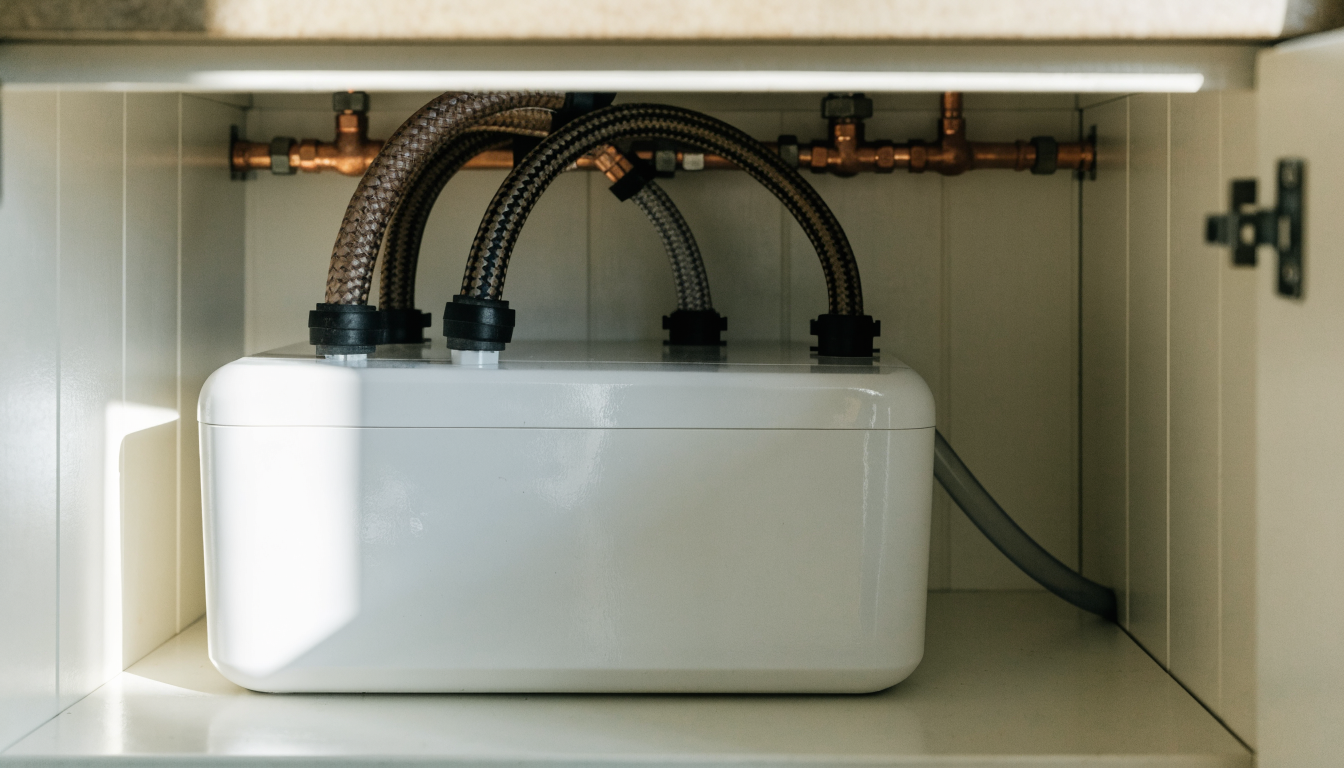
Depth kills these installs, not width. A 485mm deep unit in a standard 600mm carcass leaves you under 120mm for the hoses, the drain line and the bypass valve, and hoses need a bend radius. Measure the clear internal depth of the cupboard, from the back wall to the inside of the door, and subtract for any pipework already running down the back.
| Model | H x W x D (mm) | Under a worktop? |
|---|---|---|
| Harvey TwinTec S4 | 490 x 205 x 440 | Yes, the narrowest available |
| Kinetico Premier Compact | 498 x 219 x 468 | Yes |
| Monarch Mini Aqua HE | 485 x 270 x 480 | Yes, but deep |
| Monarch Midi HE | 555 x 275 x 485 | Tight |
| BWT WS355 | 602 x 270 x 480 | Fits a standard 600mm cupboard |
| Monarch Master HE | 710 x 275 x 485 | No |
| Monarch Matrix HE | 1038 x 275 x 485 | No, floor standing |
The five installation mistakes I saw most often
- Filling the heating circuit with soft water. This is the expensive one. Worcester Bosch state it plainly: the central heating circuit should be filled with hard water and a chemical inhibitor, using the softener bypass when filling or topping up. Get this wrong and you can be arguing about a boiler warranty. BS 14743 requires the bypass valve that makes it possible, so the valve is there. Use it.
- Buying the wrong hose kit. The same softener is sold as separate part numbers for gravity-fed versus pressurised and unvented systems, with different hoses. Ordering the gravity kit for a combi or an unvented cylinder is a common and annoying mistake. Check which system you have before you order, not after.
- No pressure limiter on high mains. Monarch specify 1.5 bar dynamic minimum and 3.5 bar static maximum, and their own guide recommends a 5 bar limiter. Plenty of UK mains run at 4 to 6 bar, so that is an unbudgeted extra part on a lot of installs.
- A dipped, kinked or over-long drain run. You need a minimum 20mm air gap, no dips, and no more than a 4 metre run on the supplied 2.5 metre hose before you go to 22mm copper. WRAS requirement R510 calls for a type AA or AB air gap to BS EN 1717, and R160 requires category 3 backflow protection.
- No separate hard water tap. The British Water Code of Practice recommends keeping one unsoftened tap for drinking and cooking. There is a proper reason for this, below.
Is softened water safe to drink?
For most people in most of the country, yes. But there is a real limit and it is worth doing the arithmetic rather than repeating the usual vague warning.
Ion exchange softening adds roughly 46 mg/L of sodium for every 100 mg/L of hardness it removes. The UK drinking water standard for sodium is 200 mg/L.
- At 300 mg/L hardness, softening adds about 138 mg/L of sodium.
- At Braintree's 416 mg/L, it adds about 191 mg/L, before you count the 20 to 40 mg/L the source water already contains.
In the hardest parts of the country that total goes past the standard. To be clear about where this comes from, that is my arithmetic from two published rates rather than a figure anyone has published as a finding, so treat it as an order of magnitude rather than a lab result. But it is the proper explanation of why the separate drinking tap exists, and it is why fitting one is not optional in a very hard water area.
Softened water should not be used for making up infant formula, and it is not suitable for anyone on a medically prescribed low-sodium diet. If that applies in your household, keep the hard tap and use it.
The two brands you cannot simply order online
Harvey and Kinetico are the two names that come up most in conversation and the two that are hardest to price, because both are sold mainly through dealers on a quote basis. That is genuinely awkward if you just want to know what something costs, so here is what is publicly published.
- Harvey TwinTec S4: around £1,149 supply-only, published by West London Water Softeners.
- Kinetico Premier Compact: around £1,695 supply-only or £2,170 fitted, published by Aquasoft UK.
The Harvey Arc, HVX and Big Blue, Kinetico's direct sales, and EcoWater's UK range are all quote-only with no published price I could find.
Kinetico is a well-built softener and uses far less water per regeneration than most, at 21 litres. It also takes block salt only, and Kinetico's own branded block is the most expensive salt on the market at roughly £3.12 per kg, which works out at around £390 a year. You do not have to buy their branded salt, but you do have to buy block.
What goes wrong over time
- Salt bridging. A crust forms across the brine cabinet. The unit looks full, makes no brine, and your water goes hard without any alarm. Most common with tablet salt in a damp cupboard and with an oversized unit.
- Salt mushing. Fine salt recrystallises into a sludge that blocks the brine draw. More likely with cheap low-purity salt, which is one place where the very cheapest option is a false economy.
- Resin fouling. Chlorine degrades the resin and iron or manganese foul the bed. Expect around ten years from a resin bed. I could not verify a typical UK replacement cost, so I am not going to guess at one.
Installation costs
Two companies publish a fixed price: BWT at £360 for their own units in selected areas, and Aquasoft at £475 for a Kinetico. The aggregator sites give wider ranges, with Checkatrade quoting around £350, MyJobQuote £150 to £600 and MyBuilder £150 to £300.
If you are getting quotes, the things that move the number are how far the softener is from the rising main, whether there is a drain within reach, and whether a hard water tap needs running to the kitchen sink.
The cheaper alternatives, and what they actually do
Having seen those numbers, it is reasonable to ask whether something cheaper will do instead. The honest answer is that nothing in the list below softens your water, and it is worth being clear about what each one is genuinely for before you spend money expecting a different outcome.
| Method | What it genuinely does | What it will not do |
|---|---|---|
| Boiling the water | Drops temporary hardness out of solution as the scale you then find in the kettle | Anything at all for the water at every other tap in the house |
| Bicarbonate of soda | Works as a mild cleaning agent and helps lift scale off surfaces | Reduce the hardness of the incoming supply |
| White vinegar or citric acid | Dissolves limescale that has already formed on kettles, shower heads and taps | Prevent any new scale; these are descalers, not treatments |
| Shower head with a filter | Reduces some of what reaches you at that one outlet | Protect the boiler, the cylinder or the washing machine |
| Jug filter | Improves taste and cuts chlorine | Make any meaningful difference to hardness |
| Washing machine tablets | Protect the element in that machine from scale | Treat anything beyond the machine itself |
Of that list, the washing machine additive is the only one worth buying on repeat. It protects the element in the appliance where scale does expensive damage fastest, and it costs a small fraction of a softener. It is not a replacement for one, and the packaging describing it as a water softener is marketing rather than chemistry, but as cheap insurance on a machine in a hard water area it earns its place.
Check washing machine tablet price on AmazonRemoving the scale you already have is a different job from stopping more of it forming. If your problem is still confined to a kettle and a shower head, deal with it directly using the right descaler for the surface or the method for descaling a kettle, and keep the softener money in your pocket until hard water starts costing you in appliances rather than in effort.
Frequently asked questions
How often does a water softener need servicing?
Mechanically, most units will run for years without one. The catch is that Monarch's parts warranty is conditional on annual servicing by Monarch at £150 a year, so with that range it is a warranty question rather than a mechanical one.
How long does a water softener last?
Ten to fifteen years is realistic, with the resin bed usually the first thing to go at around the ten year mark. More on softener lifespan, servicing and salt use here.
Block salt or tablet salt?
Whichever your machine takes. There is no chemical difference in the brine produced. If your softener accepts both, use tablet: it is roughly half to a third of the price per kilo. Only buy block if the machine requires it, which in practice means Harvey and Kinetico. Full guide to water softener salt here.
What is the difference between a water softener and a water conditioner?
A softener removes calcium and magnesium by ion exchange, which genuinely changes the water. A conditioner alters how the minerals behave without removing them, so the water is still technically hard. Conditioners are cheaper and need no salt, drain or power, but they do not deliver the soap lathering or the scum-free bath that people usually want from softening. Full comparison here.
Is a water softener worth it?
In a genuinely hard water area, for most households, yes, on the basis of appliance life and the time you get back from descaling. In a soft or moderately soft area it is hard to justify. The longer answer is here.


0 Comments