
As an Amazon Associate I earn from qualifying purchases.
Most of the time, a bathroom extractor fan that is "not working" is working. It comes on, it makes its usual noise, and it moves almost no air. The householder judges the fan by the sound, which is the one test that tells you nothing at all.
This page is the diagnosis, not the shopping. It starts from what you can actually observe, because the fix for a fan that hums without turning has nothing in common with the fix for a fan that spins happily while the mirror stays fogged. Three things are worth saying before you go any further.
- A fan that spins is the commonest fault on this list, and the most misdiagnosed. People replace a perfectly good fan because the room still steams up, when the actual problem is two metres of crushed duct in the loft.
- The law here is narrower than nearly every page tells you. Swapping a dead fan for the same fan is a replacement, and replacements are not notifiable work anywhere in the house. The exact wording is further down, quoted rather than paraphrased.
- A fan choked with dust can usually be brought back. Not always, but often enough that cleaning it properly should come before buying anything.
If yours is in a separate WC rather than a bathroom, nothing below changes. The fan, the duct, the switching and the rules are the same. The only difference is the extract rate the room was designed around, and that only matters when you come to replace it.
Start here: what is your fan actually doing?
Switch it on and watch it for thirty seconds. Then find your symptom in the panel below and go straight to that section. Working through the whole page in order is a waste of your evening.
Nothing happens at all: the power chain
Silence means the motor is not being fed. There are four places that supply can be interrupted, and they are worth checking in this order because that is roughly the order of how often each one is the answer.
1. The isolator switch, which is probably not in the bathroom
Almost every UK bathroom fan is fed through a three pole fan isolator, a small switch that breaks live, neutral and the switched live together so the fan is genuinely dead when it is off. It exists so the fan can be worked on safely, and it is the single most common reason a fan stops for no apparent reason.
It will not be next to the fan. Look for a ceiling pull cord just inside the bathroom door, or a small white rocker switch on the landing wall immediately outside the door. In houses where the fan is in the loft it is often on a joist up there. Decorators knock these off constantly, and so does anyone who mistakes it for a light switch.
2. The fuse in the fused spur, and why people buy the wrong one
Most fans are fed from a fused connection unit, usually called a fused spur, and that fuse is typically 3A. It is a consumable. It blows, and when it blows the fan is silent and everything else in the room carries on as normal, which is why people assume the motor has died.
Here is the part that catches people out, and it caught people out at the trade counter often enough to be predictable. The fuse in a fused spur is a BS 1362 cartridge fuse: ceramic, roughly 25.4mm long and 6.3mm across, physically identical to the fuse inside a 13A plug and just rated lower. Search online for "3 amp fuse" and a large share of what comes back is a 20mm x 5mm glass fuse, which is a different standard for shaver sockets and appliances. It will not fit the carrier. If you are buying spares, buy 3A BS 1362 ceramic fuses, or simply take the blown one to a merchant and match it.
One honest caveat. A fuse that blows once is a fuse. A fuse that blows again within days is telling you something is wrong downstream of it, and fitting a bigger fuse to stop it happening is how small faults become serious ones. That is the point at which you stop and call someone.
3. The light switch, if the fan is wired from the lighting circuit
A great many fans take their switched live from the bathroom light. If the light has stopped working as well, you have a lighting circuit fault rather than a fan fault, and the fan is an innocent bystander. That is a useful thing to establish in five seconds before you take a fan apart.
4. The breaker at the consumer unit
Check whether the breaker feeding that part of the house has tripped, and check the RCD as well as the individual breakers. A fan motor failing can take the circuit out with it, so a tripped breaker is sometimes the symptom rather than the cause. If it trips again immediately after you reset it, leave it off and get an electrician in.
It hums but the blades do not turn
A hum is good news in one narrow sense: power is arriving. The motor is energised and cannot turn, which points at one of three things.
- The impeller is physically jammed. Felted dust bridging the gap between the blade tips and the housing, or something that has worked its way in from the duct. Cut the power at the isolator, take the cover off, and see whether the impeller turns freely by hand.
- The backdraught shutter is fouling the blades. On some units the shutter flap sits close to the impeller and can distort or come adrift enough to catch it.
- The bearings have seized. If the impeller will not turn by hand with the power off, and there is nothing obstructing it, the motor has gone. This is where the fan gets replaced rather than repaired, because the bearings in a domestic axial fan are not a serviceable part and the motor is most of the cost of the unit.
A burning or hot plastic smell alongside the hum means stop. Switch it off at the isolator and leave it off.
It spins, but nothing is being extracted
This is the one. It is the most common real fault, it is the one people misdiagnose most often, and it is the one where a new fan is usually money wasted, because the new fan will do exactly what the old one did.
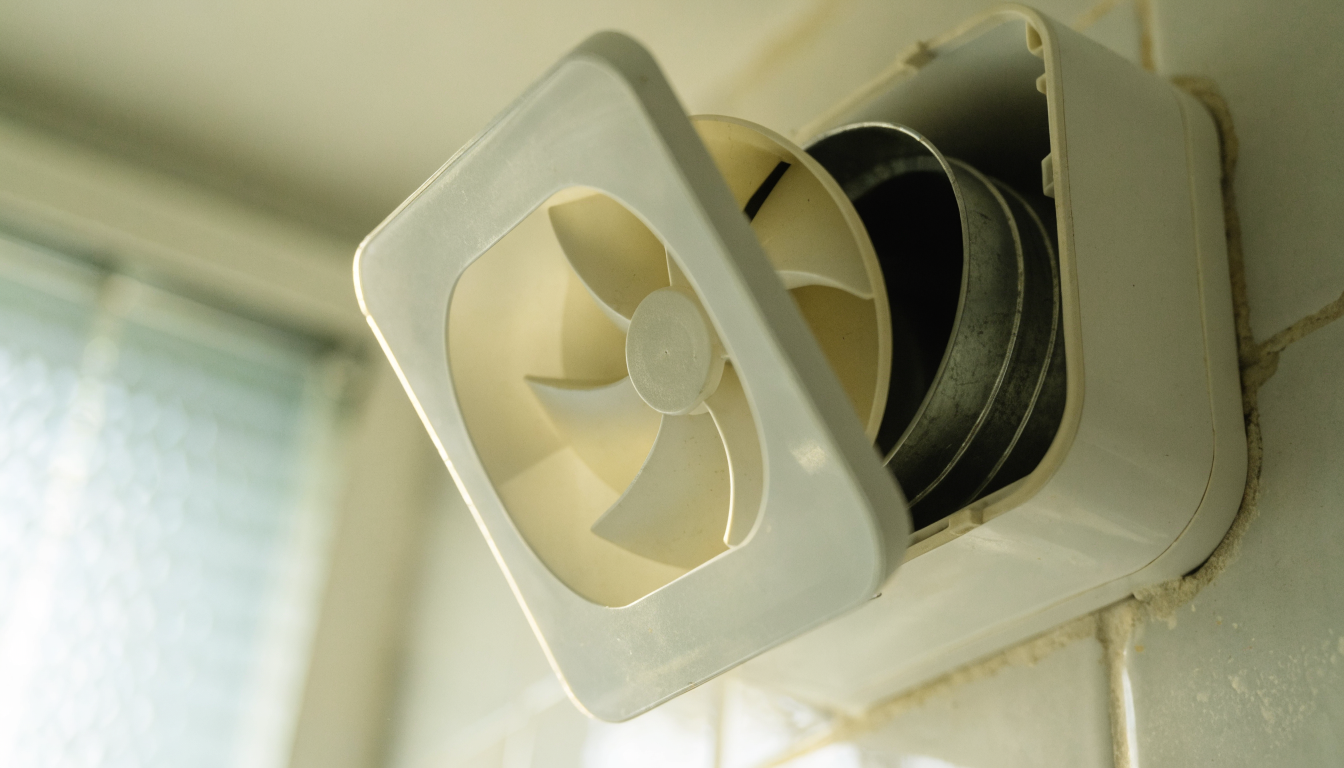
Before you touch anything, confirm the fan is genuinely moving no air. Then work out where the air is being stopped. Those are two different jobs and doing them in that order saves you taking a working fan off the wall.
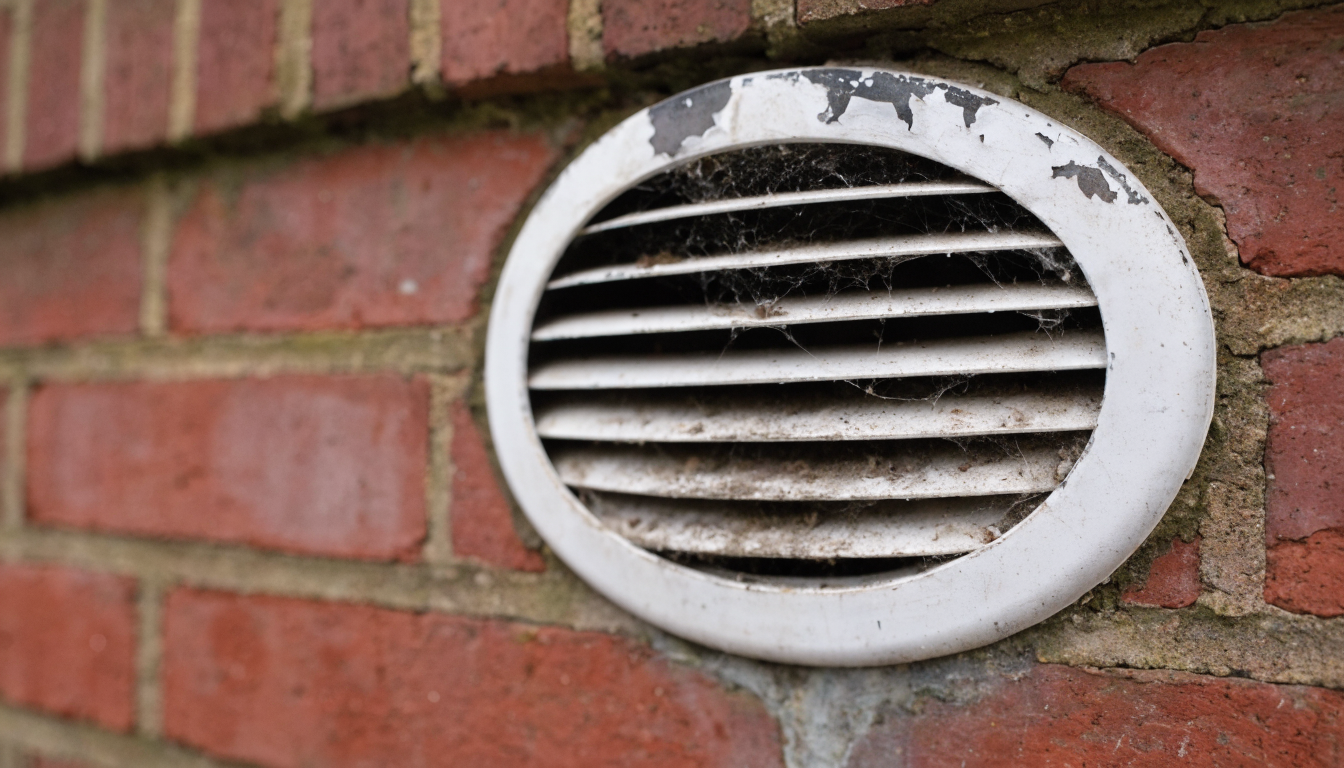
There is one more possibility, and it is the one that cannot be cleaned away. A standard axial fan, the flat square unit that sits directly on the wall or ceiling, produces very little pressure. It is designed to push air through a short, straight duct. Give it a long run, or several bends, or a sagging concertina of flexible duct, and it will spin at full speed and deliver almost nothing. No amount of cleaning fixes that, because it is not a fault, it is the wrong fan for the duct. The bathroom extractor fan buying guide sets out where an axial fan stops coping and an inline or centrifugal fan takes over.
If the duct itself is the problem, replacing a crushed run is genuinely worth doing and needs no electrical work at all. Keep the run as short and as straight as you can, pull the flexible duct taut rather than leaving it concertinaed, and clip it at both ends. A slack duct loses a surprising amount of airflow to its own ribbing.
It runs constantly and will not switch off
Three causes, and two of them are settings rather than faults.
- The overrun timer is set long. Timer models have a small adjustment, usually a rotary dial or a set of DIP switches on the circuit board behind the cover, and it is often left at the factory maximum. If your fan runs for twenty minutes after you leave the room, that is the timer doing exactly what it was set to do.
- The humidistat is set too sensitive. A humidistat model compares room humidity against a threshold. Set the threshold low, or hang wet washing in the room, or run it through a damp winter in a north-facing bathroom, and the fan will treat normal background humidity as a reason to run. Turning the sensitivity down is usually all that is needed.
- The timer or humidistat module has failed. If the fan runs continuously regardless of where the adjustment is set, the control board has gone. On most domestic fans that module is not separately available, so this ends as a replacement.
Worth saying plainly: a fan that runs on for a few minutes after you leave is not broken, it is doing the most useful part of its job. The steam is still in the room after you have gone.
It works, but it has got noisy
The character of the noise tells you which fault it is.
- A dry rattle or grinding that rises and falls with the fan speed is the bearings. That is terminal, and the fan is on borrowed time.
- A drone or buzz you can feel in the wall is usually loose fixings, or a fan screwed hard against a hollow plasterboard wall that is acting as a soundboard. Easing the fixings and bedding the unit properly often removes it entirely.
- An intermittent clatter, especially on a windy day is the backdraught shutter, either the internal one or the louvres on the outside grille. A weighted or gravity-type external cowl is quieter than cheap plastic louvres.
- A rhythmic wobble or thump is an unbalanced impeller, which is nearly always dust built up unevenly. Clean it before you condemn it.
It only comes on with the light
This is not a fault and there is nothing to fix. The fan has been wired so that its switched live comes from the light switch, which is the cheapest way to install one and extremely common in UK housing.
It is worth understanding why it is a poor arrangement, though, because it explains a lot of complaints about fans that "do not work". A light-switched fan runs whenever anyone uses the room, including for thirty seconds in the middle of the night, and stops the moment the light goes off. The one time you genuinely need extraction is immediately after a shower, when the light is usually the first thing switched off on the way out. So the fan runs constantly when there is nothing to extract and stops exactly when there is.
A timer model fixes that by continuing to run after the light goes off. A humidistat model fixes it by responding to the steam rather than the switch. Either is a better answer than the fan you have, but both involve changing the fan, not repairing it.
Where this stops being a job you can do
This is the part most pages get wrong in both directions. Some tell you that any electrical work in a bathroom is illegal without an electrician, which is not what the regulations say. Others wave it away entirely. The actual position in England is written down, and it is worth quoting rather than summarising.
Part P of the Building Regulations covers electrical safety in dwellings. Regulation 12(6A) sets out which electrical work is notifiable, meaning you must either use a registered competent person who can self-certify it, or give a building notice to your local authority building control before starting. The work that is notifiable is:
(a) the installation of a new circuit; (b) the replacement of a consumer unit; or (c) any addition or alteration to existing circuits in a special location.
The phrase that does the work there is special location, and it does not mean the room. The regulations define it as the space around a bath tap or shower head, extending from floor level up to 2.25 metres, and horizontally 0.6 metres from the edge of the bath or shower tray, or 1.2 metres from the shower head where there is no tray. A room containing a swimming pool or sauna heater also counts. That zone is considerably smaller than most people assume, and most extractor fans sit outside it.
Then comes the sentence that decides whether you can do this yourself. Approved Document P states that all other electrical installation work is not notifiable, "namely additions and alterations to existing installations outside special locations, and replacements, repairs and maintenance anywhere".
Two important qualifications. The 2013 edition of Approved Document P states on its own cover that it is for use in England, so if you are in Wales the older and wider rules still apply and you should check with your local authority building control before assuming a swap is outside the scheme. And separately from Part P, BS 7671 Section 701 divides a bathroom into zones that determine what IP rating the equipment must have in each position. That is a different question from notification: Part P decides whether you have to tell anyone, Section 701 decides whether the fan you are fitting is suitable for where it is going. The buying guide sets out those zones with a diagram.
For the avoidance of any doubt: I spent sixteen years running plumbers merchants, not wiring bathrooms. I am not an electrician and this page tells you what the regulations say, not that you should be the one doing the work. If you are looking at exposed conductors and are not sure what you are looking at, that is the answer. The same logic applies to an electric shower that has stopped working, only with far more current involved.
How to clean an extractor fan properly
Bathroom dust is mostly lint, and lint felts. It builds into a grey mat across the grille and along the leading edge of every impeller blade, which changes the blade profile and unbalances the fan. A fan in that state is drawing its full current, making its usual noise and moving a fraction of its rated air.
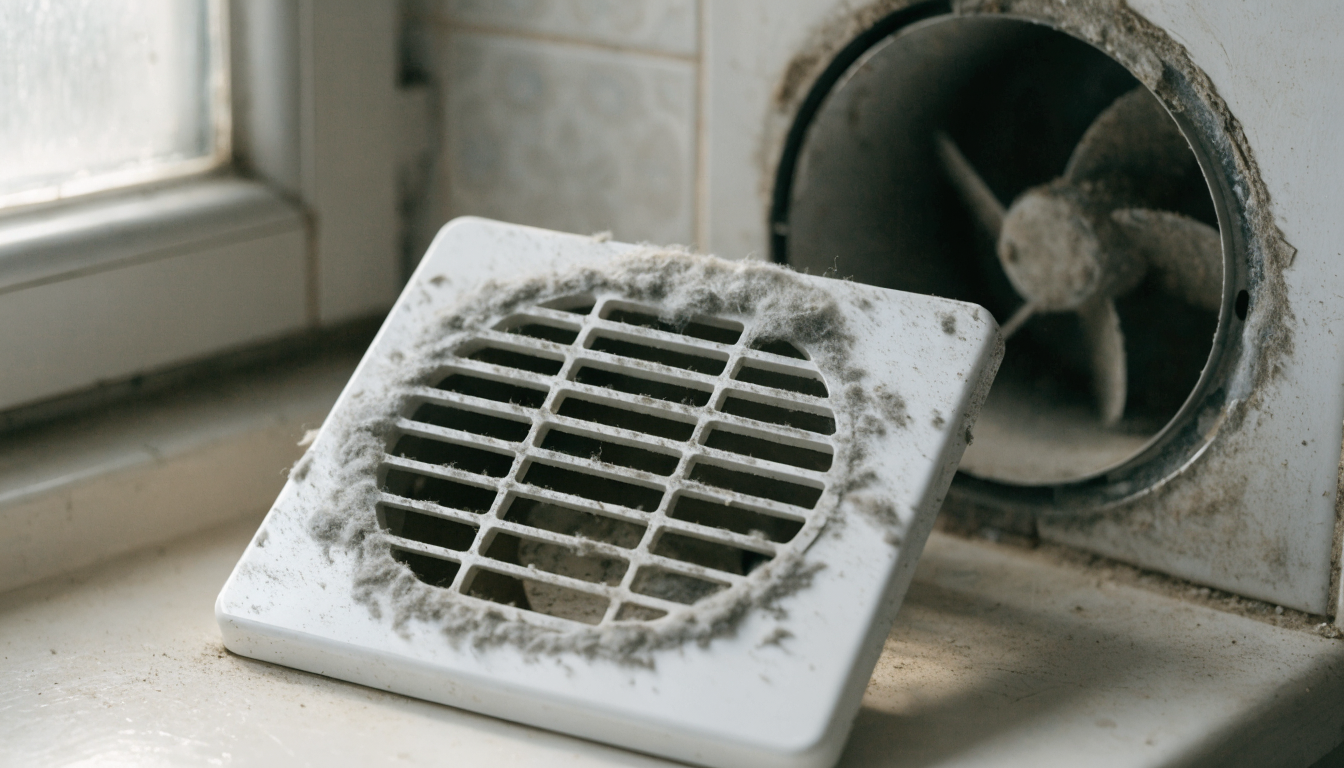
Once a year is enough for most bathrooms. It is five minutes, and the difference between a fan doing its rated job and a fan doing a quarter of it while sounding identical. If you have come to this page because of damp patches or black spotting appearing on the walls and ceiling, the ventilation and the causes of mould in a bathroom are the same conversation, and the fan is usually where it starts.
Repair it or replace it
The honest split is straightforward once you know which fault you have. Domestic extractor fans are not built to be repaired: the motor and the impeller are the fan, and neither is a spare part you can buy separately for a typical high street unit. What you can fix is everything around the motor.
| What you found | Repair or replace | Why |
|---|---|---|
| Dust on the grille and impeller | Clean it | Restores most of the lost airflow. Costs nothing. |
| Blown fuse in the spur | Repair | A consumable. Replace like for like at 3A. |
| Isolator switched off or faulty | Repair | A switch is a part, and replacing one is a replacement. |
| Backdraught shutter stuck or painted | Repair | Free the flap, or fit a new external grille. |
| Blocked, crushed or detached duct | Repair | No electrical work involved at all. The commonest real fix. |
| Choked or painted-over outside grille | Repair | A cheap part and an hour outside. |
| Seized bearings, or hums and will not turn | Replace | Bearings are not serviceable. The motor is the fan. |
| Burning smell, or scorched terminals | Replace, and get it looked at | Stop using it now. |
| Timer or humidistat module failed | Replace | The module is rarely available separately. |
| Fan is fine, but the duct run is long or bendy | Replace with a different type | An axial fan cannot push against that. It is the wrong fan, not a broken one. |
If it comes out as replace, the default for most UK bathrooms is a like-for-like 100mm timer fan, because that is what the hole, the duct and the wiring were built around. Changing to a different size or type is a bigger job than it sounds.
The straight swap
Manrose QF100T Quiet Extractor Fan with Timer
- 100mm / 4in duct, the standard UK bathroom size
- Built-in adjustable overrun timer
- Fits the majority of existing 100mm fan openings
Pros
- Replaces most older 100mm fans without altering the hole or the duct
- Timer means it runs on after the light goes off, which is when extraction actually matters
- Widely stocked, so a replacement is easy to get hold of again in future
Cons
- Timer models need a permanent live as well as a switched live, so a fan previously wired from the light alone may not have the cores present
- Not a fix for a long or convoluted duct run: an axial fan still cannot push against one
- Like any axial fan, it needs cleaning annually or it will fade the same way the old one did
Judged on specification and manufacturer documentation rather than hands-on use, this is the sensible default where an existing 100mm fan has failed and the duct run is short and straight. If your duct is long or full of bends, read the buying guide before you buy anything.
If the fan you are replacing was the one that only ran with the light, this is the moment to move to a timer or humidistat model rather than repeating the arrangement. Which of the two suits your room, and what extract rate the room needs, is covered properly in the bathroom extractor fan buying guide, which compares the axial, inline and centrifugal options against duct length and gives the sizing rules.
Parts worth having before you start
You do not need all of these. Buy against the fault you actually found, not against the list.
| Product | What it fixes | Notes | Buy |
|---|---|---|---|
Like-for-like swap Manrose QF100T 100mm fan with timer | Seized motor, failed timer, or a fan wired from the light | Standard 100mm duct, adjustable overrun | Check price on Amazon |
Xpelair C4HTSR Simply Silent Contour, humidistat and timer | A fan that runs at the wrong times, or a room that stays damp | Responds to humidity rather than the light switch | Check price on Amazon |
Zocipro 100mm flexible ducting, 3m with clamps | A crushed, kinked, sagging or detached duct run | Includes two clamps, which is what stops it coming off again | Check price on Amazon |
Airflow 100mm stainless steel external vent with fly screen | A choked, corroded or painted-over outside grille | Stainless rather than plastic, and the screen keeps nests out | Check price on Amazon |
BG 804 triple pole fan isolator pull cord switch | A failed or damaged fan isolator | Three pole, which is what a fan isolator has to be | Check price on Amazon |
On fuses, buy them in person if you can. What you need is a 3A BS 1362 ceramic cartridge fuse, and the reliable way to get the right thing is to hand the blown one over a counter. Screwfix and Toolstation both stock them, as does any merchant. I have deliberately not linked a specific online fuse multipack, because a large proportion of what is sold under "3 amp fuse" online is the 20mm glass type that will not fit your spur.
Extractor fan questions
How do you reset a bathroom extractor fan?
You do not, because domestic extractor fans have no reset button. There is nothing to reset. What people mean by this is usually one of two things: switching the isolator off and back on, which achieves nothing unless the fan is in a stuck timer cycle, or resetting a tripped breaker at the consumer unit, which is worth doing once. If the breaker trips again straight away, stop resetting it and get an electrician in, because it is doing its job.
Can I spray WD-40 on a bathroom extractor fan?
No. It is a water-displacing penetrant, not a bearing lubricant, and it leaves a film that collects exactly the felted dust you are trying to get rid of. The motor bearings in a domestic fan are sealed and not intended to be lubricated in service. If the bearings are dry enough to be making a noise, the fan is at the end of its life and spraying it will buy you a few weeks at best.
My extractor fan stopped working but the light still works. What does that mean?
It narrows things down usefully. The lighting circuit is clearly live, so the breaker and the light switch are both fine. That leaves the fan isolator, the fuse in the fan's fused spur, the fan's own timer module, or the motor. Check in that order, because that is the order of likelihood and also the order of cost.
Why does my extractor fan spin but not extract anything?
Because the air has nowhere to go, or the impeller has lost its shape. In rough order: felted dust on the blades, a backdraught shutter stuck shut, a blocked or painted external grille, a crushed or detached duct, or an axial fan being asked to push air down a duct run far longer than it was designed for. The tissue test tells you within ten seconds whether you are in this category at all.
My extractor fan stopped working after I cleaned it
Almost always one of three things, and all three are recoverable. The isolator is still switched off from before you started, which is far more common than anyone admits. The cover has not seated properly and is fouling the impeller, so check it turns freely by hand. Or moisture has got somewhere it should not have, in which case leave the unit open and completely dry for a day or two before powering it up again. If you got water onto the terminal block or the circuit board, do not energise it until it has been looked at.
Do I legally need an electrician to replace a bathroom extractor fan?
In England, replacing an existing fan with a new one is a replacement, and Approved Document P puts replacements, repairs and maintenance outside notifiable work anywhere in the dwelling. So there is no legal requirement to notify building control or use a registered competent person for a straight swap. Running a new circuit is notifiable wherever it goes, and altering an existing circuit is notifiable inside the special location zone. None of that changes the fact that the work still has to comply with BS 7671 and be done by someone who knows what they are doing. In Wales the older, wider rules apply, so check with your building control before you assume.
The fan is fine but the bathroom is still damp. What now?
If the tissue holds and the duct is clear, the fan is working and the question becomes whether it is big enough and running long enough for the room. A fan that only runs while the light is on is the usual culprit, followed by a fan that was undersized for the room when it was fitted. The sizing rules and the extract rates are in the buying guide. Where condensation has already been sitting on sealant and grout for a while, removing black mould from silicone sealant deals with the marks, and where the sealant has failed underneath, the right bathroom silicone sealant matters more than the cleaning does.
Related guides
- The best bathroom extractor fans for UK homes: what to buy once you have decided the old one is beyond saving, with the extract rates, the wiring zones and the axial versus inline argument.
- Mould in the bathroom: why ventilation, surface temperature and drying time all matter, and what actually changes the situation.
- Removing black mould from silicone sealant: what works on the marks, and when the sealant has to come out instead.
- Electric shower not working: the same diagnose-before-you-buy approach applied to the other bathroom appliance people replace too early.





0 Comments