
As an Amazon Associate I earn from qualifying purchases.
Every page that ranks for this gives you the same list: washing-up liquid and hot water, bicarbonate of soda and vinegar, a straightened wire coat hanger, a toilet brush pushed into a carrier bag. Those methods are not wrong. They work on one kind of blockage, and not one of those pages tells you how to find out whether yours is that kind.
That is the whole job here. A blockage sitting in the pan or in the trap moulded into the back of it will usually shift with detergent, hot water and patience. A blockage further down, in the soil stack or in the drain under the garden, will not move for any of it, and the kettles of water you pour in have nowhere to go but up. Two minutes of checking tells you which one you have, and it is the difference between a fixed toilet and a flooded bathroom floor.
Two other things get corrected on this page because almost every competing guide gets them wrong. Hot water, not boiling. And if the problem turns out to be in the drain rather than the pan, there is a decent chance it is not your bill to pay, which nobody seems to mention.
First, work out where the blockage actually is
A toilet is the lowest and widest thing connected to your drainage, so it is usually the first place a problem shows itself, and that is exactly why people misread it. The pan being full does not mean the pan is blocked. It means something between the pan and the sewer is blocked, and the distance matters enormously.
Read down the left of this table until you find what your house is doing.
The three checks, which take about two minutes
Not the toilet. Put a few inches of water in the bath and let it out, and watch how fast it goes. A healthy waste pulls away with a short gulp at the end. A slow drain, or a glugging that goes on, means the pipe they share with the toilet is restricted below both of them.
Upstairs and down. One blocked pan is a pan problem. Two is a drain problem, and treating it as a pan problem means you are about to pour several litres into a system that is already full.
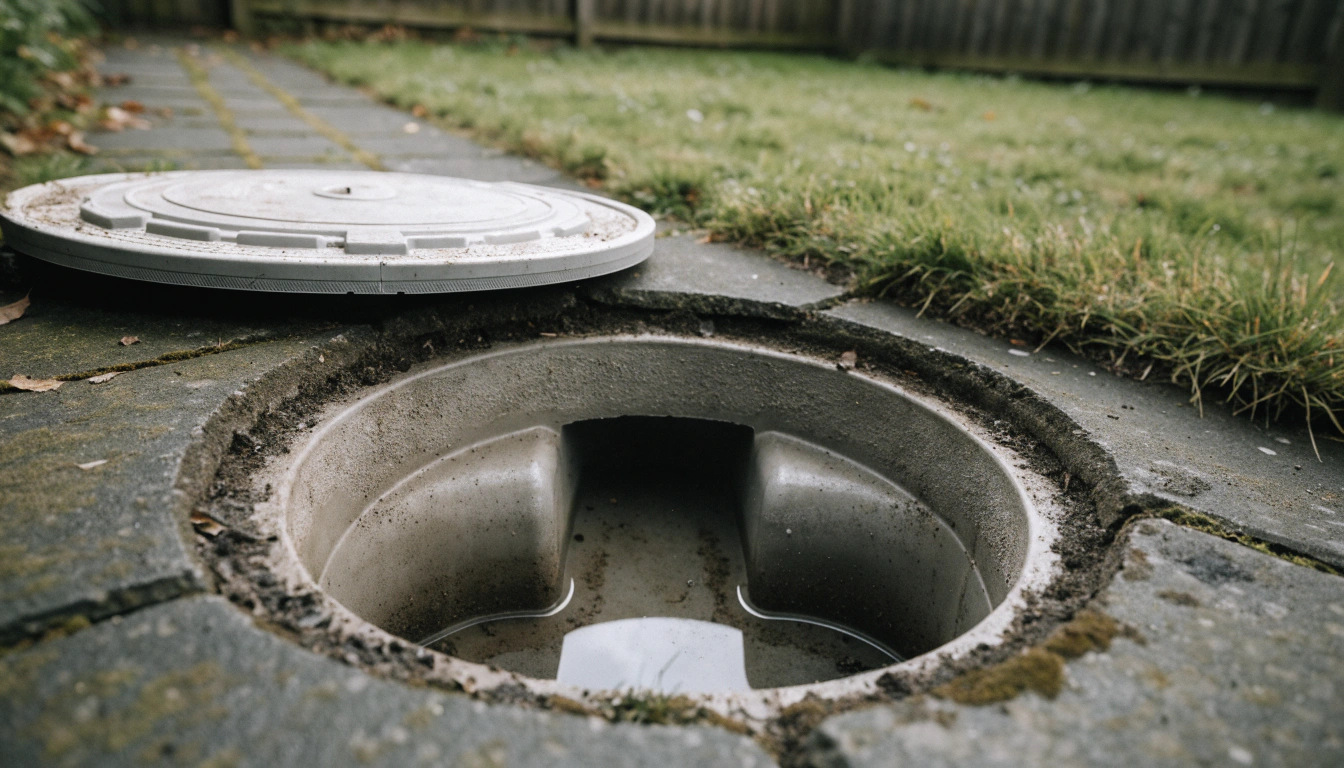
Usually a square or round cover in the path, the drive or the garden, on the drain run away from the house. A clean, empty channel means the blockage is between the house and that chamber. Standing effluent to the rim means it is further out, and that changes who deals with it.
Whatever you do, stop flushing it
A modern UK cistern delivers six litres in one go, and an older one nine. The pan holds a fraction of that before it reaches the rim. If the first flush did not clear it, the water in front of you is already more than the pan wants, and the cistern has spent the last two minutes quietly refilling so it can do it again.
Take the cistern lid off and lift the float arm or the float itself, which stops it refilling. Better still, close the small service valve on the supply pipe into the cistern, which is a slot you turn with a screwdriver so it sits across the pipe. If you cannot find either, knowing where your stopcock is is the fallback, and it is worth knowing anyway.
How to unblock a toilet without a plunger, step by step
This is for a blockage you have established is in the pan or its trap: one toilet affected, everything else in the house draining normally. You need washing-up liquid, a bucket, a jug or an old saucepan, rubber gloves and some towels on the floor.
Into a bucket, with a jug. This is the step people skip and it is the one that decides whether the rest of this happens in the pan or on your floor. You are about to add a litre or two of water, and it has to have somewhere to go.
Ten minutes at least, longer is better. It is a surfactant, so it reduces the grip between the blockage and the glaze, and it is slippery. Time matters because it has to sink through standing water and reach the thing causing the problem rather than sit on top of it.
Hot from the tap, or a kettle left to stand off the boil. The height is doing as much work as the heat, because a column of water falling into the trap is a push, and a trickle is nothing. Aim at the hole, not the sides.
Give it five or ten minutes. A level that creeps down means the blockage is porous and water is finding its way past, which is the beginning of it going. A level that sits exactly where it is means nothing is moving.
If two full attempts have changed nothing, a third will not. At that point the blockage is either solid, or it is made of something detergent cannot touch, or it is not in the pan at all. Move on to the auger rather than emptying the bottle.
The water should drop and the pan should refill to its normal level. If it climbs higher than usual before going down, the blockage has moved rather than cleared and you have bought yourself a week at best.
Hot water, not boiling, and this is not fussiness
Most of the guides on page one say boiling. Pour the kettle straight in, they say. It is the single most repeated piece of bad advice on this subject and there are two separate reasons not to do it.
The first is the pan itself. A WC pan is vitreous china, a glazed ceramic. Ceramics do not generally fail because of high temperature, they fail because of a sudden difference in temperature across the material, which makes one part try to expand while the part next to it does not. A cold pan in a cold bathroom in January, with water straight off the boil landing in one spot, is that situation written out in full. The pan may well survive it. The point is that there is no benefit to set against the risk, because nothing about the blockage needs the last twenty degrees.
The second reason is the part you cannot see. Behind the pan, the pan connector joining it to the soil pipe is plastic on anything fitted in the last few decades, and on a lot of installations it is a flexible concertina type held by push fit seals rather than a solid joint. Water that goes through the trap lands on that plastic. It is not designed around somebody pouring boiling water down it repeatedly, and a weeping pan connector behind a toilet is a floor job, not a bathroom job. If you want to know how the pan, cistern and connector go together, our guide to close-coupled toilets covers the arrangement.
Perfectly adequate and the easiest to get a few litres of. This is what to use.
Boil it, then give it a few minutes off the heat. Hotter than the tap, nowhere near boiling.
The one to avoid, for the pan and for the plastic connector behind it.
Drain chemicals in a toilet pan, and the mistake that puts people in hospital
A toilet pan is the worst place in the house to use a caustic drain product, and it is where people reach for one first because it is the most dramatic blockage they get. The pan holds standing water permanently, by design, because that water is the seal that keeps the sewer out of your bathroom. So a product poured in does not travel to the blockage and sit on it. It dilutes into a few litres of standing water and stays there, at the exact height your hands and face go when you try anything else.
This is the one that causes real injuries. The first product did not work, so an hour later a different bottle goes in. Now there is a chemistry experiment in the pan and nobody in the room knows what is in it.
An acidic descaler poured onto a caustic gives you a violent reaction and a lot of heat. Bleach poured onto an acidic cleaner gives you chlorine gas, in a small room, usually with the door shut and the window closed because it is winter. If something has already gone in and it has not worked, the answer is to stop, open the window and leave it, not to try a different bottle.
Caustic soda has a second problem specific to toilets: it generates genuine heat when it meets water, which is the same heat you have just been told to keep away from the plastic connector behind the pan. And a pan you have put caustic into is a pan you cannot then brush, auger or plunge, because every one of those splashes it. Our guide to which drain unblocker suits which blockage goes through the chemistry properly, and the short version for this page is that the products worth owning are for sink and bath wastes, not for a WC.
The tool that does this job, and why it is not a coat hanger
The coat hanger appears on every list and it comes from American pages, where it is no better an idea. The trap in a WC is a bend moulded into the back of the china, not a straight pipe, and a straightened coat hanger has neither the stiffness to push round that bend nor any way of staying off the glaze while it tries. What it does have is a cut end. Scratched glaze inside a pan is permanent, and it catches everything that passes it from then on, so you trade one blockage for a pan that blocks regularly.
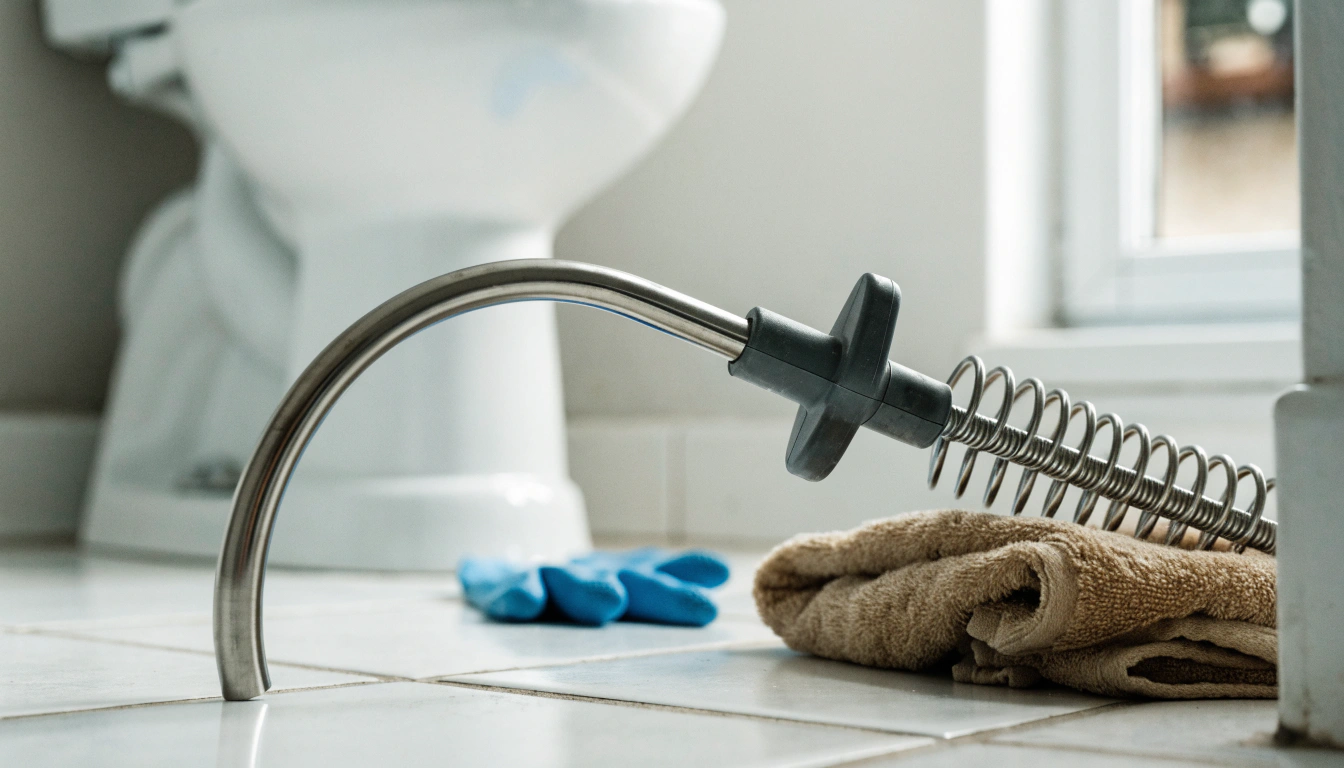
A toilet auger, sometimes called a closet auger, exists for exactly this and nothing else. It is a coiled steel spring inside a rigid guide tube bent to the shape of the trap, with a sleeve on the business end. You feed the tube into the pan until it seats, then wind the spring out through it, so the cable goes round the bend and into the blockage without ever touching the glaze. It is the tool the drainage firm brings, and it is the reason their visit takes ten minutes.
Worth saying on a page with this title: if you have no plunger because you threw out the little red cup one that never worked, the honest answer for some readers is to buy the right one. A flanged plunger has a soft rubber sleeve that folds out of the cup and into the outlet of the pan, which is what makes a seal in a WC. The flat cup sold for sinks cannot seal a toilet and never could, which is why so many people conclude that plunging does not work.
| Product | Best for | How it works | What it will not do | Buy |
|---|---|---|---|---|
The right tool for a pan Faithfull Deluxe Toilet Auger | A blockage in the pan or its trap | Guide tube holds the shape of the trap so the spring reaches the blockage without touching the glaze | Nothing beyond the trap. Its reach stops where the soil pipe starts | Check price on Amazon |
Cheapest thing that works Flanged toilet plunger | A soft blockage you want to move with pressure | The folded rubber sleeve seals against the outlet of the pan, so the push goes into the pipe instead of round the sides | Seal properly if it is the flat cup type sold for sinks. Shift anything solid | Check price on Amazon |
For wastes, not pans Drain snake with drill attachment | Sink, basin and bath waste pipes, and drain runs | Long flexible cable driven by a cordless drill to cut through grease and hair in small bore pipe | Negotiate a WC trap safely. The bare cable will mark the glaze | Check price on Amazon |
#1 The one to own
Faithfull Deluxe Toilet Auger Unblocker
- Rigid guide tube shaped to a WC trap, with a protective sleeve at the pan end
- Coiled steel spring wound out through the tube by a crank handle
- Made by Faithfull, a brand that has sat on merchant shelves for decades
Pros
- Reaches round the trap, which is the one thing improvised tools cannot do
- Keeps the cable off the glaze, so the pan is not damaged in the process
- Works on the blockages that detergent and hot water cannot touch, including compacted wipes
- Lives in a cupboard for years and costs a fraction of one emergency call-out
Cons
- Its reach ends not far past the trap, so it is useless on a blocked drain
- Messy to use and messier to put away. It needs washing off outside
- Nothing about it is pleasant, and it will not fit in a small bathroom cabinet
- Pointless if your blockage is a solid object you could hook out by hand
If you own one tool for this, own this one. Judged on specification and on what the trade carries rather than on hands-on testing, it is the only domestic tool shaped correctly for a WC trap.
#2 The trade pattern
RIDGID K-3 Toilet Auger, 3 Foot, with Bulb Head
- Three foot cable with a bulb head designed to work the blockage rather than spear it
- Vinyl guard on the guide tube to protect the china
- RIDGID is the pattern most drainage firms carry for WC work
Pros
- Built for repeated commercial use rather than one bad evening
- Bulb head is less likely to simply punch a hole through a soft blockage and leave it there
- Spares and replacement cables are available, which is rarely true of cheaper tools
Cons
- Costs considerably more than the domestic alternatives for the same three feet of reach
- Overkill for a household that may use it twice in a decade
- Still stops at the end of the trap, same as any other closet auger
Worth the difference only if you look after more than one property. For a single home the Faithfull does the same job on the same geometry.
When this will not fix it
Some blockages are not going to respond to anything in this article, and recognising one early is worth more than another hour of trying. This is the table to read when the second attempt has failed.
| What is happening | What it means | What actually fixes it |
|---|---|---|
| You know a solid object went in: a toy, a phone, a rim block and its plastic cage | There is nothing porous for water to get past and nothing soft for an auger to break up | Hooking it out, or in the worst case lifting the pan off the connector. Pouring anything in only wedges it further round the trap |
| Wipes, cotton buds or sanitary items went down | Wipes do not disintegrate. A mass of them binds together and grips the pipe wall | An auger to break up and pull back. Hot water and detergent will not touch them, whatever the packet said about flushable |
| It drains, but very slowly, and always has | A partial restriction or a drain laid at the wrong fall, rather than a blockage that arrived this week | A drainage survey. This is a defect, and clearing it just resets the clock |
| It cleared, then blocked again within days | Part of the blockage moved along and re-lodged, or something downstream is catching everything that passes | Clearing from the inspection chamber with rods, not from the pan. Repeat blockages in the same place are almost never a usage problem |
| Another appliance in the house is slow, or gurgles when you flush | The shared pipe, not the pan. The toilet is the symptom | Rodding the drain from the chamber, or the water company, depending on where it is |
| Waste water is coming up into a shower tray, a gully or the chamber | The drain is full and backing up. This is as far as DIY goes | Stop using every water outlet in the house and make the call described below |
Where it stops being your job, and who pays
This is the part worth knowing before you ring anybody, because it can be the difference between a call-out charge and a free visit. In England and Wales the law on this changed on 1 October 2011, when private sewers and lateral drains transferred to the water and sewerage companies. Thames Water, as one example, puts it plainly: "After a change in the law in 2011, we became responsible for private sewers/drains from 1 October 2011."
Citizens Advice sets out the split as it now stands: you are responsible for maintaining or repairing any drains inside the boundaries of your property, while a lateral drain, meaning the length of pipe carrying waste water from your property to a sewer, is the water company's. Its advice for a blockage in a sewer or lateral drain is to contact your water company.
Two practical notes. Ringing the water company costs nothing and they will usually tell you over the phone whether the pipe in question is theirs, so make that call before you book anybody. And if you rent, reporting it early matters in both directions: a tenant can still be charged where the blockage was caused by something that should not have gone down the pan, and an hour of enthusiastic DIY on a drain is a poor position to be arguing from.
Stopping the next one
Nearly every domestic toilet blockage that is not a drainage defect comes from one of three things, and the first of them accounts for most of what gets pulled out of drains.
Baby wipes, cleaning wipes, make-up wipes and the ones sold as flushable. They are fabric. They do not break up in water the way paper does, and they bind to each other and to anything greasy. The bin is the answer and there is no second answer.
A six litre flush moves less than the nine litre cisterns people grew up with. A large wad of paper in a low flush pan is a genuine mismatch, and two flushes a few seconds apart beats one flush with everything in it.
The plastic holder works loose, drops into the pan and goes round the trap on the next flush. It then sits there catching paper. If a block has gone missing, assume that is where it went.
Maintenance products are worth a word, because the enzyme sticks and granules sold for this are genuinely useful in the wrong place. Products like the Eco Barn enzyme drain sticks work on the greasy, hairy build-up that coats the inside of a bath, basin or shower waste, which is the pipe most likely to slow down over years. They are not a toilet product and they will not clear a blocked pan. If the bathroom waste is where your slow drainage actually is, that is the pipe to treat.
Check Eco Barn enzyme drain sticks on AmazonOne more worth adding to the list of things to keep out: cooking fat, which has no business in a toilet but ends up there in flats where the kitchen sink is already slow. It sets in the cold section of pipe under the garden and it is the single hardest thing to clear. A basic set of plumbing tools in the house is worth more than any bottle for dealing with the consequences.
Common questions
What is the fastest way to unblock a toilet without a plunger?
Bale the pan down to half, add a generous squeeze of washing-up liquid, leave it ten minutes, then pour hot water in from waist height. The baling and the waiting are the parts people skip, and they are the parts that make it work. If that has failed twice, nothing else poured into the pan will be faster than an auger.
Why is my plunger not working?
Usually one of two reasons. Either it is a flat sink plunger, which physically cannot seal the outlet of a WC pan, or the blockage is not in the pan at all and you are compressing a column of water that has nowhere to go. A flanged plunger with the rubber sleeve folded out solves the first. The checks at the top of this page settle the second.
Can you unblock a toilet with a toilet brush?
Sometimes, on a soft paper blockage sitting just inside the trap, by pushing and pulling the handle to work water back and forth. Wrapping it in a bag does not turn it into a plunger, because a carrier bag over a brush head will not hold a seal. Accept that the brush is then a bin item, and do not use one you have put chemicals anywhere near.
Does washing-up liquid actually unblock a toilet?
It helps rather than unblocks. It is a surfactant, so it lowers the surface tension and lubricates between the blockage and the pipe wall, which makes it easier for the water behind to push past. On paper and on anything greasy it makes a real difference. On a solid object or a compacted mass of wipes it makes no difference whatsoever.
Can you unblock a toilet in five minutes?
With an auger, often yes, which is exactly why a drainage firm is in and out so quickly. With detergent and hot water, no, because the method depends on soak time. Any page promising five minutes with the kitchen cupboard method is describing a blockage that was about to clear anyway.
How do plumbers unblock toilets?
A closet auger first, almost always, because it takes a couple of minutes and settles the question. If that does not reach it, they move outside to the inspection chamber and rod from there, which tells them which section of the drain is holding water. Drainage specialists go a step further with a jetter and a camera. None of them start by pouring chemicals into a pan.
What should never be flushed down a toilet?
Wipes of any description, including the ones labelled flushable, and cooking fat or oil. Those two cause most of what blocks domestic drains. After them: cotton buds, cotton wool, sanitary products, nappies, dental floss, condoms, medicines and anything with plastic in it. The rule that covers all of it is that only the three Ps go down: pee, poo and paper.
How much does a plumber charge to unblock a toilet?
There is no reliable published figure, and any page quoting a precise national average is guessing at it. What is predictable is the shape of the bill: the work itself is usually under an hour, so you are mostly paying a minimum call-out charge, which varies by region and rises sharply out of hours. Ask for the price of the visit before anyone travels, and ask specifically what happens to it if the problem turns out to be in the drain rather than the pan. And make the free call to the water company first, because if it is their lateral drain the answer is nothing.
Related guides
- Which drain unblocker suits which blockage, for the sink and bath wastes where these products genuinely belong, and the free trap check to do before buying one.
- Close-coupled toilets explained, if the pan, cistern and connector behind them are new territory and you want to know what you are looking at.
- No running water, and where your stopcock is, worth reading on a calm evening rather than while something is going wrong.
- Finding a water leak before you pay for a survey, which covers the outside chambers and the meter, and the same habit of checking before spending.
- DIY plumbing tools worth owning, for the kit that earns its cupboard space rather than the kit that sits in a drawer.


0 Comments