
As an Amazon Associate I earn from qualifying purchases.
Letting water out of a heating system is the easy part. You can drop the gauge from 3 bar to 1.2 bar in about two minutes with a bleed key and an old towel. The question that actually matters, and the one almost no page on this subject asks, is whether it is going to climb straight back up again.
If you overfilled it yourself during a top up, draining a little water is the entire repair and you will not think about it again. If the pressure rose on its own, draining it treats the symptom and the cause is still sitting there. The two cases look identical on the gauge and need completely different responses.
So this page sorts the fault first and gives you the procedure second. If the gauge is low rather than high, you want the opposite job, which is covered on the guide to how to repressurise a boiler.
First, check the pressure is actually too high
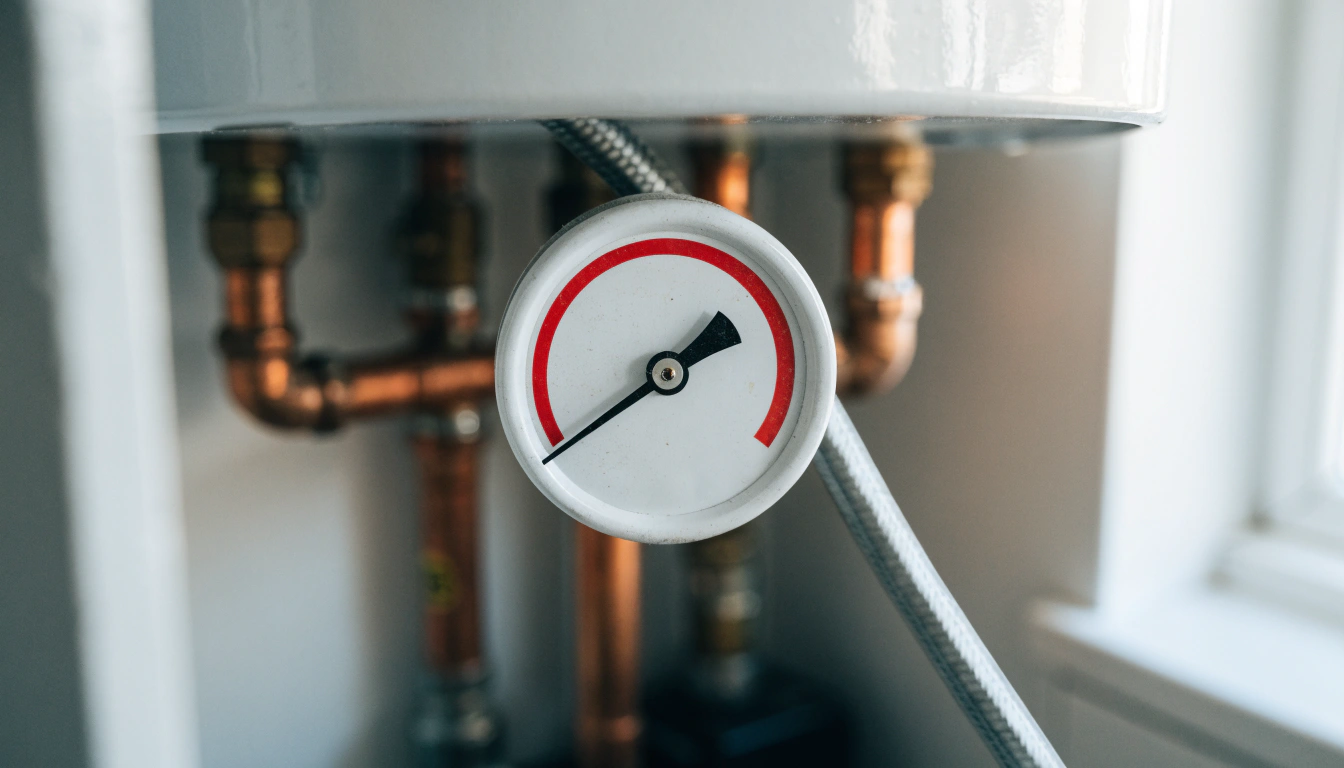
A gauge reading 2 bar is not a fault if the heating has been running. Water expands when it is heated and the pressure in a sealed system rises with it. That rise is normal, designed for, and the reason the system has an expansion vessel in the first place.
Ideal Heating put the normal operating band at 1 to 2 bar, with 1 to 1.5 bar when the heating is off, and describe anything above 2.75 bar as high. Every manufacturer words it slightly differently, and the figure that governs your boiler is the one printed in your own manual. Take your reading from cold, with the heating off for a couple of hours, or you are comparing the wrong numbers.
| Cold reading | Hot reading | What it means |
|---|---|---|
| 1.0 to 1.5 bar | Up to about 2 bar | Healthy. The swing between the two is the expansion vessel doing its job. |
| 1.0 to 1.5 bar | Close to 3 bar | The vessel is not absorbing the expansion. Draining water will not fix this. |
| 2.0 to 2.5 bar | Higher still | Overfilled. Let some water out and the swing comes back into range. |
| Over 2.5 bar | At or near 3 bar | Overfilled badly, or being refilled. Expect the relief valve to discharge. |
| Climbing week on week | Anything | Something is adding water. Find it before you drain anything. |
Work out which fault you have before you let any water out
Four different faults all end with a high reading on the same gauge. The way to tell them apart is not the number, it is when the pressure rises: during a heating cycle, while the system sits cold, or only when somebody runs a hot tap.
The speed test: how fast does it come back?
If you are not sure which row you are in, there is a test that costs nothing. Bring the pressure down to 1.2 bar cold, write down the time and the reading, and then leave it alone. What happens next sorts the fault for you.
Still reading 1.2 bar cold a week later, with a normal swing up and back while the heating runs.
What it means
- You overfilled it during a top up
- The vessel and the loop are both fine
- Nothing further to do
Next: top the inhibitor back up if you let out any real volume, and forget about it.
Back above 2 bar within hours or days, or spiking to 3 bar every time the heating fires.
What it means
- Back within hours, heating off: the filling loop is passing
- Only while the heating runs: the expansion vessel has failed
- Only after hot water is drawn: an internal combi fault
Next: stop draining it. Every cycle of fill and dump sends water out of the wall and pulls fresh oxygenated water in behind it, which is how systems corrode.
That last point is the one worth sitting with. A system that is being topped up and vented repeatedly is not just annoying, it is actively wearing itself out. Fresh mains water carries dissolved oxygen, oxygen corrodes steel radiators from the inside, and the result turns up a few years later as black sludge in the system and radiators that will not heat at the bottom.
How to lower boiler pressure with a radiator bleed valve
This is the method everybody uses, and for the overfilled case it is the right one. You are letting water out rather than air, so the preparation matters more than it does when you are bleeding a radiator in the usual way. Heating water is black and it stains carpet permanently.
How to lower boiler pressure without bleeding radiators
Bleeding a radiator is quick but messy, and it introduces air at the top of a panel that you then have to bleed back out. There are two tidier routes if your system has them.
Every radiator has one, so it is always available. Messiest of the three, and it puts air into the top of the panel. Best for small corrections.
A small square-headed valve at the lowest point of the system, often on a downstairs radiator tail or near the boiler. Takes a hose, so the water goes outside or into a bucket rather than onto the floor. Much the cleanest method if you have one.
If a magnetic filter is fitted, it usually has its own drain point with a hose connection. Convenient, and it is at a low point by design. Close the filter isolation valves first or you will drain more than you meant to.
One thing worth saying about the drain-off point, because it catches people out: on a lot of UK installations it is buried under a floorboard or behind a bath panel where the original installer put it and nobody has looked since. It is worth finding where yours is on a dry afternoon rather than on the evening you need it.
Put the inhibitor back if you let out any real volume
This is the step that gets skipped, and it is the one with a long tail. Corrosion inhibitor is dissolved in the system water. Whatever you drained out took its share of the inhibitor with it, and what is left is now diluted across the same volume of metal it was protecting before.
A couple of short bursts from a bleed valve is not worth worrying about. Draining several litres through a hose is. The number of people who came to the counter over the years to buy a radiator, having drained and refilled a system two or three times without ever adding inhibitor back, was considerable, and the radiator was the symptom rather than the problem.
Fernox F1 Central Heating Protector, 500ml
- 500ml treats a typical domestic system of up to around ten radiators
- Added through a radiator bleed point, a filter or the filling loop
- The standard protector on merchant shelves, so it is easy to match what is already in the system
Pros
- Topping up after a drain-down costs a fraction of what a corroded radiator costs
- Widely stocked, so you can get it the same day rather than waiting on a delivery
- Compatible with the usual mix of copper, steel, brass and plastic in a UK system
Cons
- It protects against corrosion and does nothing at all for a pressure fault
- Adding more inhibitor to a system that is already sludged up will not clean it, that needs a flush first
- Dosing by guesswork is common and under-dosing is the usual outcome, so check the concentration rather than assuming
Worth adding after any drain-down that filled more than a jug. Not a fix for anything described on this page, which is exactly why it gets forgotten.
How much you need depends on the size of the system rather than on the size of the bottle, and the dosing is covered properly in the guide to how much central heating inhibitor a system needs.
When lowering the pressure will not fix it
Three faults make the gauge read high and are completely untouched by draining water out. If you are on your third trip to the radiator with a jug, you are in this section rather than the one above.
A failed expansion vessel
The expansion vessel is a sealed steel can with a rubber diaphragm across the middle. One side holds the system water, the other holds a cushion of air under pressure. When the water heats and expands, it pushes against that air cushion and the pressure rise stays modest. Domestic vessels are normally pre-charged to somewhere around 0.5 to 1 bar, and the correct figure for yours is in the boiler manual.
Over years, the air leaks out past the schrader valve or the diaphragm perishes. The cushion disappears, the vessel fills with water, and there is nothing left to absorb the expansion. The result is the signature symptom: a small rise from cold, then a sharp climb to 3 bar as soon as the heating runs, and water out of the overflow pipe outside.
Recharging a vessel means draining the system pressure to zero first, then putting air back in through the schrader valve with a pump and a gauge. On a combi the vessel is usually inside the case, which puts it beyond the scope of this page. Where an external vessel has been fitted on the pipework it is more accessible, but the system still has to be drained down to do it.
A pressure relief valve that is passing
The relief valve is the safety device that stops a sealed system over-pressurising, and on a domestic boiler it is normally set to lift at 3 bar. Once it has lifted, debris can get caught under the seat and it never seats properly again, so it weeps continuously at normal pressure.
That produces the confusing version of this fault, where the system seems to be losing pressure and gaining it in turn. The tell is a damp patch, a drip or a chalky white limescale streak on the brickwork under the small copper pipe that comes through the outside wall near the boiler. It is the clue almost nobody goes outside to check, and it is covered in detail on the page about why a boiler keeps losing pressure.
A filling loop that will not shut
The filling loop joins the mains cold supply to the heating circuit. Mains pressure in a UK home is several times the pressure a heating system runs at, so a loop that is even slightly open will fill the system continuously until the relief valve lifts.
There are two versions. The obvious one is a valve that was not closed properly after the last top up, or a filling key left in place. The less obvious one is the double check valve inside the loop failing and passing a trickle with both levers shut. The test for both is the same: close both valves, physically disconnect and remove the flexible hose, and watch the gauge for two or three days. If it stops climbing, the loop was your fault.
A loop is a replaceable part on the pipework rather than a component inside the boiler, and a replacement needs to be the same specification: Part L of the Building Regulations is why loops are supplied as a removable flexible hose with a double check valve built in.
SPARES2GO Combi Boiler Filling Loop, 15mm, Part L Compliant
- 15mm by 15mm connection, the standard size on UK domestic combi and system boilers
- Double check valve and lever isolation valves, as Part L requires
- Removable flexible hose, so it can be taken off the system between top ups
Pros
- Replaces a seized or passing loop without opening the boiler case
- Lever valves give an unambiguous open or shut, unlike a worn screwdriver-slot valve you cannot read
- Cheap enough that swapping a suspect loop is quicker than proving it is faulty
Cons
- Fitting means breaking into pipework, so it is a plumbing job rather than a no-tools swap
- A minority of installations use a keyed built-in loop instead, so check what you actually have first
- Replaces a passing loop and nothing else on this page
The right buy once the removal test has shown the loop is passing. Not worth fitting on suspicion alone, because the test is free and takes three days.
Can a boiler explode if the pressure is too high?
No, and it is worth answering plainly because it is one of the most asked questions on this subject and the honest answer is reassuring.
A sealed domestic heating system has a pressure relief valve fitted precisely so that it cannot reach a dangerous pressure. When the system passes the valve's set point, normally 3 bar, the valve opens and dumps water down a pipe through the outside wall. Water going out of that pipe is not a malfunction, it is the safety device working as designed.
What high pressure genuinely does is cheaper and slower than an explosion: it stresses joints and seals, it wastes treated water and inhibitor out of the wall, it pulls fresh oxygenated water in behind, and it shortens the life of the appliance. That is the real argument for fixing it rather than living with it, and it matters more than people think when you look at how long a boiler actually lasts.
The exception to all of the above is a system where the relief valve has been capped, plugged or replaced with a blank by somebody trying to stop a drip. That removes the one device standing between a sealed system and a genuinely dangerous pressure. If you find a blanked discharge pipe or a capped relief valve, stop using the system and get a Gas Safe registered engineer to look at it.
Where this job legally stops being DIY
Letting water out of a radiator, reading a gauge and closing a filling loop are jobs for the householder. Anything that means working on the gas appliance itself is not, and this is law rather than advice.
Under the Gas Safety (Installation and Use) Regulations 1998, work on a gas fitting or gas appliance must be carried out by someone registered with the Gas Safe Register. That covers the inside of the boiler case: the expansion vessel on a combi, the pressure relief valve, the plate heat exchanger, the gas valve and the flue. It is not a question of confidence or tooling. I ran plumbers merchants for sixteen years and I have never held Gas Safe registration, which is exactly why this page stops where it does.
- Pressure returns to 3 bar every time the heating runs, after you have brought it down
- Water is running from the discharge pipe outside more than occasionally
- Pressure rises only when hot water is drawn, on a combi
- The gauge will not move at all, in either direction
- The relief valve or its discharge pipe has been capped or blanked
- You can smell gas at any point, in which case leave the property and call the national gas emergency service on 0800 111 999
Frequently asked questions
Will boiler pressure go down by itself?
It will drop as the system cools, because the water contracts again, and that is normal. It will not come down on its own from an overfilled cold reading. The only two things that remove water from a sealed system are you letting it out deliberately and the relief valve dumping it outside, and the second one is a fault rather than a solution.
Is boiler pressure of 2.5 bar when the heating is on normal?
It is high but not necessarily a fault, and the cold reading decides it. If it drops back to 1.0 to 1.5 bar once everything is cold, the system is just running near the top of its range and you could take the cold figure down slightly to give it more headroom. If the cold reading is also over 2 bar, you are overfilled. If it reaches 2.5 bar hot from a cold reading of 1.2, the expansion vessel is not absorbing properly.
Why is my boiler pressure gauge bouncing?
A needle that flickers in time with the pump usually means air trapped in the system, and bleeding the radiators properly settles it. A needle that jumps erratically with no pattern, or that moves in steps rather than smoothly, is more often the gauge itself sticking. Cross-check against the digital pressure reading on the boiler display if your model has one, because replacing a gauge to chase a fault that was never there is a common and avoidable expense.
What happens if the water pressure is too high?
In the short term, the relief valve lifts and water goes out through the wall. In the longer term, the system loses treated water and inhibitor every time that happens, draws fresh oxygenated mains water in to replace it, and corrodes faster as a result. Seals and joints are also being worked harder than they were designed for. None of it is dangerous, all of it is expensive eventually.
My boiler pressure keeps rising even after bleeding the radiators. What now?
Stop bleeding it. Repeated bleeding is treating a symptom and each round costs you inhibitor. Work out whether it climbs with the heating off or only when the heating runs. Off means the filling loop, and the test is to remove the loop entirely for three days. Only when running means the expansion vessel, which is an engineer's job on a combi.
How much water do I need to let out?
Far less than people expect. Coming down from 2.5 bar to 1.2 bar on a typical house is a matter of short bursts from a bleed valve rather than bucketfuls, which is precisely why the advice is to close the valve and go and read the gauge between each one. Continuous bleeding while watching the radiator is how people overshoot into a low pressure lockout.
Does high pressure stop a boiler working?
Many boilers will lock out and display a fault code at a high pressure reading, in the same way they do at a low one. If yours has stopped and is showing a code, bring the pressure back into range first, because resetting it without fixing the pressure will simply produce the same lockout again.
Related guides
- How to repressurise a boiler. The opposite job, with the step by step for every type of filling loop, including the keyed and keyless ones.
- Why your boiler keeps losing pressure. Read this if the gauge falls back below the band after you have set it, sorted by how fast it drops.
- Central heating inhibitor, and how much you need. The dosing arithmetic for putting protection back after a drain-down.
- How to find a water leak. For tracing the loss when the pressure is going somewhere you cannot see.
- Magnetic filters, what they catch and what they miss. Worth reading if repeated refilling has already left you with sludge.



0 Comments