
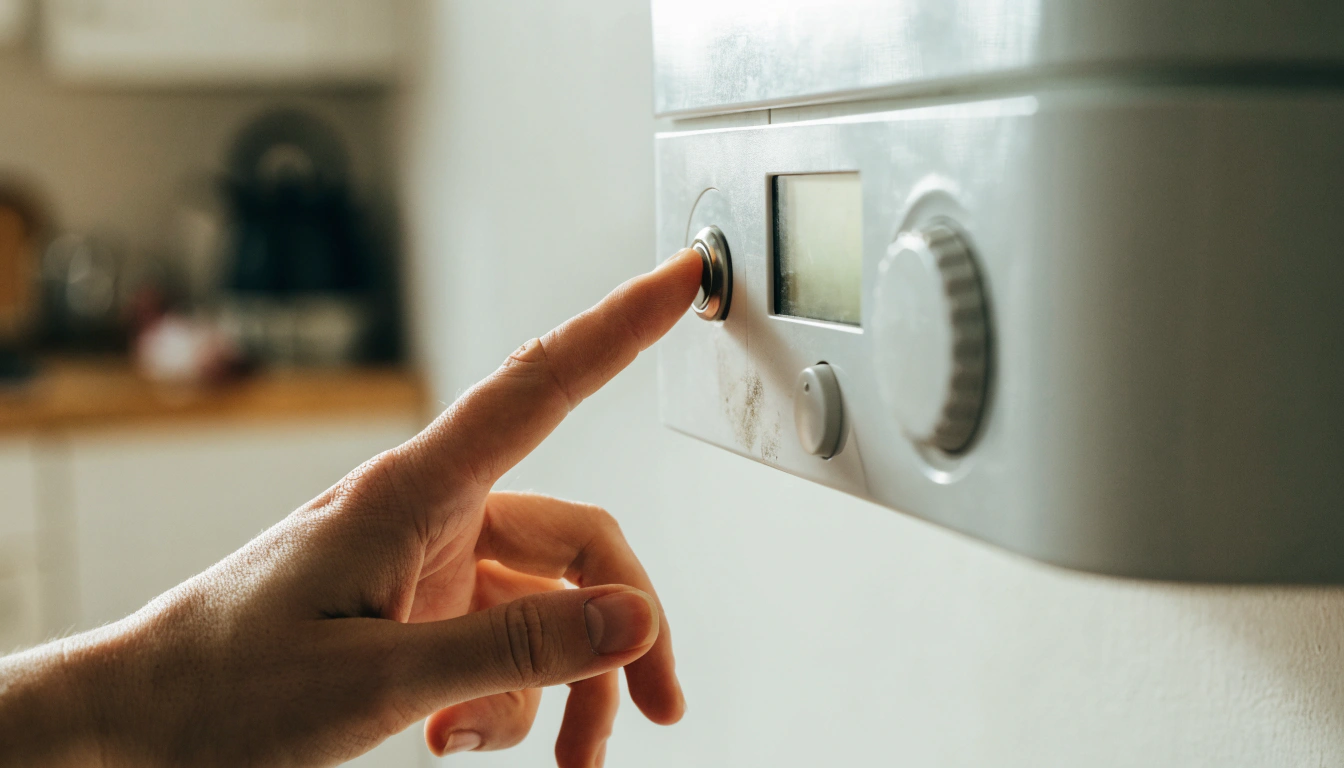
Every page on this subject shows you where the reset button is. Almost none of them tell you the thing that actually matters, which is that a boiler needing a second reset is not a boiler that needs a third one. It is a boiler with a fault, and the reset button is a safety device you are overriding rather than a fix you are applying.
A lockout is a deliberate, protective shutdown. The appliance has detected a condition it will not run in and has stopped itself on purpose. Pressing reset tells it to try again. If it locks out again on the same fault, it is telling you the condition is still there, and pressing reset a fourth and fifth time does not change that. It just repeats the attempt that the boiler already decided was unsafe.
So before you press anything, read the code. This page starts there, because which fault the boiler is reporting determines whether resetting is a reasonable thing to do at all.
Two reset attempts is a reasonable thing to try. A third is a phone call. Repeatedly resetting a boiler that locks out on an ignition, flame, flue or overheat fault means repeatedly asking an appliance to do the thing its own safety systems stopped it doing, and those are the fault families where the consequences of being wrong involve unburnt gas or combustion products. If you can smell gas at any point, do not reset anything: leave the property and call the national gas emergency service on 0800 111 999.
Write down three things before you press reset
Thirty seconds here saves an engineer a diagnostic visit, and quite often saves you the visit altogether. Once you reset the boiler the code clears, and with it goes the only evidence of what actually happened.
Photograph the display. Codes clear on reset and people never remember them accurately afterwards.
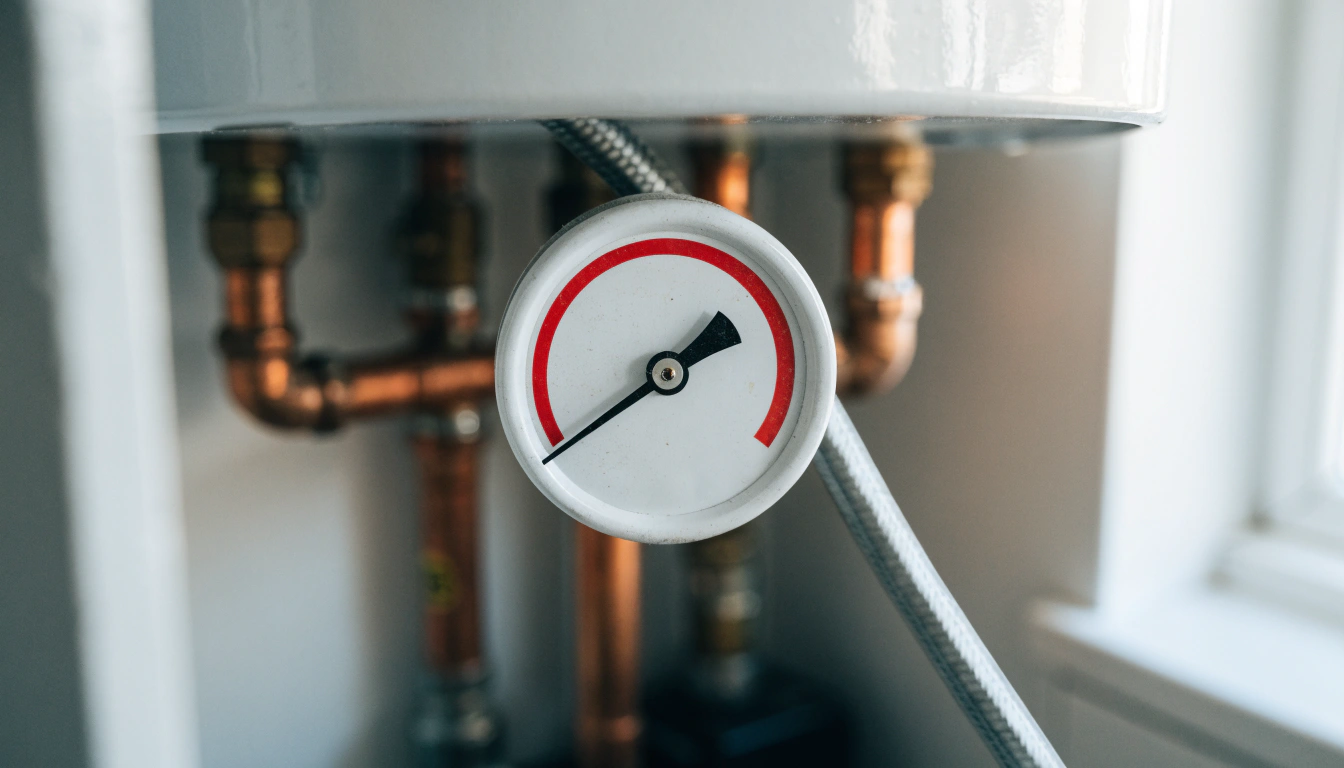
From the gauge, cold if you can. A low pressure lockout will not clear by resetting, however many times you try.
Gas hob lighting, other appliances, lights on in the house. It separates a boiler fault from a supply problem in one go.
That third one catches more faults than it should. A boiler that will not fire because the meter is out of credit, or because a prepayment meter has gone into emergency, looks exactly like a boiler fault on the display and is fixed by nothing you do at the appliance.
Which fault conditions mean reset, and which mean stop
Fault codes are manufacturer specific and there is no universal list. A code that means ignition failure on one make means something different on another, so the only reliable reference is your own boiler manual or the label inside the case door. What does transfer between makes is the category of fault, and the category is what tells you whether resetting is sensible.
| What the code is reporting | Reset? | Why |
|---|---|---|
| Low water pressure | Fix first, then reset | Resetting alone does nothing. The boiler will lock out again immediately because the condition has not changed. |
| Ignition failure, no flame detected | Once, then stop | Each attempt purges and tries again. Repeating it after two failures is the fault family where unburnt gas matters. |
| Flame loss during operation | Once, then stop | The boiler lit and then lost the flame. That is a gas supply, gas valve or combustion problem, not a glitch. |
| Overheat or high limit thermostat | Do not keep resetting | Heat is not being carried away. A pump, a blockage or a closed system. Repeat resets make a seized pump worse. |
| Fan or air pressure switch | Stop | Flue related. These protect against combustion products not leaving the property, which is the one risk worth being absolute about. |
| Frozen or blocked condensate | Clear it, then reset | The genuine exception. Thaw the pipe, reset, and it usually runs. Very common in a cold snap. |
| Sensor, PCB or gas valve fault | Once, then engineer | Occasionally a genuine transient. Twice is a component, and no amount of resetting fixes a component. |
| No code at all, boiler simply dead | Nothing to reset | Check the fused spur, the consumer unit, the programmer and the room thermostat before touching the boiler. |
The low pressure row is worth pulling out, because it is far and away the most common reason a boiler sits locked out in winter and the most common reason resetting appears not to work. Most modern combis will not fire below roughly 0.5 bar. Top the system back up first, following the guide to how to repressurise a boiler, and then reset. In that order, it works. In the other order, nothing happens and people conclude the boiler is broken. A boiler can also lock out on pressure that is too high rather than too low, and there the answer is to find out why it climbed rather than to keep draining water out.
How to reset a boiler, step by step
The control varies by make and model, but the sequence does not.
Where the reset button is on common UK boilers
Manufacturers move controls between model generations, so treat the following as where to look rather than as a specification. The authority for your appliance is the manual, and if it has gone missing most makers publish them free as PDFs on their own sites by model name.
A separate button, often marked with a crossed-out flame symbol or the letter R, usually beside the display. Worcester Bosch Greenstar models commonly use this arrangement. Press and hold rather than tap.
No separate button. The main control knob has a reset position, and you turn it there, hold briefly, then turn it back to the running position. Common on Baxi and on older control layouts generally.
A button on the digital interface that resets when held, rather than when pressed. Vaillant models commonly work this way, with a crossed-out flame marking. The display usually counts down or changes while you hold it.
Why the boiler will not fire up after a reset
A reset that appears to work, followed by nothing happening, is usually one of a small number of things, and most of them are not the boiler.
The frozen condensate exception
This one deserves its own section because it is the single most common winter lockout in the UK and it is the one case where resetting genuinely is the fix, once you have done the other half of the job.
Condensing boilers produce acidic condensate water that drains away through a plastic pipe. Where that pipe runs outside, which it very often does because it was the cheapest route at installation, it freezes in a cold snap. The boiler detects that the condensate cannot drain, and shuts down rather than letting it back up. That is correct behaviour and the appliance is undamaged.
Thawing it is a householder job: warm water poured along the external pipe, or a covered hot water bottle held against it, working from the open end back towards the house. Not boiling water, which can crack the plastic and split a joint, and takes a simple fault into a repair. Once it drains, reset and it normally runs. If it refreezes every winter, the pipe route is the actual problem, and the same thinking that applies to frozen pipes generally applies here: lag it, or have it rerouted.
When resetting will not fix it
Reset clears a latched fault. It does nothing whatever about the condition that caused the fault. These are the cases where people reset repeatedly and get nowhere, because the reset was never going to be the answer.
- Low system pressure: repressurise first
- Frozen condensate: thaw the pipe first
- No credit on a prepayment meter
- Gas emergency control valve left closed after other work
- Flat batteries in a wireless room thermostat
- Power off at the fused spur beside the boiler
In every one of these, the reset works perfectly well once the actual problem is dealt with.
- A seized pump causing repeated overheat lockouts
- A blocked heat exchanger from sludge in the system
- A failed fan, or an air pressure switch fault
- A gas valve or PCB that has failed
- A flue fault of any kind
- Any code that returns within minutes, every time
Here, each reset is another attempt at something the boiler already stopped. Two is the limit.
The overheat family is worth understanding, because it is the one people persist with longest. An overheat lockout means heat is being produced and not carried away. That is usually a pump that is not circulating, a system full of sludge, or every radiator valve shut at once. Resetting repeatedly asks the boiler to make more heat that still has nowhere to go, and a system that has got to this point is often also the one where sludge and circulation were the underlying issue all along.
Is it safe to reset a boiler yourself?
Pressing the reset button is safe and it is designed for the householder to do. It is a control on the outside of the appliance, it requires no tools, and no manufacturer expects you to call somebody to press it. That is the honest answer to a question a lot of people are nervous about.
What is not safe is treating it as a routine. A boiler that gets reset every morning before anyone has their shower is a boiler running with an unresolved fault, and the people who do this generally know it and are putting off the call. Every one of those resets is an override.
There is also a quieter argument for not living with it. Repeated lockouts on combustion-related faults are the circumstances in which an appliance is most likely to be burning badly, and a working carbon monoxide alarm is worth having regardless of the state of the boiler. The alarm is not a substitute for getting the fault fixed, but a house with a boiler that keeps locking out and no CO alarm in it is the wrong combination.
Where this job legally stops being DIY
Pressing a reset button, reading a pressure gauge, thawing a condensate pipe and changing thermostat batteries are all householder jobs. Opening the boiler case is not, and this is law rather than a matter of competence or confidence.
Under the Gas Safety (Installation and Use) Regulations 1998, work on a gas fitting or gas appliance must be carried out by a person registered with the Gas Safe Register. That covers the gas valve, the burner, the heat exchanger, the fan, every flue component and the electrodes. There is no DIY exemption for your own home. I spent sixteen years running plumbers merchants and I have never held Gas Safe registration, so the line on this page is drawn in exactly the same place I would draw it at the counter.
- The same fault code returns after two reset attempts
- The code points at the fan, the flue or an air pressure switch
- The boiler locks out on overheat more than once
- There is a smell of gas, in which case leave the property and call 0800 111 999 before anything else
- There is any sooting, staining or scorching around the boiler case
- A carbon monoxide alarm has sounded, even briefly
- The boiler needs resetting as part of anyone's daily routine
Frequently asked questions
Where is the reset button on a boiler?
Usually on the front control panel beside the display, marked Reset, R, a circular arrow or a flame symbol with a line through it. On a lot of installations it is behind the drop-down flap at the bottom of the case, which many householders have never opened. Where there is no separate button, the reset is a position on the main selector dial instead.
Can you reset a boiler yourself?
Yes. It is an external control intended for the householder and it needs no tools. What you cannot do yourself is anything behind the case, which legally requires a Gas Safe registered engineer.
How many times can you reset a boiler?
Two attempts on the same fault is a sensible ceiling. Many manufacturers also build in a limit of their own, after which the boiler refuses to reset until an engineer clears it, which tells you what they think about the practice. If the same code keeps returning, nothing about the sixth reset will differ from the second.
Why is my boiler not firing up?
Work through it in this order, because the first three are more common than the rest put together: nothing is calling for heat (programmer, room thermostat, flat batteries), the system pressure is too low, or the condensate pipe is frozen. After that, check whether other gas appliances work, which separates a boiler fault from a supply problem. Only then is it likely to be the appliance itself.
Does resetting a boiler clear the fault?
It clears the fault code, which is not the same thing. The code is a latched record that the boiler holds until it is told to try again. Whether the underlying condition has gone away is a separate question, and the answer is usually no unless you changed something.
How do I resync a boiler and a wireless thermostat?
That is a different job from resetting the boiler, and doing one will not do the other. Pairing a wireless room thermostat to its receiver is a sequence set by the control manufacturer rather than the boiler manufacturer, so the instructions come with the thermostat. Before you go looking for them, change the batteries, because a thermostat with weak batteries drops its connection and looks exactly like a pairing problem.
My boiler keeps locking out every day. Is that dangerous?
The lockout itself is the boiler protecting you, so the shutdown is the safe part. What it means is that a fault has been present for as long as the resetting has been going on. Daily resetting on an ignition, flame, flue or overheat code is the pattern worth acting on quickly rather than tolerating, and it is also the pattern that turns a repair into a replacement if it runs long enough.
Will resetting the boiler lose my heating schedule?
No. Resetting a lockout does not touch the programmer settings or the time. If the clock and the schedule have been lost, the appliance lost power rather than locked out, and the thing to check is the fused spur and the consumer unit rather than the reset button.
Related guides
- How to repressurise a boiler. Read this first if the lockout is a low pressure one, because the reset will not hold until the pressure is back in range.
- No heating but hot water. For when the boiler is running perfectly well and only half the system responds.
- Why your boiler keeps losing pressure. If you are repressurising and resetting repeatedly, this is the page that finds out why.
- Carbon monoxide alarms, and which one to fit. Worth sorting while a boiler is misbehaving rather than afterwards.
- How long does a boiler last? Useful context before paying for a repair on an appliance that keeps locking out.




0 Comments