
As an Amazon Associate I earn from qualifying purchases.
The honest answer is that nobody can tell you from the age alone, and the range you will be quoted everywhere else is narrower than the evidence actually supports. UK manufacturers publish 10 to 15 years. Worcester Bosch, Baxi, Vaillant and Ideal all sit in or around that band, and every one of them sells boilers.
That figure is disputed by people with nothing to sell. In written evidence submitted to a UK Parliament committee in October 2023, The Heating Hub cited a European Commission report putting the design life of a domestic gas boiler at 22 years, and pointed out that the German arms of those same manufacturers quote 15 to 20 years for models identical to the ones sold here.
Both things can be true at once, because lifespan is not really a property of the boiler. It is a property of the system the boiler is bolted to. I spent 16 years running plumbers merchants across the south of England, and the pattern in what went out of the door was consistent: the boilers we sold parts for over and over were not the oldest ones. They were the ones on dirty water. A serviced 15 year old boiler on a clean, inhibited system will usually outlive a badly installed 5 year old one sat on a sludged one.
This page is written by someone who does not sell boilers, does not fit them, and is not Gas Safe registered. Every published figure below is attributed to a named source. Every number that is arithmetic rather than a published figure says so.
How long does a boiler last, according to the people who make them
Here is what each source actually publishes, rather than an average of them. The spread is the interesting part, because it is far wider than the search results suggest.
The same written evidence noted something worth repeating: some installers and sales intermediaries go further than the manufacturers do, and describe a boiler as approaching the end of its life at seven to nine years. There is no published basis for that at all.
Why age is the weakest predictor of how long a boiler lasts
Age is used as the headline because it is the only variable a stranger can know without looking at your house. It is not used because it works.
What actually kills a domestic boiler is almost always one of four things, and three of them were decided long before the boiler reached the age anybody is worried about. Here they are in the order they matter.
System water quality is the one that does the damage

Central heating water sits in contact with steel radiators, copper pipe and brass fittings. Left untreated it corrodes the steel and produces magnetite, a black iron oxide sludge that is both abrasive and magnetic. It settles in the bottom of radiators, it jams pump impellers and diverter valves, and it restricts the narrow waterways of a modern heat exchanger until the boiler overheats and locks out.
That is the mechanism behind most of the premature boiler deaths I saw parts sold for. The counter conversation was nearly always the same: a boiler under ten years old, a heat exchanger being replaced for the second time, and nobody had ever put a central heating inhibitor in the system or fitted a magnetic filter on the return.
If your radiators are cold at the bottom but hot at the top, you already have the answer about your water, and the boiler is already paying for it.
Oversizing and short cycling
A boiler is sized to the heat loss of the building, but for years the default on a swap was to fit whatever output the last one was, or to go bigger for the hot water flow rate. The result is a boiler with far more output than the radiators can absorb, so it reaches temperature and shuts off almost immediately, then relights when the water cools.
Every one of those cycles is an ignition sequence, a fan start and a thermal expansion of the heat exchanger. A boiler doing that fifteen times an hour is putting more wear through itself in a winter than a correctly sized one does in three. If your system is short cycling, balancing the radiators so the whole system absorbs heat evenly is the cheapest useful thing you can do about it.
Repair or replace: the four questions that actually decide it
Ignore the age. Work through these four in order, because the second one can end the discussion on its own regardless of how the other three go.
Parts availability is what really ends a boiler, and nobody will commit to it
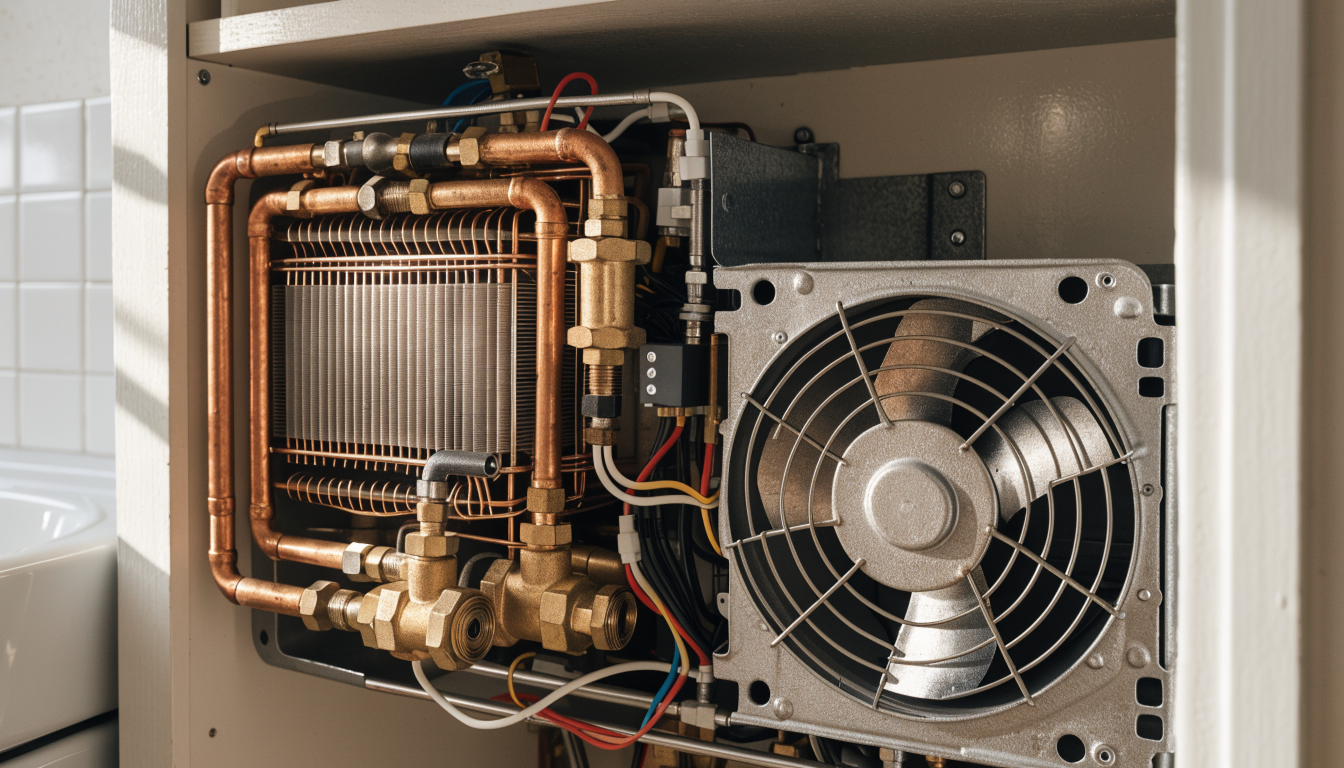
A boiler you cannot buy a heat exchanger for is finished. Its condition is irrelevant, its age is irrelevant and the engineer's opinion of it is irrelevant. This is the factor that genuinely decides most replacements, and it is the one that gets a single line in most articles.
So how long do manufacturers actually support a discontinued model? I went looking for a published commitment and could not find one.
- There is no legal requirement in the UK. The Ecodesign for Energy-Related Products and Energy Information Regulations 2021 do set minimum spare parts availability periods for some products, for example a minimum of seven years for electronic displays. Domestic boilers are not covered by any equivalent duty.
- The Government's 2024 consultation on updating ecodesign standards for hydronic space and combination heaters deals with efficiency, controls and modulation. It does not propose a spare parts availability period either.
- Worcester Bosch's own spare parts pages advertise next day availability for current parts but publish no commitment period for obsolete models. Vaillant's lifespan guidance does not mention parts availability at all.
That absence is the finding. There is no rule, so there is no number, and anyone who quotes you a flat "ten years and then parts stop" is repeating a rule of thumb rather than a policy. In practice the merchants and the pattern parts market keep common components going a long time after a model is withdrawn, which is why plenty of twenty year old boilers are still perfectly repairable.
What to do instead of guessing. Get the model name and the GC number off the data plate inside the boiler's casing door, then ring the manufacturer's technical line and ask whether the heat exchanger, gas valve and PCB for that specific model are still available. Do it before you authorise a repair, not after. A twenty minute phone call is the difference between spending money on a boiler with a future and spending it on one without.
The signs that actually mean something
Most "signs you need a new boiler" lists are a sales funnel with bullet points. Some of these symptoms genuinely indicate a boiler near the end. Others indicate a cheap fault on a boiler that is fine. The difference is worth knowing before somebody quotes you.
| Symptom | What it usually means | Does it justify a replacement |
|---|---|---|
| Repeated lockouts on the same fault code | One identifiable component or a system cause such as poor circulation | No, not until the cause is found |
| Pressure dropping constantly | A leak somewhere, or a failed expansion vessel | Rarely. A vessel is a repair |
| Rising gas bills with the same usage | Scale, sludge or a boiler that never gets into condensing mode | Only after the system has been checked |
| Banging or kettling from the boiler | Scale or sludge on the heat exchanger surface | Sometimes. The exchanger may already be damaged |
| Different components failing each winter | The system is attacking the boiler | Yes, this is the real pattern |
| Yellow or orange flame instead of blue | Incomplete combustion | Stop. This is a safety issue, not a shopping decision |
Pressure loss is the one that gets misdiagnosed most often. If your gauge keeps falling and you keep topping it up, work through why a boiler loses pressure first, and learn how to repressurise it properly. Neither of those is a reason to buy a boiler. Equally, if you have hot water but no heating, that is very often a diverter valve or a motorised valve rather than a dying appliance.
The flame colour is different in kind from everything else on that list. Incomplete combustion can produce carbon monoxide, which you cannot see or smell. Every home with a gas appliance should have an audible alarm, and there is a guide to choosing a carbon monoxide detector on this site. If the flame is not blue, turn the appliance off and call a Gas Safe registered engineer.
The efficiency arithmetic, done properly
The saving from replacing an old boiler is real, and it is routinely overstated. Rather than repeat a marketing percentage, here is the sum with the workings, so you can put your own numbers in.
The gas rate is the Ofgem price cap unit rate for 1 October to 31 December 2026, which is 7.97p per kWh with a 29.68p daily standing charge for a direct debit customer. The efficiencies are the usual comparison: an old non-condensing boiler at 70% against a modern condensing one at 90%.
The part the efficiency claims leave out
A condensing boiler only earns its rated efficiency when it condenses, and it only condenses when the water coming back from the radiators is cool enough, broadly below around 55 degrees C. A condensing boiler installed on a system running an 80 degree flow temperature, with radiators sized for the old boiler, spends most of its life not condensing at all. It is then a good boiler performing like an average one.
This is why so many people replace a boiler, watch the bill barely move, and conclude the saving was invented. The saving was not invented. It simply was not delivered, because the flow temperature was never turned down and the system was never balanced.
Now do the payback. Divide whatever your installation quote comes to by the annual saving you calculated above. For most houses, on most quotes, the answer runs into double figures in years. That is longer than the lifespan the manufacturer publishes for the boiler you are buying. Replacing a working boiler purely to save on gas very rarely adds up. Replacing a broken one is a different question entirely, and that is the question most people are really asking.
What a replacement costs, and why nobody can tell you yet
I am not going to give you a headline number, because any figure quoted without seeing your house is a guess dressed as information. What I can give you is the list of what moves the price, in the order it moves it.
- Whether the boiler type changes. A like-for-like combi swap in the same position is the cheapest job on the list. Converting a conventional system to a combi means removing a cylinder and tanks and reworking pipework, and it is a different order of cost.
- Whether the boiler moves. Moving it means new gas, water, condensate and flue routes, and it can easily add more than the difference between two boiler models.
- The flue run and where it terminates. A straightforward wall terminal is cheap. A long run through a loft, or a vertical flue through a roof, is not.
- The condensate drain. A modern boiler has to discharge condensate somewhere, and if there is no drain nearby that is extra work and sometimes a pump.
- System cleaning. A proper power flush or chemical clean, and a filter, is a real line item. It is also the line item most worth paying for, because it protects the new boiler's warranty.
- The boiler and the warranty length. This is the part everyone shops on and it is usually the smallest variable of the six.
Fixed price online installers such as BOXT and Heatable will give you a price before anybody visits, generated from an online questionnaire about your house. Those are their prices, on their terms, and they are genuinely fixed for the specification the questionnaire produces. They are not a survey. If the answers you gave were wrong about the flue, the drain or the pipework, the specification changes and so does the job.
Get at least three quotes from Gas Safe registered installers who have physically looked at the boiler, the flue route and the cylinder cupboard. A quote given over the phone is a marketing number.
Boiler cover on an older boiler: read the exclusions first
Boiler cover is the other thing people buy at this point in the decision, and it is sold hardest to exactly the people whose boilers are least likely to qualify for the good bits. This is editorial coverage, not a recommendation: there is no cover provider this site earns from, so take the following as an explanation of how the products are built rather than a steer towards one.
Take British Gas HomeCare, which publishes its terms plainly enough to quote. It states that "unlike some other insurers, we cover boilers of any age", which tells you something useful in itself: some other insurers do impose an age limit. Its own limits are worth reading carefully.
- Remove sludge or limescale from your system, or repair the damage caused by it.
- Cover any problem the boiler had before you joined, or one that appears in the first 14 days.
- Provide a free replacement boiler unless yours is less than 7 years old, or less than 10 if British Gas installed it. Older than that and they will still attempt a repair, but the free replacement is not included.
Look at the first of those exclusions again, because it is the whole argument of this page in one line. The single most common cause of premature boiler failure is the thing the cover explicitly will not pay to put right. An insurer has read the claims data and priced accordingly. You can draw the obvious conclusion about where your money is better spent.
The three things that genuinely extend a boiler's life
Two of these protect the boiler from the system. The third protects you from the boiler. None of them is expensive relative to a replacement, and none of them is a substitute for an annual service by a registered engineer.
1. Inhibitor, kept topped up
Inhibitor is a corrosion suppressant dosed into the heating circuit. It is not a one-off: it is consumed and diluted, and it needs checking and topping up, particularly after any work that has drained part of the system. Fernox F1 is the product the trade counter sold more of than anything else in the category, and it is dosed through a radiator or a filter, not through the boiler.
Fernox F1 Central Heating Protector
- Corrosion and scale inhibitor for sealed and open central heating systems
- 500ml concentrate, dosed via a radiator or a magnetic filter
- Suitable for mixed metal systems including aluminium radiators
Pros
- The standard UK trade inhibitor, so any engineer will recognise it
- Protects the component that costs the most to replace, the heat exchanger
- Cheap relative to a single heat exchanger repair
Cons
- Not a one-off. It dilutes and needs checking, and most owners never do
- Does nothing about magnetite already circulating, which needs a filter and a clean
- Will not rescue a system that is already heavily sludged
Assessed on specification and manufacturer documentation rather than hands-on testing. If your system has never been dosed, this is the cheapest thing you can do that measurably affects how long the boiler lasts.
There is a fuller explanation of dosing, how much to use and how to tell whether yours has any left in the guide to central heating inhibitor. Screwfix, Toolstation and Wickes all stock it in branch if you would rather collect it today: Screwfix, Toolstation, Wickes.
2. A magnetic filter on the return
Inhibitor slows corrosion down. A magnetic filter catches what corrosion has already produced, before it reaches the heat exchanger. Fitted on the return pipe into the boiler, it collects magnetite on a magnet in a canister that gets emptied at each service. Several manufacturers now require one as a condition of the longer warranties they advertise, which tells you what they think of the risk.
MagnaClean Professional2 22mm Magnetic Filter
- Fits 22mm return pipework into the boiler
- Magnetic core captures magnetite, with a chemical dosing point
- Serviced by emptying the canister at the annual service
Pros
- The filter most UK installers name by default, so servicing it is routine
- Required or recommended by several manufacturers for extended warranty terms
- Gives an engineer a visible read on how dirty the system actually is
Cons
- Needs a Gas Safe registered engineer or competent plumber to cut into the pipework
- Useless if nobody ever empties it, which is common
- Does not replace inhibitor, it works alongside it
Assessed on specification and manufacturer documentation rather than hands-on testing. Fit it at the same time as any boiler work rather than as a separate job, because the labour is the bulk of the cost.
Check the pipe size at the boiler before ordering, since 22mm is the common domestic return but not universal. The comparison of the different models is in the guide to MagnaClean magnetic filters. B&Q and Screwfix both list filters too: Screwfix, B&Q.
3. A carbon monoxide alarm
This one does nothing for the boiler's lifespan and everything for yours. An ageing gas appliance is exactly the scenario a CO alarm exists for, and an alarm costs a fraction of a service. The site's guide to carbon monoxide detectors covers why an alarm matters, where it goes, which standard to look for and how long the sensor lasts.
Where this stops being a DIY question
Frequently asked questions
Is a 12 year old boiler considered old?
It is old by the standard UK manufacturers publish, and middle-aged by the European figure. A 12 year old boiler that has been serviced annually, sits on inhibited water and has never had a significant fault is not a replacement candidate. A 12 year old boiler that has never been serviced, has black water in the radiators and has had three different parts fitted in two winters is. The age is the same in both cases and tells you nothing.
How do I know if my boiler needs to be replaced?
Three findings, together, are the honest trigger: different components failing repeatedly, a repair cost that is a serious fraction of a replacement, and confirmation from the manufacturer that key parts for your model are obsolete. One of those alone is usually a repair. The third one alone can be decisive, because a boiler without available parts cannot be maintained whatever its condition.
Is it worth replacing a 10 year old boiler?
Usually not, if it is working. A 10 year old boiler is almost certainly already a condensing boiler, so the efficiency gain over a new one is small and the payback arithmetic above will not stack up. The exception is if parts are already hard to source or the system has done visible damage to it.
How long do combi boilers last compared with other types?
A combi has more to go wrong inside the casing than a system or regular boiler does: a diverter valve, a plate heat exchanger for the hot water and the sensors that go with them. A regular boiler has the fewest components in the appliance itself, although the pump, vessel and valves still exist, just elsewhere in the house. In practice the difference in appliance lifespan is smaller than the difference water quality makes, and the trade-offs are covered in the guide to the pros and cons of a combi boiler. In a hard water area the plate heat exchanger is the combi's weak point, and it is a repair rather than a write-off.
How long does a boiler last if it is never serviced?
Nobody publishes a figure for this and I am not going to invent one. What can be said is that skipping the service removes the only scheduled opportunity anybody has to spot a degrading seal, a blocking condensate trap or combustion drifting out of range before it becomes a failure. It also voids most manufacturer warranties, which turns a covered repair into a bill.
Is replacing a boiler a big job, and how long does it take?
A like-for-like swap in the same position is commonly a one to two day job. Moving the boiler, changing the system type or removing a cylinder and tanks takes longer and involves making good afterwards. The installation time is driven by the pipework and the flue, not by the boiler itself.
How do I find out how old my boiler is?
Open the casing door and look for the data plate, which carries the model name, the serial number and the GC number. The manufacturer's technical line can date it from the serial number, and the same call is the one to use to ask about parts availability. Benchmark logbooks and old service records, if the previous owner left them, give you the service history as well, which matters far more than the date.
Related guides
- Central heating inhibitor: how much to dose, how to tell whether yours has any left, and why it runs out.
- MagnaClean magnetic filters: which model suits which pipe size, and what a filter can and cannot catch.
- Boiler losing pressure: the leak-versus-expansion-vessel diagnosis before anyone quotes you for a boiler.
- Common radiator problems: what cold spots, noise and leaks are telling you about the system water.
- How to balance radiators: the job that lets a condensing boiler actually condense.




0 Comments