
Turning a radiator off is a twenty second job, right up until the valve will not turn, or you close the wrong one, or you come back in March to find the room has damp in the corner.
There are two valves on a radiator and they do completely different jobs. Only one of them is meant to be turned off and on. The other is a setting, not a switch, and treating it like a tap is how people end up with a house that heats unevenly for the next two years without ever connecting the two events.
I spent 16 years running plumbers merchants across the south of the UK. A good number of the TRV heads I sold went to people whose valve was not broken at all.
The two valves, and which one you want
Every radiator has one at each end. They are not interchangeable.
| What it looks like | What it is for | |
|---|---|---|
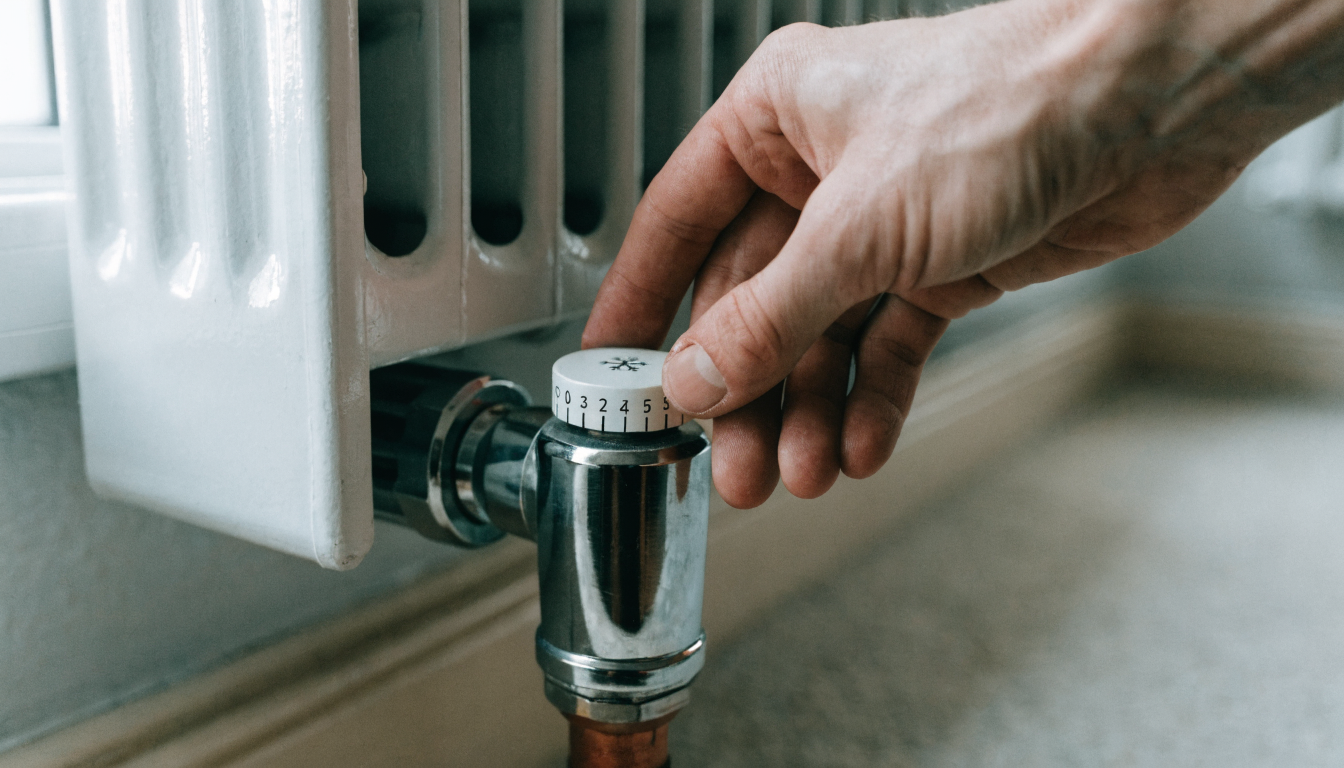
| The control valve | Either a numbered dial marked roughly 0 to 5 with a snowflake or star (a TRV), or a plain knob or wheel-head you twist (a manual valve) | Controlling this radiator. This is the one you turn off. |
| The lockshield | A plain plastic cap, often with no markings, that just sits there. Pull or unscrew it and there is a metal spindle underneath | Balancing the flow through this radiator against every other radiator in the house. A setting, not a switch. |
A lot of guides tell you the control valve is on the left and the manual valve is on the right. That is simply not true, and on a radiator that has been moved, replaced or plumbed by someone in a hurry it can be either way round. Identify them by what they look like.
Turning it off for normal use
This is what you want ninety-five per cent of the time: an unused room, a bedroom that gets too warm, a spare room in summer.
- If it has a TRV, turn the numbered dial clockwise down to 0, or better, to the snowflake or star if it has one. See below for why the snowflake is usually the right answer.
- If it has a manual valve, turn the knob clockwise until it stops. Firmly, but do not force it past its stop.
- Leave the lockshield alone. You do not need it for this, and touching it costs you your balancing.
That is it. Clockwise closes, anti-clockwise opens, the same as every tap in the house.
One thing worth knowing: a TRV at 0 is not perfectly watertight. It is a temperature control, not a stop valve, and a small amount of water will still pass. For everyday purposes that does not matter. For taking the radiator off the wall, it matters a great deal.
Isolating it completely, to remove or repair it
This is the other job, and it is the one where the lockshield comes into it. You need both ends shut to stop water flowing through the radiator at all.
- Turn the heating off and let things cool.
- Close the control valve fully clockwise.
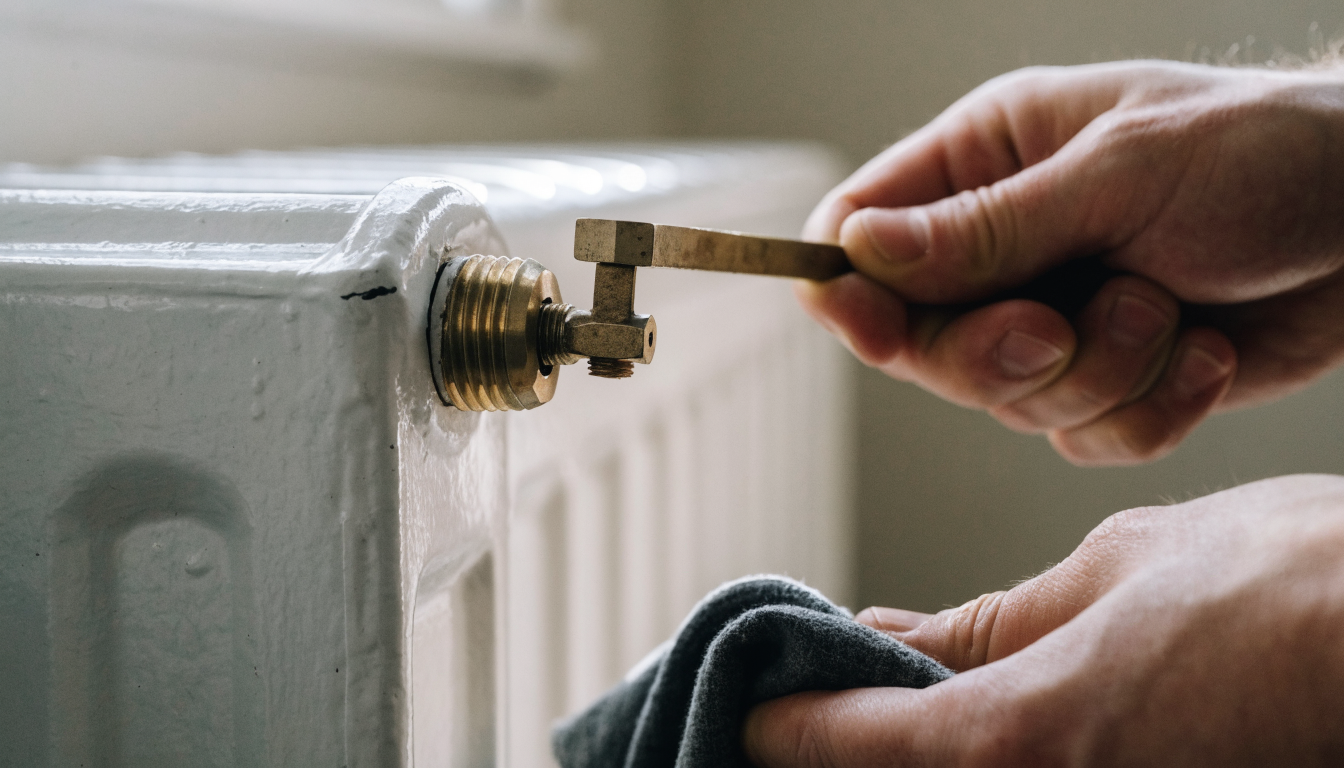
- Take the cap off the lockshield. Some pull off, some unscrew. Underneath is a small metal spindle, usually square or with a flat.
- Count the turns as you close it. Turn the spindle clockwise with a small adjustable spanner or pliers, counting every full turn and part turn until it stops. Write the number down. On a piece of masking tape stuck to the radiator is ideal, because you will not remember it in an hour.
- When you put it back, open it by exactly that many turns. Not "about two", exactly what you counted.
Why counting actually matters
Every guide tells you to count the turns. Almost none of them say why, so people treat it as optional fussiness. It is not.
The lockshield is how your system is balanced. Water takes the path of least resistance, so without balancing, the radiators nearest the boiler would get most of the flow and the far ones would barely warm up. Balancing means deliberately restricting the near radiators, by partially closing their lockshields, so the far ones get their share. Each lockshield in the house is set to a different, specific opening.
Close one fully and reopen it to a guess, and you have changed the flow through that radiator and, because it is all one circuit, nudged the flow through the others too. The symptom is not dramatic. It is one room that is now slightly cooler than it used to be, or a radiator at the far end that takes noticeably longer to warm. People rarely connect it back to the afternoon they took a radiator off to paint behind it.
Count the turns.
The valve that will not turn off
This is the most common reason anyone searches for this, and it is usually the cheapest thing in the house to fix.
A TRV works by pushing down on a small spring-loaded pin in the top of the valve body. Turn the dial down and the head presses the pin in to close the valve. That pin sticks, particularly if the radiator has sat in one position since last winter, because limescale and general gunge build up around it.
The radiator then stays hot no matter what the dial says, and the valve looks broken. It almost never is.
- Take the head off. There is usually a knurled collar or a small nut at the base of the dial. Undo it and the plastic head lifts straight off. No water comes out, this is the outside of the valve.
- Look at the pin in the middle. It should stand proud and spring back when you press it.
- If it is stuck down, grip it gently with pliers and work it up and down a few times. A tap with the handle of a screwdriver often frees one. A drop of penetrating oil helps, kept off the carpet.
- Once it springs freely, put the head back on and the valve will work again.
That is the fix for the large majority of "my TRV is broken" cases. If the pin genuinely will not free up, or the valve body weeps once you have been at it, then the valve needs replacing, which is a job involving draining down and is a reasonable point to call someone.
Worth preventing while you are there: open every TRV fully over the summer when the heating is off. A valve left closed for six months is exactly the one that seizes. Turning them all up to maximum in April costs nothing and saves the whole performance in October.
Why "off" is usually the wrong setting for an empty room
Here is the part that most pages telling you to turn radiators off to save money leave out.
Use the frost setting, not zero
The snowflake or star on a TRV dial is a frost protection setting, typically holding the room somewhere around 5 to 8 degrees. It is not the same as 0.
A completely unheated room in a British winter gets cold enough that warm moist air drifting in from the rest of the house condenses on the cold walls, particularly in corners and behind furniture on an outside wall. That is how you get black mould in a spare bedroom nobody uses. The heating cost of holding a room just above that threshold is small. The cost of redecorating a damp wall is not.
The frost setting also protects the pipework in genuinely cold spells, which matters if any of it runs through an unheated space.
The saving is smaller than you think
Turning one radiator off does reduce what you spend, but not in proportion to the number of radiators, for two reasons.
First, heat moves. A cold room next to warm rooms draws heat through the walls and doors, so the neighbouring radiators work slightly harder.
Second, and less obviously, a condensing boiler is at its most efficient when it is running gently against a lot of radiator surface and returning cool water to the boiler. Shut off a good proportion of your radiators and the return water comes back hotter, the boiler stops condensing properly, and its efficiency drops. You can genuinely lose a slice of what you thought you were saving.
Turning off one or two genuinely unused rooms is sensible. Turning off half the house to save money is working against the boiler.
Never turn them all off
A heating system needs somewhere for the water to go while the boiler is firing. Close every radiator and the pump is pushing against a dead end. Most systems have either an automatic bypass valve or one radiator deliberately left without a TRV, usually the bathroom or the hall, precisely to guarantee a minimum flow.
If one of your radiators has no TRV, that is almost certainly deliberate. Do not "fix" it by fitting one. Without that path the boiler short cycles, firing and cutting out repeatedly, which is hard on it and wasteful.
Frequently asked questions
Which way do I turn a radiator valve to turn it off?
Clockwise to close, anti-clockwise to open, on both the control valve and the lockshield. Same as a tap.
How do I know if my radiator valve is open or closed?
On a TRV, read the dial: 0 or the snowflake is closed, 5 is fully open. On a manual valve, turn it anti-clockwise counting the turns until it stops, which tells you how far open it was, then set it where you want. For a lockshield with the cap off, turn it clockwise counting until it stops, and that count is how far open it had been. Note the number before you change anything.
Can I turn off just one radiator?
Yes, that is exactly what the control valve is for. Use the frost setting rather than 0 if the room is going to be unused for a long stretch through winter.
Why are my radiators still hot when the heating is off?
Different problem, and not a radiator fault. The usual causes are a zone valve stuck open so the heating circuit stays live while the boiler is heating water, a boiler running its own pump overrun after shutdown (which is normal and brief), or on an older gravity system, hot water rising through the circuit by convection. If a radiator is hot hours after everything has shut down, a stuck zone valve is the first thing to check.
Can I turn off a radiator that is leaking?
Yes, and you should, straight away. Close both valves as described above to isolate it, which will stop or greatly slow the leak while you get someone to look. Put a container under it in the meantime. If the leak is coming from the valve body rather than a joint, closing the valve may not stop it, in which case the system needs draining down.
My radiator has no knob on one end at all. How do I turn it off?
That end is the lockshield, and the plain cap is meant to be there. Pull or unscrew it and turn the spindle underneath with pliers or a small spanner, counting the turns. If both ends have plain caps, the radiator has two lockshields, which happens on older installations, and neither is intended as a control. It will work, but you are balancing rather than switching, so count carefully at both ends.




0 Comments