
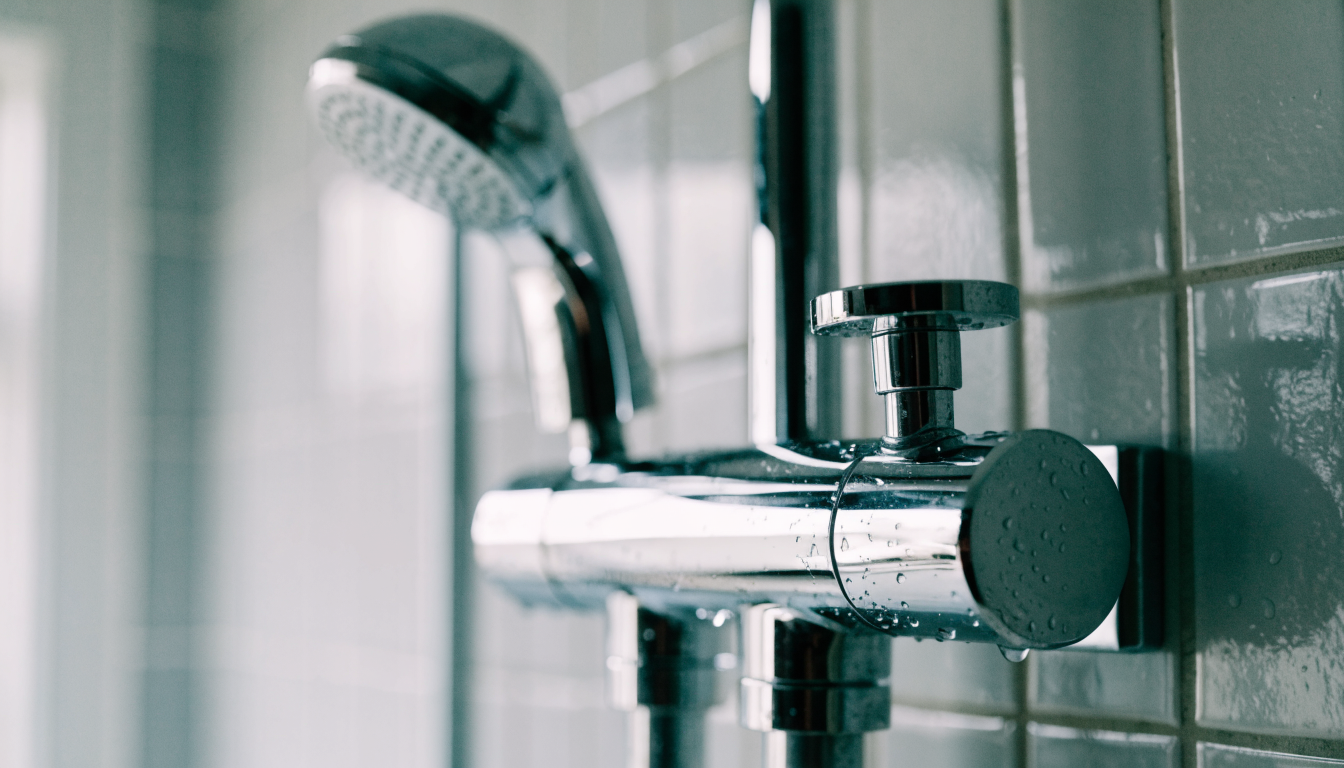
A mixer shower blends hot and cold water from your existing plumbing inside a valve, and sends the result to the shower head. It does not heat any water itself. That is the whole idea, and every page on the internet will tell you the same thing.
What almost none of them will tell you is when a mixer shower is the wrong choice for your house, because nearly every page ranking for this question is written by a company that sells mixer showers.
I spent 16 years running plumbers merchants across the south of the UK. Mixer showers were the single most common thing people brought back, and it was almost never because the shower was faulty. It was because it did not suit the plumbing it had been fitted to. So this guide covers how they work, and then spends most of its time on the part that decides whether you will be happy.
The question that actually matters: what system have you got?
Go and look before you buy anything. It takes two minutes and it determines everything.
| Your system | How to tell | Mixer shower verdict |
|---|---|---|
| Combi boiler | No tanks anywhere. No hot water cylinder in a cupboard, nothing in the loft. Boiler on the wall, hot water is instant and endless | Good. Mains pressure on both sides, naturally balanced. Almost any bar mixer works. Flow is capped by the boiler, see below |
| Unvented cylinder (Megaflo and similar) | A large insulated cylinder, usually white metal, with an expansion vessel and pressure valves plumbed around it. No tank in the loft | Best case. Mains pressure and high flow at the same time. This is what a big rain head actually needs |
| Gravity fed | A cold water tank in the loft and a copper cylinder in an airing cupboard | Careful. Standard bar mixers will barely dribble. You need a gravity-rated valve, or a pump |
| System boiler with vented cylinder | Cylinder in a cupboard plus a small tank in the loft, boiler with no tanks of its own | Careful, same as gravity. The hot side is still tank-fed |
The gravity-fed problem, with the number
On a gravity system, your water pressure comes from nothing but the height of the tank above the shower. The rough rule is 0.1 bar for every metre of height between the bottom of the cold tank and the shower head.
A typical two storey house with a tank in the loft and a shower on the first floor might give you two or three metres of head, so 0.2 to 0.3 bar. Most standard bar mixer showers want 1.0 bar minimum to work as designed.
That is the entire explanation for the most common complaint I ever heard across a trade counter: someone buys a nice bar mixer, fits it in a 1960s house, and gets a trickle. The shower is fine. It was never going to work there.
A bungalow is worse again, because the tank may be barely a metre above the shower head. And if the shower is on the same floor as the tank, or above it, gravity gives you nothing at all.
Your two options are a valve specifically rated for low pressure or gravity, which manufacturers state clearly in the spec as something like "0.1 bar minimum", or a shower pump. Which brings us to the expensive mistake.
Three compatibility mistakes worth avoiding
1. Fitting a pump to a combi
You cannot fit a shower pump to a combi boiler, and you cannot fit one to an unvented cylinder either.
Shower pumps are designed to draw water from a stored supply, a tank and a cylinder, where there is a reservoir to pull from. On a mains pressure system there is nothing to draw from: the pump would be pulling directly on the incoming main, which your water company does not permit and which the pump is not built for. Manufacturers say so in the instructions, and it invalidates the warranty.
If your combi shower feels weak, the answer is not a pump. It is almost always flow rate rather than pressure, which is a different problem with a different fix. There is more on that in the guide to improving shower pressure on a combi.
2. Feeding the mixer from two different pressures
A mixer valve works by blending two supplies. It assumes they arrive at roughly similar pressure. Feed it mains cold on one side and gravity-fed tank hot on the other and the cold will simply overwhelm the hot.
The result is a shower that is either freezing or, when you crank the dial to compensate, wildly unstable. People blame the valve. The valve is doing exactly what it was designed to do with the supplies it has been given.
Both supplies need to come from the same source: both from the mains, or both from the stored system. This is the sort of thing that gets bodged during a bathroom refit and then puzzles people for years.
3. Buying a rain head your boiler cannot feed
This one is worth understanding because it is the difference between pressure and flow, and the two get muddled constantly.
A combi boiler's hot water output is limited by its kilowatt rating. A modest combi might deliver somewhere around 10 litres a minute of genuinely hot water; a large one considerably more. That figure is on the boiler's data badge, usually quoted as litres per minute at a 35 degree rise.
A large rain head can want 15 litres a minute or more to look anything like the photograph. Fit one to a boiler that cannot supply that, and no valve, no pump and no plumber will fix it. You will have plenty of pressure and not enough water.
Check your boiler's flow rate before you fall in love with a shower head. It is the single most useful number in this whole subject and virtually nobody looks it up.
The types, and which ones matter
Thermostatic or manual
This is the only distinction that genuinely affects safety, and it is worth paying for.
A manual mixer just blends in whatever ratio you set. If someone runs a tap and the cold pressure drops, the mix goes hot. That is how people get scalded.
A thermostatic mixer contains a wax or bi-metallic cartridge that senses outlet temperature and continuously adjusts the blend to hold it steady. If the cold supply fails entirely, a thermostatic valve shuts down rather than delivering scalding water.
Buy thermostatic. In a household with children or anyone elderly, treat it as non-negotiable.
One caveat from the trade counter: the thermostatic cartridge in a cheap bar mixer is a consumable. In a hard water area it scales up and gets sluggish or sticks, typically after a few years. That is not a fault, it is the nature of the part, and on better valves the cartridge is a replaceable item rather than a reason to bin the shower.
Exposed, concealed and the rest
- Bar mixer. The horizontal bar across the wall with a control at each end. The most common type, easiest to fit, easiest to replace when it fails.
- Concealed valve. Only a plate and handles show, the working parts are buried in the wall. Looks better. Remember that when it needs a cartridge in eight years, somebody has to get at it, so think about access before you tile over it.
- Single lever. One lever for both temperature and flow. Convenient, though it makes it harder to return to exactly the same temperature each time.
- Sequential. One control, turned progressively from off through cold to hot. Common in care and commercial settings because it is hard to get wrong.
- Digital. An electronic processor unit hidden elsewhere with a small control panel in the shower. Genuinely good, considerably more expensive, and it does need a power supply, so it is not a like-for-like swap.
Exposed versus concealed is a decision about looks and future access, not performance. Bar versus single lever is about preference. Thermostatic versus manual is the one that matters.
What a mixer shower really costs to run
Every retailer page says mixer showers are cheaper to run than electric ones. The picture is more interesting than that, and the arithmetic is worth seeing.
Using the Ofgem cap for 1 October to 31 December 2026: electricity at 26.32p per kWh, gas at 7.97p per kWh.
A 9.5kW electric shower, ten minutes. 9.5kW for a sixth of an hour is 1.58 kWh, which costs about 42p.
A mixer shower on gas, ten minutes at 12 litres a minute. That is 120 litres, raised from roughly 10 degrees to about 40. The heat needed is around 4.2 kWh, and allowing for boiler efficiency call it 4.9 kWh of gas, which costs about 39p.
Almost identical. Which is not what anyone expects.
The reason they land so close is that they are not delivering the same shower. A 9.5kW electric shower can only heat about 4.5 litres a minute to a comfortable temperature, so ten minutes gives you roughly 45 litres. The mixer gave you 120. Per litre of hot water, gas is dramatically cheaper. Per shower, you simply use a lot more of it.
If you are on a water meter that matters, because the extra 75 litres has to be paid for twice, once as supply and once as wastewater. On a metered supply a generous mixer shower can genuinely cost more per shower than a weak electric one.
So the honest version is this: a mixer shower is far cheaper per litre and usually a much better shower. It is not automatically cheaper per shower, and on a meter it may not be cheaper at all. What you are buying is a better shower at similar cost, not the same shower for less.
One more thing nobody mentions: an electric shower's flow depends on how cold the incoming mains is, because it has a fixed kilowatt rating to work with. In February the mains is colder, so the flow drops to keep the temperature up. That is why electric showers feel notably worse in winter, and it is not your imagination.
Frequently asked questions
What is the difference between a mixer shower and a thermostatic shower?
They are not alternatives. Thermostatic is a feature of a mixer shower, not a different kind of shower. All thermostatic showers are mixer showers; not all mixer showers are thermostatic. A manual mixer blends in whatever ratio you set it to, a thermostatic one actively holds the outlet temperature steady.
Does a mixer shower need electricity?
No, with two exceptions. A standard mixer shower is entirely mechanical and needs no power at all. A digital mixer needs a supply for its processor unit, and a shower pump needs a fused spur. The valve itself never does.
Which is cheaper to run, electric or mixer?
Per litre of hot water, a gas-heated mixer is far cheaper, because gas costs roughly a third of what electricity does per kWh. Per shower they come out remarkably close, because a mixer delivers two to three times as much water. On a water meter the mixer can work out dearer. The full arithmetic is above.
What are the common problems with mixer showers?
In order of how often I saw them: the valve was never suited to the water system in the first place; the thermostatic cartridge has scaled up in a hard water area and gone sluggish or stuck; the shower head and hose are blocked with limescale, which looks exactly like a pressure problem and is not; the flow restrictor fitted in the head is doing its job and the owner did not know it was there. Actual valve failure is some way down the list.
Do you need a plumber to fit one?
Swapping a bar mixer for another bar mixer onto existing wall fittings is a competent DIY job and needs no notification. Anything involving moving pipework, fitting a concealed valve into a wall, installing a pump or altering a stored water system is a plumber's job, and anything touching an unvented cylinder legally requires someone G3 qualified.
How long does a shower mixing valve last?
The valve body will outlast the house. The thermostatic cartridge inside it is the wearing part, and in a hard water area it is the one that decides the lifespan. A cheap bar mixer where the cartridge is not serviceable tends to be a replace-the-whole-thing item after a few years. A better valve with a replaceable cartridge keeps going. In a hard water area that difference is worth more than the finish or the brand.
Related guides
- The best mixer showers in 2026
- The best mixer showers for low water pressure, if you are on a gravity system
- The best showers for combi boilers
- The best electric showers, if a mixer is not right for your system
- How to increase shower water pressure with a combi boiler



0 Comments