

As an Amazon Associate I earn from qualifying purchases.
Most pages about electric showers rank them by price and spray patterns. That skips the question that actually decides the purchase, which is whether your house can feed the unit at all. An electric shower takes cold water off the rising main and needs its own circuit from the consumer unit, so the shortlist is set by your cable and your water supply before anyone's opinion of a showerhead comes into it.
Three findings shape this guide. Cost per litre of hot water is identical across every kW rating, so going up in power makes a shower quicker, never cheaper, and the arithmetic is below. The same shower delivers measurably less water in February than in August, which is not a fault and is the single most common complaint about a unit that is working exactly as designed. And the one feature here that changes an outcome rather than an experience is thermostatic control, which only one of these seven units actually has.
A word on how this is judged. These picks rest on published specifications, manufacturer documentation and 16 years of running plumbers merchants in the south of the UK, where I saw which showers came back through the returns door and which ones the fitters asked for by name. I have not fitted or used these units myself, and I am not a plumber or an electrician. Where a figure is arithmetic rather than a published number, it says so.
At a glance
- Best value: Triton Seville 8.5kW, the default answer for a second bathroom or a straight replacement.
- Best for replacing an older Triton: Triton T80Z Fast-Fit 8.5kW, because the swivel fittings meet existing pipe and cable positions.
- Best for a tank-fed cold supply: Triton T80SR 8.5kW pumped, the only unit here that runs off a gravity tank.
- Best looking: Triton Amore Slender 9.5kW, if the shower is on show and the circuit will take 9.5kW.
- Best thermostatic: Mira Advance Flex Extra 8.7kW, and the only pick here for a care setting.
- Best mid-range all-rounder: Mira Sport Max 9kW, where Airboost makes a modest flow feel better than it measures.
- Best dual outlet: Triton Danzi DuElec 9.5kW, with the caveat that rainfall heads and electric showers are a compromise.
The seven compared
The output column is the rating of the specific listing linked, not the highest rating the model is sold in. Several of these ranges run from 7.5kW to 10.8kW under the same name, which is where a lot of confusion starts.
| Product | Best for | Output | Water feed | Watch out for | Buy |
|---|---|---|---|---|---|
 Best value Triton Seville | A straight replacement | 8.5kW | Cold mains | Not thermostatic, single spray | Check price on Amazon |
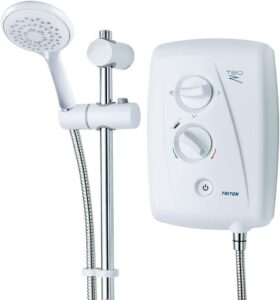 Best retrofit Triton T80Z Fast-Fit | Replacing an older Triton | 8.5kW | Cold mains | Fast-fit only helps on a Triton swap | Check price on Amazon |
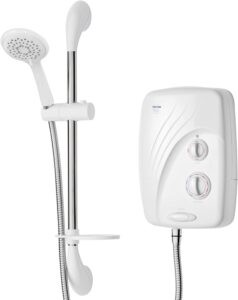 Best tank-fed Triton T80SR pumped | A gravity tank supply | 8.5kW | Tank fed, 8cm minimum head | A pump is one more thing to fail | Check price on Amazon |
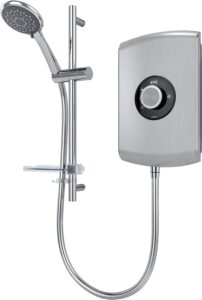 Best looking Triton Amore Slender | A bathroom that has been done properly | 9.5kW | Cold mains | 9.5kW often means a circuit upgrade | Check price on Amazon |
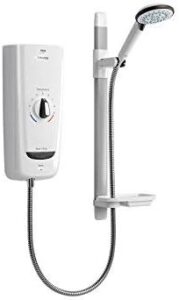 Best thermostatic Mira Advance Flex Extra | Care settings, children, limited grip | 8.7kW | Cold mains | Lower flow than a 9.5kW at similar money | Check price on Amazon |
 Best all-rounder Mira Sport Max | Making a modest flow feel better | 9kW | Cold mains | Confusing range, check the model number | Check price on Amazon |
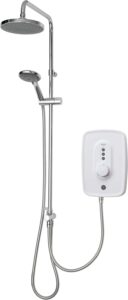 Best dual outlet Triton Danzi DuElec | A fixed head plus a handset | 9.5kW | Cold mains | Rainfall heads suit high flow, not this | Check price on Amazon |
How an electric shower works, and the three things that follow from it
An electric shower takes one cold feed off the rising main, passes it over a heating element inside the unit, and heats it on the way through. Nothing is stored, and your hot water system plays no part at all. That single fact explains most of what people like and dislike about them.
It keeps working when the boiler does not. Because it never touches your hot water, an electric shower carries on regardless of a dead boiler, a cold cylinder or a household that has used all the hot water. That independence is why so many of them end up in second bathrooms, en suites and loft conversions rather than as a main shower.
The flow rate is decided by the kW rating, not by your water pressure. A fixed amount of power has to lift the incoming water up to showering temperature, so the unit throttles the flow to achieve that. Turn it up and the water gets cooler, not faster. This is the part that disappoints people who expected a mains pressure shower to behave like a mains pressure mixer. Our breakdown of electric shower wattage sets out what each step up in kW buys you.
It is not a power shower, whatever it looks like on the wall. The two get confused constantly because both are boxes with a control dial. A power shower is a pump and a mixer in one housing, it takes both hot and cold from a gravity system with a tank in the loft, and it will not work on a combi or an unvented cylinder. An electric shower takes cold only and works on any system. If you are not certain which you want, the different types of shower works through what each system will and will not take, electric showers versus mixer showers settles the most common comparison, and the best power showers covers the other option properly.
Will your house take one? Check the circuit before you choose a kW rating
The question that decides this purchase is not which electric shower is best in the abstract, it is which one your house can actually feed. An electric shower needs its own dedicated circuit from the consumer unit, with the cable and the protective device sized for the load. Going up in kW from whatever is already on the wall is the most common way a cheap shower turns into an expensive job.
The water side is simpler. The cold feed has to come straight off the rising main in 15mm or larger pipe, and most units want at least 0.7 bar of running pressure at the shower. A tank-fed cold supply will not run a standard electric shower, which is why the pumped models exist, and why the T80SR below is the only pick here that will work on gravity.
| Shower output | Typical cable | Typical MCB |
|---|---|---|
| 7.5kW | 6mm | 32A |
| 8.5kW | 6mm | 40A |
| 9.5kW | 10mm | 45A |
| 10.5kW or 10.8kW | 10mm | 50A |
One more specification worth settling before you shop. A thermostatic electric shower holds the temperature when the pressure moves, for instance when someone opens a tap or flushes a toilet elsewhere in the house. Of the seven units here, only the Mira Advance Flex Extra is sold as thermostatic. Triton labels its thermostatic models explicitly and none of these Triton units carry that label: the Danzi DuElec specification states thermostatic, no. Everything else on this list manages temperature by stabilising pressure, which is not the same thing and is not a safeguard against scalding.
What an electric shower actually costs to run
Under the Ofgem price cap for 1 October to 31 December 2026, the national average electricity unit rate is 26.32p per kWh with a standing charge of 54.83p a day, for a single-rate direct debit tariff. Checked on 8 October 2026. Everything in this section is arithmetic from that rate, so if your tariff differs, scale it.
A shower's running cost is its kW rating multiplied by the time it is on. A 10 minute shower at 8.5kW uses 1.42kWh, which is 37p. The same 10 minutes at 10.8kW uses 1.8kWh, which is 47p. Over a year, one 10 minute shower a day works out as follows.
Arithmetic, not a published manufacturer figure: kW multiplied by hours, multiplied by the Ofgem capped unit rate of 26.32p per kWh for 1 October to 31 December 2026. One shower a day, 365 days. Two people doubles it.
Now the part that gets left out everywhere else. The bigger unit does not cost more per litre of hot water, it costs more per minute, because it is giving you more litres per minute. Work it through at a 35 degree temperature rise, which is roughly a winter mains temperature up to a comfortable showering temperature. The 8.5kW unit delivers about 3.5 litres a minute, so a 10 minute shower is 35 litres for 37p, which is 1.07p a litre. The 10.8kW unit delivers about 4.4 litres a minute, so the same 10 minutes is 44 litres for 47p, which is also 1.07p a litre.
The two numbers are identical, and they have to be. Electric showers convert essentially all the electricity they draw into heat in the water, so the energy per litre at a given temperature rise is fixed by physics and not by the model. Going up in kW buys you a better shower, not a cheaper one. The only ways to spend less are to use less water or to spend less time under it. That is also why an energy class on an electric shower listing tells you almost nothing useful: there is no meaningful efficiency difference to label.
| Output | Winter flow, 35 degree rise | Summer flow, 25 degree rise | 10 minutes costs |
|---|---|---|---|
| 7.5kW | 3.1 litres a minute | 4.3 litres a minute | 33p |
| 8.5kW | 3.5 litres a minute | 4.9 litres a minute | 37p |
| 9.5kW | 3.9 litres a minute | 5.4 litres a minute | 42p |
| 10.5kW | 4.3 litres a minute | 6.0 litres a minute | 46p |
| 10.8kW | 4.4 litres a minute | 6.2 litres a minute | 47p |
If running cost is the deciding factor rather than a curiosity, our guide to energy efficient electric showers goes through the features that genuinely reduce consumption and the ones that are marketing.
Why this list is mostly Triton and Mira
Six of the seven picks here are Triton and the other is Mira, and that deserves an explanation rather than being left to look like laziness or a deal. Triton and Mira dominate what is actually buyable and supportable in the UK at these prices. They are what the trade counters stock, what the vans carry, and what you can get a solenoid or a shower head for in a week rather than a month. The shopping results on this search are almost entirely Triton and Mira units, and the top-ranked answer on the question that Google puts above everything else for this term says flatly that Triton is the market leader.
Spares availability is not a small consideration on a product with a two year guarantee and a hard water area working against it. The failures I saw come back across the counter were rarely about the badge on the front. They were scaled elements, blocked heads and circuits that were never right in the first place, and the thing that decided whether the customer got a working shower again was whether the part was on the shelf.
To be clear about what this list is not: Bristan, Aqualisa, Gainsborough and Redring all make electric showers, and some of them are perfectly sound units. They are covered here as context rather than as recommendations, because availability and spares support for them is thinner than for the two big names and I have not verified current listings for them. If you find a good price on one and your local merchant stocks the range, that is a reasonable buy. This is a list of what you can buy today and keep running in five years, not a claim that nobody else makes a decent electric shower.
The best electric showers for 2026
Best value: Triton Seville 8.5kW
The Seville is the unit that gets fitted when the job is to put a working shower back on the wall without a conversation about it. It is an 8.5kW cold mains unit in a plain white case, with rotary controls for temperature and power and universal cable and water entry points so it meets most existing Triton pipework. Triton list a two year parts and labour guarantee.
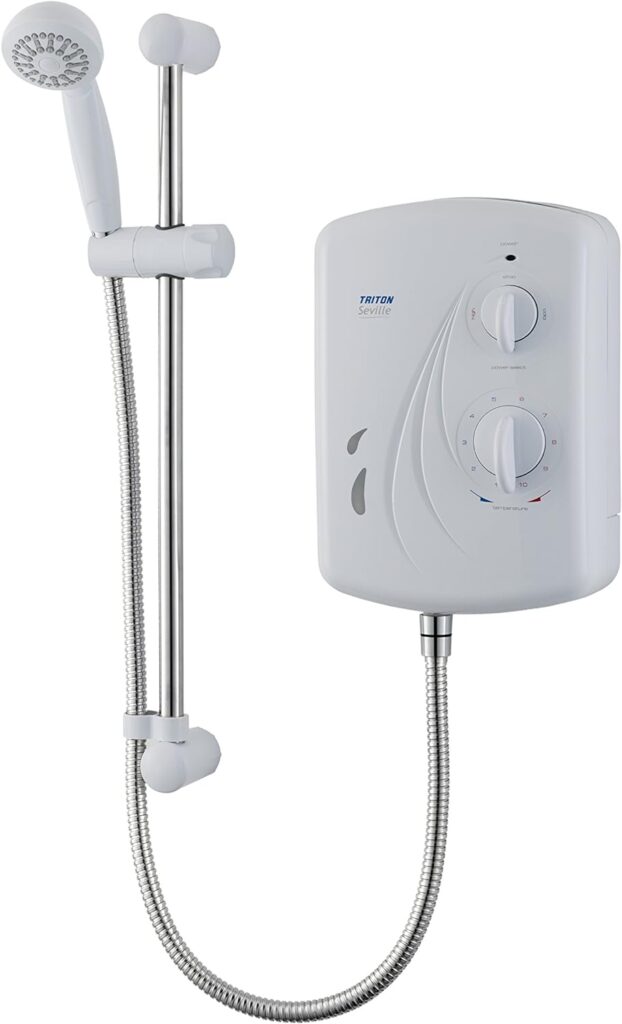
#1 Best value
Triton Seville 8.5kW Universal Electric Shower
- 8.5kW output, cold mains fed
- Rotary temperature and power controls
- Universal cable and water entry points for a like-for-like swap
- Single spray rub-clean handset
- 2 year parts and labour guarantee
- Also sold in 7.5kW, 9.5kW and 10.5kW outputs
Pros
- The cheapest sensible way to get a working shower back on the wall
- Universal entry points mean most existing Triton pipe and cable positions line up
- Simple rotary controls with nothing to fail electronically
- Spares are carried by every merchant and most plumbers
Cons
- Not thermostatic, so the temperature moves if someone opens a tap elsewhere
- Single spray pattern only, with no diverter or rainfall option
- Plain white plastic case with no attempt at styling
- 8.5kW is a modest flow and noticeably more so in winter
The default answer for a second bathroom, a rental, or a straight replacement where nobody is going to judge the shower on anything but whether it works. Stay at 8.5kW unless the existing circuit is already sized for more, because the saving on the unit disappears the moment an electrician has to run new cable.
Best for replacing an older Triton: Triton T80Z Fast-Fit 8.5kW
The T80Z exists to make a replacement quicker. Its swivel-fit and swing-fit connections let the installer meet the pipe and cable entries that are already in the wall rather than chasing out new ones, which on a like-for-like Triton swap is a genuine saving in time and making good. Mechanically it is the same proposition as the Seville with a better handset.
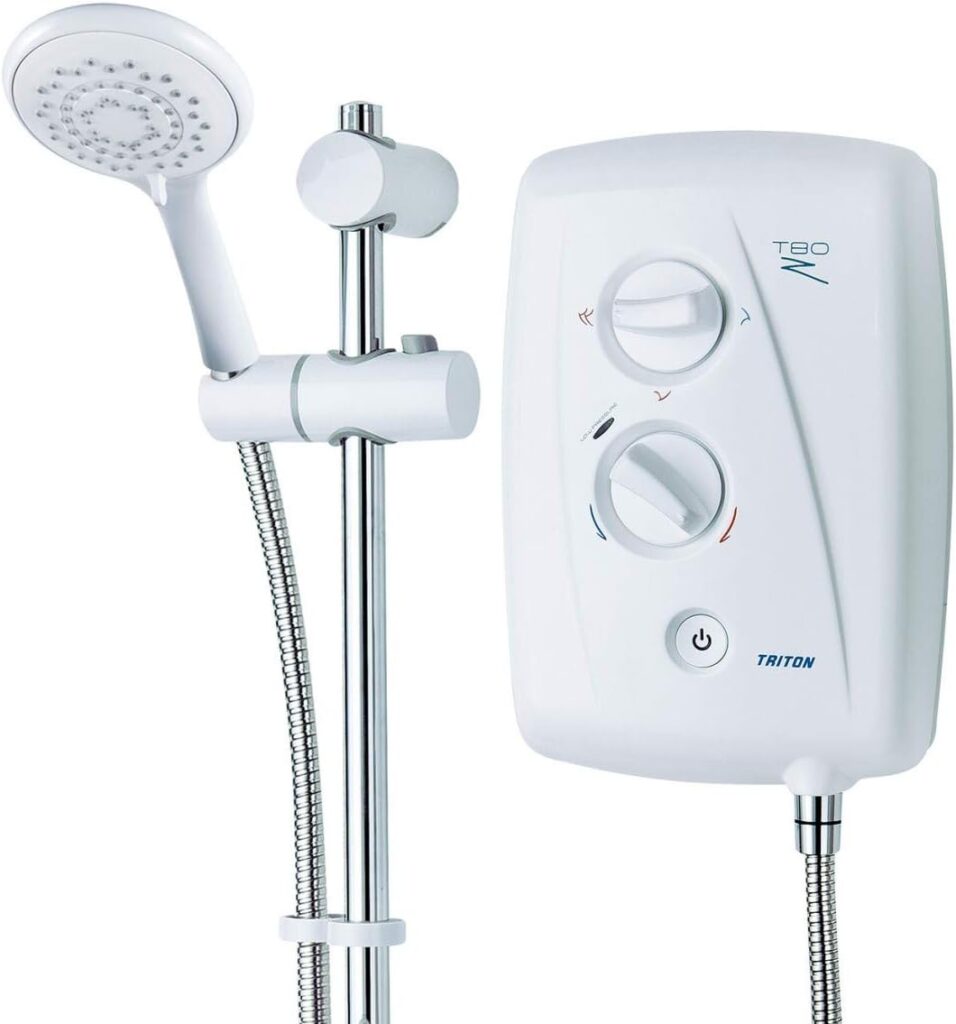
#2 Best retrofit
Triton T80Z Fast-Fit 8.5kW Electric Shower
- 8.5kW output, cold mains fed
- Swivel-fit and swing-fit connections for existing pipe and cable entries
- 5 spray rub-clean handset
- 2 year parts and labour guarantee
- Also sold in 7.5kW, 9.5kW and 10.5kW outputs
Pros
- The swivel and swing fittings are a real time saver on a replacement
- 5 spray handset is a step up on the Seville for very little more
- Part of the T80 range, which has the best spares availability of any electric shower in the UK
Cons
- Not thermostatic
- The fast-fit advantage only pays off if you are replacing another Triton, and buys nothing on a new installation
- Case is a similar grade of plastic to the cheaper Seville
- No temperature readout, so settings are guesswork on the dial
Worth the small premium over the Seville only if you are taking an old Triton off the wall and want the new one to meet the same pipe and cable positions. On a fresh installation there is no advantage here to pay for, so buy the Seville instead.
Best for a tank-fed cold supply: Triton T80SR 8.5kW pumped
This is the pick most often bought by the wrong person, so read this part carefully. The T80SR has an integral pump and is designed to run from a cold water storage tank, which B&Q and Triton state can be as little as 8cm above the unit. That is an unusually low head requirement and it solves a real problem in a loft conversion or a top floor bathroom on a gravity system.
What it does not do is fix low mains pressure. If your cold water comes off the rising main, as it does on a combi or an unvented cylinder, a pumped tank-fed unit is the wrong product and a standard shower will give you the same flow for less money. The phrase low water pressure on the marketing sells this unit to a lot of people who needed something else entirely.
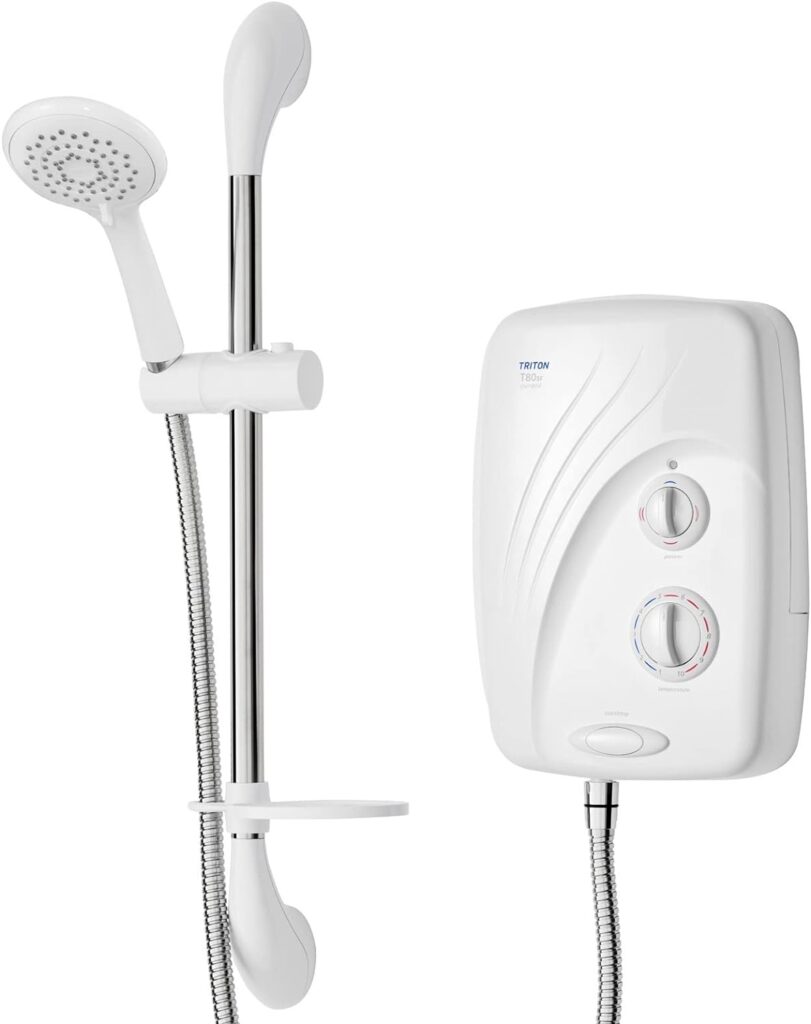
#3 Best for tank-fed systems
Triton T80SR 8.5kW Pumped Tank Fed Electric Shower
- 8.5kW output with an integral pump
- Fed from a cold water storage tank, which can be as little as 8cm above the unit
- Numbered temperature dial, push start and stop, power selector with cold, economy, medium and full
- Multi-mode rub-clean handset with riser rail and anti-twist hose
- 2 year parts and labour guarantee
Pros
- Solves the one problem a standard electric shower cannot, which is a gravity cold supply with almost no head
- The 8cm minimum head is unusually low and matters in a loft or top floor bathroom
- Power selector lets you drop to economy in summer when flow is already higher
- Riser rail and hose are included, which is not always the case at this price
Cons
- It is a pumped unit for tank-fed systems, not a cure for low mains pressure on a combi or unvented cylinder
- A pump is one more component to fail, and it is audible even in the quieter running version
- Dearer than a standard 8.5kW unit that would give the same flow on a mains feed
- Not sold as thermostatic, despite having a numbered temperature dial
Buy this only if your cold supply genuinely comes from a tank in the loft. On a mains cold feed it is money spent on a pump you do not need and a noise you did not want. Check where your cold water comes from before you order, not after.
Best looking: Triton Amore Slender 9.5kW
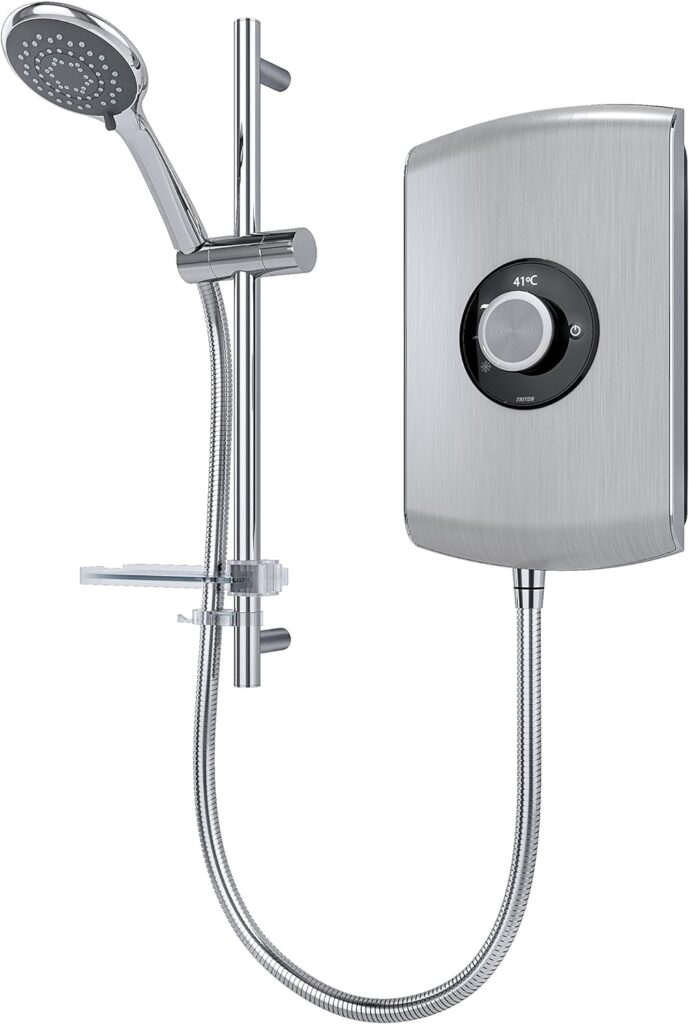
The Amore is the only unit here that does not look like a white plastic box on a tiled wall. The listed version is 9.5kW in brushed steel, with a digital temperature readout, touch-activated controls and a phased shutdown that flushes the element with cooler water to slow limescale. In a hard water area that last feature is worth more than the finish.
#4 Best looking
Triton Amore Slender 9.5kW Electric Shower, Brushed Steel
- 9.5kW output, cold mains fed
- Brushed steel finish, also sold in white and gloss black
- Digital display with temperature readout
- Touch-activated power selector and temperature control
- Phased shutdown to reduce limescale in the element
- 5 spray handset with riser rail and 1.5m anti-twist hose
Pros
- The only pick here that suits a bathroom that has been properly finished
- Digital readout makes a temperature setting repeatable instead of guesswork
- Phased shutdown is a genuine benefit anywhere with hard water
- 9.5kW gives a usefully better winter flow than the 8.5kW units, roughly 3.9 litres a minute against 3.5
Cons
- You are paying for the finish rather than the performance
- Brushed steel shows water spots and fingerprints, and the bathroom it suits is the one where that gets noticed
- The slim case limits where cable and pipe can enter, making it a poorer like-for-like swap than the T80Z
- 9.5kW is the output where circuit upgrades start appearing, since many existing showers are on cable sized for 8.5kW
The pick if the shower is on show and the room has been done properly. Get the existing cable rating checked before you commit, because the jump from 8.5kW to 9.5kW is exactly where a cheap upgrade turns into an electrician and a morning of mess.
Best thermostatic: Mira Advance Flex Extra 8.7kW
This is the only unit on the list sold as a thermostatic electric shower, and that makes it the only one I would put in a house where somebody cannot move quickly. A thermostatic unit holds its temperature when the pressure changes, so a toilet flushing elsewhere in the house does not produce a surprise. The controls are two large separate handles rather than a small dial, which matters as much as the thermostat for anyone with limited grip or sight.

#5 Best thermostatic
Mira Advance Flex Extra 8.7kW Thermostatic Electric Shower
- 8.7kW output, cold mains fed
- Thermostatic, sold specifically as a thermostatic electric shower
- Two large separate handles for temperature and power
- Designed as a direct replacement for an existing Mira Advance
- Also sold in a 9.8kW output
Pros
- The only unit on this list sold as thermostatic, which is the one feature here that prevents a scald rather than improving a shower
- Large separate handles are far easier than a small rotary dial for anyone with limited grip or poor eyesight
- Direct-swap design for an existing Mira Advance saves a great deal of making good
- Mira spares are as widely stocked as Triton
Cons
- Costs more than a standard unit of similar output
- 8.7kW buys a lower flow than a 9.5kW non-thermostatic unit at similar money, so you are trading flow for safety
- The direct-replacement advantage only applies if a Mira Advance is already on the wall
- Styling is functional rather than attractive
If anyone using the shower is elderly, very young, or cannot move quickly, this is the pick and the extra cost is not really optional. Every other unit here manages temperature by stabilising pressure, which is a comfort feature. This one is a safety feature.
Best mid-range all-rounder: Mira Sport Max 9kW
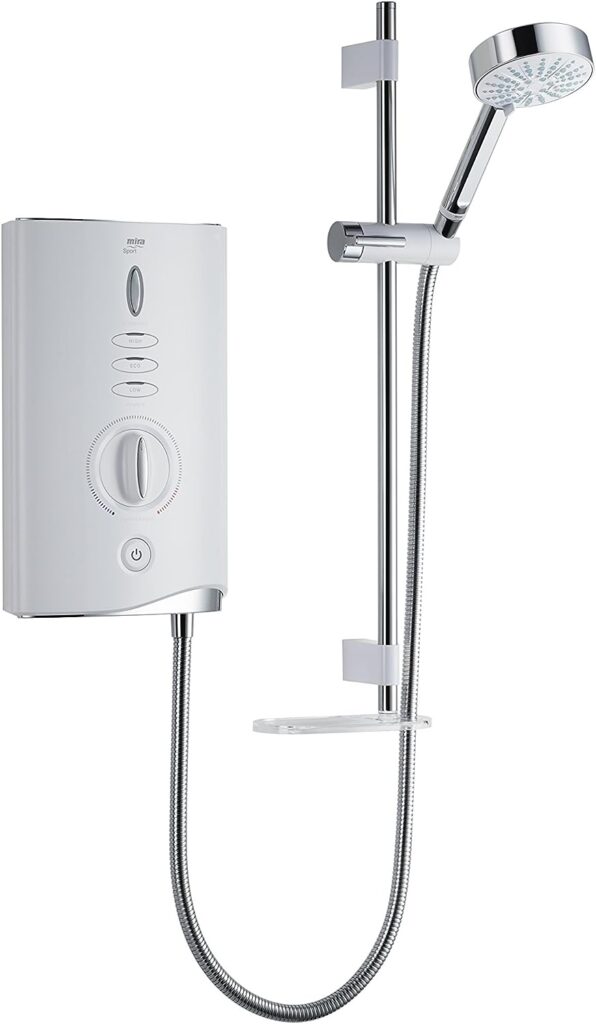
The Sport Max is the unit that makes a modest flow feel better than it measures. Airboost draws air into the water on its way out, so the spray feels fuller without any more water passing through the element. Mira also fit Clearscale, which they state reduces limescale build-up by up to 50 per cent, and a phased shutdown.
Check the model number on whatever listing you buy from. The listing linked here is the 9kW version, model 1.1746.007, not the 10.8kW unit. The Sport range runs to several variants at very different prices and the differences are not obvious from the product titles. Our full Mira Sport electric shower review decodes the range model by model, and if the top of the range is what you are after, the most powerful electric showers covers the 10.5kW and 10.8kW units and the circuits they need.
#6 Best all-rounder
Mira Sport Max 9kW Electric Shower, model 1.1746.007
- 9kW output in this listing, model 1.1746.007, cold mains fed
- Airboost draws air into the flow to make the spray feel fuller
- Mira Clearscale, which Mira state reduces limescale build-up by up to 50 per cent
- 110mm four spray rub-clean showerhead
- Opti-flo, which Mira state evens out flow across the year
- Phased shutdown
Pros
- Airboost is the one feature on this list that makes a modest flow feel better rather than just measure better
- Clearscale and phased shutdown are a sensible pairing anywhere with hard water
- The larger 110mm head spreads the flow better than the small handsets on the budget units
- Well supported by merchants and spares stockists
Cons
- The Sport range runs to several variants at very different prices and the listings do not make the differences obvious
- This listing is the 9kW version, so do not buy it expecting the 10.8kW top of the range
- Dearer than a Triton of the same output, and the extra buys feel rather than flow
- Mira do not describe the Sport Max as thermostatic, so it is not a substitute for the Advance Flex in a care setting
The best compromise on this list if you want the shower to feel better than its kW rating suggests and nobody using it needs thermostatic protection. Read the model number on the listing before you buy, because the range is genuinely confusing and the price gap between variants is large.
Best dual outlet: Triton Danzi DuElec 9.5kW
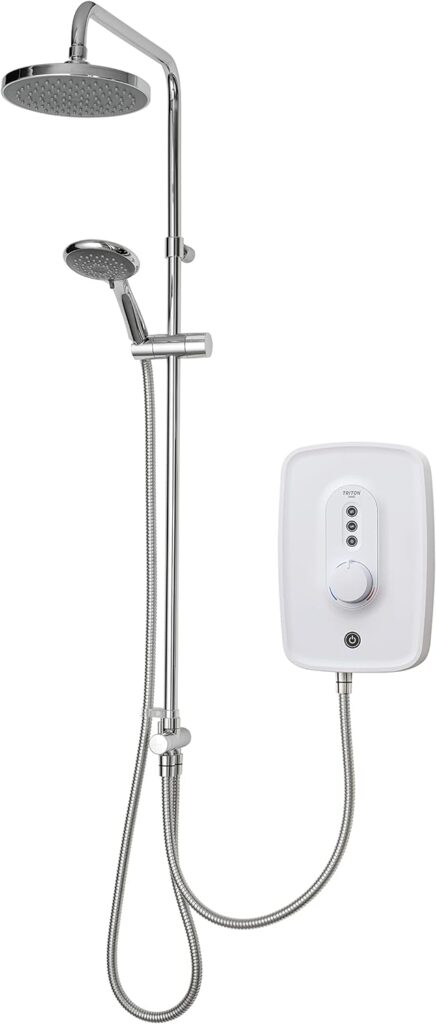
The Danzi DuElec is a 9.5kW unit with two outlets: a fixed rainfall head above and a handset on a hose, with a diverter between them. At this price that is unusual, and keeping a handset means you can still rinse a bath or wash a child's hair. Triton's specification lists a two year parts and labour guarantee, BEAB and CE compliance and BS 7671.
Be realistic about what a rainfall head does on an electric shower. The unit has a fixed flow of around 3.9 litres a minute at 9.5kW in winter by the arithmetic above, and a rainfall head spreads that over a much larger area than a handset does. The result feels gentler, which some people want and many people do not expect. Rainfall heads were designed for high flow mains pressure mixers, not for a throttled electric feed.
#7 Best dual outlet
Triton Danzi DuElec 9.5kW Electric Shower
- 9.5kW output at 230V, cold mains fed
- Dual outlet: fixed rainfall head plus a handset on a hose
- Soft-touch buttons for power and temperature, three settings
- Phased shutdown to reduce limescale
- 5 spray handset with 1.5m anti-twist hose
- 2 year parts and labour guarantee, BEAB and CE compliant
- Also sold in an 8.5kW version
Pros
- Dual outlet is rare at this price, and the diverter means you keep a handset for cleaning and hair washing
- Soft-touch controls and a tidy case look considerably better than the budget units
- Phased shutdown helps in a hard water area
- Triton publish a full specification for it, which is more than can be said for some competitors
Cons
- A rainfall head spreads a small flow over a large area, so it feels weaker than the same unit through a handset
- Not thermostatic: Triton's own specification states thermostatic, no
- The fixed head needs pipework run up the wall, which is a bigger job than a straight swap
- More components, including a diverter, means more that can go wrong
Buy this for the look and the convenience of two outlets, not for the showering experience. Electric showers do not have the flow to make a rainfall head work the way the photographs suggest, and that is physics rather than a fault in this particular unit. If the rainfall head is the whole point, you want a mixer shower and a different guide.
What goes wrong with an electric shower, and when
No manufacturer publishes a design life for an electric shower, so any single figure you read for how long one lasts is somebody's estimate rather than a specification. What is published is the guarantee, and on the units here that is two years parts and labour. In a hard water area, limescale is what decides the real answer.
Scale forms on the heating element because that is the hottest surface the water touches. As it builds, the element overheats locally and eventually fails, which is why phased shutdown, the feature that runs cooler water through the unit after you switch off, appears on the better models and is worth having rather than being marketing.
The failures worth knowing about, roughly in order of how often they came across the counter:
- Blocked showerhead or hose. Flow drops and the unit may start cutting out. It is the cheapest fault and the one most often misdiagnosed as a dead shower, because restricted flow raises the back pressure and trips the protection.
- Scaled or failed element. The unit powers up and the water stays cold. On a shower past its guarantee this usually ends the unit rather than justifying a repair.
- Solenoid valve or microswitch. The shower will not start, or runs cold because the valve is not opening in step with the element. Both are stocked parts on Triton and Mira units, which is the practical argument for sticking to those two brands.
- Pressure relief device venting. Water appears from the bottom of the unit. It has usually done its job in response to a blockage downstream rather than failed on its own.
If yours has stopped working, start with diagnosis rather than parts. Our guide to an electric shower not working runs through the symptoms in the order that tells them apart, which saves buying a solenoid for what turns out to be a scaled head.
Frequently asked questions
What is the best electric shower on the market?
There is no single best unit, and the honest version of this question is which one your house will take. For most homes the answer is an 8.5kW Triton on the cable that is already there, because it is cheap, universally supported and does not trigger electrical work. If anyone using the shower cannot move quickly, it is the thermostatic Mira Advance Flex Extra instead. If your cold water comes from a tank in the loft rather than the mains, it is the pumped Triton T80SR and nothing else on this list will work.
Is a 10.5kW shower better than a 9.5kW?
It is faster, not better. By the arithmetic above, a 10.5kW unit delivers roughly 4.3 litres a minute against 3.9 for a 9.5kW at a winter temperature rise, so about half a litre a minute more. It needs heavier cable and a larger protective device, and it costs more per minute because it is delivering more water per minute. Per litre of hot water the two cost exactly the same to run. If the circuit is already sized for 10.5kW, take it. If it is not, the upgrade usually costs more than the difference is worth.
Is Mira better than Triton?
No. They are direct competitors at a similar standard and the differences are feature by feature rather than brand by brand. Mira's Airboost genuinely makes a modest flow feel fuller, and Clearscale is a sensible thing to have in hard water. Triton is usually cheaper at the same output, and the universal and fast-fit entries across the T80 range make replacements easier. Both have spares networks that mean a part arrives in days, and in five years that will matter more than anything on either specification sheet.
Is a 10.5kW shower more powerful than an 8.5kW?
Yes, but power here means flow and not pressure. A 10.5kW unit heats more water per minute to the same temperature, roughly 4.3 litres a minute against 3.5 at a winter temperature rise. The force the water comes out with is set by your mains pressure and the showerhead, not by the kW rating, so a bigger unit gives you more water rather than a harder spray. Our guide to electric shower wattage works through each step up in detail.
What is the best 10.5kW electric shower in the UK?
None of the seven listings verified for this guide is a 10.5kW unit, so naming one here would mean recommending something I have not checked. Several of the models above, including the Seville, the T80Z and the Danzi, are sold in higher outputs under the same name, so the sensible route is to pick the model on its features and then buy the output your circuit will take. The thing that decides a 10.5kW purchase is almost never the shower. It is the 10mm cable and 50A protective device it typically needs. The most powerful electric showers covers that end of the range properly.
Can you replace an 8.5kW shower with a 9.5kW?
Only if the circuit will take it, and it is not a like-for-like swap electrically. The cable size, the protective device and the spare capacity in the consumer unit all have to be assessed against BS 7671 for the actual installation, including how long the run is and how the cable is clipped or buried. Plenty of 8.5kW showers sit on 6mm cable that will not carry 9.5kW. Because the work is in a bathroom it is notifiable under Part P in England and Wales, so get it assessed before you buy the shower rather than after it is out of the box.
Do electric showers use a lot of electricity?
Yes, in short bursts. An 8.5kW shower draws more than a kettle and an oven together while it is running, which is why it needs its own circuit. It uses 1.42kWh in 10 minutes, which at the Ofgem capped rate of 26.32p per kWh for 1 October to 31 December 2026 is 37p a shower, or about £136 a year for one 10 minute shower a day. The offsetting point is that an electric shower heats only the water you use and stores nothing, so there are no standing losses from a cylinder.
Which is cheaper to run, an electric or a mixer shower?
For the same volume of water, a mixer fed by a gas combi is cheaper, because gas costs substantially less per kWh than electricity. That advantage is partly eaten by the water a mixer delivers, since a mains pressure mixer will happily run at two or three times the flow of an electric shower, so the cheaper fuel heats a great deal more water. Electric showers versus mixer showers works the comparison through properly, and the best mixer showers covers the alternative.
Related guides
- Electric shower wattage explained: what each step up in kW actually buys you in flow, and the cable it needs.
- The most powerful electric showers: the 10.5kW and 10.8kW end of the market, and whether your consumer unit will take one.
- Energy efficient electric showers: which features genuinely cut consumption and which are marketing.
- Electric shower not working: diagnose the fault in the right order before you buy any parts.
- Mira Sport electric shower review: the four variants decoded, because the listings will not tell you the difference.



0 Comments