
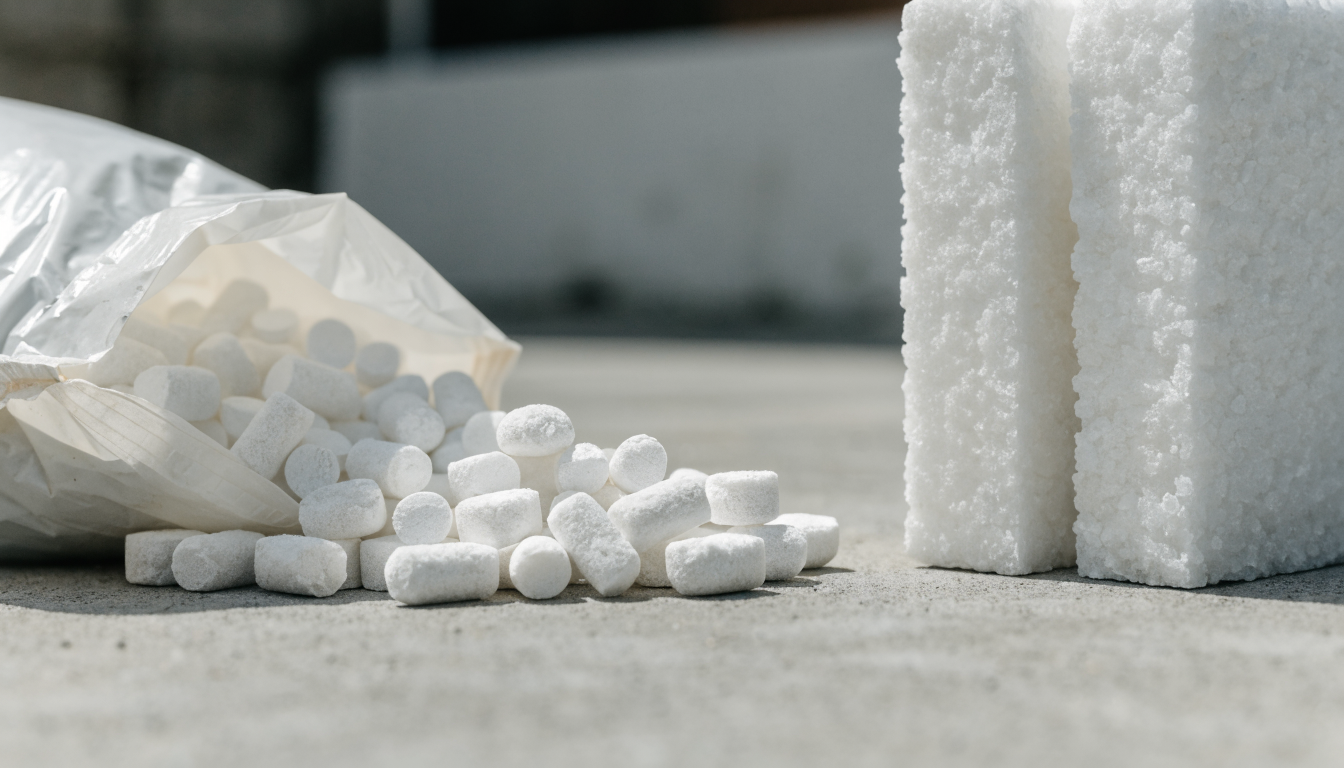
Salt is the part of owning a water softener that nobody thinks about before they buy, and it is the part that decides what the machine costs over its life. Depending on which softener you own and where you shop, feeding it costs anywhere between £50 and £390 a year. That is a bigger spread than most people expect, and it comes down to two things: the format your machine takes, and the size you buy it in.
I spent 16 years running plumbers merchants across the south of the UK, so I have sold a lot of salt and heard most of the questions. Here are the straight answers. All prices were checked on 15 September 2026 and are quoted per kilo, because that is the only way to compare a 4kg block against a 25kg bag.
The short version
- Use whichever format your machine takes. Some take both, some take block only. Check the manual before anything else.
- If yours takes both, buy tablet. It is roughly half to a third the price per kilo and there is no chemical difference in the result.
- A family of four uses about 125 kg a year. That is five 25kg bags, or around thirty 4kg blocks.
- Buy in bulk if you have anywhere dry to keep it. A pallet works out around £0.40 per kilo against £0.64 or more for single bags.
- Branded salt is the most expensive way to buy it and, for tablet and standard block, buys you nothing the supermarket-grade product does not already give you.
Block or tablet? There is no chemical difference
This is the question I was asked most often across the counter, usually by someone who had been told block salt was purer or gentler on the machine. It is not.
Both formats are compacted sodium chloride. Both dissolve into brine, and the brine is what actually regenerates the resin. The Water Softener Centre, which sells both, states it plainly: there is no difference between brine made from block salt and brine made from tablet salt.
What differs is the packaging, and therefore the price.
| Format and route | Price per kg | 125 kg per year |
|---|---|---|
| Tablet, 25kg bags on a pallet of 40 | £0.40 | £50 |
| Tablet, 25kg single bags | £0.64 | £80 |
| Block, Spectrum | £1.19 | £149 |
| Block, Harvey direct | £1.20 | £150 |
| Block, BWT | £1.62 | £203 |
| Block, Kinetico branded | £3.12 | £390 |
Tablet salt comes in 25kg sacks and ships on pallets, so it is handled like any bulk commodity. Block salt comes in moulded pairs, in small cartons, and it is sold as a convenience product. You are paying for the handling, not for better salt.
So why does block exist at all?
Two real reasons, and they are both about the machine rather than the chemistry.
Some softeners, notably the Harvey and Kinetico ranges, have a small brine cabinet designed around two blocks sitting in a specific position. You cannot pour a bag of tablet into them. If you own one of those, the decision is made for you.
The other reason is handling. A 4kg block is easy to carry in from the car and drop in with one hand. A 25kg sack is a proper lift, and if the softener lives in an awkward cupboard that matters more than the price does. That is a legitimate reason to pay more, as long as you know that is what you are paying for.
The thing worth understanding before you buy a softener at all: choosing a block-only machine commits you to roughly £70 to £100 a year more in salt for as long as you own it. Over fifteen years that is £1,050 to £1,500, which is comparable to the price of the softener. It is covered in more detail in the water softener buying guide.
How much salt do you actually need?
About 125 kg a year for a family of four. That figure is worth trusting because two independent routes land on it.
EcoWater publish 125 kg a year for a four-person household. Separately, Monarch's own installation guide gives the Midi HE a capacity of 2,280 litres at 300 ppm hardness and a salt use of 1.0 to 1.7 kg per regeneration. At typical UK consumption of around 142 litres per person per day, four people use roughly 207,000 litres a year, which works out at about 91 regenerations, so 91 to 155 kg. The published figure sits comfortably inside the calculated range.
| Household | Roughly per year | In 25kg bags | In 4kg blocks |
|---|---|---|---|
| 1 to 2 people | 60 to 70 kg | 3 bags | 16 blocks |
| 3 to 4 people | 125 kg | 5 bags | 31 blocks |
| 5 to 6 people | 180 to 190 kg | 7 to 8 bags | 46 blocks |
Harder water means more salt, and the difference is not small
Manufacturers quote capacity at 300 ppm. If your water is harder, the softener regenerates more often and gets through more salt.
Take the same family of four with a Monarch Midi HE. At 300 mg/L it regenerates every four days. Move them to Braintree, where the water measures 416 mg/L, and the effective capacity drops to 1,644 litres, so it regenerates every 2.9 days instead. Salt consumption rises by 39 per cent.
If you are in one of the hardest areas, Braintree, Sunderland, Great Yarmouth, Nottingham or Cambridge among them, budget closer to 175 kg a year for four people rather than 125. Your water company publishes your hardness figure, usually searchable by postcode.
Where is it cheapest?
The answer depends entirely on whether you have somewhere dry to store 200 kg of salt.
If you have a garage or a dry shed: buy a pallet
A pallet of forty 25kg bags brings the price down to roughly £0.40 per kilo, against £0.64 or more buying bags one at a time. On 125 kg a year that is £50 instead of £80, and a pallet is eight years of salt for a family of four.
Realistically most people do not want a tonne of salt in the garage. A half pallet or a run of ten bags still gets you most of the discount, and ten bags is two years of supply. The specialist salt suppliers who come up when you search will all quote for this, and it is worth getting two or three prices because delivery is a meaningful part of the cost on something this heavy.
If you are buying a bag at a time: the trade merchants beat the salt specialists
For single bags and small quantities, the builders merchants and trade counters are consistently competitive, and you can collect rather than pay carriage on 25 kg.
- Screwfix carry BWT tablet and block, and click and collect means no delivery charge on a heavy item.
- Toolstation carry Calmag tablet in 10kg, which is the easier lift if 25 kg is too much.
- B&Q and Wickes both stock 25kg tablet and Kinetico-compatible block, useful if one is closer than a trade counter.
One thing to watch: the per-kilo price on a 10kg bag is always worse than on a 25kg bag. If you can manage the weight, the bigger sack is the better buy every time.
What to avoid
Manufacturer-branded salt bought direct is the most expensive route to the same product. Kinetico's own branded block works out at roughly £3.12 per kilo, which is more than seven times the pallet price of tablet salt and more than double the price of ordinary block. If your machine needs block, it needs block, but it does not need their block unless the manual specifically says so.
The exception is Harvey's newer Arc and Cobalt models, which use a proprietary curved block that genuinely only Harvey supply. Worth knowing before you buy one of those, because it ties your salt supply to a single company for the life of the machine.
Does the brand matter at all?
Mostly no, with one qualification.
What you want is high-purity sodium chloride, usually sold as food grade or Grade A, typically 99.8 per cent or better. Every mainstream tablet salt in the UK meets that. At that point one bag is the same as another and you should buy on price.
The qualification is the very cheap unbranded stuff. Lower purity leaves more insoluble residue in the brine tank, which is the main cause of salt mushing, where fine salt recrystallises into a sludge that blocks the brine draw. That is a genuinely annoying fault to clear. It is the one place where the absolute cheapest option can cost you more than it saves, so buy a recognised brand or a supplier who states the grade.
Storing it without causing problems
Salt is hygroscopic. It pulls moisture out of the air, and damp salt is what causes most of the faults people blame on the softener.
- Keep spare bags off a concrete floor. Concrete wicks moisture. A pallet, a board or a shelf is enough.
- Do not overfill the brine cabinet. Filling to the brim means the salt at the bottom sits wet for months. Two thirds full is plenty, and topping up more often is better than filling it once a year.
- Watch for salt bridging. This is the one that catches people out: a hard crust forms across the cabinet, the tank looks full from the top, but there is an air gap underneath and no brine is being made. The softener carries on as if nothing is wrong and your water quietly goes back to hard. Every few months, push a broom handle gently into the salt. If it hits a crust with space below it, break the crust up.
- Bridging is more likely in an oversized machine, because it regenerates rarely and the salt sits undisturbed for longer. Another reason not to buy bigger than you need.
Frequently asked questions
Can I use dishwasher salt in my water softener?
You can, but it makes no sense financially. Dishwasher salt is the same sodium chloride in a finer granular form, sold in 1 to 2 kg boxes at several pounds a kilo. It works out at many times the price of tablet salt for an identical result. It will not harm the machine, it will just empty your wallet.
It does not work the other way round either: do not put softener tablet salt in a dishwasher, because the tablets are too large for the dishwasher's salt reservoir.
Can I use table salt or rock salt?
No. Table salt usually contains anti-caking agents and often iodine, neither of which belongs in a brine tank. Rock salt, the sort sold for gritting, contains a significant amount of insoluble grit and dirt that will settle in the cabinet and block the brine draw. Use salt sold for water softeners.
Can I use water softener salt on my driveway?
It will melt ice, because it is salt. But it is an expensive way to do it and it is the wrong product. Gritting salt costs a fraction as much per kilo, and the grit in it provides traction that pure white tablet salt does not. If you have half a bag going hard in the shed then by all means use it up, but do not buy softener salt for the purpose.
How often should I top the salt up?
Check it monthly and top up when it drops below about a third. Most people find they add a bag every couple of months. Getting into the habit of a quick monthly look is also how you catch salt bridging before it costs you a month of hard water.
Will softened water be too salty to drink?
Softening adds sodium rather than salt as such, roughly 46 mg/L for every 100 mg/L of hardness removed, against a UK drinking water limit of 200 mg/L. In most of the country the result stays inside the limit, but in the very hardest areas it can approach or exceed it. That is why the British Water Code of Practice recommends keeping one unsoftened tap for drinking and cooking. Softened water should not be used for infant formula or by anyone on a prescribed low-sodium diet.
What happens if I run out?
Nothing dramatic. The softener keeps running but stops softening, so you get hard water through the taps until you refill it. No damage is done. Refill it, and on most machines you can trigger a manual regeneration to get back to soft water the same day rather than waiting for the next scheduled cycle.
Related guides
- The best water softeners in 2026, with real prices and running costs
- Is a water softener worth it?
- How long do water softeners last?
- What is limescale, and how do you get rid of it?


0 Comments