
As an Amazon Associate I earn from qualifying purchases.
If your boiler keeps losing pressure, the single most useful thing you can work out before anything else is how fast it falls. A system that drifts down over several months and a system that needs topping up every few days are two different faults with two different answers, and almost nothing you will read online draws that line clearly.
Worcester Bosch tell their own customers that a healthy sealed system typically needs topping up once or twice a year. That is the benchmark worth holding in your head. Once or twice a year is a system doing what sealed systems do. Once a week is a fault you are paying for in gas, in corrosion and eventually in a repair bill.
This page is about diagnosis, not procedure. It sorts the causes by how quickly they empty a system, tells you where to look for the leak that most people never check, and explains the expansion vessel test properly rather than listing it as a bullet point. If you just need to get the gauge back up tonight, the step by step is on our guide to how to repressurise a boiler, and this page will still be here when it drops again.
What pressure should a boiler be?
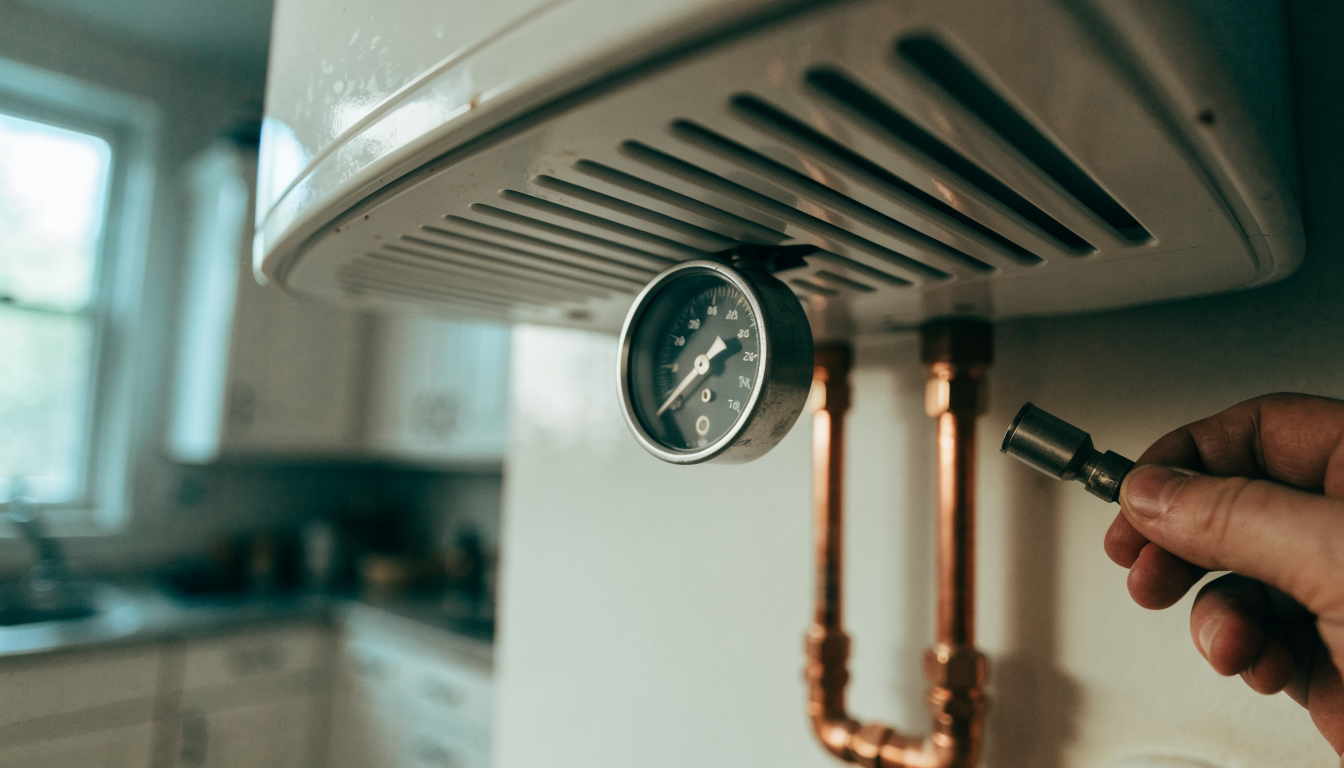
On a cold system, most UK combi and system boilers want somewhere between 1.0 and 1.5 bar. Worcester Bosch put the target at 1 to 1.5 bar cold and describe anything below 0.5 bar as being down in the red section, meaning water has been lost and needs replacing.
The part people get wrong is that the number moves. Water expands when it heats up, so the gauge will read higher with the heating running than it did first thing in the morning. A reading taken mid cycle tells you very little. Take every reading from cold, ideally before the heating has come on, and always compare like with like.
Months or days: the distinction that gives you the diagnosis
A sealed heating system is not hermetic. It has dozens of mechanical joints, a pump seal, radiator valve glands and an automatic air vent, and over a long enough period it will shed a small amount of water as vapour and seepage without anything being wrong. That is why manufacturers expect an annual top up rather than none at all.
What that means in practice is that the rate of loss is your first diagnostic tool, not the fact of loss. Write the reading and the date on a scrap of paper taped next to the boiler and you will know within a fortnight which of the two columns below you are in.
That last point is the one worth dwelling on. Every time you open the filling loop you are introducing mains water carrying dissolved oxygen and fresh minerals into a sealed system that was designed to hold the same water for years. Do that weekly for a winter and you will dilute the corrosion inhibitor to nothing and start building sludge, which is a separate and more expensive problem. Our guide to central heating inhibitor covers what to put back in.
Match the symptom to the cause
Work down this in order. The behaviour of the gauge between cold and hot separates an expansion vessel fault from a leak faster than any amount of crawling around with a torch.
Cause one: a leak somewhere in the system
This is the most common answer and the most frustrating one, because a heating leak large enough to empty a system in a week can still be small enough to leave no puddle. At 1.5 bar, a seep of a few millilitres an hour will drop the gauge noticeably over a fortnight and will evaporate off warm pipework before it ever reaches a floor.
Go round in this order. The list is deliberately weighted towards the places that actually fail rather than the places that are easy to see.
| Where to look | What you are looking for | Why it fails |
|---|---|---|
| Radiator valve spindles, both ends of every radiator | Rust streaks down the valve body, a green or white crust, a damp carpet fibre at the skirting | Gland packing hardens with age and with the valve being turned after years of sitting still |
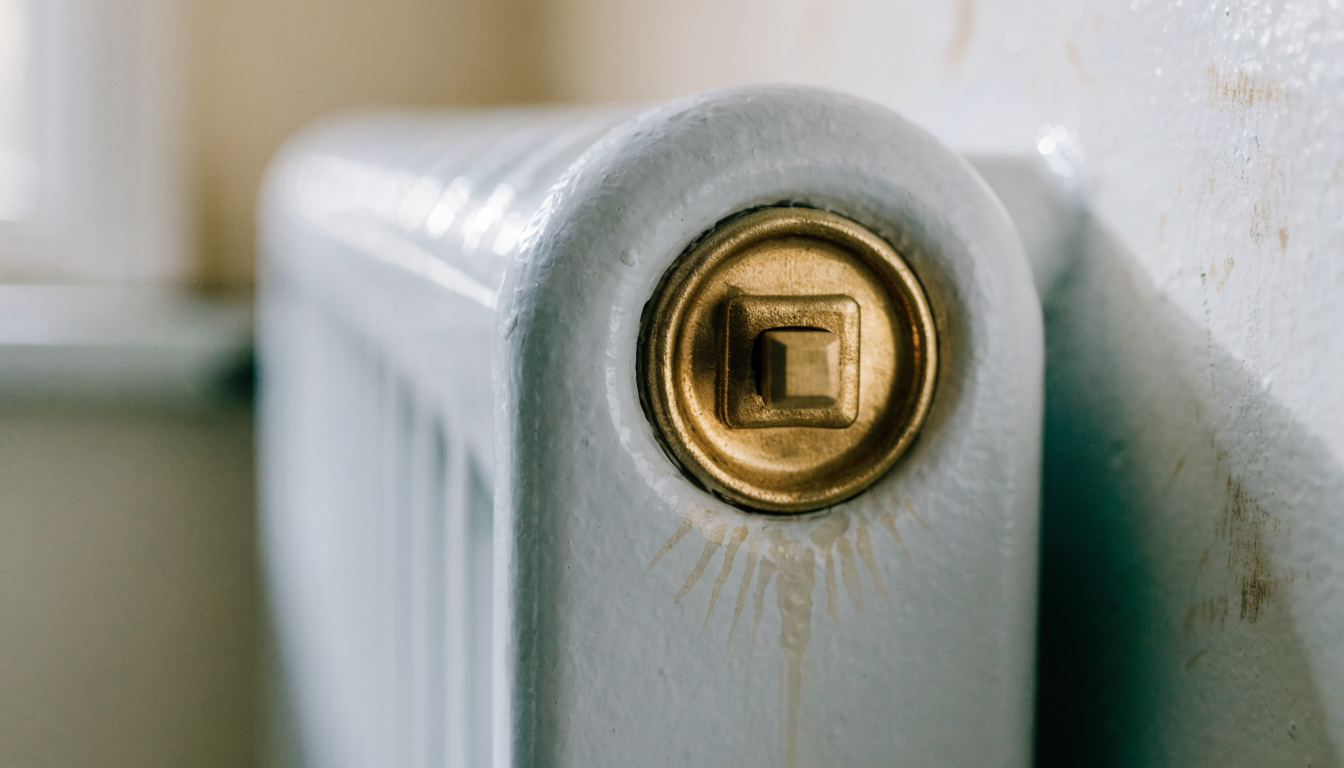
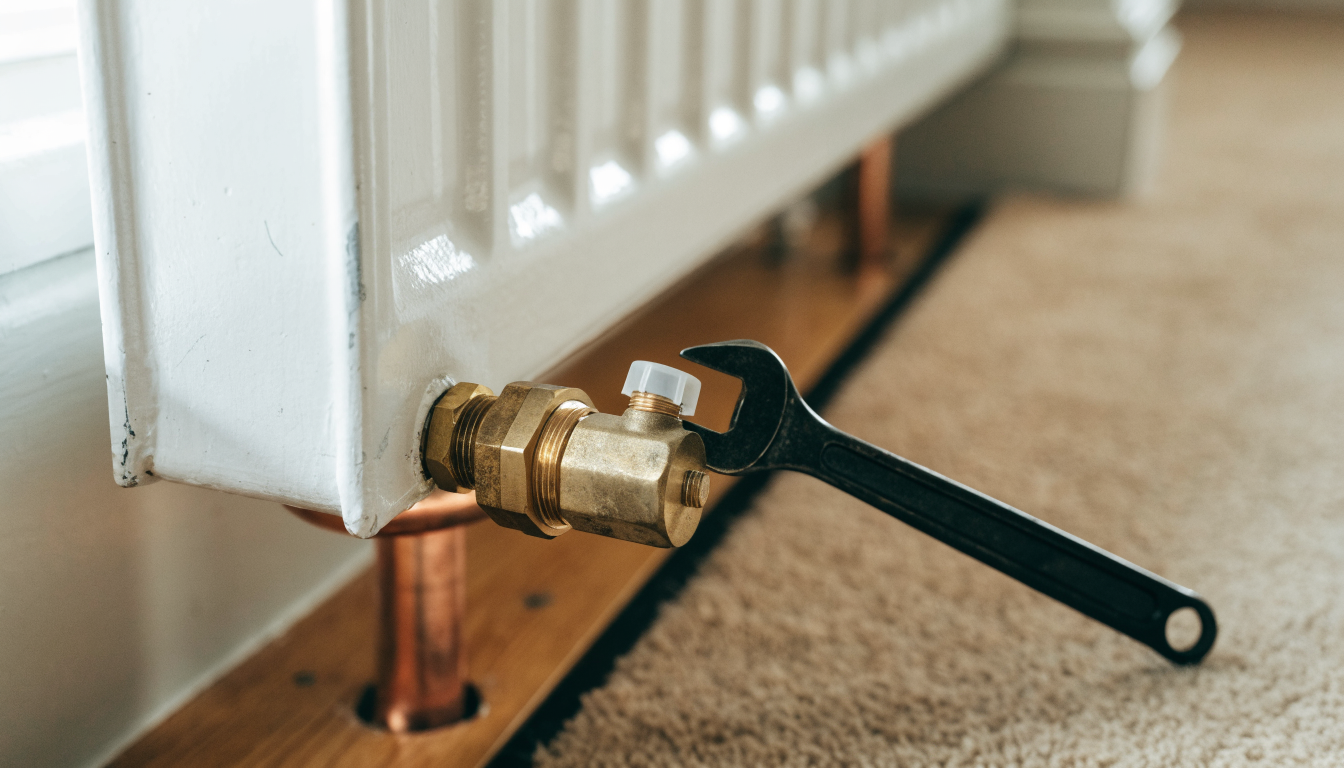
| Radiator bleed points and blanking plugs | A rust tear running down the panel from the top corner | Over-tightened or cross-threaded bleed screws, and corrosion from the inside out |
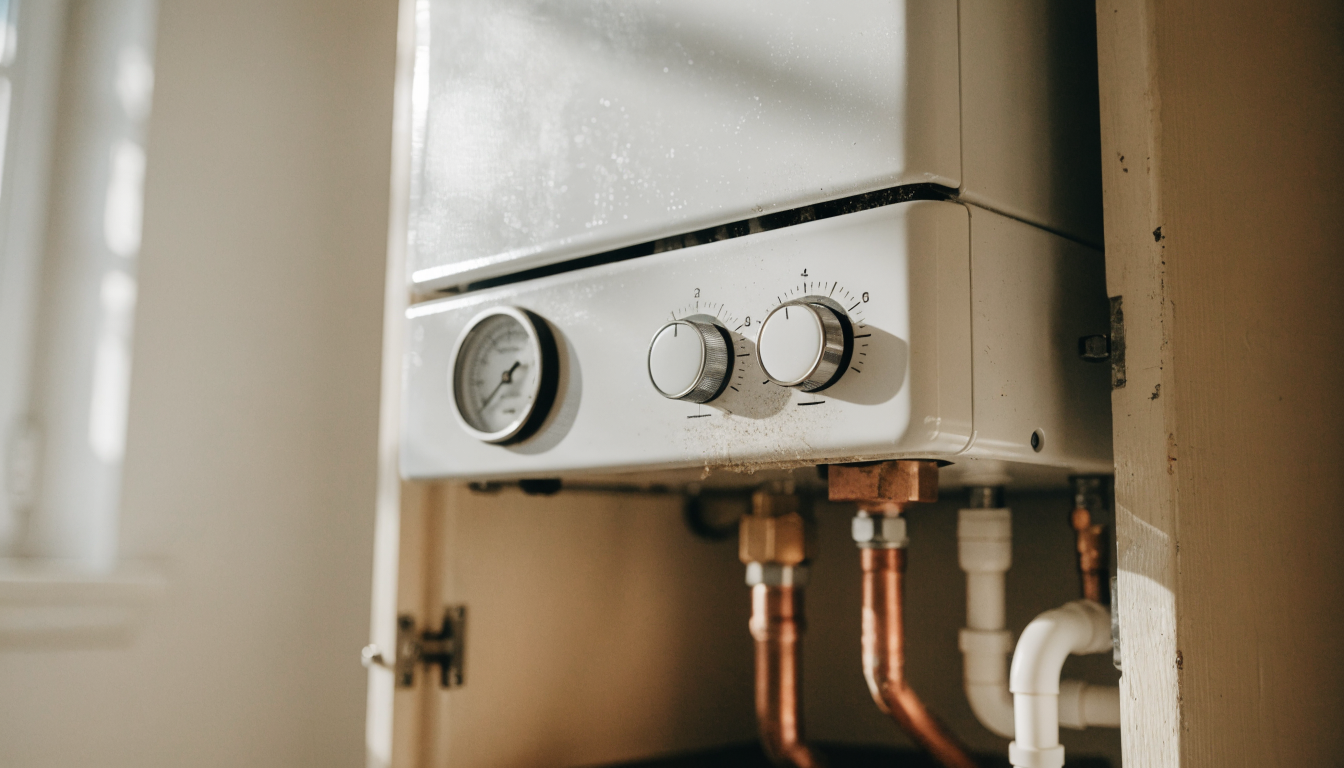
| Under the boiler and inside the bottom of the casing | Water tracking down the pipes, limescale on the copper, a stained floor or cupboard base | Internal seals, the pump head, the diverter valve. Inside the case is not your job |
| The outside discharge pipe from the relief valve | Dripping, damp brick, a chalky white streak below the pipe end | Covered in its own section below. This is the clue most people never check |
| Joints under floorboards, especially near radiator tails | Lifted or cupped boards, a warm patch underfoot, a stained ceiling in the room below | Compression joints buried at first fix, or a nail or screw driven through a pipe |
| Airing cupboard and loft pipework | Drips on the cylinder, damp insulation, corrosion on valve bodies | Cold, condensation and decades of nobody looking |
One thing that will save you an afternoon: if the drop only happens when the heating is on, the leak is almost certainly on the heating circuit and is opening up with heat and expansion. If it drops just as fast with the heating off for three days, the leak is pressure driven and will be somewhere that is under pressure all the time. Our guide on detecting plumbing leaks goes further on tracing a leak you cannot see, and working out why a radiator is not heating up is worth reading if a particular radiator has gone cold at the same time.
Leak sealer: what it is honestly for
Leak sealer is a liquid additive that circulates with the system water and is drawn into a weeping joint, where contact with air causes it to set and block the gap. It genuinely works on the kind of pinhole and weeping joint that has no accessible repair, most usefully on buried pipework under a solid floor where the alternative is lifting the floor.
What it is not is a repair. It buys you time on a leak you cannot reach, and it will do nothing at all for a failed expansion vessel, a passing relief valve or a dripping radiator valve, because none of those are gaps that sealer can bridge. Used as a first resort it also means the actual fault never gets found. Add it knowing what it is: a stopgap, chosen because the real repair is disruptive or expensive, not because it is easier than looking.
Fernox F4 Leak Sealer 500ml
- Treats a system up to around 130 litres, which covers most domestic properties
- Added through a radiator or the filling loop, no drain-down required
- Non-corrosive and compatible with the usual mix of copper, steel, brass and plastic
Pros
- The most established name on the merchant shelf, so it is easy to get hold of on the day
- Realistic answer for a pinhole under a solid floor where the repair means lifting the floor
- Works alongside inhibitor rather than replacing it
Cons
- It is a stopgap and not a repair, and it will not touch a vessel or valve fault
- Cannot seal a gap above a certain size, so a joint that is visibly running will defeat it
- Adding it without diagnosing first means the real fault stays hidden
Worth having if you have traced the loss to a small weep you genuinely cannot reach. Not worth adding until you know that is what you are dealing with.
For a joint that is weeping where you can actually get a hand to it, self-amalgamating tape will hold a small weep under heating pressure for long enough to get an engineer booked. It fuses to itself rather than sticking, so it copes with a wet pipe better than any adhesive tape will.
Ultratape self-amalgamating pipe tape on AmazonCause two: a failed expansion vessel
This is the fault behind most of the systems that lose pressure within days, and it is the one the retailer pages mention in a single line and move on from. Understanding it takes two minutes and it changes what you tell the engineer on the phone.
Water expands when heated, and a sealed system has nowhere for that extra volume to go. The expansion vessel is a sealed steel tank divided by a rubber diaphragm, with a cushion of pressurised air on one side. When the system heats up, the extra water pushes against the diaphragm, squashes the air, and the pressure rise stays modest. When it cools, the air pushes back. That is all it does, and it is the only reason your gauge does not swing violently every cycle.
Two things go wrong with it. The diaphragm splits, which lets water into the air side. Or the air charge leaks away slowly through the schrader valve over ten or fifteen years. Either way the cushion is gone, and the system now has no room to expand into.
The test: watch the swing between cold and hot
This is the only part of expansion vessel diagnosis you can do yourself, and it is genuinely diagnostic. Take a reading from a properly cold system, first thing in the morning before the heating has fired. Then run the heating hard for half an hour, until the radiators are properly hot, and read it again.
Two caveats worth knowing before you conclude anything. A big cold to hot swing can also be caused by a vessel that is the right pressure but too small for a system that has had radiators added over the years, which is a different fix. And on some system boiler installations the vessel is a separate cylinder sitting in the airing cupboard or loft rather than inside the boiler, which changes the cost of replacing it considerably. Either way, the reading you took is the useful thing to hand over.
Cause three: the relief valve is discharging outside
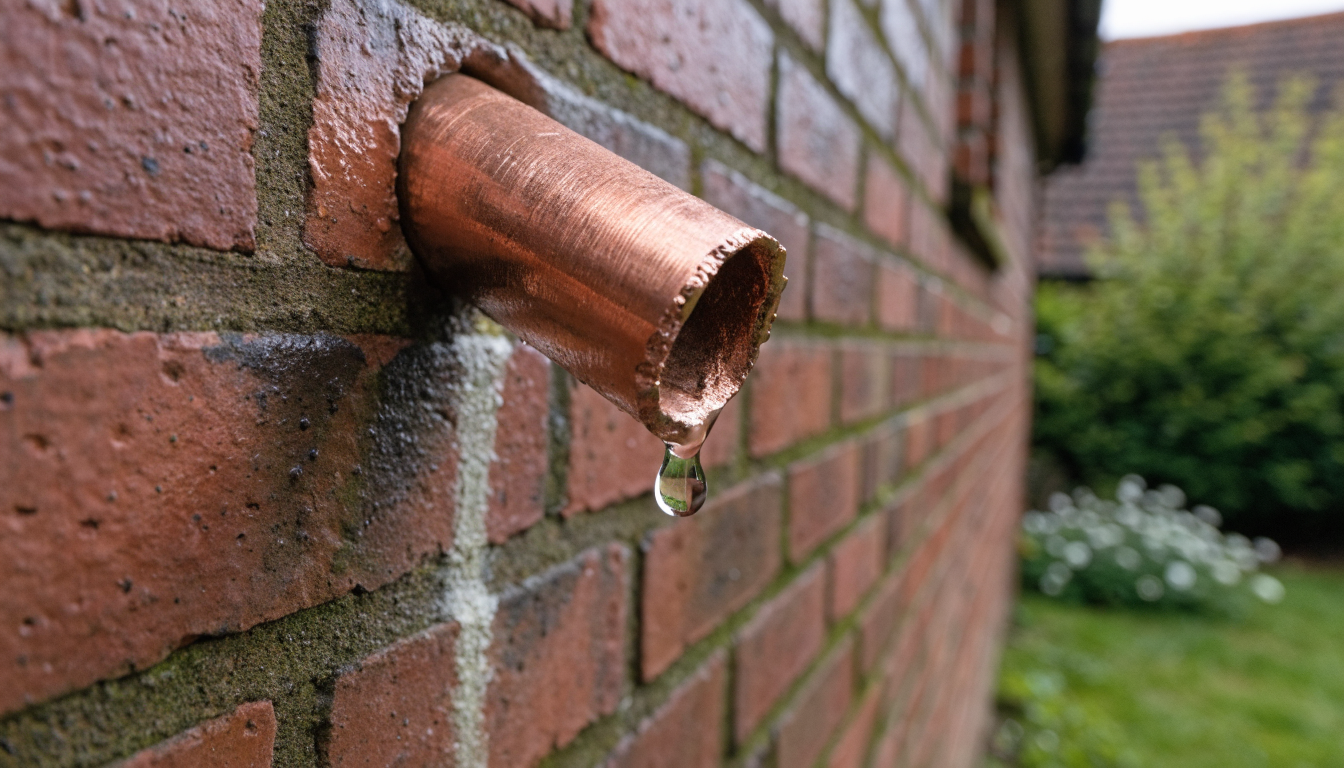
Every sealed system has a pressure relief valve. If system pressure exceeds the valve's set point, it opens and dumps water to a discharge pipe, which on the great majority of UK installations runs through an outside wall and points down at the ground or a drain. It is a safety device and it working is not, in itself, a fault.
What makes it the most overlooked clue on the whole topic is that it takes the evidence outside. The water leaves the house, evaporates off a paving slab or soaks into a border, and the homeowner spends a month looking for a leak indoors while the system quietly empties itself out of a pipe nobody has looked at since the boiler was fitted.
Go outside and find the pipe. It is usually 15mm or 22mm copper, coming through the wall at roughly the height of the boiler, cut at an angle and pointing down. Look for water at the end, a damp patch on the wall below it, or, if it has been happening a while, a chalky white limescale streak on the brickwork. If the ground below it is damp when the rest of the wall is dry, you have found where your water is going.
The valve discharging tells you one of two things. Either something is pushing system pressure too high, which usually means the expansion vessel above or a filling loop that is passing, or the valve itself has failed and is no longer seating. A tiny piece of sludge or scale caught on the seat will hold it fractionally open, and once it has been lifted and dropped a few times it often will not reseat cleanly. Replacing it is work inside the boiler case on a combi, so the same stop line applies.
Cause four: a leaking automatic air vent
Most systems have at least one automatic air vent, a small brass cylinder with a plastic cap on top, fitted at a high point on the pipework or on the boiler itself. Its job is to let air out on its own so you do not have to chase it around with a bleed key. Inside is a float that drops as air collects and lifts to close as water arrives.
When the seat gets dirty or the float degrades, it stops closing fully and starts letting water out as well as air. The loss is tiny, usually well under a litre a month, so it belongs firmly in the slow column. What it leaves behind is a giveaway: a crust of white or green residue on top of the vent, or a rust mark on whatever is under it.
A vent on accessible pipework in an airing cupboard is a straightforward isolate and swap for a plumber and is not a gas job. One inside the boiler casing is, again, behind the stop line.
Cause five: a filling loop left open, or passing
This one causes the opposite problem, and it is worth knowing because the end result looks identical. The filling loop connects the mains cold supply to the heating circuit so you can top up. Mains pressure in a UK home is far higher than heating pressure, so if that connection is even slightly open, the system fills continuously.
Pressure climbs, the relief valve lifts, water goes out of the wall, and once the heating cools you find yourself back at a low reading. From the gauge alone it looks like a system that is losing pressure. It is actually a system that is being overfilled and then vented.
Two versions of this. The obvious one is a loop that was simply not closed properly after the last top up, or a filling key left in place. The less obvious one is a double check valve inside the loop that has failed and is passing a trickle even with the lever closed. The test for the second is the same as the test for the first: close both valves fully, disconnect and remove the flexible loop entirely, and watch the gauge for a couple of days. If the pressure stops climbing, the loop was your problem.
A braided loop that is seized, perished, or whose check valve is passing is a replaceable part and is not inside the boiler. Part L of the Building Regulations is why loops are supplied as a removable flexible hose with a double check valve in the first place, so a replacement wants to be the same specification.
SPARES2GO Combi Boiler Filling Loop, 15mm, Part L Compliant
- 15mm x 15mm connection, the standard size on domestic combi and system boilers
- Double check valve and lever isolation valves, as Part L requires
- Supplied as a removable assembly so it can be taken off the system between top ups
Pros
- Replaces a seized, perished or passing loop without touching anything inside the boiler case
- Lever valves give you an unambiguous open or closed, unlike a worn screwdriver-slot valve
- Cheap enough that replacing a suspect loop is faster than testing one
Cons
- Fitting still means breaking into pipework, so it is a plumbing job rather than a no-tools swap
- Check your existing connections first, as a minority of installations use a keyed built-in loop instead
- A new loop fixes a passing loop, and nothing else on this page
The right buy if you have proved the loop is passing or the existing one has seized. Not a fix for a system that is genuinely losing water.
Cause six: you bled the radiators, which is not a fault
If the pressure dropped once, cleanly, on the day you went round with a bleed key, and has been stable since, nothing is wrong. Bleeding removes air from the system, the total volume inside the sealed circuit falls, and the gauge falls with it. That is the mechanism working as designed.
Bleed everything first, then top the system back up once at the end, rather than topping up between radiators. The one thing worth noticing is how much it dropped. A single radiator with a pocket of air at the top should barely move the needle. If bleeding one radiator takes the pressure down half a bar, that radiator was holding a lot of air, and a system that keeps making air is usually telling you about corrosion. Our guide to bleeding a radiator covers what to do when bleeding does not fix the cold radiator.
How to lower boiler pressure
Half the people reading this arrived with the opposite problem, usually because a top up ran away from them. The gauge is sitting at 2.5 bar or higher on a cold system and the boiler is either complaining or dumping water outside.
The cause is nearly always overfilling. Mains pressure fills a heating system alarmingly quickly, and the gap between 1.2 bar and 3 bar is a few seconds of an open filling loop. The other cause, if you did not fill it, is a filling loop that is passing, covered above.
The fix is to let a small amount of water out, and the easiest controlled place to do that is a radiator bleed valve. You are letting water out rather than air, so a container and a cloth matter more than usual.
Some radiators have a drain-off point on the valve at the bottom instead, which is tidier if you can fit a hose to it, but the bleed valve is quicker and every radiator has one. If you end up going too far, the topping up procedure is on our boiler repressurising guide.
Where this job stops being yours
This is not advice, it is the law. Under the Gas Safety (Installation and Use) Regulations 1998, work on a gas appliance must be carried out by someone registered with Gas Safe. A combi or system boiler is a gas appliance, and that covers the inside of its casing regardless of whether the specific component you are touching carries gas.
In practice the line falls like this. Topping up through the filling loop is a homeowner job that manufacturers explicitly expect you to do, and so is bleeding radiators, checking the gauge, and going outside to look at the discharge pipe. Anything that involves taking the front off the boiler is not. That includes the expansion vessel on a combi, the pressure relief valve, the internal air vent, the pump and the heat exchanger.
Work on the pipework, radiators and valves outside the boiler is plumbing rather than gas work, so a competent plumber can do it. The distinction is the appliance, not the water.
What to have ready before you call someone
Something that came up constantly across the merchant counter: the customers who got a cheap, quick fix were almost always the ones who arrived with information rather than a symptom. The same holds for an engineer visit. Five minutes of note-taking can be the difference between a diagnostic call-out and a single visit that fixes it.
- The rate. "It goes from 1.5 to 0.8 in about four days" is worth more than "it keeps dropping".
- The cold and hot readings. The swing test above, written down. This is the single most useful thing you can hand over.
- Whether the outside discharge pipe is wet. Yes or no, and whether there is a stain under it.
- Whether it drops with the heating off. Turn it off for two or three days in mild weather and watch.
- The boiler make, model and age, and roughly when it was last serviced.
On age: if the boiler is well past fifteen years, a pressure fault is worth costing against replacement rather than fixing in isolation, because the parts that fail at that age tend to keep failing. Our guide to how long a boiler lasts sets out what actually determines lifespan.
Frequently asked questions
Why do I have to keep topping up the pressure on my boiler?
Because water is leaving the sealed circuit somewhere. If you are topping up once or twice a year, that is ordinary seepage and is what manufacturers expect. If you are doing it weekly, the two most likely causes are a failed expansion vessel pushing water out through the relief valve, or an active leak on the pipework. The swing test between cold and hot separates the two.
Can a boiler lose pressure without a leak?
Yes, in the sense that there may be no leak you can find indoors. A failed expansion vessel causes pressure to spike when hot, which lifts the relief valve and sends water out through a pipe on an outside wall. There is a leak, but it is the safety valve doing its job, and the water leaves the building. Bleeding radiators also lowers pressure with no leak involved at all, because you have reduced the volume in the system.
How often should the pressure drop on a boiler?
Worcester Bosch tell their customers a system will typically need topping up once or twice a year. Use that as your yardstick. Twice a year is fine. Every month is worth investigating. Every week is a fault, and continuing to top it up is quietly damaging the system through repeated introduction of fresh oxygenated water.
Is it normal for boiler pressure to drop 0.1 bar a month?
That is within the range most systems sit in, and at that rate you would be topping up roughly twice a year from 1.5 bar. It is not worth chasing on its own. What is worth watching is whether the rate changes. A system that shed 0.1 bar a month for five years and now sheds 0.1 bar a week has developed a fault, and the trend is the signal rather than the figure.
Do I need a new boiler if the pressure keeps dropping?
Not usually. Pressure loss on its own is a repair, not a replacement, and the common causes are an expansion vessel, a relief valve or a leak on the system, none of which condemn a boiler. The calculation changes when the appliance is old enough that parts are getting scarce or the repair cost starts approaching a meaningful fraction of a new installation. Get the fault diagnosed first and decide afterwards.
How do I fix a boiler that keeps losing pressure?
You fix the cause, not the pressure. Topping up is a symptom treatment. Establish the rate of loss, do the cold to hot swing test, check the outside discharge pipe, then go round the radiator valves and any accessible pipework looking for rust staining and damp. That narrows it to a vessel fault, a valve fault or a leak, and the first two are Gas Safe work on a combi.
Why does my boiler lose pressure overnight?
Some of it is not loss at all. Pressure genuinely falls as the system cools overnight, because the water contracts, so a reading taken hot in the evening and cold in the morning will differ even on a perfectly healthy system. Compare cold to cold on consecutive mornings before deciding you have a problem. If it is still falling on that basis, you have a real loss and the causes on this page apply.
Is it dangerous if my boiler keeps losing pressure?
Low pressure itself is not dangerous. Modern boilers lock out rather than run dry, so the likely outcome is no heating and no hot water rather than anything hazardous. The risks are indirect: an unfound leak doing damage to floors and ceilings, and repeated refilling corroding the system from the inside. Treat it as urgent for the damage it causes, not for the danger.
Related guides
- How to repressurise a boiler, for the actual topping up procedure once you know what you are dealing with.
- How to bleed a radiator, including what to do when bleeding does not fix the cold radiator.
- Radiator not heating up? Work out whether it is air, sludge or a stuck valve before you touch anything.
- Detecting plumbing leaks, for tracing a leak you can measure but cannot see.
- How long does a boiler last? Worth reading before you spend on a repair to an old appliance.



0 Comments