
As an Amazon Associate I earn from qualifying purchases.
You remove mould from walls with a fungicidal product left in contact for the time on the label, not wiped straight off, and then you keep it off by changing the wall rather than the cleaning routine. Nothing you spray makes it permanent. The only permanent variable is whether that patch of wall stays warm enough and the room stays dry enough for the growth to have nothing to live on.
Search this and you get cleaning companies, paint manufacturers, a tabloid with a 55p hack and two Pinterest pins. The useful detail is missing from nearly all of it, because the cleaning company wants the callout and the paint company wants you to believe the tin is the answer.
Three things on this page the others leave out. Whether your mould is sitting on the paint film or has got into the plaster behind it decides the whole job, and there is a ten second test for it. Bleach removes the colour faster than anything else and the growth slower than almost anything else, which is exactly why the patch comes back looking identical. And anti-mould paint is worth buying, but priced per square metre the two best-known tins differ by about a pound, and only one of them actually carries a guarantee rather than a claim.
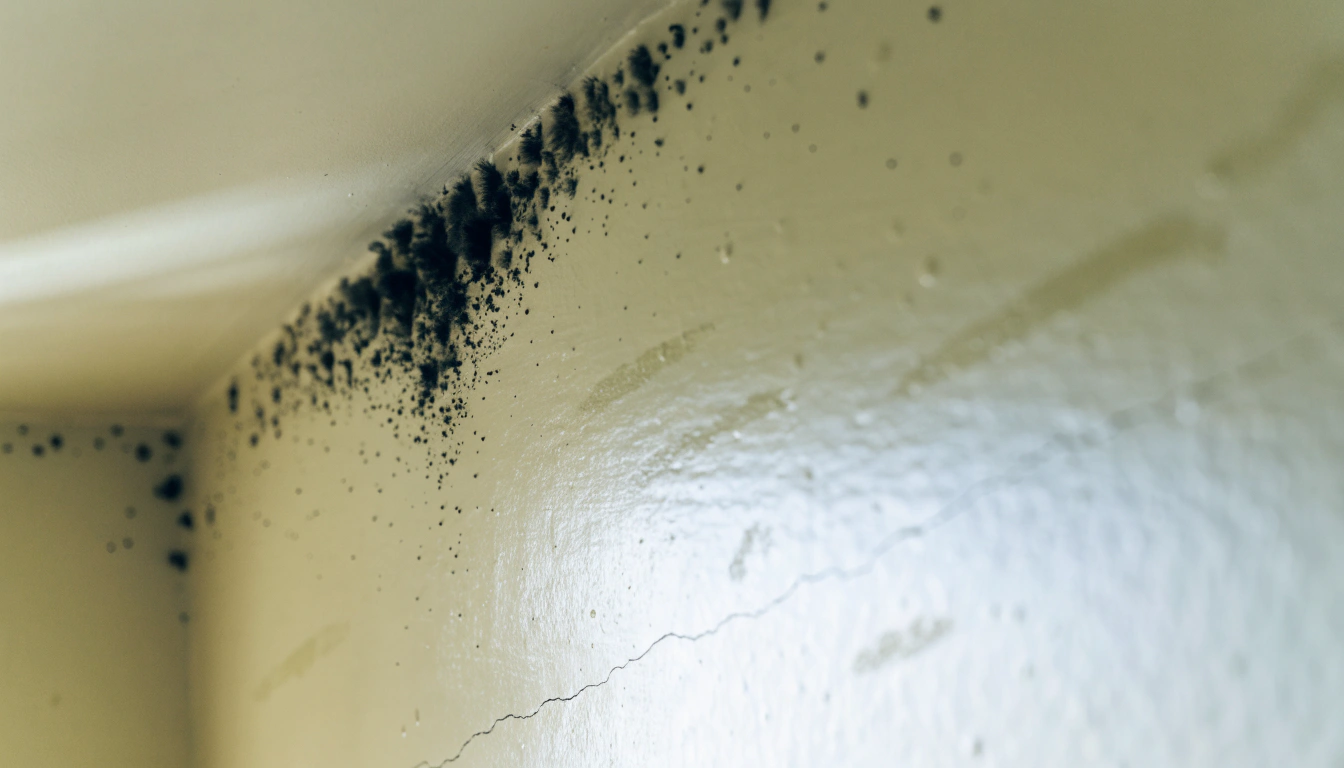
The ten second test that decides the whole job
Before you buy anything, find out what you are actually cleaning. Put on a glove, wet a cloth with warm water and a drop of washing up liquid and rub a small patch firmly for about ten seconds. What happens next tells you which of three jobs this is, and they are not the same job.
Will cleaning hold? That depends which damp put it there
The word people put in the search is "permanently", and the honest answer is that permanence has nothing to do with the product you clean with. It depends entirely on where the water is coming from. Clean a condensation patch and change nothing and it returns in a few months. Clean a rising damp patch and it returns regardless of what you change indoors.
| What you see | Likely cause | Will cleaning hold? |
|---|---|---|
| Speckling in top corners, behind furniture, along window reveals. Worse November to March. Windows stream in the morning. | Condensation | Yes, if you also lower the humidity or warm the surface. Cleaning alone buys you one season. |
| A tide mark rising from the skirting, roughly to waist height, with blown plaster and salt deposits. Present all year. | Rising damp | No. The damp proof course has failed or been bridged. This is a building repair. |
| An isolated patch away from the corners that darkens after heavy rain and dries back between. | Penetrating damp | No. The repair is outside: a gutter, a render crack, a pointing joint, a slipped tile. |
| A patch that appeared quickly and is growing, near a bathroom, kitchen, soil stack or pipe run. Wet rather than cold to the touch. | A leak | No, and it will keep spreading until the leak is found. |
If you are in the first row, the question of what to do about the humidity is worth its own read: whether a dehumidifier will help with mould goes through the sizing, the running cost and the cases where it is the wrong purchase.
What actually removes mould from a wall
Four things get recommended constantly and they do noticeably different jobs. The thing that separates them is not strength, it is whether they stay wet on the surface for long enough. Mould removal is a contact time problem. Spraying and immediately wiping is the single most common reason a treatment appears not to work.
| Product | What it does well | Where it falls down | Use it on |
|---|---|---|---|
| Household bleach, diluted | Removes the black colour faster than anything else, and costs almost nothing | It is an oxidiser working on pigment. The wall looks clean within minutes while the growth in a porous surface is barely touched, and the water in the bleach soaks into the plaster | Hard, non-porous surfaces. A poor choice on bare or blown plaster |
| White vinegar | Cheap, no fumes to speak of, safe around most finishes | Weak and slow. It needs a long dwell and repeat applications, and it does nothing about the stain. It also puts more water into a wall that already has too much | Light surface growth on a sound, non-porous finish. Not a serious answer on plaster |
| Fungicidal mould remover spray | Formulated to cling and stay wet, which is the thing that matters. Removes growth and lightens staining in one pass | Costs several pounds a bottle rather than pennies, and the fumes need the window open | Painted plaster walls and ceilings. The default choice for this job |
| Fungicidal wash plus anti-mould paint | Treats the surface and then changes it, so the next spore that lands has nothing to grow on | Two products, a drying wait between them, and a redecorating job | A wall you are going to repaint anyway, or one that has come back more than once |
On silicone it is a different story again, because mould gets underneath the surface of the bead where nothing reaches it. If the black is on a sealant joint rather than the wall, the sealant guide covers when the bead can be saved and when it has to be cut out.
How to remove mould from walls, step by step
You are about to spray a bleach-based or fungicidal chemical in an enclosed room. Ventilating to outside while keeping the internal door closed is the right way round. Gloves and eye protection, and a disposable mask if you are doing more than a small patch.
Almost everybody's instinct, and it is the wrong move. Dry brushing throws the growth into the air of a room you are standing in and spreads it to clean walls. Wet it before you touch it.
This is the step people get wrong. Read the contact time on the label, which is usually in the order of fifteen minutes, and actually wait it out. A foam formulation is worth paying for here because it stays put on a vertical wall instead of running down to the skirting.
Start at the clean edge and work in towards the patch, not the other way, so you are not dragging growth across clean paint. Bin the cloth rather than rinsing it in the sink and reusing it on the next wall.
Plaster that has been damp for a winter needs days, not hours, with heat and air movement on it. Painting over a wall that is still carrying moisture is how you trap the problem behind a new finish.
Mould staining bleeds through ordinary emulsion, sometimes after weeks. A stain blocking primer is a cheap step that stops you painting the same wall three times.
The paint buys you years rather than months. It does not buy you forever, and it will not hold on a wall that is still getting wet.
What to use
These are judged on published specification, manufacturer documentation and sixteen years running plumbers merchants, not on hands-on testing. I am not a plumber and I have not tested these on my own walls.
#1 The default for a painted wall
HG Mould Remover Foam Spray, 500ml
- Foam rather than liquid, so it stays on a vertical surface
- 500ml trigger spray
- For walls, ceilings, tiles, grout and sealant
- Chlorine based
Pros
- The foam is the point: it holds on a wall for the contact time instead of running to the skirting
- Lightens staining as well as removing growth, which a plain fungicidal wash often will not
- Widely stocked, so you are not waiting on a delivery while the patch spreads
- One bottle covers a typical corner patch several times over
Cons
- Chlorine based, so the window has to be open and it will mark fabrics and some flooring if it drips
- Will lighten coloured emulsion as well as the stain, so test somewhere out of sight first
- Does nothing whatever about the cause, and the label does not pretend otherwise
- Not the right product for bare or blown plaster, where the issue is the wall rather than the surface
The one to reach for when the ten second test said surface growth on sound paint. Spray it, leave it for the contact time on the label, wipe outwards with a cloth you then throw away. If the patch returns within a few months, the product did its job and the room did not, and the answer is ventilation rather than a stronger spray.
#2 For a patch that keeps coming back
Dryzone Mould Remover and Prevention Kit
- Three 450ml sprays: a remover, a steriliser and a preventer
- Designed as a three stage sequence rather than a single product
- From a damp proofing manufacturer rather than a household cleaning brand
Pros
- The three stage approach addresses the thing single sprays do not, which is what happens after the wall is clean
- The preventative stage is useful on a wall you are not going to repaint
- Comes from a company whose main business is damp rather than cleaning products
- Enough volume for several rooms rather than one patch
Cons
- Costs considerably more than a single bottle of fungicidal spray
- Three stages with waiting between them, so it is an afternoon rather than ten minutes
- The preventative stage is not a substitute for anti-mould paint on a wall you are redecorating
- Still will not hold on a wall that is wet from rising or penetrating damp, and nothing in the kit claims it will
Worth the extra over a single spray in one specific situation: a wall you have already cleaned once that has gone mouldy again, where you are not planning to redecorate. If you are repainting anyway, a cheap fungicidal wash plus a tin of anti-mould paint does the same work for similar money and leaves you with a finished wall.
Anti-mould paint, priced per square metre
Anti-mould paint contains a fungicide in the dried film, so a spore landing on it has nothing to establish on. It is the one product on this page that genuinely changes the wall rather than cleaning it, and it is the step most people skip.
The two tins everyone ends up choosing between look similar on the shelf and are not priced the same once you work out what they cover. The arithmetic is tin price divided by the area the manufacturer says it covers at the number of coats they specify.
| Paint | Price | Stated coverage | Cost per square metre, two coats | What the maker promises |
|---|---|---|---|---|
| Zinsser Perma-White 2.5L matt, Screwfix | £39.99 | 10 m² per litre, so 25 m² a tin at one coat | £3.20 | Guaranteed to prevent mould and mildew growth on the paint film for at least 5 years |
| Ronseal 6 Year Anti Mould Paint 2.5L matt, Toolstation | £34.19 | Around 13 to 16 m² a tin with two coats | £2.14 to £2.63 | States surfaces stay mould-free for up to six years, as a claim rather than a stated guarantee |
Working it through: the Zinsser tin covers 25 m² at one coat, so 12.5 m² at two, and £39.99 divided by 12.5 is £3.20 a square metre. The Ronseal tin is quoted at 13 to 16 m² with two coats already allowed for, so £34.19 divided by 16 is £2.14 and divided by 13 is £2.63.
Around a pound a square metre cheaper on the stated figures. On a single bedroom wall of roughly 10 m² that is about a tenner in it, which is not the deciding factor for most people.
The difference worth paying for is not the coverage, it is that Screwfix states a five year guarantee against growth on the paint film. Ronseal's six years is written as what the paint does, not as something you can hold anyone to.
One thing to be clear about, because the tins are shelved next to each other: anti-mould paint and damp proof paint are not the same product. Damp proof paint is a barrier coating meant to hold back moisture coming through a wall. Putting it on an internal wall that is wet from rising damp traps the water in the plaster and usually moves the problem a foot higher up. If the ten second test said the plaster has gone, paint of any kind is the wrong purchase.
When this will not fix it
Everything above is a surface treatment. If the wall is getting wet from somewhere, every one of these steps is a delay rather than a repair, and the only thing you will have bought is a cleaner-looking wall for one winter.
- A tide mark climbing from the skirting. Rising damp. The damp proof course has failed, or the outside ground level, a flower bed or a raised path has been built up above it and is bridging it. Go and look outside before you believe a damp proofing quote.
- A patch that darkens every time it rains. Penetrating damp. Blocked gutter, cracked render, failed pointing, slipped tile. The repair is on a ladder, not in a spray bottle.
- A growing patch near plumbing. A slow leak on a concealed pipe or a failed shower tray seal produces a damp patch that behaves exactly like penetrating damp. Our guide to finding a water leak before you pay for a survey is where to start.
- An extractor fan that spins but moves no air. Very common, and it makes a ventilation problem look inexplicable. A blocked duct, a stuck backdraught shutter or a crushed flexible hose will do it. Check it against our guide to an extractor fan that is not working.
- Mould on one cold corner while the rest of the house is fine. That corner is a cold bridge and is sitting below dew point while the room average looks perfectly normal. Insulation, pulling furniture off the wall and steady background heat are the levers. No product solves a temperature problem.
Keeping it off, which is the part that makes it permanent
Mould needs a surface that spends time wet. You get rid of that in one of two ways: put less water into the air, or keep the surface warmer. Everything that works is one of those two.
Stop drying washing on radiators, which is the single largest source in most houses. Run the bathroom fan on its timer with the door shut. Lids on pans. Open the trickle vents somebody taped shut. All free or nearly free.
Move the wardrobe four inches off the external wall so air can get behind it. Heat the room steadily rather than in two hour blasts, because the wall never catches up. Insulate the cold corner if you are doing the work anyway.
Approved Document F sets a minimum intermittent extract rate of 15 l/s for a bathroom and 30 l/s for a kitchen with a cooker hood ducted outside. A great many fitted fans do not reach it, and a fan that is under rate is the reason the moisture is reaching your bedroom wall in the first place. The best bathroom extractor fans compares published extract rates against that minimum, and the condensation guide works through where the moisture in a typical household actually comes from.
If you rent
Damp and mould growth is a recognised housing hazard rather than a housekeeping failing. It appears as hazard 11 in the Housing Health and Safety Rating System operating guidance, made under section 9 of the Housing Act 2004, and a council can inspect a property against it.
Social housing tenants in England have defined timescales under Awaab's Law: the landlord must investigate a reported significant damp or mould hazard within 10 working days, provide a written summary within 3 working days of the investigation finishing, and make the property safe within 5 working days of it finishing. If the landlord's complaints process does not resolve it, the Housing Ombudsman is the next step. Private tenants should report it to the landlord in writing and then to the environmental health team at their local council. Report it before you spend your own money on paint.
Questions people ask about mould on walls
How do you get rid of mould on walls permanently and naturally?
Permanently and naturally are pulling in opposite directions. The natural options, white vinegar and bicarbonate of soda, are weak and slow, and both involve putting more water onto a wall that already has too much. They will clear light surface growth given a long dwell and repeat applications. What makes the result permanent is not the cleaner at all, it is whether the wall stays above dew point afterwards, and that is a ventilation and heating change rather than a cleaning product. If you want a genuinely low-chemical approach, do the free ventilation fixes first and you may find there is very little left to clean.
Can I just spray vinegar on mould and leave it?
You can leave it on, and leaving it on is better than wiping it straight off, because contact time is the thing that matters. What you should not do is leave it and consider the job finished. Vinegar does not remove the staining, so a cleaned patch often still looks dirty, and on porous plaster you have added water to a wall that is already carrying more than it should. Let the wall dry out properly afterwards with the window open and some heat on it.
What are the downsides of using vinegar for mould?
Three. It is slow and needs repeating, where a fungicidal spray does the job in one pass. It leaves the stain behind, so a wall can be treated and still look exactly as bad. And it is acidic, so it should never be mixed with bleach and should be kept off natural stone, unsealed grout and some metal fittings. On a painted plaster wall the honest position is that vinegar is a reasonable first try on light growth and the wrong tool for anything established.
Does having the heating on stop mould?
Steady heat helps and intermittent heat often does not, which is why people get contradictory answers. Mould forms where the surface is cold enough for the air touching it to reach dew point. A wall that is warmed gently all day stays above that point. A wall in a house heated hard for two hours in the evening and then left to go cold never gets warm right through, so the moisture released during the evening condenses on it overnight. Heating one problem room steadily at a modest setting does more than heating the whole house harder for a shorter time.
Does bleach kill mould on walls?
It kills what it reaches, and on a porous wall it does not reach much. Bleach is an oxidiser and it works very fast on the pigment, which is why the black disappears within minutes and the wall looks fixed. The growth within the plaster is largely untouched, and the water carrying the bleach soaks in. That combination is the reason a bleached patch so often comes back looking identical in a couple of months. On a hard non-porous surface bleach is fine. On plaster, a fungicidal product designed to cling is the better buy.
Should I paint over mould?
Not without treating it first. Emulsion over live growth lifts and flakes within months, and the staining ghosts through the new coat anyway. The sequence is treat, dry fully, stain block if any shadow remains, then paint. If you are going to the trouble of repainting, use an anti-mould finish rather than ordinary emulsion, because the price difference over a single wall is small and the fungicide in the film is the only part of the job that keeps working after you have put the brushes away.
Why does mould keep coming back on the same wall?
Because that wall is the coldest surface in the room and nothing has changed about that. It is usually a north-facing external wall, an uninsulated corner, the reveal round a window, or the bit of wall behind a wardrobe where no air moves. Spores are in the air of every house all year round, so the wall is not being reinfected from somewhere special. It is simply the first surface in the room to go wet, every time. Change its temperature or change the humidity of the room and the same wall stops being the one.
Related guides
- Will a dehumidifier help with mould?: the sizing, the running cost arithmetic and the three kinds of damp it does nothing for.
- How to stop condensation on windows: where the twelve litres of water a day in your house comes from, which is the same water that ends up on the wall.
- The best bathroom extractor fans: which units actually clear the 15 l/s Part F minimum, because most of the moisture starts in one room.
- Removing black mould from silicone sealant: the one surface where cleaning usually fails, because the growth is inside the bead rather than on it.
- Getting rid of black mould in the bathroom: tiles, grout and the specific habits that keep a bathroom clear.





0 Comments