

As an Amazon Associate I earn from qualifying purchases.
This site used to carry four separate towel rail guides, all competing with each other and all saying roughly the same thing. This is now the only one, and it covers the whole decision: what size you need, what output you are actually getting, what the thing costs to run at today's electricity price, and which of the rails you can buy online are worth the money.
Three things came out of putting it together. Most of these rails do not publish a wattage at all, which makes it impossible to size one properly or work out what it costs to run, and that is worth saying plainly rather than inventing a figure. Leaving a 500W rail on permanently costs about £95 a month at the current capped unit rate, so the advice you will read elsewhere that it is cheaper to leave it running is wrong. And a towel rail is usually not a room heater: 500W is about 1,700 BTU an hour, well short of what the radiator you are taking off that wall was probably producing.
The basis for this page: current retailer listings, manufacturer documentation and 16 years of selling heating and bathroom products over a plumbers merchants counter. I have not fitted any of these rails and I am not a plumber or an electrician. Where the job needs a qualified person, I say so rather than talk you through it.
At a glance
- Best overall: Greened House Curved Chrome 500 x 800mm, because it is the only one here that comes with a timer and a room thermostat
- Best for a large bathroom: Warmehaus Straight Chrome 1800 x 500mm
- Best for a cloakroom: Warmehaus Flat Panel Chrome 650 x 400mm, and the only one that publishes its wattage
| Product | Best for | Listed size | Listed output | Timer or thermostat | Buy |
|---|---|---|---|---|---|
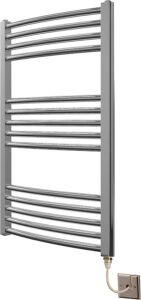 Best overall Greened House Curved Chrome 500 x 800 | Most bathrooms | 500 x 800mm | Not published | 7 day timer and room thermostat | Check price on Amazon |
Greened House Curved Chrome 500 x 1800 | A tall narrow wall | 500 x 1800mm | Not published | Timer | Check price on Amazon |
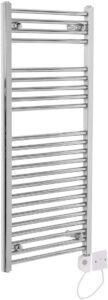 Best for a large bathroom Warmehaus Straight Chrome 1800 x 500 | Large bathrooms | 1800 x 500mm | Not published | None | Check price on Amazon |
Best for a cloakroom Warmehaus Flat Panel Chrome 650 x 400 | Cloakrooms and small en suites | 650 x 400mm | 100W | None | Check price on Amazon |
A word on the brands, because two of the three picks come from one of them. Warmehaus, Greened House and a rotating cast of unbranded sellers are what is actually buyable in chrome at sensible money on Amazon UK. The established British names, Zehnder, Vogue and JIS among them, sell through merchants and bathroom showrooms rather than online marketplaces, so they are not in the picks here. If you are buying through a merchant instead, their own-brand rails usually do publish a wattage and a BTU figure, which is a real advantage.
What a towel rail actually costs to run
This section comes before the recommendations deliberately, because it is the part most likely to change your mind. An electric towel rail converts essentially all the electricity it draws into heat, which sellers describe as being 100% efficient. That is true and almost beside the point. Efficiency is not the same as cheap, and electricity is the expensive way to make heat in a British house.
| Element output | 2 hours a day | 4 hours a day | Left on constantly | 4 hours a day for 30 days |
|---|---|---|---|---|
| 100W | 5p | 11p | 63p a day | £3.16 |
| 300W | 16p | 32p | £1.89 a day | £9.48 |
| 500W | 26p | 53p | £3.16 a day | £15.78 |
| 750W | 40p | 79p | £4.74 a day | £23.69 |
Is it cheaper to leave a heated towel rail on all the time?
No, and it is not a close call. The idea comes from a half-remembered argument about whole central heating systems and thermal mass, and it does not transfer. A towel rail has almost no thermal mass, and its element draws its rated power whenever it is on. Running it twice as long costs twice as much. The constant column in the table above is what that mistake costs over a month.
What does save money is control. A timer that brings the rail on for an hour before the household gets up, and a room thermostat that cuts the element once the bathroom is warm enough, between them take most of the cost out of owning one. That is the single reason the Greened House rail is the pick below rather than the bigger Warmehaus.
Electric, central heating or dual fuel?
There are three ways to feed a towel rail and the choice has more effect on your bills than the model does. The reason is the price of the fuel. Under the cap for this quarter, electricity is 26.32p per kWh and gas is 7.97p per kWh, so the same quantity of heat from a gas boiler costs a little under a third of what it costs from an electric element.
| Type | How it is fed | Works in summer | Cost of the heat | Who fits it |
|---|---|---|---|---|
| Electric only | A fused spur from the consumer unit | Yes | Highest, at the electricity rate | Electrician |
| Central heating only | Flow and return pipes off the heating circuit | No, not unless you fire the whole system up | Lowest, if you heat with gas | Plumber |
| Dual fuel | Both, with an element inside a plumbed rail | Yes, on the element | Gas in winter, electricity in summer | Plumber and electrician |
Dual fuel is the arrangement that makes the most sense in a house with a wet heating system, because it gives you cheap heat for the seven or eight months the heating is on and a warm towel for the months it is off. It is also the dearest to install, since it needs both trades. A plumbed rail on its own is the cheapest to run and useless in July, which is the complaint that sells electric rails in the first place.
One thing to get right on a plumbed or dual fuel rail: fit a thermostatic valve on it, so the bathroom can be controlled separately from the rest of the house. Our explainer on what a thermostatic radiator valve does covers why, and the common mistake of fitting one in a room that also holds the main thermostat.
What output do you need, and why the missing wattage matters
Heat output on radiators and towel rails is quoted in BTU per hour in the UK trade, and the conversion is fixed: one kilowatt is 3,412 BTU per hour. That turns an element rating into something you can compare against the radiator already on the wall.
| Element | Output in BTU per hour | Realistically that is |
|---|---|---|
| 100W | 341 | A warm hand towel, nothing more |
| 300W | 1,024 | Towels dried, a small room taken off the chill |
| 500W | 1,706 | Towels plus useful warmth in a small bathroom |
| 750W | 2,559 | Approaching actual room heating in a well insulated bathroom |
Here is the practical test, and it is better than any online BTU calculator. Find the output of whatever is heating that bathroom now, which is on the manufacturer's data sheet for the radiator or printed on a label behind it. If you are taking out a panel radiator producing four or five thousand BTU and putting up a 500W towel rail producing seventeen hundred, the room will be colder afterwards. People do this every day and then blame the rail.
A BTU calculator asks about room volume, insulation, double glazing, how many external walls you have and what the rail is made of. It is a reasonable starting point for a new installation. It is not a substitute for knowing what you are replacing.
The towel rails worth buying
Best overall: Greened House Curved Chrome 500 x 800mm
A 500mm wide curved chrome rail supplied with a seven day programmable timer and a room thermostat. The controls are the reason it wins. Everything else on this page runs at full power until somebody switches it off.
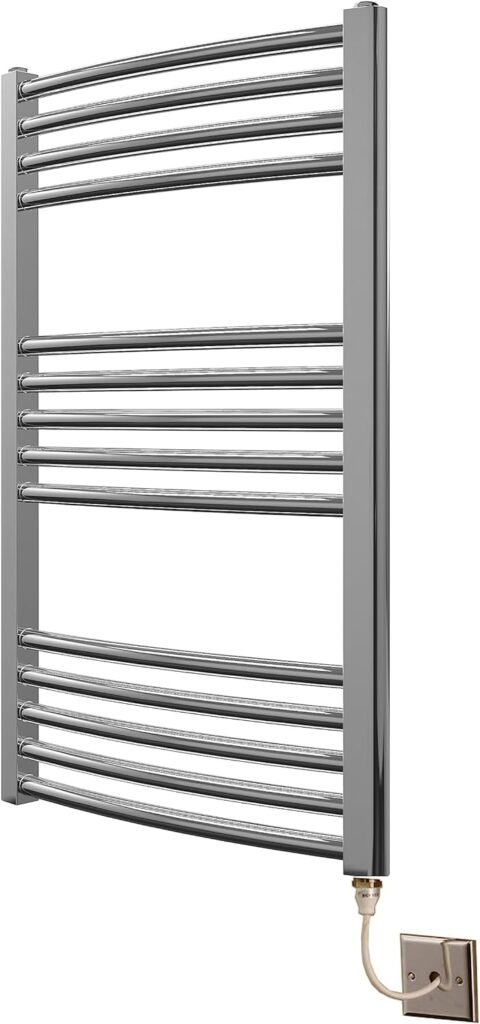
#1 Best overall
Greened House Curved Chrome Electric Towel Rail, 500 x 800mm
- 500mm wide by 800mm high, curved chrome
- Supplied with a 7 day programmable timer and a room thermostat
- PTC heating elements
- The same rail is also sold in a 500 x 1800mm version
- Wall mounted, fixings supplied
Pros
- The only rail here supplied with both a timer and a room thermostat, which is what actually keeps the running cost down
- Curved bars hold a bath sheet without it sliding straight off
- Chrome on a rail at this money is unusual
- 500mm wide suits the narrow spare wall most UK bathrooms have
Cons
- No wattage is published anywhere in the listing, so you cannot size it against the radiator you are removing or cost its use
- The controller has several programmable periods and takes some working out
- Timer mode has to be switched on before the programmed periods do anything, which catches people out
- Chrome over mild steel will pit in time in a bathroom with poor ventilation
The pick for most bathrooms, and the controls are the whole argument. A timer plus a room thermostat means the element only draws power when it needs to, which matters more to the bill than anything else here. Marked down for publishing no wattage, which on a heating product is a genuine failing rather than an oversight.
If 800mm is not enough height, the same rail is sold in a 500 x 1800mm version that takes considerably more, though that listing mentions a timer and not the room thermostat, so check what is in the box before you order.
See the 500 x 1800mm version on AmazonBest for a large bathroom: Warmehaus Straight Chrome 1800 x 500mm
The tallest rail here, and a straightforward sealed electric unit with manual control. Buy it for capacity, and budget for a separate timer.
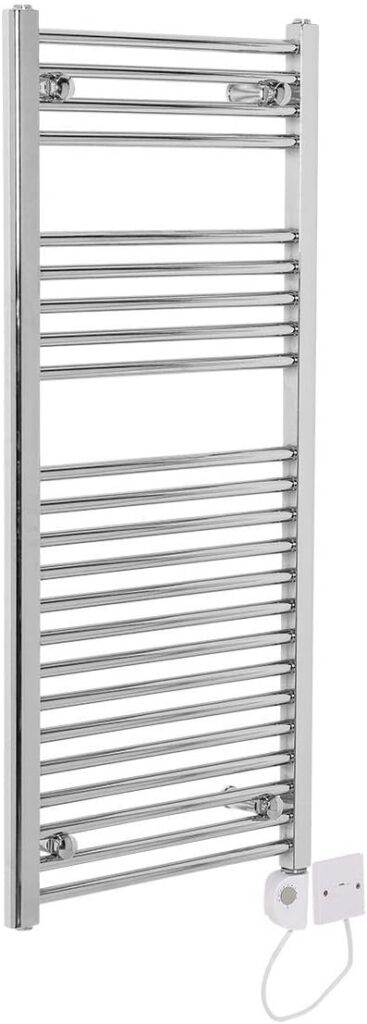
#2 Best for a large bathroom
Warmehaus Straight Chrome Electric Towel Rail, 1800 x 500mm
- 1800mm high by 500mm wide, straight chrome
- Manual control, with no timer and no thermostat
- Electric only, filled and sealed at the factory
- Wall mounted
Pros
- The tallest rail on this page, so it will take a family's towels at once
- Straight bars wipe down more easily than curved ones
- A sealed electric unit has very little to go wrong other than the element itself
Cons
- Manual only, so it runs at full power from the moment it is switched on, which is the expensive way to own a towel rail
- No wattage published, so the heat output is unknown
- 1800mm of height needs a genuinely clear wall and a sound fixing into something solid
- Nothing stops you leaving it on for a fortnight by accident
This one is about capacity rather than economy. It will dry everything a family produces, but with no timer and no thermostat you are relying on remembering to switch it off, and the running cost table shows what forgetting costs. If you buy it, have it wired to a switched fused spur with a timer so the decision is not left to memory.
Best for a cloakroom: Warmehaus Flat Panel Chrome 650 x 400mm
A small 100W flat panel, and the only listing in this group honest enough to tell you its wattage. That makes it the only one you can cost and size properly before you buy.
#3 Best for a cloakroom
Warmehaus Flat Panel Chrome Electric Towel Rail, 650 x 400mm
- 650mm high by 400mm wide
- 100W element, which is about 341 BTU per hour
- Flat panel chrome
- Electric only
Pros
- One of very few rails at this end of the market that publishes its wattage, so you can size it and cost it
- Small enough for a downstairs loo or a tight en suite
- At 100W it costs around 11p a day run for four hours, the cheapest way on this page to have a warm towel
- A flat panel is the easiest shape to keep clean
Cons
- 341 BTU an hour will warm a hand towel and little else, so do not buy it expecting any room heating
- Too small to hold a bath sheet
- No timer or thermostat, so switching it on and off is your job
- 400mm wide limits what you can hang over it
Honest about what it is, which is rare in this category. A 100W panel is a towel warmer and not a heater, and in a cloakroom that is exactly the right product. Put it in a family bathroom expecting it to replace a radiator and you will be disappointed, which is a fault of the buyer rather than the rail.
Sizing and fitting: measuring up before you order
Width is almost always the constraint and height is where you buy capacity and output. Measure the clear wall you have, then take something off for the brackets and for getting a hand behind the rail, and work to that rather than to the maximum that will physically fit.
A few things that are easy to get wrong:
- Reach, not just fit. A rail you cannot get to from the bath or the shower is a rail whose towels stay on the floor. The old advice to put a radiator on the coldest external wall under a window is sound for a radiator and often wrong for a towel rail, because a towel rail needs to be where the wet person is.
- What the wall is made of. A loaded 1800mm rail is a serious cantilever. On a stud wall it wants fixing into the studs or into noggins put in for the purpose, not into plasterboard with cavity anchors and optimism.
- Towel depth. Bars set close to the wall will not take a folded bath sheet. Check the depth from wall to bar, not just the overall dimensions.
- Pipe centres on a plumbed rail. If you are replacing a plumbed rail or radiator, the existing pipe centres decide a great deal. Matching them saves lifting the floor.
Worth saying as well: a towel rail is not a ventilation strategy. If your bathroom steams up and stays damp, the rail will not fix it, and warm damp air deposits condensation somewhere else instead. That is an extraction problem, and it is covered in what to check when a bathroom extractor fan is not working and in how to stop condensation on windows.
Finishes, and which ones survive a bathroom
Finish is sold as a styling decision and is really a durability decision. Three constructions cover almost everything on sale, and they do not age the same way. Every rail in the picks above is the first of them.
Cleaning one without ruining the finish
A damp cloth and a little washing up liquid, then dried off, is the whole job. The part worth knowing is what to keep away from it. Do not use a limescale remover, a descaler or vinegar on a plated or painted rail. Those are acids, and on a towel rail there is no scale on the outside for them to work on, so the only thing they can attack is the chrome or the paint. The same goes for abrasive cream cleaners, which take the shine off plating and leave it duller every time.
Worth doing once or twice a year: check the bracket screws. A rail carrying wet towels works its fixings loose slowly, and a rail that has started to lean is easier to sort out before the fixing pulls out of the wall than after.
What goes wrong over time
Towel rails are simple things, and they fail in a small number of predictable ways. This is what brought them back to the counter.
The cold-at-the-top and cold-at-the-bottom distinction is the most useful thing on this page for anyone with a plumbed rail, and it is the diagnosis almost nobody makes before reaching for a bleed key. Our guide to bleeding a radiator, and what to do when bleeding does not fix it works through it properly. In a hard water area, limescale shortens the life of an electric element as surely as it does anything else that heats water.
Frequently asked questions
Do electric towel rails use much electricity?
Less than most people fear, if they are controlled, and a great deal more if they are not. A 300W rail run for four hours a day costs about 32p a day at the current capped rate. The same rail left on continuously costs £1.89 a day. The rail is not the variable, the hours are.
Can a heated towel rail heat the whole bathroom?
Sometimes, in a small, well insulated bathroom, with a rail at the top of the output range. Usually not. Work out the BTU output of the rail from its wattage, compare it with the output of the radiator currently in the room, and you will have your answer before you buy rather than after.
Should I buy electric or dual fuel?
If the bathroom already has heating pipes in it and you heat with gas, dual fuel is the better long-term answer, because the winter heat then costs roughly a third of what the element would cost. If there are no pipes within reach, or the rail is going into a loft conversion or an en suite built into a cupboard, electric only avoids a lot of floor lifting.
Can I fit an electric towel rail on a plasterboard wall?
Yes, but fix it into the studwork or into noggins added behind the board, not into the board alone. A full-length rail hung with wet towels on it puts a long lever on those brackets, and plasterboard fixings are the usual reason a rail ends up leaning away from the wall.
Do I need a plumber or an electrician?
An electric-only rail needs an electrician, because the connection is notifiable work in a bathroom. A plumbed rail needs a plumber. Dual fuel needs both. Mounting the rail on the wall is the part you can reasonably do yourself.
Why do so few towel rails publish a wattage?
Because publishing it invites the comparison that loses the sale. A buyer who knows a rail is 300W can work out that it produces about a thousand BTU an hour, compare that with the radiator they are removing, and decide against it. Merchant own-brand rails and the established British manufacturers do publish the figure. Marketplace listings often do not.
Related guides
- How to bleed a radiator, and what to do when bleeding does not fix it, for the diagnosis behind a half-warm plumbed rail
- What is a thermostatic radiator valve, if you are plumbing a rail in and want the bathroom controlled separately
- Bathroom extractor fan not working, because damp is a ventilation problem and not a heating one
- Wet rooms: what is actually involved, where heating and drying the room matters more than anywhere else in the house




0 Comments