

As an Amazon Associate I earn from qualifying purchases.
Topping up a boiler is a ten minute job, and almost every guide written about it fails the reader at the same point: it tells you to open the valves on your filling loop without telling you how to work out which kind of filling loop you are looking at. There is no single design. A braided hose with two valves, a keyed filling link hidden behind a flap, and a keyless blue lever all do the same job and are operated completely differently.
The second thing most pages get wrong is the target number. You will see 1.5 bar quoted as though it were universal. It is not. Worcester Bosch tell you to stop at just over 1 bar, Baxi publish a working range of 1 to 2 bar, and British Gas talk about 1.5 bar. They are not contradicting each other, they are describing different appliances on systems of different heights. Your manual is the authority, not a blog.
This guide covers all three filling loop designs, the honest version of the target pressure, what to do when you overshoot (which happens constantly), how to clear the lockout afterwards, and the legal line where this stops being a homeowner job.
First, identify which filling loop you have
Do this before you touch anything. The three designs are easy to tell apart once you know what you are looking for, and the instructions diverge immediately after that point. Open the cupboard, look underneath the boiler, and match what you see to one of these three.
One thing worth saying plainly, because it came up at the counter more often than almost anything else: a filling loop that has been left permanently connected and permanently open is not a convenience, it is a fault waiting to happen. Under the Water Supply (Water Fittings) Regulations the loop is meant to be a temporary connection, disconnected after use, or fitted with the correct double check valve arrangement so heating water can never track back into your drinking water.
What pressure should a boiler be?
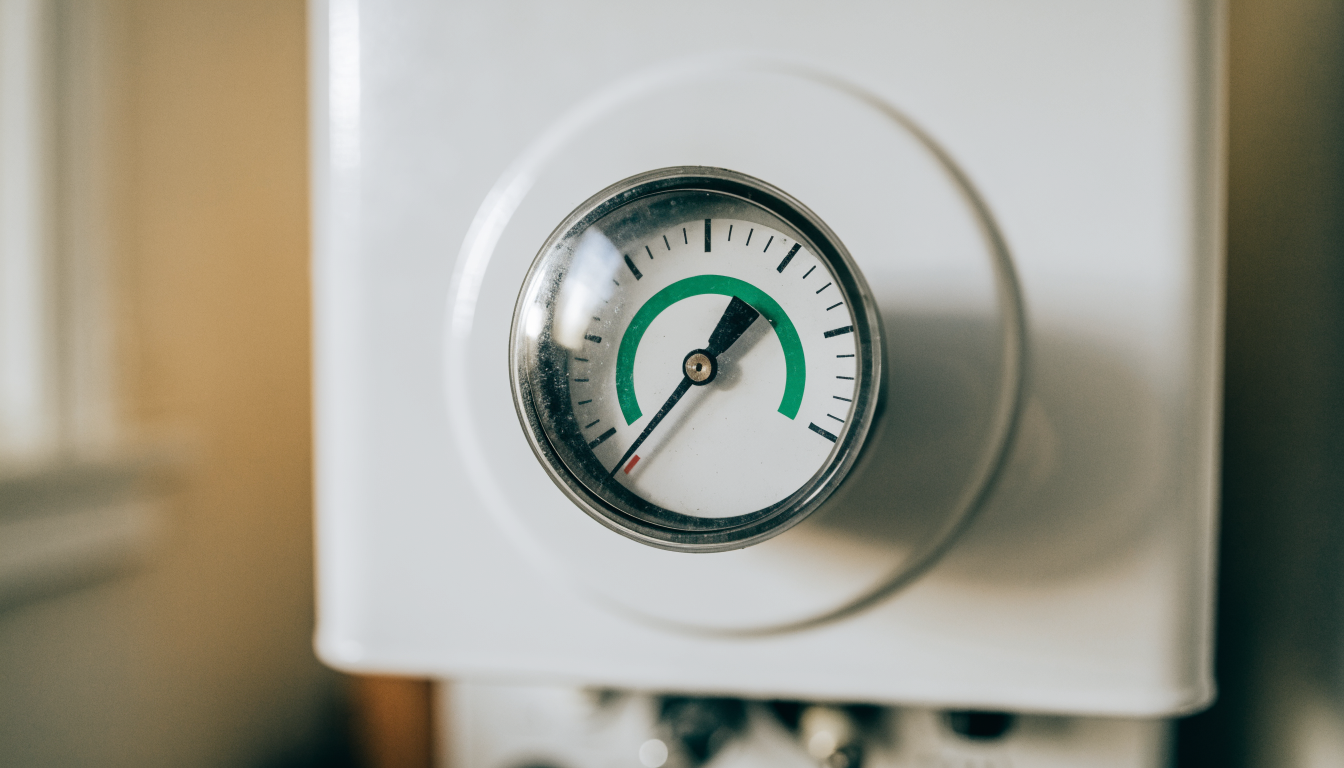
Cold, with the heating off, most sealed systems want somewhere between 1 and 1.5 bar. That is a band, not a setting, and the correct figure for your appliance is printed in your manual and often on the gauge itself as a green arc.
The reason it varies is height. The system has to hold enough pressure to push water to the highest radiator in the building and keep it there. A bungalow needs less than a three storey townhouse with a radiator in a loft conversion. Roughly, every extra storey adds about 0.1 bar to the minimum you need. That is why a figure that works perfectly in one house leaves the top radiator cold in another.
If you have topped up correctly and one radiator is still cold at the top, pressure was not your problem. Air was, and the fix is to bleed the radiator instead. Cold at the bottom with a hot top is a different fault again, covered in our guide to common radiator problems.
How to repressurise a boiler with an external filling loop
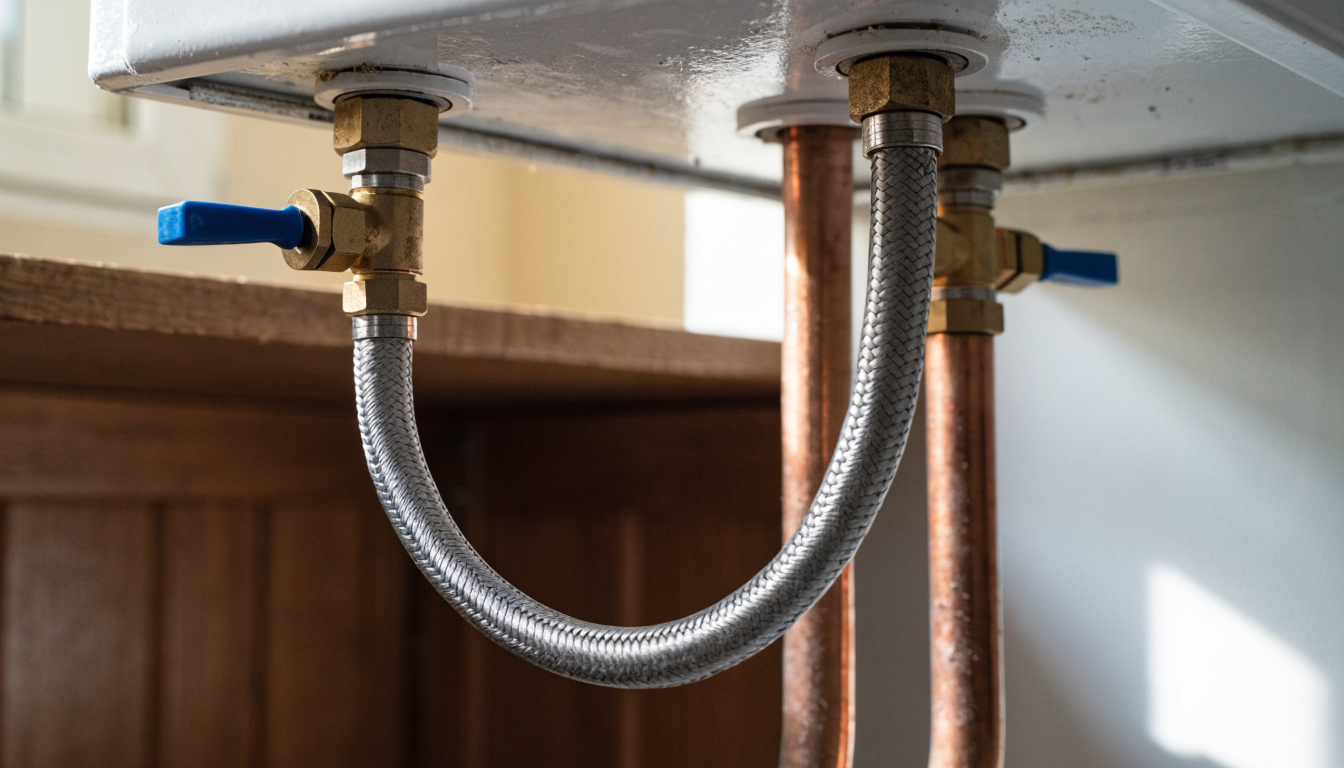
This is the braided hose with a valve at each end. The whole operation takes under a minute once the boiler is off, and the single most common mistake is opening one valve, hearing nothing, and assuming the loop is broken.
If your loop has a permanently connected hose, the correct practice is to undo one end once you have finished and store the hose somewhere you will find it again. That is the arrangement the water regulations expect, and it also removes any chance of a failed check valve pushing mains pressure into the heating circuit while nobody is watching.
How to increase boiler pressure using an internal filling key
Worcester Bosch systems mostly use a keyed filling link rather than a hose. There is no braided pipe to find, which is why people with a Greenstar so often conclude their boiler does not have a filling loop at all.
- Drop the flap on the underside of the boiler. The key is normally clipped inside it. Behind the flap you will find a black plastic port marked with an open padlock and a closed padlock.
- Line the key up with the open padlock symbol and push it fully home. It should seat with a small amount of resistance. If the key will not go in, you almost certainly have the wrong one, not a broken port.
- Turn the key anti-clockwise towards the closed padlock and hold it there. Water starts moving and the needle begins to climb.
- Return the key to the open padlock position as soon as you reach your target. Worcester Bosch's own advice is to stop at just over 1 bar rather than pushing on to 1.5.
- Pull the key out and clip it back in the flap. Leaving it in the port is the quickest route to snapping it off, and it is a part that is easier to lose than to replace.
Worcester produced more than one key profile across the Greenstar range, a larger and a smaller pattern, and they are not interchangeable. If yours has gone missing and you cannot tell which you need from looking at the port, a matched pair costs less than a single call-out and removes the guesswork.
For a lost Worcester key
HTS Boiler Filling Key for Worcester Bosch Combi Boilers (large and small pair)
- Supplied as a matched pair, one large and one small profile
- Compatible with Worcester Bosch keyed filling links
- Replaces Worcester part number 87161211070
Pros
- Removes the need to identify which key profile your boiler takes before ordering
- Far cheaper than a call-out to top up a boiler you could top up yourself
- Spare key means the job does not stop the next time one disappears
Cons
- Aftermarket rather than a genuine Worcester part
- Useless on a boiler with a keyless lever or an external braided loop, so identify yours first
- Plastic, and it will snap if you force it against a seized port
Only relevant if the identification panel above put you in the keyed filling link group. If it did, buying the pair rather than trying to identify the profile from a photograph is the sensible route.
How to repressurise a boiler with a keyless lever
The newest design, and the most forgiving. A single blue lever sits on the underside of the boiler, sometimes recessed enough that you have to feel for it rather than see it.
- Find the blue lever or tab under the boiler casing. There is no flap to open and no key to fetch.
- Pull it down and hold it. It is spring loaded and will not stay down on its own, which is deliberate.
- Release it when the needle reaches your target. Because it shuts itself the instant you let go, this is the one design that is genuinely hard to overfill.
What to do if you overshoot the pressure
Going past the mark is the single most common outcome of a first attempt, and it is not a disaster. A system sitting at 2.5 or 3 bar will usually vent itself through the pressure relief valve, which discharges outside or to a drain, and you will find a puddle or a dripping pipe on an external wall.
The way to bring it down without touching the boiler is to let a small amount of water out of a radiator. British Gas give the same advice, and it is the correct one because it keeps you outside the appliance casing entirely.
1. Turn the heating off and let the system cool. Bleeding a hot radiator sprays scalding water.
2. Put a thick cloth and a shallow container under the bleed valve at the top corner of any radiator.
3. Open the bleed valve a quarter turn anti-clockwise with a bleed key. Water, not air, should come out.
4. Let a small amount out, close the valve, then walk to the boiler and read the gauge. Repeat in small bursts rather than one long one.
5. Stop when you are back in the band. Overshooting downwards just means starting the fill again.
If the pressure will not come down, or it climbs back up on its own within a day or two, stop bleeding radiators. A system that pressurises itself has either a filling loop valve passing water or a failed heat exchanger, and neither is fixed from the outside.
Resetting the boiler and clearing a lockout
Most modern combis will not fire below roughly 0.5 bar. They shut down deliberately and display a fault code, which is called a lockout. Topping the pressure back up does not always clear it on its own.
A lockout is a protective shutdown, not a breakdown. The boiler has detected a condition it will not run in and has stopped itself. With the pressure restored, press and hold the reset button for a few seconds, or turn the control dial to the reset position if your model uses one, and wait for the ignition sequence to run.
What matters is what you do next. If the same lockout returns, do not keep resetting it. Repeatedly resetting a boiler that keeps locking out is not persistence, it is overriding a safety device without knowing what it is protecting against. Two resets is a reasonable attempt. A third is a phone call to an engineer.
Where this job legally stops being DIY
Everything described above happens outside the boiler casing: a hose, a key, a lever, a radiator bleed valve. All of it is a homeowner job and none of it requires a registered engineer.
The moment you take the front off the boiler, that changes. Under the Gas Safety (Installation and Use) Regulations 1998, work on a gas appliance may only be carried out by someone competent and registered with Gas Safe. That covers the pressure gauge itself, the pressure relief valve, the expansion vessel, the automatic air vent and the heat exchanger. It applies whether or not you are being paid, and it applies in your own home.
Replacing a boiler pressure gauge is a good example. On plenty of older system boilers the gauge is mounted on external pipework and looks like a simple swap. On a combi it is almost always inside the casing, wired or piped into the appliance, and swapping it is engineer work regardless of how straightforward the part looks in a catalogue.
How often is too often to top up a boiler?
Here is the number that actually matters, and almost nobody publishes it plainly: a healthy sealed system should need topping up roughly once a year, or not at all. Some go five years without a look.
Topping up treats the symptom. If you are in the bottom two rows of that panel, the useful next step is working out where the water is going, which is a different job with a different method: our guide to why a boiler keeps losing pressure sorts the causes by how quickly the gauge falls, because the speed of the drop narrows it down faster than anything else. Rapid losses point one way, a slow seasonal drift points another.
Two things are worth checking yourself before anyone else gets involved, because both are common and both are outside the casing. Run a dry hand around the union nuts on every thermostatic radiator valve and lockshield in the house, feeling for damp rather than looking for a drip, since a weep that small evaporates before it stains. Then look at the outside wall near the boiler for a small pipe with a stained or dripping end, which is the pressure relief valve discharge telling you the system has been venting itself.
Is boiler cover worth it if you keep topping up?
This is the point at which a lot of people start looking at a boiler cover policy, and it is a reasonable thing to consider. A hidden leak under a solid floor is the kind of repair that costs more than a year of premiums in a single visit. It is also a product where the exclusions matter more than the headline, so it is worth knowing what you are actually buying.
| Usually included | Usually excluded or limited |
|---|---|
| Boiler breakdown, parts and labour | Pre-existing faults, including one you have already reported |
| An annual service and safety inspection | Boilers over a stated age, often refused at sign-up |
| Controls, thermostat and timer failures | Full system replacement, or a boiler judged beyond economic repair |
| Leaks on visible heating pipework | Sludge and scale damage, on the grounds it is poor maintenance |
| Radiator valve failures, on the wider policies | An initial exclusion period, commonly the first few weeks |
| Sometimes leak detection and access | Parts no longer available for an obsolete model |
The caveat that catches people out is age. Several providers will not take on a boiler beyond a certain age at all, and others will accept it but exclude it from the parts cover, which leaves you paying a monthly premium for an annual service and not much else. If your appliance is getting on, read our guide to how long a boiler lasts before you commit, because the honest arithmetic sometimes favours putting the money aside instead.
The other one is sludge. Policies routinely exclude damage caused by system contamination, and a system that has been repeatedly topped up with fresh mains water is exactly the system most likely to have it. Keeping the inhibitor dose correct is not just good practice, it protects the claim you might one day want to make.
Prices and terms move constantly and vary by provider, boiler age and postcode, so compare current quotes directly rather than trusting any figure quoted on a page like this one. Read the exclusions before the price.
Replacing a filling loop that has failed
Braided loops do not last forever. The braid corrodes where it has sat damp against a wall, the rubber inner perishes, and the check valve inside can start passing, which lets the system creep up in pressure days after you thought you had finished. A loop that weeps at the nut when you open it, or one where the system pressure rises with both valves shut, wants replacing rather than nipping up.
The part to look for is a WRAS approved, Part L compliant loop with an integral double check valve. That last detail is the one that matters and the one cheap loops leave out: the check valve is what stops heating water tracking back into the cold mains. A loop without one should not be on a domestic system at all.
Straightforward replacement loop
SPARES2GO Combi Boiler Filling Loop, Part L Compliant, 15mm Lever Check Valve
- 15mm x 15mm connections, the standard domestic size
- Part L compliant with an integral check valve
- Lever operated valves rather than slotted screwdriver heads
- Straight configuration
Pros
- Includes the check valve arrangement a domestic loop is supposed to have
- Lever valves are far easier to judge open or shut than a slotted head
- Fits the 15mm pipework used on the overwhelming majority of UK combi installations
Cons
- Straight pattern, so measure the gap between your pipes before ordering
- Aftermarket part, not a manufacturer branded one
- No use to you if your boiler uses a keyed or lever filling link rather than an external hose
A sensible like for like replacement for a corroded or weeping external braided loop, provided you have measured the centres between your two pipes and confirmed 15mm.
Worth checking the trade counters too, since filling loops are a stock item and the price at a merchant or a shed is often keener than online for a part this ordinary. Both Screwfix and Toolstation carry them, and you can put your hands on the thing before you buy it, which matters when you are matching pipe centres.
One habit worth adopting while you have the system open: if you have drained or bled a meaningful amount of water out, top the inhibitor back up at the same time. It is a five minute job on the back of one you are already doing, and skipping it is how systems that were properly dosed on day one end up with no protection at all five years later.
Frequently asked questions
Can I repressurise my boiler myself?
Yes. Operating a filling loop, a filling key or a lever filling link is all outside the appliance casing and is a homeowner job. What you cannot do legally is work on anything behind the boiler front panel, which under the Gas Safety (Installation and Use) Regulations 1998 requires a Gas Safe registered engineer.
How do I fix low pressure on my boiler?
Identify which of the three filling arrangements your boiler has, then open it slowly while watching the gauge and close it inside your manual's stated band, which for most UK systems is somewhere between 1 and 1.5 bar cold. Then reset the boiler if it has locked out. If the pressure drops again within days, topping up is not the fix and you are looking for a leak.
Do you need to repressurise a boiler after bleeding radiators?
Often, yes. Bleeding removes air and a little water from a sealed system, so the gauge falls. Bleeding one radiator might drop it a fraction. Going round the whole house can easily take it below the minimum and trigger a lockout. Check the gauge after bleeding, not before, and top up if you have gone under the band.
How much does it cost to repressurise a boiler?
Nothing, if you do it yourself. You are adding a few litres of mains water through a fitting that is already installed, and the cost of the water is negligible. If you call an engineer out to do it, you pay that firm's minimum call-out charge, which varies far too much by region and by company for any honest national figure to be quoted here. Get a price on the phone first.
How often should a boiler need repressurising?
About once a year is normal, and plenty of healthy systems go longer. Two or three times a year is worth investigating. Monthly or more is a fault, and continuing to top up rather than diagnose it does real damage, because fresh mains water carries dissolved oxygen and accelerates corrosion inside the system.
Do you have to turn your boiler off to repressurise it?
It is not a strict requirement on most appliances, but it is the better way to do it. A hot system already reads higher than a cold one, so filling a hot system to 1.5 bar can leave it well under the minimum once it cools. Switch it off, let it settle, and you are working from a true cold reading.
Is low boiler pressure dangerous?
Not in itself. A boiler that drops too low locks itself out rather than running in an unsafe condition, which is the protection working as intended. The practical result is no heating and no hot water. What is worth taking seriously is the cause, since low pressure with no obvious explanation means water has left a sealed system and gone somewhere.
Can I repressurise a boiler without a filling loop?
Every sealed system has a filling arrangement of some kind, because there has to be a way of getting water into it. If you cannot find a braided hose, look for a keyed filling link or a blue lever on the underside of the boiler. If none of those exist, the loop has been fitted away from the boiler, and following the cold mains pipe usually finds it.
Related guides
- How to bleed a radiator, for when the pressure is fine but a radiator is still cold at the top, and for letting pressure back out safely.
- Common radiator problems, which sorts cold spots by where on the radiator they are and tells you what each pattern means.
- Central heating inhibitor, worth reading if you have drained or topped up repeatedly and never put any protection back in.
- How long does a boiler last, for deciding whether an ageing appliance is worth covering, repairing or replacing.



0 Comments