
As an Amazon Associate I earn from qualifying purchases.
Every limescale remover on a UK shelf is an acid, and the differences between them are almost entirely differences of which acid and how much of it. The bottle rarely says. The safety data sheet always does, because the manufacturer is legally obliged to publish it, and reading a handful of those sheets tells you more about which product to buy than any number of side-by-side spray tests.
Three things came out of doing that for this guide. Kilrock K is 30 to 60 per cent formic acid and Viakal is 1 to 5 per cent formic acid, which is a tenfold difference between two products sat on the same shelf. HG's concentrate works out at roughly 77p per litre of usable solution once you dilute it as the manufacturer instructs, against about £10 per litre for a ready-to-use spray. And the manufacturers themselves name the surfaces their products destroy, in writing, in documents almost nobody reads.
That last point is the one that costs people money. Google's AI Overview for this search currently tells readers that vinegar "dissolves scale safely without damaging specialized finishes." That is the opposite of true. Acetic acid will etch marble, limestone and travertine on contact, and it is no kinder to old enamel or to brushed brass than anything else in this article. The surface table below is the part of this page worth bookmarking.
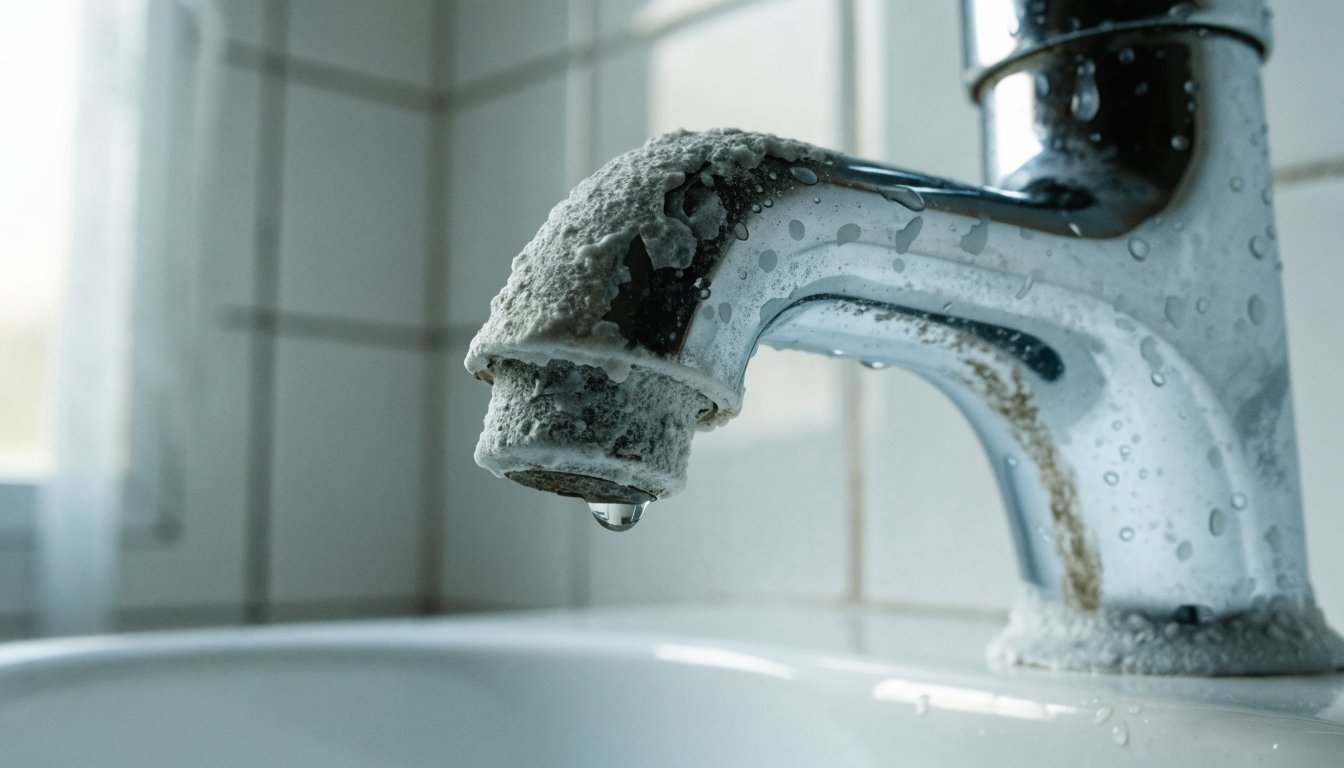
The short answer, by job
There is no single best limescale remover, because descaling a kettle and cleaning a shower screen are different chemical problems with different constraints. Here is where each pick lands.
- Best overall on cost: HG Limescale Remover Concentrate, because diluted as instructed it is a fraction of the price per litre of anything ready-mixed
- Best ready-to-use bathroom spray: HG Limescale Remover Foam Spray, phosphoric plus sulphamic, clings to vertical glass
- Gentlest option for finishes you are unsure about: Astonish Specialist Limescale Remover, citric acid only
- Strongest for appliances and soaking: Kilrock K Multi Purpose Descaler
- Best for kettles and coffee machines: Oust All Purpose Descaler sachets, lactic acid, pre-measured
- Cheapest that genuinely works: citric acid powder, with white vinegar close behind
- Best for a washing machine: Care+Protect 3 in 1 sachets
Which acid is actually in each limescale remover
Limescale is calcium carbonate. Any acid will dissolve it, producing calcium salts, water and carbon dioxide, which is the fizzing you see. What varies is how strong the acid is, how concentrated it is in the bottle, how fast it works and what else it attacks on the way.
Every figure in the table below comes from the manufacturer's own published safety data sheet for that product, not from marketing copy. Formulations change, so treat these as the composition published at the time of writing rather than a permanent fact.
Strength and concentration are two different things
People conflate these and it leads to bad buying. Acid strength is a fixed property of the molecule. Formic acid is a stronger acid than acetic acid, which is why Viakal at 1 to 5 per cent formic still does useful work. Concentration is how much of it is in the bottle, and that is what the manufacturer controls.
A weak acid at high concentration, such as the lactic acid in Oust sachets, and a strong acid at low concentration, such as the formic in Viakal, can end up doing similar work on the same deposit. The route each takes to get there is what decides whether it is safe on the surface you are pointing it at.
The alkaline cleaners people reach for by mistake
Bathroom sprays split into two families and they do opposite jobs. Bleach-based and alkaline bathroom cleaners deal with soap scum, body fats, mould and general grime. They will not touch limescale, because dissolving a carbonate needs acid and an alkali is the wrong end of the scale entirely.
This is why a shower screen that has been cleaned weekly for two years still looks cloudy. The soap film has been coming off all along and the mineral film has not. If you want to understand what is forming on the glass and why it bonds the way it does, the background is in what limescale actually is and how it forms.
One warning that matters more than the rest. Never mix an acidic descaler with a bleach-based cleaner. Acid plus sodium hypochlorite releases chlorine gas. Rinse thoroughly and let a surface dry before switching products on it.
Surface safety: what acid descalers will damage
This is the section the retailer roundups leave out, and it is the reason people ruin expensive things. Marble worktops, limestone tiling, brushed brass taps and powder-coated towel rails are all more expensive than the bathroom they sit in is worth per square metre, and all of them are damaged permanently by products sold as general bathroom cleaners.
The restrictions below are not my opinion. HG's own directions for its concentrate exclude marble, travertine, granito, hardstone and other calcareous natural stone, matt gloss paintwork and lead glaze. Procter and Gamble's product information for Viakal excludes old enamel, plastic water boilers, marble or natural stone, silver, gold, copper and aluminium, along with hot, damaged or scratched surfaces.
If you are unsure what a surface is, the test is cheap. Put a single drop of ordinary white vinegar on a hidden corner, leave it two minutes and wipe it off. If it fizzes or leaves a dull mark, the surface is calcareous or the finish is not acid-resistant, and no descaler in this guide belongs anywhere near it.
What each product actually costs per litre
Bottle price tells you almost nothing when one product is ready to use and another dilutes ten to one. This is the comparison nobody publishes, and on a product you rebuy several times a year it is the difference between spending a few pounds and spending thirty.
All prices below are non-Amazon shelf prices including VAT, checked on 18 September 2026. They move, so treat them as a snapshot. Amazon prices are not published anywhere on this site.
| Product | Retailer | Price | Cost per litre as used |
|---|---|---|---|
| HG Limescale Remover Concentrate 1L | Screwfix | £8.48 | About 77p diluted 1:10, or £8.48 neat |
| HG Coffee Machine Cleaner & Descaler 500ml | Screwfix | £4.39 | £8.78 |
| KilrockPRO Multi-Purpose Descaler 1L | Toolstation | £8.49 | £8.49 |
| HG Bathroom Limescale Remover Foam Spray 500ml | Screwfix | £4.99 | £9.98 |
| Scrubb Limescale Remover 750ml | Toolstation | £7.99 | £10.65 |
| HG Extra Strong Bathroom Limescale Remover 500ml | Screwfix | £5.59 | £11.18 |
| HG Appliance Descaler 500ml | Screwfix | £5.79 | £11.58 |
| Scrubb Calcium, Limescale & Rust Remover 1L | Screwfix | £13.18 | £13.18 |
| HG Power Gel Brush Limescale Remover 250ml | Screwfix | £6.99 | £27.96 |
Two caveats stop that being a straight win for the concentrate. HG's directions say the 1:10 dilution is for light soiling and enamelled baths, and that heavier deposits want it undiluted, so you will not always get eleven litres from one. And a gel in a brush-cap bottle is expensive per litre because you use millilitres of it on a toilet rim rather than sloshing it about, so the comparison flatters it less than it deserves.
The honest conclusion is that if you buy limescale remover more than twice a year, buying ready-mixed spray is costing you roughly ten times what it needs to. Buy the concentrate and a cheap trigger bottle.
Three different jobs, three different approaches
Most of the confusion around this product category comes from treating descaling as one task. It is three, and the constraints on each are different.
Job one: descaling appliances
Kettles and coffee machines are the easy case. Fill, add the descaler, leave it for the stated time, boil or run a cycle, then rinse two or three times. The mistake people make is under-rinsing, which leaves a taste, and the second mistake is descaling once a year when in a hard water area it wants doing every month or two.
Bean-to-cup coffee machines are the lock-in case worth flagging. Several manufacturers specify their own branded descaler and tie the warranty to it, and their sachets frequently cost several times what a generic lactic acid descaler costs for the same volume of solution. Before you accept that, read the actual warranty wording rather than the prompt on the screen. Some of them say "a suitable descaler" rather than naming a product.
Washing machines and dishwashers are a different problem because you are descaling the element and the internal pipework at the same time as dealing with detergent residue. Running a maintenance wash at 60 degrees or above with a combined cleaner and descaler sachet, once a month, handles both. The full method, and the signs that scale is what is actually wrong with the machine, are in the guide to limescale in washing machines.
Job two: cleaning visible scale off bathroom surfaces and glass
Work from the bottom up on a vertical surface, because product running down over dry glass leaves streaks that are harder to shift than what you started with. Give it the full dwell time on the label rather than wiping straight away, and do not let it dry on the surface.
Hardened scale on glass rarely comes off in one pass. Two or three shorter applications with a rinse between each will beat one long one, because the acid is spent once it has converted the top layer and fresh product reaches deeper. Scrubbing harder does nothing useful and scratches the glass.
If you are dealing with soap scum as well as scale, which on a shower screen you almost always are, the order matters. Do the scale first with acid, rinse it completely, dry the glass, then deal with the soap film separately. Doing it the other way round means the acid spends itself on the soap layer before it reaches the minerals. The site's guide to shower cleaners covers the soap scum half of that job.
Job three: soaking a scaled-up shower head or tap aerator
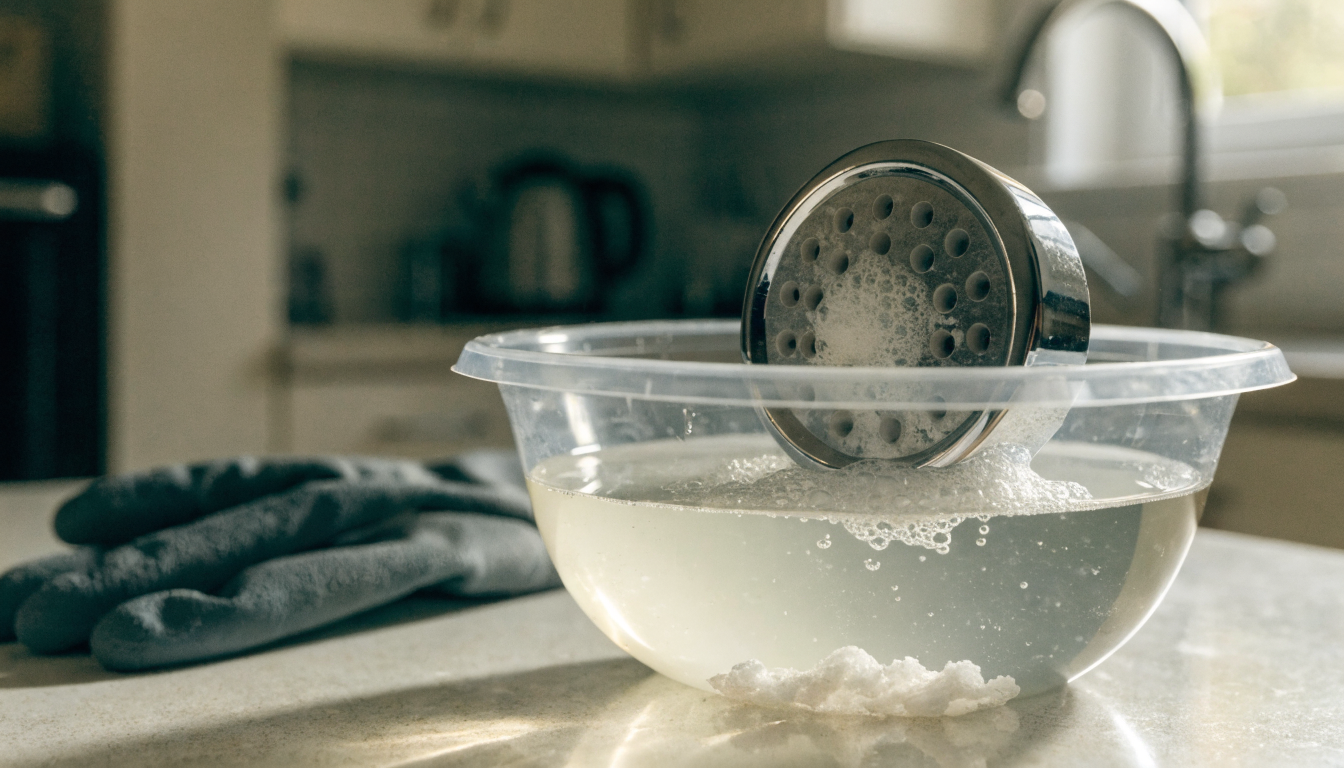
A shower head that has gone from a proper spray to several thin jets is blocked, not worn out, and the number of people who replaced a perfectly good head when a bowl and half an hour would have fixed it is considerable. The same applies to a kitchen tap that has slowed to a dribble, where the aerator screws off the end of the spout and is usually completely packed.
Take the part off rather than tying a bag of solution around it. A bag never covers the whole head, it drips, and it leaves the top half untouched. HG's own instruction for its concentrate is to submerge a clogged shower head for thirty minutes and then brush it, which is exactly right.
- Unscrew the head from the hose. Hand tight is usually enough. If it will not move, a cloth round it and grips will, and check for a washer when it comes off.
- Mix the solution in a bowl, not in the bath. A bowl lets you fully submerge the head with less product, and it keeps acid off the bath enamel.
- Submerge face down and leave it. Thirty minutes minimum, longer if the head is badly gone. Fizzing stopping means the acid is spent, so change it and go again if the nozzles are still blocked.
- Rub the rubber nozzles with a thumb. Most modern heads have flexible nozzles specifically so softened scale pops out under finger pressure.
- Rinse thoroughly, refit, and run it hot for a minute. That clears loosened debris out of the head before it settles back in the passages.
Do not soak a thermostatic cartridge, a shower pump or anything with a wax element in it. If the flow problem is at the valve rather than the head, descaler is not the answer and you risk turning a slow shower into a leaking one.
The picks
These are chosen on published composition, manufacturer directions and value per litre rather than on hands-on testing, and that is stated plainly because it is true. HG appears three times because HG publishes complete safety data and directions for every product, prices its concentrate sensibly and sells through trade counters as well as supermarkets, which is a combination the supermarket brands do not match.
| Product | Acid | Format | Best job | Buy |
|---|---|---|---|---|
Best overall HG Limescale Remover Concentrate | Phosphoric + oxalic | Concentrate, dilutes 1:10 | Everything, cheapest per litre | Check price on Amazon |
Best ready-to-use HG Limescale Remover Foam Spray | Phosphoric + sulphamic | Foaming trigger spray | Vertical glass and tiles | Check price on Amazon |
Gentlest Astonish Specialist Limescale Remover | Citric acid 1-5% | Trigger spray | Finishes you are unsure about | Check price on Amazon |
Strongest Kilrock K Multi Purpose Descaler | Formic acid 30-60% | Dosed concentrate | Soaking heavy deposits | Check price on Amazon |
Best for kettles Oust All Purpose Descaler | Lactic acid 30-50% | Pre-measured sachets | Kettles and coffee machines | Check price on Amazon |
Viakal Limescale Remover Spray | Formic acid 1-5% | Trigger spray | Weekly maintenance | Check price on Amazon |
Cheapest Dri-Pak Citric Acid | Citric acid, 100% | Powder | Appliances, you set the strength | Check price on Amazon |
Best for washing machines Care+Protect 3 in 1 Sachets | Not disclosed by brand | 12 sachets | Washing machine and dishwasher | Check price on Amazon |
HG Limescale Remover Concentrate
#1 Best overall
HG Limescale Remover Concentrate 500ml
- Phosphoric acid under 25% with oxalic acid under 2%, per the published safety data sheet
- Used neat on heavy deposits or diluted 1:10 for light work and enamelled baths
- Oxalic content lifts rust staining as well as scale
- Also sold in a 1 litre bottle through trade merchants
Pros
- By far the lowest cost per litre of working solution once diluted
- One product covers taps, tiles, shower heads and appliance soaking
- HG publishes full directions and a complete safety data sheet, which most supermarket brands do not
- The oxalic acid handles the orange staining that sits underneath scale on old taps
Cons
- You need your own trigger bottle and have to mix it, which is a faff most people will not bother with
- Explicitly excluded by HG from marble, travertine, granito and other calcareous natural stone, matt gloss paintwork and lead glaze
- Undiluted it is aggressive enough that gloves and ventilation are not optional
- Formally classified as corrosive to metals, so it must be kept off bare aluminium, copper and brass
If you live in a hard water area and buy descaler regularly, this is the one that stops the spending. A litre of it diluted as HG instructs makes around eleven litres of working solution, which is roughly a tenth of what the equivalent in ready-mixed spray costs. The trade-off is that you have to decant and dilute it yourself, and it is strong enough that the surface restrictions have to be taken seriously rather than skimmed.
Worth knowing: the 1 litre bottle was £8.48 at Screwfix when checked on 18 September 2026, which is the better buy per litre than the 500ml if you get through it.
HG Limescale Remover Foam Spray
#2 Best ready-to-use spray
HG Limescale Remover Foam Spray Super Powerful 500ml
- Phosphoric acid 5 to 7% with sulphamic acid 1 to 2%, per the published safety data sheet
- Foaming trigger so it holds position on vertical glass
- No dilution, no mixing, no separate bottle
- Sold through Screwfix and Wickes as well as the supermarkets
Pros
- The foam is the point: it stays where you spray it instead of running into the shower tray
- Two acids working together handles both fresh film and older bonded deposits
- Widely stocked, so you can get it the same day rather than waiting on a delivery
- Widely stocked at merchants and supermarkets, and reasonably priced for a ready-mixed product
Cons
- Around thirteen times the cost per litre of the same brand's concentrate diluted as directed
- The same natural stone, lead glaze and bare metal restrictions apply as to every acid product here
- Foam makes it harder to judge how much you have actually applied, so it is easy to overuse
- The scent is strong in a small unventilated bathroom
The sensible choice if you want to buy one bottle and use it without thinking about it. The foaming formula genuinely solves the problem with vertical glass, where an ordinary liquid spray is on the floor before it has done anything. Buy this if you descale occasionally. If you are doing it monthly, the concentrate is the same manufacturer and a fraction of the price.
Astonish Specialist Limescale Remover
#3 Gentlest branded option
Astonish Specialist Limescale Remover 750ml
- Citric acid monohydrate 1 to 5% is the only acid listed on the safety data sheet
- 750ml, larger than most trigger sprays in this category
- Marketed as spray and dissolve without scrubbing
- Made in the UK by Astonish in Leeds
Pros
- The mildest branded product here by a clear margin, which makes it the least likely to damage a finish you cannot identify
- Citric acid is what most appliance descalers use, so it is the same chemistry as a food-safe kettle descaler
- Bigger bottle than the 500ml standard, which improves the cost per litre against its direct rivals
- Far less unpleasant to use in a small bathroom than the phosphoric products
Cons
- Genuinely weaker on hardened deposits, and that is chemistry rather than formulation, so repeat applications are normal
- Citric acid at 1 to 5% is a mild solution, so do not expect it to shift years of neglected scale in one pass
- Still an acid, so the natural stone and old enamel exclusions still apply in full
- Not a substitute for a soak when a shower head is properly blocked
The one to reach for when the finish matters more than the speed. If you have a bathroom full of taps you cannot identify the coating on, or you are cleaning a rental and would rather not find out the hard way, a mild citric acid product applied three times is a much better bet than a strong phosphoric one applied once. Accept that it is slower and it is a sound choice.
Kilrock K Multi Purpose Descaler
#4 Strongest of the consumer descalers
Kilrock K Multi Purpose Descaler 250ml
- Formic acid 30 to 60%, per the published safety data sheet, which is the highest acid concentration of anything here
- Supplied as a dosed concentrate, not a spray
- Intended for kettles, shower heads, coffee machines and irons
- Also sold as Mega-K in a 1 litre bottle
Pros
- Nothing else on a supermarket shelf is this concentrated, so it deals with deposits that defeat sprays
- Dosing means you can mix it weak for a kettle or strong for a soak
- Very good value per descale given how little you use at a time
- The obvious answer for a shower head that has years of scale in it
Cons
- Formic acid at this concentration is corrosive and demands gloves, ventilation and care around splashing
- Not a surface product, so do not treat it as a bathroom spray
- Same metal, natural stone and enamel exclusions, and with this concentration the consequences are faster
- The 250ml bottle is small, so heavy users will want the 1 litre version
This is the one to keep in the cupboard for the jobs where a spray has already failed. A 30 to 60 per cent formic acid solution is a serious chemical and it should be treated as one, but for a shower head or an aerator that is genuinely packed solid, strength and contact time are the only two things that will fix it and this brings the strength. Keep it well away from anything on the avoid list.
Oust All Purpose Descaler sachets
#5 Best for kettles and coffee machines
Oust All Purpose Descaler, 3 sachets
- Lactic acid 30 to 50%, per the published safety data sheet
- Pre-measured 25ml sachets, so no guessing at a dose
- Stated working time of around ten minutes on a kettle
- Suitable for kettles, coffee machines, irons and shower heads
Pros
- The pre-measured sachet removes the main reason people descale kettles badly, which is under-dosing
- Lactic acid is a weaker acid than formic, which is the right trade-off inside something you drink from
- Nothing to store half-used, so no bottle going off in the cupboard
- Works out sensibly per descale despite looking expensive per litre
Cons
- Costs considerably more per descale than a spoonful of citric acid powder doing the same job
- Three sachets does not last long in a hard water area where a kettle wants descaling monthly
- Single-use sachets are a lot of packaging for a small amount of liquid
- Not suitable for surface cleaning, so it is not a one-product solution
The convenience pick, and convenience is worth something on a job people otherwise put off. If the honest reason your kettle has not been descaled in a year is that you could not be bothered to work out how much vinegar to use, a box of sachets fixes that. If you are willing to measure a tablespoon of citric acid instead, you will do the same job for a lot less.
Viakal Limescale Remover Spray
Viakal Limescale Remover Spray 500ml
- Formic acid 1 to 5%, per the published safety data sheet
- Trigger spray, ready to use
- The most searched limescale remover in the UK by a wide margin
- Procter and Gamble publish a product information sheet naming the surfaces to avoid
Pros
- Stocked absolutely everywhere, which is a genuine advantage when you need it today
- Formic acid is a strong acid, so even at 1 to 5% it does useful work on fresh film
- Good on weekly maintenance, which is the job it is actually designed for
- Procter and Gamble publish clear surface restrictions, which not every brand bothers to do
Cons
- At 1 to 5% formic it is roughly a tenth the concentration of Kilrock K, so it is not a rescue product for hardened scale
- Liquid rather than foam, so it runs off vertical glass before it has finished working
- Procter and Gamble exclude it from old enamel, plastic water boilers, marble or natural stone, silver, gold, copper and aluminium
- Expensive per litre for what is a fairly dilute solution
Viakal is a perfectly reasonable maintenance spray that a lot of people buy expecting it to be a heavy-duty descaler, and then conclude it does not work. It is a low concentration of a strong acid, designed to be used weekly on surfaces that are not badly scaled. Used that way it does the job. Pointed at a shower screen that has been neglected for three years, it will not, and nothing at that concentration would.
Care+Protect 3 in 1 Washing Machine and Dishwasher Sachets
Best for washing machines
Care+Protect 3 in 1 Washing Machine and Dishwasher Cleaner, 12 sachets
- Twelve sachets, intended as a twelve month supply at one maintenance wash per month
- Combines descaling with degreasing and deodorising in one dose
- Universal, so it is not tied to one appliance brand
- Used in an empty machine on a hot cycle
Pros
- Handles scale and detergent residue together, which is what an appliance actually accumulates
- Twelve sachets at one a month is the right frequency for a hard water area
- Not brand-locked, so it works in whatever machine you own
- Cheaper per dose than most manufacturer-branded appliance cleaners
Cons
- The manufacturer does not publish the acid used in the way HG, Kilrock and Oust do, so you cannot check the chemistry
- A combined product is a compromise: a dedicated descaler descales harder
- Will not rescue a machine where scale has already caused an element or bearing failure
- Twelve months is only a twelve month supply if your water is not very hard
The practical answer for a washing machine, where the realistic alternative is doing nothing. A monthly maintenance wash at 60 degrees or above with a combined cleaner does more for the life of the machine than an annual heroic descale, because it stops the deposit establishing rather than fighting it later. The lack of published composition is a mark against it on a page built around published composition, and that is worth saying.
The cheap options that genuinely work, and where they do not
Two household products do most of what the branded bottles do, for a fraction of the money, and pretending otherwise on a page that earns from product links would be dishonest.
White vinegar is acetic acid, typically around 5 to 6 per cent in cleaning-grade bottles. That is a weak acid at modest concentration, which makes it slow but perfectly capable given time. A vinegar-soaked cloth wrapped round a tap spout and left for an hour will clear it. Vinegar in a kettle, brought to the boil and left overnight, will descale it.
Dri-Pak White Vinegar 500ml
- Acetic acid, cleaning grade rather than food grade
- Sold for cleaning, so no sugars or colourings to leave residue
- Also available in an extra strength version
- One of the cheapest descaling options per litre
Pros
- Cheap enough that you can use it generously and not think about it
- Works on every job in this guide given enough contact time
- Nothing to dilute or measure
- Rinses away completely, so it is fine in a kettle
Cons
- Slow, and on hardened scale slow can mean several repeat applications
- The smell lingers in a small bathroom for hours
- Exactly as damaging to marble, limestone and old enamel as any branded acid, contrary to what a lot of advice online claims
- Does not cling, so it is close to useless sprayed on vertical glass
The honest budget answer for soaking jobs and for anything horizontal. Where it falls down is vertical surfaces and hardened deposits, because it has neither the concentration to work fast nor the formulation to stay put. Treat it as the default for kettles and tap soaks and buy something formulated for the shower screen.
Citric acid powder is the better of the two, and the one most people have never tried. It is supplied at 100 per cent strength, so you set the concentration yourself, it has no smell at all, and a tablespoon in a kettle of hot water descales it properly. It is the same acid Astonish use in their specialist spray, just without the water.
Cheapest per application
Dri-Pak Citric Acid 250g
- Citric acid at 100% as supplied, so you control the dilution
- No smell, unlike vinegar
- The same acid used in most appliance descalers and in Astonish Specialist Limescale Remover
- A 250g tub covers a great many kettle descales
Pros
- The lowest cost per descale of anything in this guide by a distance
- No odour, which matters if you dislike the vinegar smell in a kitchen
- You can mix it weak for an appliance or strong for a soak
- Long shelf life as a dry powder, unlike a part-used bottle of solution
Cons
- You have to measure it, and there is no dose on the tub for every job
- Weaker acid than formic or phosphoric, so hardened bathroom deposits still take repeat passes
- No surfactant, so it does not wet a greasy surface well and is poor on soap scum
- Still an acid, so the natural stone and old enamel exclusions apply exactly as they do to everything else
The best value descaler available if you are prepared to measure a spoonful. For kettles, coffee machines and shower head soaks it does everything a branded sachet does at a small fraction of the cost. It is not a bathroom surface cleaner and it will not cling to glass, so it does not replace a formulated spray, but for the appliance half of the job it is difficult to argue with.
Where the cheap options are genuinely not adequate: vertical glass, because neither clings; heavily bonded scale that has been building for years, because concentration matters and neither has much; and anywhere you need a surfactant to cut through a mixed soap and mineral film. On those three jobs a formulated phosphoric product does something the kitchen cupboard cannot.
Prices for citric acid powder and cleaning vinegar vary enormously between formats and retailers, and the cheapest sources are often Amazon, where this site does not publish prices. Compare on pence per 100g rather than on pack price, and buy the largest format you will get through.
What goes wrong over time
The failure mode with descaler is not that it stops working. It is that people stop doing it, the deposit crosses a threshold, and then no consumer product will fix it in one go.
- Scale hardens as it ages. Fresh deposit is soft and porous and comes off with a weak acid. Old deposit has been repeatedly wetted and dried and is dense. The same product that worked last year appears to have stopped working.
- A part-used bottle loses nothing, but the trigger does. Acid attacks the spring in cheap trigger sprays. If a bottle has stopped spraying properly, it is usually the mechanism, not the contents.
- Repeated acid use dulls chrome at the edges. Not the plating itself so much as the joints and the base where product pools and is not rinsed. Rinsing is the step everyone skips.
- Elements fail before you see anything. By the time a washing machine or a kettle is visibly scaled, the element has been running hot under an insulating layer for a while. Descaling then is damage limitation.
If you are buying this every month, you are treating the symptom
This is the part a page that only wanted to sell descaler would leave out. Buying limescale remover repeatedly in a hard water area is a recurring cost that exists because the water arriving at the property is hard, and there is a plumbing answer to that rather than a cleaning one.
The number of people who came to the merchant counter for another bottle of descaler when the actual conversation should have been about what was arriving in their mains supply was considerable. Nobody at a supermarket shelf is going to have that conversation with them.
There are two distinct routes and they do different things, which the marketing for both routinely muddles.
- An ion exchange water softener removes the calcium and magnesium from the water. Scale stops forming because the minerals are no longer there. It needs plumbing in, it needs a drain connection and it needs salt topping up, which is its own recurring cost. The options are covered in the guide to the best water softeners.
- A water conditioner leaves the minerals in the water but alters how they crystallise, so they are less inclined to bond to surfaces. Cheaper, no salt, no drain, and a smaller effect. The water conditioner options and the honest comparison between conditioners and softeners set out what each realistically achieves.
Whether the sums work depends on how hard your water actually is and how long you are staying in the house, which is worked through in is it worth having a water softener. In genuinely soft water areas it is not worth it, and anybody telling you otherwise is selling.
If the problem is specifically the shower, and the rest of the house is tolerable, a shower filter is a much smaller commitment than a whole-house system. Note that these are sold on claims about skin and hair that this site does not make. What a filter does is reduce what reaches that one outlet.
Questions people actually ask
How do you remove hardened limescale?
With contact time, not with force. Hardened scale is dense, so the acid can only work on the surface layer, and once that layer has converted the acid is spent. The method that works is repeated shorter applications with a rinse between each, rather than one long soak in the same tired solution. On a fitting you can remove, take it off and submerge it. On a fixed surface, lay a descaler-soaked cloth or kitchen roll over the deposit so it cannot run off and cannot dry out. Scrubbing hard does nothing except scratch the surface you are trying to save.
Is vinegar better than Viakal?
It depends entirely on the job. Viakal is formic acid at 1 to 5 per cent and vinegar is acetic acid at around 5 to 6 per cent. Formic is the stronger acid of the two, so litre for litre Viakal bites harder, but the gap is smaller than the price difference suggests. For soaking a tap or descaling a kettle, vinegar wins comfortably because contact time is doing the work and cost is the only real variable. For a vertical shower screen, Viakal wins because it is formulated to sit on the surface and vinegar simply runs off. Neither is safe on marble or old enamel, whatever you have read elsewhere.
Does WD-40 really remove limescale?
No. WD-40 is a water-displacing penetrating oil and it contains no acid, so it cannot dissolve calcium carbonate. What it does is coat the deposit in oil, which makes a lightly scaled tap look shinier and can help a loosened flake come away. The scale is still there under the film, and you have now added an oily layer that the next acid product will have to get through before it can reach the deposit. It also leaves a slippery residue in a bath or shower tray, which is worth avoiding for reasons that have nothing to do with limescale.
What is the strongest limescale remover you can buy?
Of the consumer products checked for this guide, Kilrock K is the most concentrated at 30 to 60 per cent formic acid, with Oust sachets close behind at 30 to 50 per cent lactic acid, though lactic is the weaker acid of the two. Above that you are into trade materials: sulphamic acid crystals, sold by builders merchants and by B&Q in small tubs, are supplied as a solid and you mix them to whatever strength you want. Sulphamic is the standard descaling acid for commercial water heaters and it will remove deposits nothing on a supermarket shelf will touch. It also removes chrome plating, etches stone and burns skin, so it belongs in the hands of someone who has read the data sheet.
What should you not use Viakal on?
Procter and Gamble's own product information sheet excludes old enamel, plastic water boilers, marble or natural stone, silver, gold, copper and aluminium. It also says not to use it on hot, damaged or scratched surfaces, or on household appliances, and recommends testing a hidden area first if you are unsure. That list is more restrictive than most people assume from a product sold as a general bathroom spray, and the natural stone and old enamel entries in particular catch people out in period properties.
Can you put limescale remover in a washing machine?
Not a bathroom spray, no. Those contain surfactants and thickeners that have no business in a drum, and some are formally classified as corrosive to metals. Use a product sold as an appliance descaler, or citric acid powder, dosed into an empty machine on a hot cycle. Run it at 60 degrees or above, because the temperature does as much work as the chemical. A monthly maintenance wash is far more effective than an occasional heavy one.
How often should you descale in a hard water area?
There is no published universal figure, because it depends on your water hardness and how much hot water passes through the appliance, and anyone quoting you a precise interval is guessing. As a working rule in a hard water area: kettle monthly, coffee machine when it prompts you, washing machine and dishwasher monthly with a maintenance wash, shower head twice a year, and bathroom surfaces whenever a film appears rather than waiting for a crust. The point of frequency is that soft fresh deposit comes off with anything, and hardened deposit comes off with nothing easily.
Related guides
- What is limescale, for why it forms where it does and why it bonds harder in some places than others
- Limescale in washing machines, for the maintenance wash method and the symptoms that mean scale rather than a fault
- Best water softeners, if the descaler bill has got to the point where a permanent fix makes sense
- Water conditioners versus water softeners, for the honest difference between the two before you spend anything
- How long water softeners last, for what the long-term cost of the permanent option actually looks like


0 Comments