
As an Amazon Associate I earn from qualifying purchases.
Almost every page ranking for radiator reflector panels is written by somebody who sells them, and almost every one of them quotes a percentage without showing you a single sum. So here are the sums, and here is the thing the retailer pages bury: whether these are worth buying has almost nothing to do with which brand you choose and almost everything to do with what your wall is made of.
Three findings from the research behind this page. First, on a radiator fixed to an internal wall a reflector panel saves you precisely nothing, and on a modern insulated wall it saves so little that the panel will outlive the payback period. Second, the independent measurement everyone quotes was taken on a wall with a U-value of 0.44 W/m²K, which is roughly a filled cavity, and the saving that came out of it works out at about 46p per radiator per year on gas. Third, the Energy Saving Trust figure of £18 a year for a whole house appears to have been priced at a gas rate lower than the one you are paying now, which means the honest number today is probably higher than the one they publish.
Sixteen years behind a plumbers merchant counter taught me that the products people came in for in October were rarely the ones that would have helped them most. Radiator foil sold in volume every autumn. Inhibitor and a decent magnetic filter did not. That pattern is worth keeping in mind before you spend anything.
The only question that matters: does your wall qualify?
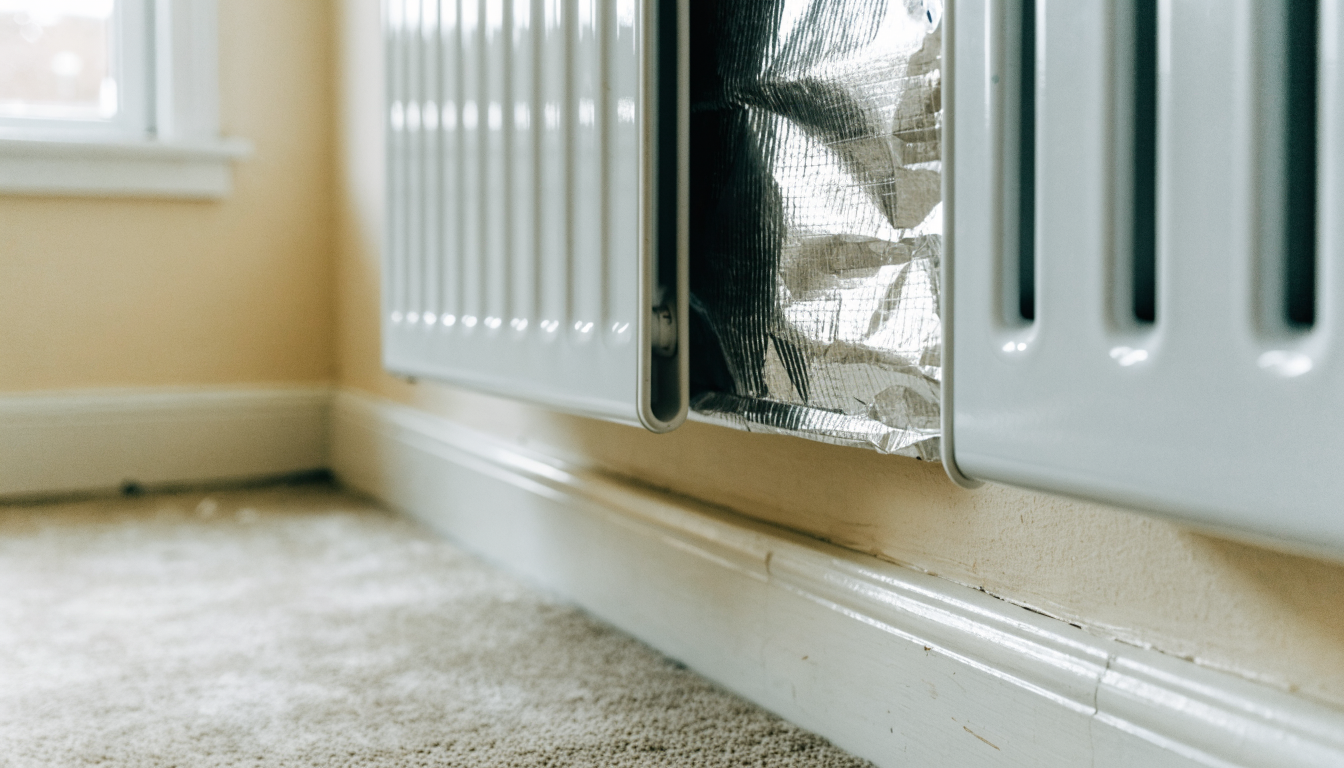
A radiator reflector panel does one job. It sits between the back of the radiator and the wall and cuts the heat that would otherwise pass into that patch of brickwork. If the brickwork behind it leads outside, some of that heat was being lost. If it leads into your hallway, none of it was.
That gives you a diagnostic you can run in about two minutes, before you spend a penny. Work down it honestly.
How to tell whether you have a solid wall or a cavity wall
Nobody at a till is going to ask you this, so you have to work it out yourself. There are four checks and any two agreeing is usually enough.

| Check | Solid wall | Cavity wall |
|---|---|---|
| Brick pattern outside | Short brick ends appear regularly among the long faces | Every visible brick shows its long face, in a repeating offset pattern |
| Wall thickness at a window or door reveal | Around 230mm, about nine inches | 270mm or more, often 300mm plus on newer houses |
| Age of the house | Usually built before about 1920 | Usually 1930s onwards |
| Your EPC | Will say solid, and whether it is insulated | Will say cavity, and usually whether it has been filled |
If the house is rendered or pebbledashed you cannot read the brickwork, so fall back on the reveal thickness and the EPC. If the EPC says the cavity has been filled, treat the wall as a poor candidate. If you genuinely cannot tell, the Energy Saving Trust recommends a borescope inspection by a registered installer, which means drilling a small hole in the outside wall to look.
What radiator foil actually saves, with the arithmetic shown
The measurement everybody cites without naming it comes from work by Harris in 1995, which put a heat flux sensor on the wall behind a radiator and measured the loss with and without foil. The flux fell from 7.1 W/m² to 3.1 W/m². That is a real, measured 4.0 W/m² saving, and it is the only solid starting point available.
Here is that number turned into money, using the Ofgem price cap unit rates for 1 October to 31 December 2026, which are 7.97p per kWh for gas and 26.32p per kWh for electricity. Every step is shown so you can change an assumption you disagree with and redo it.
Cross-checking against the Energy Saving Trust number
The Energy Saving Trust say panels on uninsulated external walls save £18 a year in Great Britain, and cut carbon by 60kg a year. Those two figures have to be consistent with each other, so it is worth checking whether they are.
UK natural gas emits roughly 0.183 kg of CO2 per kWh under the government conversion factors. Saving 60kg therefore means saving about 328 kWh of gas a year. At 7.97p that is £26, not £18. Working backwards, the £18 implies a gas rate of about 5.5p per kWh, which is a good deal cheaper than the current cap. That is arithmetic on my part rather than a figure anybody publishes, and the Energy Saving Trust may be using a different carbon factor. But it points the same way: their headline figure is probably conservative at today's prices.
Split £18 to £26 across the four to six radiators a typical three bedroom semi has on external walls and you land at roughly £3.50 to £5 per radiator per year. Combine that with the bottom-up sum above and the honest answer is somewhere between £2 and £5 per radiator per year on a solid or uninsulated wall. Anybody quoting you one confident figure is guessing, because the answer depends on a wall they have never seen.
Payback per radiator, by wall type
Panels work out at roughly £4 to £5 per radiator once you have cut a roll or a pack down. Put that against the saving and the picture is clear. Prices checked on 18 September 2026.
| Wall behind the radiator | Saving per radiator per year, gas | Cost per radiator | Payback |
|---|---|---|---|
| Solid brick or stone, uninsulated | £2.00 to £5.00 | About £4 | 10 months to 2 years |
| Cavity wall, never filled | £1.50 to £3.50 | About £4 | 14 months to under 3 years |
| Cavity wall, already filled | About £0.50 | About £4 | Roughly 8 years |
| Built after 2000, or internally insulated | Under £0.30 | About £4 | Over 13 years |
| Internal wall | £0.00 | About £4 | Never |
If the room is heated electrically rather than by a gas boiler, multiply the saving column by about three. Electricity is 26.32p against gas at 7.97p, and there is no combustion loss to allow for. An electrically heated room on a solid wall is the one case where these things pay for themselves inside a single winter.
Where the same £25 does more good
This is the comparison the retailer pages cannot run, because every line of it points somewhere other than their checkout. All figures below are the Energy Saving Trust's own published annual savings for Great Britain.
Reflector panels come last, and by a distance. That does not make them a bad buy, because £18 for a £25 outlay is a better return than most things in a house. It makes them a bad first buy. Work down that list from the top. If the thermostat is still at 22 and the radiators have never been bled, the foil can wait. Our guides on how to bleed a radiator and what a thermostatic radiator valve actually does cover the two jobs above it.
The panels worth buying if your wall qualifies
There is not much between the serious products, because the physics is the same and the low emissivity surface is the same aluminium in every case. What separates them is how they mount, how thick they are and how much wall each pack covers. These are judged on specification, manufacturer documentation and what sold and came back through a merchant counter, not on hands-on testing.
- Radflek 3 Pack, the one to buy if you are not taking radiators off the wall
- SuperFOIL Rad-Pack, thicker bubble core, better on a cold solid wall
- Wickes Thermal Foil Insulation, the cheapest sensible way to do a whole house
- Heatkeeper 15 Pack, rigid panels, only if you have the gap for them
| Product | Best for | Type | Covers | Radiator removal | Buy |
|---|---|---|---|---|---|
Best overall Radflek 3 Pack | Fitting without taking the radiator off | Thin foil laminate sheets, 1200mm x 600mm | Up to 6 radiators | Not needed, clips hang from the wall brackets | Check price on Amazon |
Best on solid walls SuperFOIL Rad-Pack 0.6m x 5m | Cold solid brick and stone | 3mm bubble core with foil both sides | About 4 radiators | Not needed if you can reach behind | Check price at Screwfix |
Cheapest per radiator Wickes Thermal Foil Insulation 600mm x 8m | Doing every external wall radiator at once | Plain foil roll, cut to size | 6 to 7 radiators | Not needed if you can reach behind | Check price at Wickes |
Rigid panel option Heatkeeper 15 Pack | Radiators with a generous wall gap | Rigid foil-faced panels that slot together | Varies with radiator width | Usually needed on tight gaps | Check price on Amazon |
Radflek 3 Pack
#1 Best overall
Radflek 3 Pack Radiator Reflectors
- Three sheets at 1200mm x 600mm, each covering up to two radiators
- Hangs on clips that sit between the existing radiator wall brackets
- Radstik adhesive strips included for the gap the sheet cannot cover
- Independently tested by the BBA with the data verified by BRE
- Manufacturer states greater than 95% reflectivity and a 60 year life
Pros
- Genuinely fits without taking the radiator off the wall, because the sheet is thin enough to slide down behind it
- The clip system means no adhesive on wallpaper, which is where most DIY foil jobs go wrong
- Has real third party test documentation behind it rather than a marketing percentage
Cons
- Thin foil laminate, so it adds almost no insulation of its own beyond cutting the radiant loss
- Costs more per radiator than cutting a plain foil roll to size
- The clips only work if your radiator brackets leave the usual gap, and some slimline brackets do not
If you want this done in an afternoon without draining anything down, this is the one. The clip fixing is the actual product; the foil itself is much the same as everybody else's.
Radflek sell direct at £24.49 for the three sheet pack, which works out at about £4.08 per radiator if you get the full six out of it. That direct price was checked on 18 September 2026.
SuperFOIL Rad-Pack 600mm x 5m
#2 Best on solid walls
SuperFOIL Rad-Pack Radiator Reflector Insulation 0.6m x 5m
- 3m² roll, 600mm wide by 5m long
- 3mm bubble core sandwiched between low emissivity foil faces
- Self-adhesive pads supplied for fixing to the wall
- Cut to length with scissors, fits any radiator width
- Sold through Screwfix, Toolstation and Wickes
Pros
- The bubble core adds a genuine layer of insulation on top of the reflective effect, which matters most on a cold solid wall
- One roll does a whole ground floor of a small house
- Stocked at trade counters, so you can collect it the same day
Cons
- Thicker than a plain foil sheet, so it needs more gap between radiator and wall than some panel radiators leave
- The self-adhesive pads have to be pressed onto the wall, which means getting a hand behind the radiator
- Adhesive pads on painted or papered walls will take the finish with them if you ever remove the sheet
The better technical choice on solid brick, where the extra 3mm of bubble core is doing something the foil alone cannot. Check your radiator-to-wall gap before ordering.
Screwfix and Toolstation were both showing £19.00 including VAT on 18 September 2026. At 3m² that is roughly four radiators covered, or about £4.75 each. Wickes also list a shorter SuperFOIL Rad-Foam at 0.6m by 3m for £20.00, which is a worse deal per radiator and worth avoiding unless you only have two to do.
Wickes Thermal Foil Insulation 600mm x 8m
#3 Cheapest per radiator
Wickes Thermal Foil Insulation 600mm x 8m
- 4.8m² roll, 600mm wide by 8m long
- Plain reflective foil, no bubble or foam core
- Cut to size with scissors
- Sold in Wickes branches and online
- Enough for six or seven typical radiators
Pros
- By some distance the lowest cost per radiator of anything sold for this job
- Thin enough to go behind almost any radiator, including tight panel installations
- No pack size problem: buy one roll and do the whole house
Cons
- No fixing system supplied, so you are providing your own adhesive or clips
- Plain foil with no core adds nothing beyond cutting the radiant loss, so it is the weakest option on a very cold solid wall
- Easier to crease during fitting than a stiffer laminate sheet, and a creased sheet performs worse
The sensible buy if you have six or more radiators on external walls and the patience to work out your own fixings. The foil is doing the same job as the branded sheets.
Wickes were showing £22.00 including VAT on 18 September 2026. Across 4.8m² that is about £3.30 per radiator, which is the cheapest per unit of anything in this guide.
Heatkeeper 15 Pack
#4 Rigid panel option
Heatkeeper Radiator Insulation Panels 15 Pack
- Rigid foil-faced panels rather than a flexible sheet
- Panels interlock so you make up the width you need
- Do not crease or sag once fitted
- Sold in 5, 10, 15, 20 and 30 panel packs
- Widely stocked, and the brand has been on the market a long time
Pros
- Rigid construction means the reflective face stays flat and square to the radiator, which is what the low emissivity surface needs
- Interlocking panels suit awkward radiator widths better than cutting a roll
- Will not tear if you catch it while cleaning behind the radiator
Cons
- Rigid panels need a bigger gap between radiator and wall than foil does, and plenty of panel radiators do not leave one
- Realistically a radiator-off job on a tight installation, which turns a ten minute task into a drain down
- Heatkeeper sell almost entirely through Amazon, so there is no non-Amazon price to publish here for comparison
The right answer only where the radiator sits well proud of the wall. On a standard panel radiator with a 25mm gap, buy foil instead and save yourself the job.
One Heatkeeper listing, the ten panel pack, could not be verified as live when this guide was written, so it is deliberately not recommended here. If a listing will not confirm, it does not go on the page.
Foil, rigid panel or kitchen foil: does the cheap option work?
The Energy Saving Trust say plain aluminium kitchen foil will not work. That is not quite what the research shows, and the difference is worth understanding before you spend £25 you did not need to.
Harris's 1995 measurements, the ones the whole industry quotes, were taken using ordinary aluminium foil. The heat loss through the wall behind the radiator fell to less than 30% of its original value. The physics of kitchen foil is fine. Aluminium has a low emissivity whether it came from a builders merchant or a supermarket.
The problem is everything else. Kitchen foil is about 11 microns thick. It tears while you are handling it, it creases, and a creased low emissivity surface no longer faces the radiator squarely, which is the entire mechanism. It also has no mounting system, so you are taping it up, and tape behind a radiator lets go within a season or two. Then it sags, touches the radiator, and starts conducting heat straight into the wall instead of reflecting it.
There is one more thing worth knowing about all of these. Despite the name, a radiator gives off most of its heat by convection rather than radiation, because a surface at 60 or 70°C is a weak radiator in Stefan-Boltzmann terms. So a reflector panel is doing less reflecting than the marketing implies and more insulating. That is why the bubble-cored products edge out plain foil on a genuinely cold wall, and why the whole category is worth less on a wall that is already insulated. The research by Baldinelli and colleagues in 2017 found savings of up to 8.8% in the worst insulation conditions and around 1.6% on walls insulated to 1980s standards, with modern standards reducing the benefit to negligible.
Fitting: do you really not need to remove the radiator?
Radflek, SuperFOIL and most own-brand rolls all say no radiator removal is needed. Two of those claims hold up and one depends entirely on your radiator.
- Radflek's claim is sound. The clips hook over the existing wall brackets, so the sheet hangs in the gap without anything needing to stick to the wall. If you can get two fingers behind the radiator you can fit it.
- SuperFOIL and plain foil rolls are conditional. Self-adhesive pads have to be pressed firmly onto the wall, and you cannot press firmly through a 25mm gap. On a radiator that sits proud of the wall it is straightforward. On a tight modern panel radiator it is not, and the honest answer is that you will end up taking it off.
- Rigid panels are usually a removal job. The panel has to go in flat and square, and there is rarely room to manoeuvre a rigid board into a gap it barely fits through.
If you do end up taking the radiator off, that is a different size of job. It means isolating both valves, draining down into a tray and getting the thing off the brackets without spreading black sludge across the carpet. Our guide on how to remove a radiator covers it properly, and it is worth reading before you commit, because a £19 roll of foil is not worth a drained system and a refill you then have to repressurise the boiler for.
Whichever product you use, four fitting points decide whether it works at all. The shiny face points at the radiator, not the wall. The sheet does not touch the radiator, because contact means conduction. Leave a small air gap so convection can still carry heat up the front. And cut it slightly smaller than the radiator so it stays out of sight.
What goes wrong over time
These have no moving parts, so nothing breaks. What happens instead is that they quietly stop performing, and because nobody looks behind a radiator from one decade to the next, nobody notices.
| What happens | Why it matters | What to do |
|---|---|---|
| Dust builds up on the reflective face | Low emissivity depends on a clean, bright surface. The gap behind a radiator is one of the dustiest places in a house | Run a duster or a vacuum crevice tool down the back once a year, before the heating season |
| Adhesive pads let go and the sheet sags | A sagging sheet touches the radiator and conducts heat into the wall rather than reflecting it away | Check it by eye each autumn. Refix or move to a clip system |
| Foil creases or tears | A creased surface no longer faces the radiator squarely, which is the whole mechanism | Replace the sheet. This is why the thicker laminates outlast plain kitchen foil |
| Damp or mould appears at the sheet edges | Foil is a vapour barrier. Stuck flat to a cold solid wall with no air gap, it can trap moisture behind it | Make sure there is a small air gap and the room is ventilated. Do not seal all four edges to the wall |
| Adhesive pulls wallpaper off when removed | Not a performance issue, but an expensive surprise if you redecorate | Use a clip system on papered walls rather than pads |
The damp point is the one worth taking seriously and the one no retailer page mentions. A metallised sheet stuck tight against cold brickwork stops water vapour moving, and vapour that cannot move condenses. It is a small risk on a ventilated room and a larger one in a bedroom that never gets a window opened. Leave the gap.
If the radiator itself is cold at the top, cold at the bottom or never gets properly hot, the foil is not your problem. Work through the common radiator problems first, because a radiator that is only producing half its rated output is costing you far more than a reflector panel will ever save. Keeping on top of heating system maintenance is worth more than any accessory you can bolt onto it.
Radiator reflector panels: your questions answered
Do radiator reflective panels work?
Yes, measurably, but only on external walls and only meaningfully on poorly insulated ones. Published measurements show heat loss through the wall behind a radiator falling to under a third of its original value with foil fitted. The question is not whether they work, it is whether what they save is worth what they cost on your particular wall. On solid brick, yes. On a filled cavity, barely. On an internal wall, not at all.
What are the disadvantages of putting foil behind radiators?
Four real ones. Foil is a vapour barrier, so fixed flat to a cold wall with no air gap it can trap moisture and encourage mould at the edges. Dust settling on the reflective face degrades performance, and behind a radiator is a dust trap. Adhesive fixings take wallpaper with them when removed. And if the sheet sags into contact with the radiator it conducts heat into the wall instead of reflecting it, which is worse than not fitting it at all.
Which radiator reflector is best?
Radflek if you want it fitted without taking radiators off the wall, because the bracket clips are the only fixing system that genuinely works in a narrow gap. SuperFOIL Rad-Pack if your walls are solid brick and you want the extra bubble core doing some insulating as well. A plain foil roll from Wickes if you have six or more radiators to do and want the lowest cost per radiator. The reflective surface is much the same aluminium in all three.
Is it a good idea to put foil behind a radiator?
On an uninsulated external wall, yes. It costs around £4 a radiator and on a solid wall it should pay for itself inside one or two heating seasons. On an insulated wall or an internal wall it is a waste of an afternoon. Run the three-step check near the top of this page before buying anything, and if your radiators are on internal walls, spend the money on draught proofing instead.
What are the disadvantages of foil insulation?
Reflective foil insulation only performs when it faces an air gap, because its low emissivity surface has nothing to work against if it is sandwiched tight against a solid material. It also depends on staying clean and flat, which real buildings do not always allow. And because it is vapour-tight, it changes how moisture moves through a wall build-up, which is a genuine consideration in older solid-walled houses.
Is aluminium foil a good heat reflector?
It is an excellent one, with reflectivity above 95% when clean and flat, and that is true of kitchen foil as much as purpose-made sheet. The measured study that underpins most claims in this market used ordinary aluminium foil. What you are paying extra for in a branded product is thickness, a mounting system and a surface that stays flat and clean for years, not better reflectivity.
Do radiator reflector panels work on a cavity wall?
On an unfilled cavity wall, yes, though the saving is smaller than on solid brick. On a cavity that has already been filled with insulation, the wall is doing most of the job itself and the panel is left saving somewhere around 50p a radiator a year, which takes roughly eight years to pay back. If your EPC says the cavity is filled, put the money elsewhere.
Related guides
- How to bleed a radiator, the free job that beats every paid one on this page for return per hour spent
- What is a thermostatic radiator valve, and why room-by-room control saves more than foil ever will
- Common radiator problems, for diagnosing a radiator that is not giving out the heat you are paying for
- How to remove a radiator, if your wall gap is too tight to fit panels any other way
- How to reduce your water bill, the same style of honest arithmetic applied to metered water



0 Comments