
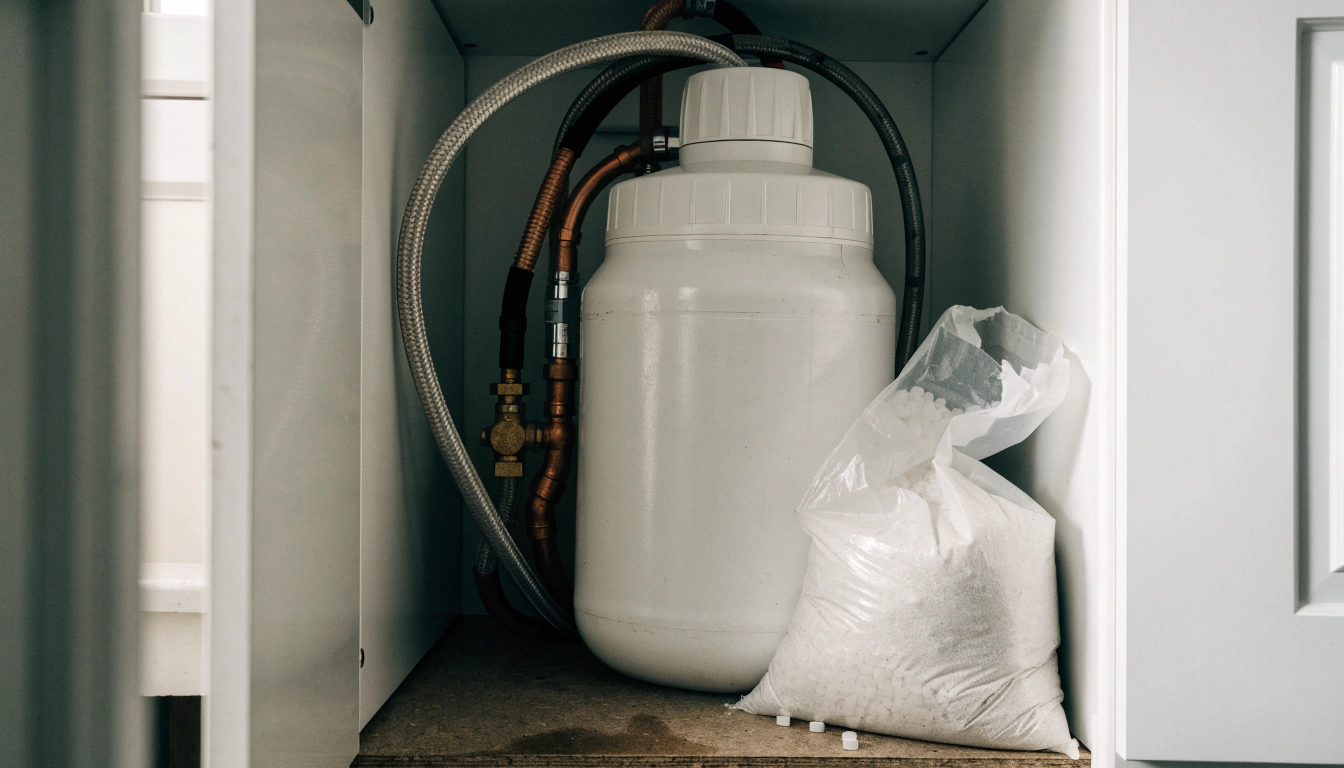
Every page on the first screen of Google for water softener cost is run by somebody who installs softeners, sells softeners, or collects your details and sells them to somebody who does. None of them publish a number, because a number costs them the quote. The aggregators fill the gap with ranges so wide they are useless: £150 to £600 for fitting, £300 to £1,500 for a machine.
So this page does the thing none of them will. It gives the prices I could verify this week, names the retailer and the date against each one, and then shows the arithmetic for what the machine costs you over fifteen years rather than on the day you buy it.
The short version, and it is the reason this page exists: the fifteen-year cost of owning a water softener in the UK runs from about £1,725 to about £7,935, and the machine itself accounts for less than £1,000 of that gap. Almost everything that decides your real cost is a decision you make after the softener is on the wall.
I spent 16 years running plumbers merchants across the south of the UK, then a couple more with an independent merchant. I am not a plumber and have never held Gas Safe registration, and I have not fitted any of the machines below. Everything here is published specification, manufacturer documentation and retailer pricing, plus what people actually came to the counter and asked for.
What a water softener costs to buy, checked this week
These are prices I checked on the retailer's own page on 26 November 2026. Where I could not re-check a price myself this week, I have said so and given the date it was last verified, rather than passing an old figure off as today's till price.
| Unit | Price inc VAT | Retailer | Checked |
|---|---|---|---|
| BWT Water Softener 14Ltr (code 62242) | £522.49 | Screwfix | 26 Nov 2026 |
| Spectrum Compact Under Counter 14Ltr (code 721EW) | £529.99 | Screwfix | 26 Nov 2026 |
| Kinetico Premier Compact | £1,495.83 | Friendly Water | 26 Nov 2026 |
| Monarch Midi HE | £670.61 | Water Softener Direct | 15 Sept 2026, not re-checked |
| Harvey TwinTec S4, supply only | £1,149.00 | West London Water Softeners | 15 Sept 2026, not re-checked |
The Screwfix BWT is worth a second look. In September the same unit was £599.00 there, and Google's own shopping data today still shows it at £585 to £749 across UK merchants. At £522.49 it is currently the cheapest route into a mainstream softener I can find, and it is cheaper than it was. If you are buying, that gap is the single easiest £70 you will save on this entire page.
The other thing the price spread tells you is that buying from the manufacturer is usually the worst deal. In September the identical BWT WS355 was £592.04 at Trading Depot, £599.00 at Screwfix and £740.61 from BWT's own online shop: a £148 spread on the same box in the same week. That pattern has not changed, and it is the opposite of what most people assume.
One honest flag on the Kinetico figure. Friendly Water list the Premier Compact at £1,495.83, but their page does not state whether that is supply only or includes fitting. In September, Aquasoft UK published £1,695 supply only and £2,170 fitted for the same machine. Treat £1,495.83 as a supply-only price until the retailer confirms otherwise.
What moves the water softener cost, in order of impact
This is the part that matters, and it is ordered by how much money each decision actually moves over fifteen years. Note where the machine itself lands: fourth.
Based on a family of four using 125 kg of salt a year. Workings for every figure are in the sections below.
Installation cost, and the two companies that publish a fixed price
Two companies publish a fixed installation price rather than quoting. BWT charge £360 to fit their own units in selected areas, and Aquasoft UK charge £475 to fit a Kinetico. Both figures were verified in September 2026 and I have not re-checked them this week. Everything else is an estimate, and it is worth being clear about the difference.
Checkatrade put the job at around £350. MyJobQuote say £150 to £600. MyBuilder say £150 to £300. Google's AI summary currently says roughly £350. None of those are prices. They are averages of jobs of unknown difficulty in unknown houses, which is why they disagree with each other by a factor of four.
Nobody can price this job from a phone call. The cost is decided by how far the softener sits from the rising main, whether there is a drain within the 4 metre maximum run, whether the mains pressure needs a limiter fitting, and whether a separate hard water tap has to be run to the kitchen sink. If a company gives you a firm number before anyone has looked at your stop tap, they are either padding it heavily or they will find reasons to revise it later.
The costs that get added on site, and that almost never appear in a headline price, are worth knowing before anyone arrives.
Running costs, with the arithmetic shown
Three things cost money once the softener is running: salt, water and electricity. They are nothing like equal, and the order surprises people.
Salt, which is the whole ballgame
A family of four gets through roughly 125 kg of salt a year. That is EcoWater's own published figure, and it agrees with arithmetic from Monarch's install guide, which gives the Midi HE 2,280 litres of capacity at 300 ppm and 1.0 to 1.7 kg per regeneration. At normal UK household consumption that is about 91 regenerations a year, so 91 to 155 kg. Two independent methods landing in the same place is about as solid as this gets.
What those 125 kg cost depends entirely on the format your machine accepts.
| Salt route | Price per kg | 125 kg a year | Fifteen years |
|---|---|---|---|
| Tablet salt, 25kg bags on a pallet | £0.40 | £50 | £750 |
| Tablet salt, single 25kg bag (Hydrosoft at Costco, £17.59, checked 26 Nov 2026) | £0.70 | £88 | £1,319 |
| Generic block salt | £1.20 | £150 | £2,250 |
| Kinetico branded block | £3.12 | £390 | £5,850 |
There is no chemical difference between the formats. The Water Softener Centre, which sells both, states plainly that there is no difference between brine made from block salt and brine made from tablet salt. The difference is packaging: tablet comes in 25kg bags and on pallets, which is why it is cheap, and block comes in moulded pairs, which is why it is not. There is a fuller breakdown in the guide to water softener salt.
So a block-only machine, which in practice means anything from Harvey or Kinetico, commits you to roughly £1,500 more in salt over fifteen years than a machine that takes tablet. Buying the manufacturer's own branded block instead of generic block costs you £3,600 on top of that. Block is a requirement on those machines. The brand on the box is not, and that distinction is worth £3,600.
The exception worth naming: the Harvey Arc and the TwinTec Cobalt require Harvey's own proprietary curved salt, so on those two models you genuinely are locked to one supplier. The TwinTec S4 takes standard block, which is one reason it is the Harvey that makes financial sense.
Water, which only matters if you are metered
Regeneration flushes the resin bed to drain, and machines vary by a factor of four. Using 91 regenerations a year and Thames Water's 2026/27 rate of £4.0223 per cubic metre:
- Kinetico Premier Compact, 21 litres per regeneration. 91 × 21 = 1,911 litres, so 1.911 m³ × £4.0223 = £7.69 a year, or £115 over fifteen years.
- BWT WS355, up to 80 litres per regeneration. 91 × 80 = 7,280 litres, so 7.28 m³ × £4.0223 = £29.28 a year, or £439 over fifteen years.
- Harvey publish 17 litres per regeneration for the Arc, which is in Kinetico's territory. They do not publish capacity per regeneration for the TwinTec S4, so no annual water figure can honestly be calculated for it, and I am not going to invent one.
- Monarch do not publish water used per regeneration at all, so the same applies to the Midi HE.
- On an unmetered supply all of this is £0.
Electricity, which is almost nothing
No manufacturer publishes a wattage for any of these units, which is worth saying rather than filling in with a guess. What can be said is where the consumption goes: it is standby for the display and the flow meter, not the regeneration motor, which runs for a few minutes every few days.
Taking roughly 3W continuous, that is 3 × 24 × 365 ÷ 1,000 = 26.28 kWh a year. At 26.32p per kWh, the Ofgem price cap unit rate for 1 October to 31 December 2026, that is £6.92 a year, or £104 over fifteen years. From 1 January to 31 March 2027 the capped rate rises to 32.69p per kWh, which takes the same 26.28 kWh to £8.59 a year, or about £129 over fifteen years. The motor itself accounts for pennies either way, and the cap changes quarterly, so that rate will move again.
Which means the real argument for a non-electric machine is that there is no transformer or control board to fail, not that it saves you money on the electricity bill. It saves you under £7 a year.
The fifteen-year water softener cost, four realistic routes
Here is the number nobody else publishes. Same house throughout: family of four, 300 mg/L hardness, 125 kg of salt a year, fitting taken at the £350 Checkatrade estimate except where the manufacturer publishes a fixed price.
| Route | Unit | Fitting | Running, per year | Fifteen-year total |
|---|---|---|---|---|
| Screwfix BWT, pallet tablet salt, unmetered | £522.49 | £350 | £56.92 | £1,725 |
| Screwfix BWT, bagged tablet salt, metered | £522.49 | £350 | £124.20 | £2,735 |
| Harvey TwinTec S4, generic block | £1,149.00 | £350 | £150.00 | £3,749 |
| Kinetico Premier Compact, generic block, metered | £1,495.83 | £475 | £157.69 | £4,336 |
| Monarch Midi HE on the Monarch service plan | £670.61 | £350 | £244.92 | £4,694 |
| Kinetico Premier Compact, Kinetico branded block | £1,495.83 | £475 | £397.69 | £7,936 |
The Monarch row is the one that catches people, and it deserves its own section.
The warranty condition that costs £2,250
Monarch advertise a seven year parts and two year labour warranty. In Monarch's own wording, it is subject to annual servicing charges by Monarch. Their service plan is £12.50 a month, so £150 a year. Over the seven years the warranty actually runs, that is £1,050 of servicing to protect a softener that cost around £670. Keep paying it for fifteen years and it is £2,250, which is more than three times what the machine cost.
Now compare. The Harvey TwinTec S4 carries ten years parts and two years labour with no stated servicing condition. The machine that costs nearly twice as much to buy has the better warranty terms and no attached contract. That inversion is not published anywhere I could find, and it is the sort of thing you only notice if you read the small print on both before you buy rather than after.
None of this makes the Monarch a bad softener. It is the machine I would point most people at on price and availability, and there is a full Monarch Ultimate Midi HE review covering it properly. It does mean that if you decline the service plan you should know you are declining the warranty, and if you take it you should put £150 a year in the fifteen-year sum.
Work out your own number in five steps
Why the first page of Google will not give you a price
It is worth understanding what you are reading when you search this. On the live results for "water softener cost" the organic listings are eBay, a price comparison site, two affiliate roundups, the Harvey shop and a trade forum thread from 2023. The installers that do rank, Thames Valley Water Softeners and Aquasoft among them, rank on pages whose purpose is to offer a free survey.
Harvey's own cost page is the clearest example. It discusses running costs at length, publishes that the Arc uses 300 g of salt and 17 litres of water per regeneration, notes honestly that non-electric does not mean cost-free, says there is no honest universal figure for savings, and then asks you to book a free demonstration. There is no price on it anywhere.
That is a reasonable commercial decision on their part. It just means the searcher who wants to know what this costs before talking to a salesperson is not served by anyone with something to sell, which is the gap this page is filling.
One cost that is not money
Softening adds sodium: roughly 46 mg/L for every 100 mg/L of hardness removed. The UK drinking water limit is 200 mg/L. At 300 mg/L hardness that is 138 mg/L added, which is within the limit. At Braintree's verified 416 mg/L it is 191 mg/L added before you count the 20 to 40 mg/L already in the source water, and that total exceeds the standard.
That is arithmetic from two published rates rather than a published claim, and it should be read as such. It is also the proper explanation for why the separate hard water tap exists, why the British Water Code of Practice recommends one, and why it belongs in your quote rather than being treated as optional. Softened water is not suitable for anyone on a prescribed low-sodium diet, and it should not be used to make up infant formula.
Common questions about water softener cost
How much should a good water softener cost?
Between about £520 and £1,500 for the machine, based on prices I verified on 26 November 2026. Below roughly £480 you are usually looking at a very small cabinet or a water conditioner rather than an ion exchange softener, which is a different product doing a different job. Above about £1,500 you are paying for a quote-only dealer model, and you should ask what the extra buys beyond the badge.
How long does a 25kg bag of water softener salt last?
For a family of four at 125 kg a year, a 25kg bag lasts about ten weeks, so you are buying five bags a year. A couple in a smaller house might get fifteen or sixteen weeks from the same bag. If yours is emptying much faster than that, your hardness is high, the machine is undersized, or it is regenerating more often than it needs to.
Can I put two bags of salt in my water softener?
Only if the cabinet holds it, and filling to the brim is not free of consequence. Salt that sits damp for long stretches is exactly the condition that causes salt bridging, where a crust forms across the brine cabinet, the unit looks full, no brine is actually made, and your water quietly goes hard again with no warning light. Keep it topped up rather than packed, and that is also why oversizing a softener is a false economy.
Do plumbers recommend water softeners?
In hard water areas, generally yes, with one firm condition that matters more than the recommendation. The heating circuit must be filled with hard water and inhibitor, not softened water. Worcester Bosch put it plainly: the central heating circuit should be filled with hard water and a chemical inhibitor, using the softener bypass when filling or topping up. Getting that wrong is the fault that costs people a boiler warranty, and it is worth reading up on how much inhibitor a system needs.
Is a water softener cheaper than living with the limescale?
That depends on what the scale is costing you, and it is a harder sum than the showrooms suggest because most of the savings they quote are not individually verifiable. If your problem is currently confined to a kettle and a shower head, deal with it directly first using the right descaler for the surface. The honest case for a softener is strongest where scale is reaching the appliances and the hot water system, not where it is a cosmetic nuisance.
Related guides
- The best water softeners in 2026, for which machine to actually buy once you know what the fifteen-year cost looks like
- Water softener salt compared per kilo, the single biggest line in every sum on this page
- Is it worth having a water softener, if you are still deciding whether to spend anything at all
- What limescale actually is, and why hardness figures decide your running cost
- How to reduce your water bill, the same style of arithmetic applied to metered water


0 Comments