
As an Amazon Associate I earn from qualifying purchases.
Search MagnaClean in the UK and nine of the ten results are somewhere trying to sell you one. Adey's own site holds the top spot, then Screwfix, then a shopping carousel, then eBay, Wolseley, two independent merchants and a manufacturer landing page. There is exactly one page on the whole of the first screen that is not a shop, and it runs to a few hundred words. Nobody in that list has any reason to tell you the three things that actually decide whether this purchase is worth making.
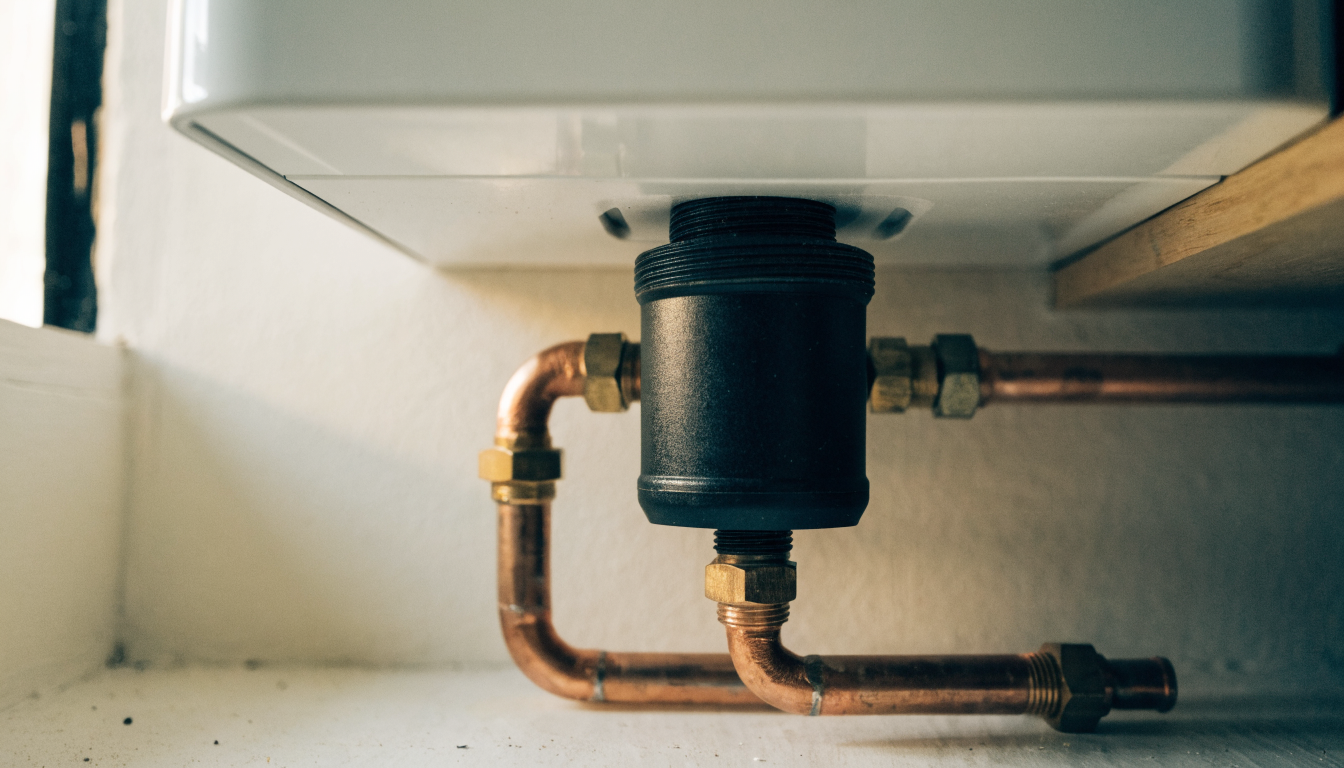
So here they are up front. MagnaClean is a brand name owned by Adey, not a type of product, in the same way Hoover is not a type of vacuum cleaner. A magnetic filter only catches iron, which means it does nothing at all about limescale, and the sales copy is carefully worded to avoid saying so. And the decisive question is almost never which brand, it is whether the thing physically fits, because a MagnaClean Professional2 needs 203mm of height plus 50mm of clearance top and bottom, and an awful lot of boilers do not have 300mm of straight pipe anywhere near them.
I ran plumbers merchants across the south of England for sixteen years. I am not a plumber and I have never held Gas Safe registration, so nothing here is written from having fitted one. It is written from manufacturer documentation, published specifications and a long time spent watching which of these came back through the returns door and which the fitters asked for by name.
What a magnetic filter actually catches
A central heating system is a closed loop of steel radiators, copper pipe and a heat exchanger, full of water. Left untreated, the oxygen in that water corrodes the steel and produces magnetite, an iron oxide that looks like black silt. It circulates, it settles in the bottom of radiators, it scours pump bearings and it collects in the narrow waterways of a modern heat exchanger. That black water you get out of a radiator when you bleed it is magnetite.

Magnetite is ferrous, so a strong magnet in the flow will hold it. That is the entire principle, and it works. What it does not do is anything about the other things floating around a heating system, and this is the distinction that every retailer page skates past.
This matters most in hard water areas. If you live in Kent, Essex, Cambridgeshire or anywhere else with heavily calcareous water, a magnetic filter does nothing whatsoever about scale in the heat exchanger. That is a separate problem with a separate solution, and no amount of neodymium will help. Anyone selling you a magnetic filter as scale protection is either confused or being deliberately loose with the truth.
MagnaClean is a brand, not a product category
Adey Innovation launched the first MagnaClean in 2003 and the name stuck so hard that it became the counter word for the whole category. People came in asking for a MagnaClean the way they ask for Sellotape. That is a marketing achievement rather than a technical one, and it has a practical consequence: if you go in asking for a MagnaClean you will get quoted an Adey price, when three other manufacturers make a filter that does the same job and two of them are cheaper.
The real field is Adey (MagnaClean), Fernox (TF1), Sentinel (Eliminator), Spirotech (SpiroTrap), BoilerMag and a spread of own-brand units from the sheds. Screwfix's own Flomasta filter is a rebadged unit at £76.49, and Worcester Bosch sell a branded System Filter at £177.99 which matters for warranty reasons covered further down. Both prices checked on 18 September 2026.
What it costs, before you look at the shopping list
The filter is the cheap part. Here is what the main options actually cost at the two retailers that publish prices openly, all inclusive of VAT and all checked on 18 September 2026.
| Filter | Retailer | Price inc VAT |
|---|---|---|
| Sentinel Vortex 100 mini under-boiler, 22mm | Screwfix | £54.98 |
| Sentinel Eliminator Vortex250, 22mm | Toolstation | £69.99 |
| Flomasta Magnetic Central Heating Filter, 22mm | Screwfix | £76.49 |
| Sentinel Eliminator Vortex250, 22mm | Screwfix | £79.99 |
| Sentinel Eliminator Vortex 300, 22mm | Screwfix | £80.00 |
| Sentinel Eliminator Vortex500 with valves, 22mm | Screwfix | £104.98 |
| Adey MagnaClean Professional2, 22mm | Screwfix | £112.48 |
| Sentinel Eliminator Vortex500 with valves, 28mm | Screwfix | £110.99 |
| Sentinel Vortex 700 dual-action, 28mm | Screwfix | £114.98 |
| Adey MagnaClean Atom, 22mm | Screwfix | £136.26 |
| Adey MagnaClean Atom with chemical pack, 22mm | Screwfix | £151.46 |
| Worcester Bosch Magnetic System Filter, 22mm | Screwfix | £177.99 |
Fitting is the part nobody will quote you honestly without seeing the pipework. It involves draining the system down or freezing the pipe, cutting into a live circuit, fitting a tee, and refilling and rebalancing afterwards. I could not find a single published fixed price for the labour from any national installer, so I am not going to invent one. What I can tell you is what moves it, in order of impact:
- Whether it goes in during a boiler swap or on its own. Fitted alongside a new boiler, the system is already drained and the marginal labour is small. Retrofitting to a working system is a separate visit with a drain-down.
- Whether there is accessible straight pipe. If the return runs straight down into the boiler with 300mm of clear copper, it is quick. If it disappears into a boxed-in corner behind a cupboard carcass, it is not.
- Whether the system needs cleaning first. Fitting a filter to a system already full of sludge without cleaning it is putting a sticking plaster on the symptom. A proper chemical clean or a power flush is a job in its own right.
- Pipe size. A 28mm cut and tee is more awkward than 22mm and the filter costs more.
The running cost is nil. There is no power, no consumable and no cartridge. The only recurring cost is the inhibitor you top up after any drain-down, which brings us to the part of this that people get wrong most often, covered below. If your system is already showing its age, it is worth reading how long a boiler realistically lasts before spending on protection for an appliance near the end of its life.
The picks at a glance
- Best overall: Adey MagnaClean Professional2, 22mm. The one the trade buys, if you have the space.
- Best where space is tight: Sentinel Eliminator Vortex250. 110mm tall against the Professional2's 203mm.
- Best for non-magnetic debris: Fernox TF1 Sigma. Cyclonic separation as well as a magnet.
- Best small Adey: MagnaClean Micro2, if you want the brand in a 151mm body.
- Worth knowing about: MagnaClean Atom, for pipework with almost no room at all.
How the main filters compare
| Filter | Best for | Pipe sizes | Body height | Capacity | Warranty | Check it |
|---|---|---|---|---|---|---|
Best overall Adey MagnaClean Professional2 22mm | Most systems with room under the boiler | 22mm and 28mm | 203mm | 550ml | 10 years if registered within 30 days | Check price on Amazon |
Adey MagnaClean Micro2 | Smaller systems, tighter cupboards | 22mm | 151mm | 250ml | 10 years if registered within 30 days | Check price on Amazon |
Smallest Sentinel Eliminator Vortex250 | Very tight pipework | 22mm | 110mm | 180ml | Check with Sentinel | Check price on Amazon |
Sentinel Eliminator Vortex 300 | A larger canister on 22mm pipe | 22mm | Check spec sheet | Check spec sheet | Check with Sentinel | Check price on Amazon |
Best non-magnetic capture Fernox TF1 Sigma with valves 22mm | Systems with flux and copper debris | 22mm and 28mm | 115mm (22mm version) | Not published | 10 years | Check price on Amazon |
BoilerMag 22mm | A cheaper magnet-only option | 22mm | Not published | Not published | Check with BoilerMag | Check price on Amazon |
The filters worth fitting
Three of the five picks below are Adey or Sentinel, and that is not an accident of taste. Between them those two brands account for most of what is genuinely stocked and reliably available in the UK at sensible money. Fernox make a very good filter but it has quietly disappeared from the Screwfix range, which tells you something about where it sits in the retail market even if it says nothing about the product.
#1 Best overall
Adey MagnaClean Professional2, 22mm
- 22mm compression connections at the valve
- 203mm tall, 98mm wide at the lid, 100mm between filter centre and valve centre
- 550ml fluid capacity, the largest of the domestic Adey range
- Removable magnet sheath so the magnet lifts out without opening the pipework
- 10-year warranty when registered with Adey within 30 days of installation
Pros
- The unit the trade actually asks for by name, so any plumber will know how to service it without reading anything
- Largest sludge capacity in the domestic range, which means longer between empties on a dirty system
- Sheath design means you are not fighting a magnet stuck to the inside of a canister
- Parts and replacement seals are stocked everywhere
Cons
- Needs 203mm of height plus 50mm clear above for the air vent and 50mm below for the drain plug, so call it 300mm of clear space
- Costs meaningfully more than a Sentinel or a shed own-brand that catches magnetite just as well
- The 10-year warranty is worthless unless somebody registers it within 30 days, and most installers do not
- The brand premium is real and you are paying part of it for the name
If you have the space, this is the one to buy, and the reason is servicing rather than filtration. Every heating engineer in the country has emptied one, the sheath comes out cleanly, and the seals are stocked. On pure magnetite capture a filter half the price will do the same job.
Check price on AmazonCheck price at ScrewfixCheck price at Toolstation
#2 Best where space is tight
Sentinel Eliminator Vortex250
- 22mm connections with an integrated isolation valve
- 110mm high, 148mm long, 81mm wide, 990g
- 9,000 gauss magnet with a 180ml collection chamber
- Rated to 100 degrees C and 3 bar, maximum flow 35 litres per minute
- GRP body with a forged brass T-piece
- Mounts on horizontal or vertical pipework
Pros
- Roughly half the height of a MagnaClean Professional2, which is often the difference between fitting it and not
- Cheapest credible filter from a major chemical manufacturer
- Integrated isolation valve means fewer separate fittings to buy
- Horizontal or vertical mounting gives you options when the pipe run is awkward
Cons
- 180ml capacity against the Professional2's 550ml, so a dirty system fills it faster and you empty it more often
- 3 bar maximum working pressure is lower than the Fernox TF1 Sigma's 5 bar, which is worth checking against your system pressure
- Sentinel do not publish a headline warranty figure as prominently as Adey or Fernox, so confirm it before you rely on it
- Less familiar to installers than a MagnaClean, so expect to be talked out of it
The filter to specify when the honest answer to a MagnaClean is that it will not fit. Accept that a smaller chamber means a shorter service interval and it is a sensible buy, particularly under a wall-hung combi where the return drops into a tight boxed-in corner.
#3 Best for non-magnetic debris
Fernox TF1 Sigma with valves, 22mm
- 22mm and 28mm versions available
- 22mm version measures 115mm high, 255mm long, 180mm deep and weighs 1.33 to 1.43kg
- Maximum working pressure 5 bar, maximum working temperature 100 degrees C
- Maximum flow rate 25 litres per minute
- Hydronic Particle Separation chamber working alongside a neodymium magnet assembly
- Can be installed up to 45 degrees off vertical
- 10-year warranty
Pros
- The cyclonic chamber traps non-magnetic debris the magnet cannot hold, which is the gap in every magnet-only filter
- 5 bar pressure rating, the highest of the filters here
- 45 degrees of installation tolerance is genuinely useful on pipework that is not plumb
- Low body height at 115mm despite a full-size chamber
Cons
- 255mm long on the 22mm version, so it trades height for width and needs a clear horizontal run
- Fernox no longer appears in the Screwfix central heating filter range, so buying it means Amazon or a merchant
- Fernox publish a capture claim of up to 100 percent of system contaminants, which is manufacturer marketing rather than an independently verified figure and should be read as such
- No micron rating is published for the separation chamber, so there is no way to compare it numerically against a rated mesh
The technically most interesting filter here, because it is the one addressing the limitation the whole category shares. If your system has had recent pipework done and you are worried about flux residue and copper swarf rather than just magnetite, this is the one. Measure the horizontal run first.
#4 Best small Adey
Adey MagnaClean Micro2 filter and chemical pack
- 22mm connections at the valve
- 151mm high, 98mm wide at the lid, 100mm between filter centre and valve centre
- 250ml fluid capacity
- Same removable sheath servicing arrangement as the Professional2
- 10-year warranty when registered within 30 days
- Supplied with Adey cleaner and inhibitor in the pack version
Pros
- 52mm shorter than the Professional2 while keeping the familiar Adey servicing method
- The chemical pack version includes the inhibitor you need anyway, which is genuinely better value than buying separately
- Same brand familiarity, so no argument with the engineer who services it
Cons
- 250ml capacity, well under half the Professional2, so it needs emptying considerably more often on a sludgy system
- Only available in 22mm, so no use on a 28mm primary
- Still needs clearance above and below for the vent and drain plug, so the 151mm body height understates the real space needed
- Beware listings described as 26x34, which is a French threaded version and will not connect to UK 22mm compression pipework
A sensible compromise if you want the Adey servicing arrangement in a shorter body. On capacity alone the Sentinel Vortex250 is not far behind at a lower price, so buy this one for the brand consistency rather than the specification.
The MagnaClean Atom, covered rather than recommended
The Atom is the one to know about if nothing else will go in. Adey publish it at 95mm high and 95mm wide at the lid, 148mm wide including the valves, with a 230ml capacity, and they state it needs only 115mm of pipe space to install. It has a slip socket so it goes in without cutting a long section out, and it has a bypass mode so the filter can be serviced without shutting the heating down.
Two caveats. It is £136.26 at Screwfix as of 18 September 2026, which is more than the Professional2 despite being a great deal smaller, because you are paying for the packaging rather than the filtration. And the Screwfix listing states a two-year manufacturer's guarantee while Adey's own product page states ten years subject to registration within 30 days. I could not reconcile those two, so treat the ten years as conditional on registering it and confirm the terms with Adey before you rely on them. The Atom is listed at Screwfix here if you want to check the current price and specification yourself.
Sizing and clearance: the question that decides it
Every buying guide on this subject compares gauss ratings. Almost none of them tell you to go and measure the cupboard, which is the step that determines what you can actually fit. Do this before you buy anything.
Take the body height from the specification, then add clearance at both ends. Adey specify 50mm above the Professional2 for the air vent and 50mm below for the drain plug. Without that, you can fit the filter but you cannot service it, and a filter you cannot service is decoration. The graphic below shows the real space requirement rather than the headline figure.
22mm or 28mm
Match the filter to the pipe it goes on, not to the size of the house. The overwhelming majority of UK domestic heating primaries are 22mm, and a 22mm filter is what you want. Measure the outside diameter of the pipe where the filter will go: 22mm copper measures 22mm across the outside, 28mm measures 28mm.
You need 28mm where the primary itself is 28mm, which in practice means larger houses, some older gravity systems, and most heat pump installations where the flow rates are higher and the temperature difference across the system is smaller. Fitting a 22mm filter into a 28mm circuit with reducers creates a restriction exactly where you do not want one. If your system is a heat pump rather than a boiler, look specifically for a filter rated for it, because the flow rates are different and several manufacturers list a separate heat pump model.
Where it goes in the circuit
On the return, as close to the boiler as the pipework allows, and downstream of the pump. The logic is simple: the return is the water coming back from the radiators carrying everything it has picked up, and the point of the filter is to take that debris out before it reaches the heat exchanger. A filter on the flow catches whatever survived the heat exchanger, which is the wrong way round.
Two practical points the diagram cannot show. The filter needs to be somewhere you can get a bowl underneath it, because servicing means opening the drain plug and letting black water out. And it wants isolation valves either side, which every decent filter now includes as part of the kit, so the system does not have to be drained down every time it is emptied. If your pressure drops after any work on the system, repressurising the boiler is a five minute job you can do yourself.
Is a filter a condition of your boiler warranty?
Sometimes, and the detail matters more than the headline. This gets repeated online as a flat yes, which is not accurate, so here is what the manufacturers actually publish.
Worcester Bosch make a filter a condition of the extended guarantee rather than the standard one. Their published guarantee lengths state that a Greenstar 8000+ carries eight years as standard, ten years when installed with any System Filter, and twelve years extended. A Greenstar 4000, CDi Compact or i System Compact carries seven years as standard, eight with a System Filter, ten extended. Their oil boilers carry two years as standard, five with a System Filter and seven extended. Their terms state that the extended length is achieved "when installing the boiler with any Greenstar System Filter by a Worcester Bosch Accredited Installer or Worcester Bosch Accredited Partner", and separately that "extended guarantees are not available when the appliance is fitted with a System Filter Micro". That last line is the trap. Fit the small one and you do not get the long guarantee, and nobody tells you at the counter.
Vaillant do not require a filter at all in their published guarantee terms. What they require is water quality. Their terms state that all water circulating in the boiler "must be in a clean and uncontaminated state (correctly and fully treated with corrosion inhibiter where applicable...) before first ignition and maintained so throughout the boiler life cycle with details logged in the Benchmark log book", and that "the boiler must be flushed prior to first ignition". They also state that registration must happen within 30 days or the guarantee reverts to twelve months. A filter helps you meet the water quality condition. It is not itself the condition.
On the British Standard: BS 7593:2019 is the code of practice for preparing, commissioning and maintaining domestic heating systems, and Approved Document L has referenced it since June 2022. It is widely summarised, including by Sentinel and Adey, as recommending a permanent in-line filter capable of capturing magnetic and non-magnetic debris, alongside chemical cleaning before commissioning and annual testing of inhibitor levels. The standard itself is a paid document and I have not read the full text, so I am reporting the manufacturers' summaries as summaries rather than quoting the standard. The distinction between "recommends" and "requires" is doing real work in those summaries and is worth treating carefully.
It has to be emptied, and this is where most of them fail
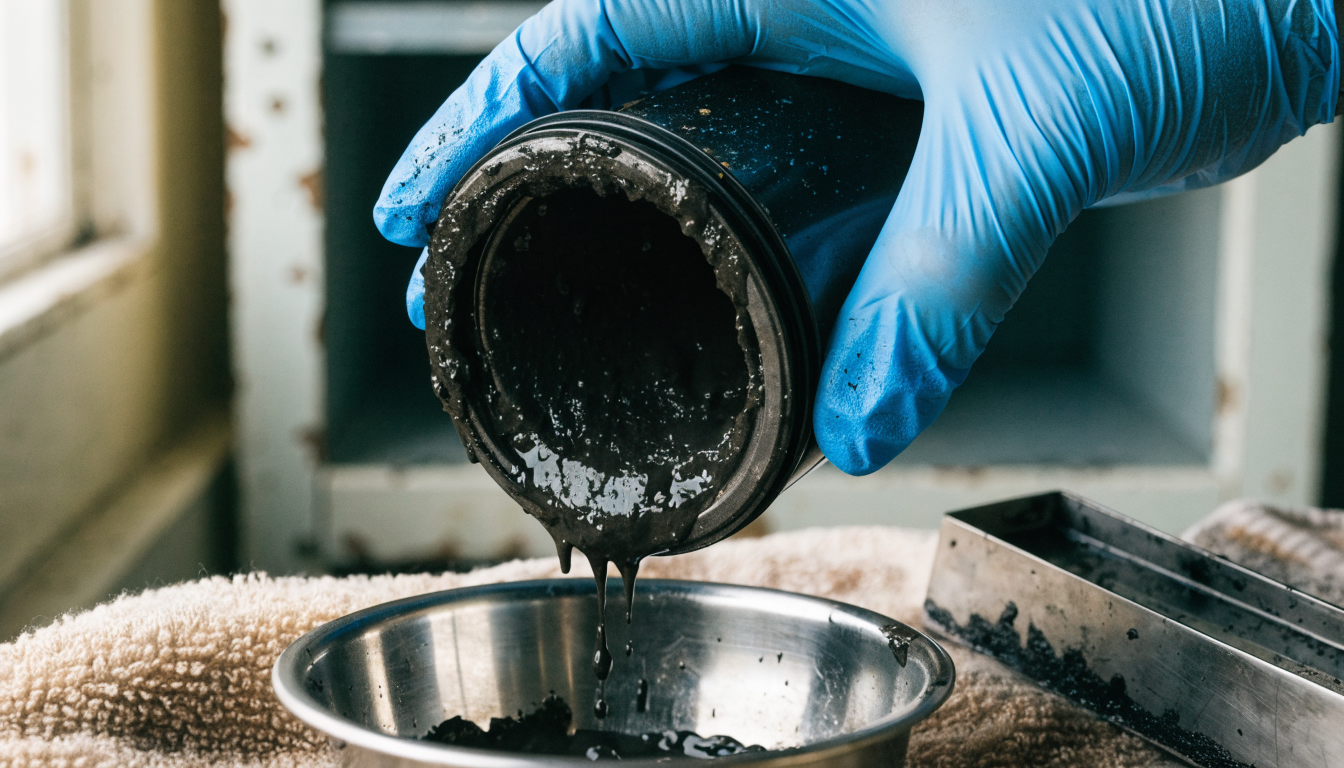
A magnetic filter is not a fit and forget item. It has a finite chamber, the chamber fills with iron, and once it is full the filter stops filtering. Nothing warns you. The heating carries on working and the debris carries on circulating past a chamber that has no room left in it. A filter nobody ever empties is worse than no filter at all, because it gives you the confidence to skip everything else.
Emptying it is not a difficult job on a filter with isolation valves. Close both valves, put a bowl underneath, open the drain plug, let it run, lift the magnet sheath out and wipe it, reassemble, reopen the valves and check the pressure. The Adey units take a plastic spanner that is supplied with the filter and which everybody loses, which is why "magnaclean spanner" is one of the most common related searches on this topic. Keep it taped inside the boiler cupboard door.
If you are not confident opening a drain plug on a pressurised system, leave it to the engineer at the annual service. Gas appliances themselves are a different matter entirely: any work on the boiler, its flue or its gas supply legally requires a Gas Safe registered engineer, and that is law rather than advice. General system upkeep is covered in more depth in our guide to maintaining your heating system.
A filter and inhibitor are not alternatives
This is the single most common misunderstanding at the counter and it costs people real money. A filter catches magnetite that already exists and is already circulating. Inhibitor stops the magnetite forming in the first place. One is a cure, the other is prevention, and doing only the first means the system carries on corroding while you congratulate yourself on the black sludge in the canister.
Inhibitor depletes. It gets diluted every time the system is drained to change a radiator or fix a leak, and it degrades slowly on its own. If a filter was fitted five years ago and the inhibitor has never been topped up since, the filter is quietly filling with the evidence of a problem that is still running. Any time you take a radiator off, you lose inhibitor and it needs replacing.
The sequence that actually works on an existing system is: clean it, fit the filter, dose the inhibitor, and test the inhibitor level annually. Doing only the middle step is the expensive way to feel like something has been done.
What goes wrong over time
- The seals perish. The large O-ring on the canister lid is the usual culprit, and it weeps rather than bursts, so it shows up as a slow drip and a pressure drop rather than a flood. Replacement seal kits are cheap and stocked for the Adey and Sentinel units.
- The chamber packs solid. On a system that has never been cleaned, the magnetite compacts into a dense cake that is hard to get out and easy to leave in. If the canister comes off and the sludge does not pour, the system needs cleaning properly, not just the filter emptying.
- The isolation valves seize. Valves that are never operated stiffen up. Turning them once a year at the service keeps them free, which matters because a seized valve turns a ten minute empty into a full system drain-down.
- The spanner disappears. Trivial and extremely common. Without the correct plastic spanner people reach for grips, and grips crack the plastic lid.
- Nobody registers the warranty. Both Adey and Vaillant require registration within 30 days. Miss it and a ten-year cover reverts to whatever the default is. This is the most avoidable failure on the list.
If you are seeing cold spots and are not sure whether the problem is air or sludge, that diagnosis comes first and the filter comes second. Our guide to common radiator problems covers how to tell them apart, and bleeding a radiator is the first thing to try if the cold spot is at the top rather than the bottom.
Questions people actually ask
What does a MagnaClean filter do?
It sits in the return pipe of a central heating system with a powerful magnet in the flow, and holds onto the magnetite, the black iron oxide sludge, that is circulating in the water. That stops the sludge reaching the boiler's heat exchanger and the pump. It does not soften water, remove limescale or catch non-magnetic debris unless the particular model has a mesh or cyclonic chamber as well as a magnet.
Do magnetic central heating filters work?
Yes, at the one job they do. Magnetite is ferrous and a strong neodymium magnet in the flow path will hold it, which is straightforward physics rather than a marketing claim. The honest caveats are that it only works on iron, that it only works while the chamber has room in it, and that it deals with the symptom of corrosion rather than the cause. A filter on an uninhibited system is treating an ongoing problem rather than solving it.
Is a MagnaClean worth it?
A magnetic filter is worth fitting on almost any wet central heating system. Whether it is worth paying the Adey premium specifically is a different question. The Professional2 is the best-supported unit in the country and the one every engineer knows how to service, which has genuine value. On magnetite capture alone, a Sentinel Eliminator Vortex250 at around thirty to forty pounds less does the same thing. Buy the Adey for servicing familiarity and capacity, not because the brand name implies better filtration.
Where should a MagnaClean be fitted?
On the return pipe, downstream of the pump, as close to the boiler as the pipework allows, and somewhere you can get a bowl underneath it. Fitting it on the flow means it only catches debris that has already been through the heat exchanger, which defeats the purpose. It also needs clearance above and below for the air vent and drain plug: Adey specify 50mm at each end of the Professional2.
How often should a MagnaClean be cleaned?
At least once a year, and it makes sense to do it at the annual boiler service while the engineer is there and the system is cool. Empty it more often than that on an older or already sludged system, on a small-chamber filter, and in the first couple of months after a new installation or a power flush when fresh pipework sheds debris quickly.
What happens if a MagnaClean is not cleaned?
The chamber fills with compacted magnetite and the filter stops capturing anything. There is no alarm and no obvious symptom, so the system carries on circulating debris past a filter everyone assumes is working. On a badly neglected unit the sludge cakes hard enough that it has to be dug out. Over a long enough period a heavily packed chamber can also restrict flow.
How long do MagnaClean filters last?
Adey publish a ten-year warranty on the Professional2, Micro2 and Atom, conditional on registering the product with them within 30 days of installation. Fernox publish ten years on the TF1 Sigma. In practice the body outlives the warranty easily; what wears out is the seals, and those are a cheap replaceable part rather than a reason to change the filter. The number that matters is the registration deadline, not the headline.
How much does it cost to fit a magnetic filter?
The filter itself runs from around £55 to £180 at the sheds depending on brand and size, prices checked on 18 September 2026. The labour is the variable and I could not find a national installer publishing a fixed price for it, so any figure quoted online without a site visit is a guess. The things that move it are whether it is done alongside a boiler installation or as a standalone visit, whether there is accessible straight pipework, whether the system needs cleaning first, and the pipe size.
Which magnetic filter system is the best?
For most UK homes with space under the boiler, the Adey MagnaClean Professional2 in 22mm, because of its 550ml capacity and how well supported it is. Where there is not room for a 300mm vertical run, the Sentinel Eliminator Vortex250 at 110mm tall. Where the concern is flux residue and copper swarf rather than just magnetite, the Fernox TF1 Sigma, because the cyclonic chamber addresses debris the magnet cannot hold.
Related guides
- Common radiator problems for telling sludge apart from air before you spend anything.
- Maintaining your heating system for where the filter fits into the wider annual routine.
- How to repressurise a boiler for the pressure drop that follows any drain-down.
- What is a thermostatic radiator valve for the other component most likely to seize on a sludged system.
- How long does a boiler last for whether protecting this one is still the right call.




0 Comments