
As an Amazon Associate I earn from qualifying purchases.
A ceiling extractor fan looks like the tidy answer. The grille sits flush in the plasterboard, nothing clutters the tiling, and the air goes up and away into the loft. The part nobody mentions is that the air still has to get out of the building, and the route it takes is what decides whether the fan does anything at all.
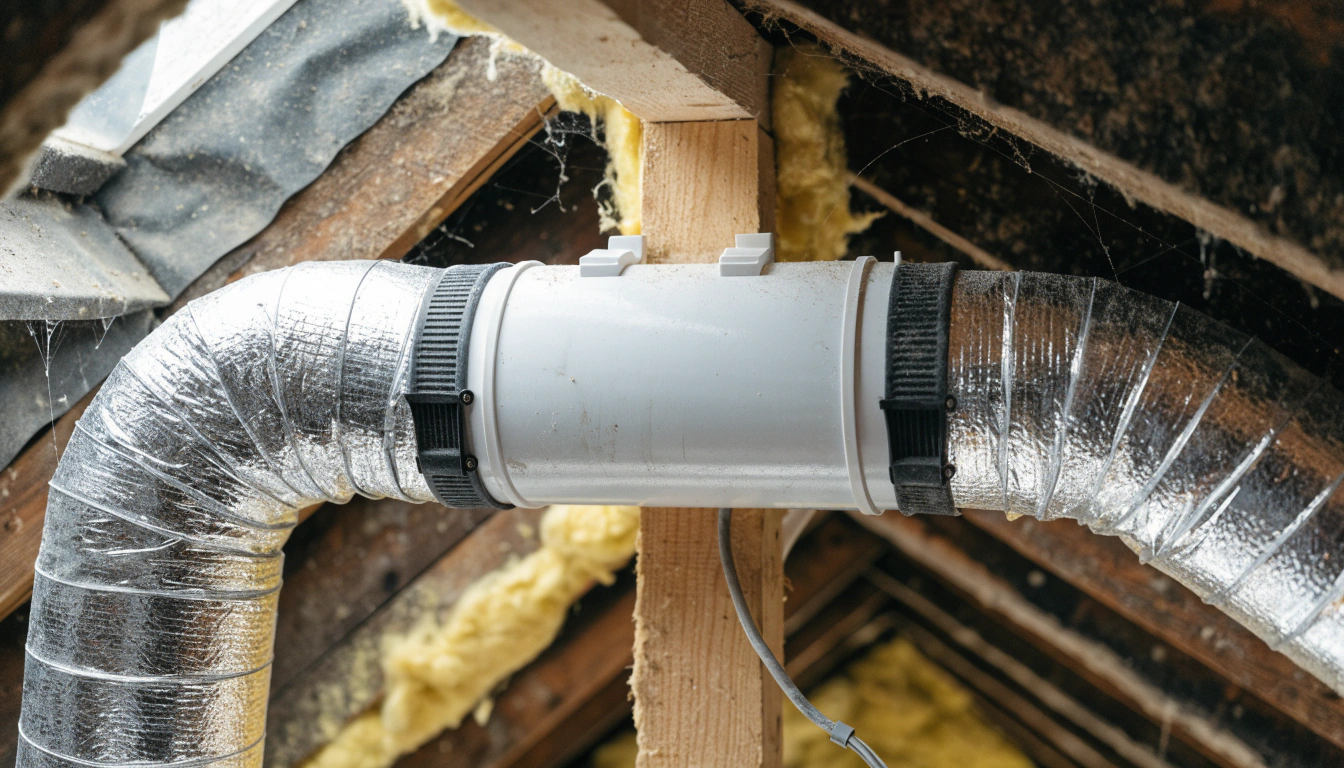
Two figures make that concrete. Approved Document F limits flexible duct connected to an axial fan to 1.5 metres (Volume 1, paragraph 1.77). The Xpelair Airline inline kit, one of the most widely sold ceiling fan kits in the country, is supplied with 3 metres of flexible ducting in the box. Nothing is being hidden. The kit simply gives you more flex than the guidance allows you to use on an axial fan, and most people use all of it.
The second figure is bends. The Domestic Ventilation Compliance Guide limits a duct run to two bends for extract rates up to 30 litres per second. A ceiling fan that drops into a loft, turns to run along the joists and then turns again to reach a soffit has used both of them before it goes anywhere.
This page is about the mounting job rather than the fan. Which fan to buy, how the bathroom zones work and which units are genuinely quiet are covered in the guide to the best bathroom extractor fans, which compares nine of them on published extract rate and noise. What follows is the part that guide does not cover: whether a ceiling position suits your house, and how to duct it so the fan still moves 15 litres per second when it is in.
I spent 16 years running plumbers merchants across the south of the country and a couple more with an independent. Ceiling fans and inline kits came back over the counter for one reason far more often than any other: they had been fitted at the end of a duct run that was never going to let them work, and the customer had concluded the fan was faulty. I have not fitted or tested any of the kits below, and I am not an electrician. Everything here is judged on published manufacturer specification, the regulations themselves and what came back through the returns door.
Ceiling unit or inline kit: start here
There are two genuinely different products sold as ceiling extractor fans, and most buyers do not realise they are choosing between them. A ceiling-mounted unit has its motor in the ceiling void behind the grille. An inline kit puts a plain grille in the ceiling and the motor further away in the loft, connected by ducting at both ends. Work out which one your house wants before you look at a single product.
What a ceiling fan has to achieve
Approved Document F Table 1.1 sets the intermittent extract rate for a bathroom at 15 litres per second. A separate WC needs only 6 litres per second. That 15 figure is the target the installed fan has to hit, not the figure on the box.
Manufacturers quote free air performance, measured with nothing attached. The Xpelair Airline range is published at 85 cubic metres an hour, which the data sheet rounds to 24 litres per second. Divide 85 by 3,600 and you get 23.6, so the rounding is fair. The useful way to read that number is as a margin: 24 litres per second of free air against a 15 litre per second requirement leaves you 9 litres per second to lose in ducting, bends and grilles before the installation stops complying.
Nine litres per second sounds generous. It is not, and the regulations know it. BEAMA's guidance on Part F puts it plainly: "The stated extract rate of a fan may be lower when installed due to resistance from ductwork, grilles etc." That is why Approved Document F asks for the installed rate to be measured rather than assumed, and why the duct rules below exist at all.
One more rule that decides position rather than product. Approved Document F paragraph 1.21 says a mechanical extract terminal should sit as high as is practicable in the room, and no more than 400 mm below the ceiling. A ceiling position satisfies that by definition, which is a genuine point in its favour and the reason so many installers default to it.
The duct run, which is where ceiling installations fail
A wall fan pushes air through 200 mm of brick and it is outside. A ceiling fan has to get it across a loft. Everything below comes from Approved Document F Volume 1 and the Domestic Ventilation Compliance Guide, which is the document building control reach for when they want the detail.
| Rule | The figure | Source |
|---|---|---|
| Rigid duct first | "Rigid ducts should be used wherever possible" | Approved Document F, para 1.76 |
| Flexible duct on an axial fan | 1.5 metres maximum | Approved Document F, para 1.77 |
| Flexible duct on a centrifugal fan | 6 metres at 6 to 30 l/s, 3 metres at 31 to 60 l/s | Domestic Ventilation Compliance Guide, Table 1 |
| Number of bends | Two up to 30 l/s, one above that | Domestic Ventilation Compliance Guide, Table 1 |
| Bend radius | Inner radius at least equal to the duct diameter | Domestic Ventilation Compliance Guide, Diagram 1 |
| Flexible duct must be pulled taut | Extended to at least 90 per cent of its maximum length | Domestic Ventilation Compliance Guide, Table 1 |
| Supporting flexible duct | Supports at centres no greater than 600 mm | LABC Warranty technical guidance, citing BSRIA BG 43/2013 |
| Insulation through a loft | Equivalent of at least 25 mm of material at 0.04 W/(m.K) or better | Domestic Ventilation Compliance Guide, Table 1 |
| Joints | Mechanically secured and adequately sealed | Approved Document F, para 1.81 |
| Fall | Horizontal duct slopes slightly downwards away from the fan | Domestic Ventilation Compliance Guide, Table 1 |
Why concertina flexible duct is the problem
Aluminium concertina duct is cheap, bends anywhere and is sold alongside every fan on the shelf. Its internal surface is a continuous series of ridges, and air moving through it is being dragged across every one of them. That is the whole reason the guidance puts a 1.5 metre cap on it behind an axial fan while allowing rigid duct to run much further.
The second problem is the one you can see in any loft. Flexible duct left loose sags between the joists, and every sag is a trough. Pulled taut to 90 per cent of its length, as the compliance guide requires, it is a reasonable final connection. Left as supplied, concertinaed into a metre of space because the run was only a metre, it has perhaps half its internal diameter available and collects condensate in the dips.
What to do instead is not complicated. Use a short piece of flex at the fan where you need the flexibility, clamp it to rigid 100 mm round duct as soon as you can, run the rigid duct in as straight a line as the loft allows, and seal every joint with aluminium foil tape rather than cloth duct tape, which dries out and lets go.
Rigid 100mm round duct on AmazonAluminium foil duct tape on AmazonThe gap between the first bar and the second is the entire budget for your duct run. I cannot tell you what one 90 degree bend costs you out of it, and neither can anyone else honestly, because domestic fans at this size are not sold with a pressure and volume curve. What can be said is that the people who wrote the guidance capped the run at two bends for a reason, and that the only way to know what your installed fan actually moves is to measure it, which is what Approved Document F asks the installer to do.
Where the duct has to end up
Approved Document F paragraph 1.18 is short and does not leave room: "Extract ventilation to outside should be provided" in bathrooms, among other rooms. Outside means outside the building. A duct that stops at the edge of the insulation and points vaguely at the eaves is not outside, and it is the single most common bodge in this whole job.
Venting a bathroom fan into a loft void does not remove the moisture from your house. It moves roughly 15 litres per second of warm, saturated air into the coldest enclosed space you own, where it condenses on the underside of the roof covering and on the timbers. The damp is no longer on the bathroom ceiling. It is in the roof structure instead, and it does not announce itself until something is already rotten.
There are three places the duct can legitimately finish, and the right one depends on the roof rather than on preference.
Best when the bathroom is near an eaves and the run can stay short.
Watch for discharging into a ventilated eaves, where some of the moist air is drawn straight back into the loft through the soffit vents either side of it. Use a ducted soffit terminal that connects to the duct rather than an open grille.
Best when the bathroom sits in the middle of the house and the shortest route out is straight up through the roof slope.
Watch for the terminal needing to match your roof covering. A tile vent is specific to the tile profile, and fitting one means lifting tiles, which is roofing work.
Best when there is a gable within reach and you can keep the run straight along the joists to it.
Watch for the distance. This is the route most likely to tempt you past two bends and well past any sensible duct length.
Whichever you use, the compliance guide asks for the terminal to have a free area of at least 90 per cent of the duct's free area. A fine mesh grille sold as insect proof can fail that easily, and it is the last thing in the chain, so it throttles everything upstream of it.
Condensation inside the duct, and insulation
This is the failure that people blame on the fan. Warm saturated air from a shower enters a bare metal duct running through a loft that is at outside temperature. It condenses on the inside of the duct wall. The water runs back down the duct, because the duct was laid level or with a fall towards the fan rather than away from it, and it drips out of the ceiling grille. The householder concludes the fan is leaking.
Two things prevent it. The first is the fall: the compliance guide asks for horizontal ducting to slope slightly downwards away from the fan, so any condensate that does form runs towards the outside rather than back into the room. A vertical section needs a condensate trap.
The second is insulation. The requirement is the equivalent of at least 25 mm of material with a thermal conductivity of 0.04 W/(m.K) or better wherever the duct passes through an unheated void. LABC Warranty's technical guidance puts the same requirement as a thermal resistance of at least 0.6 m²K/W, citing BRE Report BR 262, and adds a detail worth knowing: the insulation should be factory applied rather than wrapped round the duct on site. That is the argument for buying ready insulated flexible ducting rather than lagging plain duct yourself, and it is why insulated duct exists as a separate product at roughly twice the price.
Insulated 100mm flexible ducting on AmazonToolstation were listing 100 mm insulated flexible ducting at £48.99 including VAT for a 10 metre roll, checked on 27 November 2026. Against the cost of the fan it is not the expensive part of the job, and it is the part most likely to be left out.
Insulation and fire in the ceiling void
Two things in the loft want attention once the duct is in. Loft insulation should not be packed around a ceiling-mounted fan's body, because the motor needs to lose its heat somewhere and a smothered motor runs hotter and dies sooner. Pull the quilt clear of the housing rather than tucking it in neatly.
The other is the hole itself. Cutting a 100 mm or larger opening in a ceiling removes a piece of the fire resisting layer between the rooms, which matters in a house with a loft conversion or a flat below, where that ceiling is doing a job beyond holding the paint up. In an ordinary two storey house with an uninhabited loft above, it is not usually an issue. Where the ceiling is part of a protected escape route or separates dwellings, it is, and a fire rated fan housing or hood is the answer.
Zones, and why your ceiling height matters
BS 7671 divides a bathroom into zones, each with a minimum IP rating, and the full picture including the section diagram is in the bathroom extractor fan guide. One part of it is specific to ceiling mounting and worth pulling out here.
Zone 1 runs from the floor to 2.25 metres above finished floor level. It does not go any higher. So whether a fan directly over a bath or shower is in a zone at all depends on how high your ceiling is.
A grille directly over the bath sits above the 2.25 metre line, so it is outside the zones. The zone rules do not force a particular IP rating on it.
The same grille in the same position is now inside Zone 1. A low ceiling, a dormer, or a bath on a raised plinth all do this.
This is where the inline kit earns its place again. Put the motor in the loft and the thing in the ceiling is a grille, which is a far easier object to justify directly above a shower than a mains powered motor. The low voltage kits take it further by running the light and in some cases the grille on a SELV transformer sited outside the room.
Will it physically fit above your ceiling?
This is the check that decides the job and it is the one almost nobody does before ordering. A ceiling-mounted fan needs its body depth above the plasterboard, and then the duct has to leave it and turn.
Work the turn out before anything else. The compliance guide asks for a bend's inner radius to be at least equal to the duct diameter. On 100 mm duct that means you need more than 100 mm of clear depth above the ceiling board to turn the duct through 90 degrees without crushing the bend radius, and that is before the fan body itself. Ceiling joists in a typical first floor are often 100 mm to 150 mm deep. In the shallower case there is simply nowhere to make a compliant turn, whatever the product listing says will fit.
The ceiling and inline kits worth buying
A note on what is here and what is not. Most 100 mm fans sold as ceiling extractor fans are the same axial units sold as wall fans, fitted into a ceiling instead. Those are compared on extract rate and noise in the main extractor fan guide and there is no sense repeating them here. What follows is the genuinely ceiling specific equipment: the inline kits that put a grille in the ceiling and the motor somewhere sensible.
On brands, the shopping results and Google's own summary for these searches name Xpelair, Vent-Axia, Manrose, Airflow and occasionally Blauberg and Kair. Three of those are below. Airflow's iCON range is a ceiling and wall unit rather than an inline kit, and it is covered in the main guide. EnviroVent and Greenwood, both names you will hear from installers, do not appear in the retail results for these terms at all, because they sell largely through the trade rather than over a counter, so there is nothing useful to link you to.
| Product | Type | Free air rate | Published noise | IP rating | Warranty | Buy |
|---|---|---|---|---|---|---|
Best with a light Manrose Primeline LEDSLKTC | Inline kit, LED grille, timer | 24 l/s | 41 dB | IPX5 | 3 years | Check price on Amazon |
Best complete kit Xpelair Airline AL100T | Inline kit, timer | 24 l/s (85 m³/h) | 40 dB(A) at 3 m | IPX4 | 2 years | Check price on Amazon |
Light and low voltage Xpelair Airline ALL100 | Inline kit, LED grille, SELV | 24 l/s (85 m³/h) | 40 dB(A) at 3 m | IPX4 | 2 years | Check price on Amazon |
Longest duct runs Vent-Axia ACM100T | Inline mixed flow, timer | 71 l/s (256 m³/h) | 23 dB(A) | IP44 | Not published on the listings checked | Check price on Amazon |
Best ceiling kit with a light: Manrose Primeline LEDSLKTC
#1 Best ceiling kit with a light
Manrose Primeline LEDSLKTC Inline LED Showerlight Fan Kit with Timer
- 100mm inline fan with an LED ceiling light grille and chrome bezel
- 24 litres per second maximum flow rate
- IPX5 rated, which Manrose state as suitable for Zone 1
- Timer over-run control, single fan speed
- Supplied as a kit with the fan, LED lamp, timer control and installation parts
- 3 year warranty
Pros
- The IPX5 rating is the one that matters if your ceiling is under 2.25 metres and the grille sits over the bath or shower, where IPX4 units leave you arguing with an inspector
- Light and extract in one opening, so one hole in the ceiling instead of two
- 24 l/s free air gives a 9 l/s margin over the 15 l/s a bathroom has to achieve
- Three year warranty against the two years the Xpelair kits carry
Cons
- Published at 41 dB, marginally the loudest figure of the four here, and Manrose do not state the distance it is measured at, so it cannot be compared like for like with the Xpelair 3 metre figure
- Single speed, so there is no low setting for continuous background running
- The LED lamp is integral to the grille, so a failed lamp is a grille replacement rather than a bulb change
- Wattage is not published on the retail listings checked
The one to choose when the grille has to go directly over a bath or shower in a room with a low ceiling, because the IPX5 rating settles the zone question outright. The three year warranty is a genuine edge over the Xpelair kits, and the 41 dB figure is not a fair comparison against their 40 dB at 3 metres, because nobody states what distance it belongs to.
Plumbworld were listing it at £67.09 including VAT, checked on 27 November 2026.
Best complete inline kit: Xpelair Airline AL100T
#2 Best complete inline kit
Xpelair Airline AL100T 100mm Inline Axial Extractor Fan Kit with Timer
- 100mm inline axial fan supplied with a loft fitting kit
- 85 cubic metres an hour, which Xpelair state as 24 litres per second
- 40 dB(A) measured at 3 metres
- 16 watts
- IPX4 rated
- Adjustable over-run timer, 2 to 30 minutes
- 2 year UK guarantee
Pros
- A genuinely complete kit, so the grilles, fixings and loft mounting parts are in the box rather than discovered missing halfway up a ladder
- The adjustable 2 to 30 minute timer covers the 15 minute minimum overrun that Approved Document F asks for in a room with no openable window
- 16 watts is a low draw, and the running cost arithmetic is worked through in the questions below
- Xpelair publish the distance their noise figure is measured at, which most of this category does not
Cons
- Supplied with 3 metres of flexible ducting, while Approved Document F paragraph 1.77 limits flexible duct on an axial fan to 1.5 metres, so roughly half of what is in the box should not be used as flex on this fan unless Xpelair can evidence otherwise
- IPX4, not IPX5, so it is the wrong choice if the grille lands inside Zone 1 under a low ceiling
- Axial rather than mixed flow, so it is the least suited of these four to a long or bendy run, which is awkward for a kit aimed at lofts
- No light, so a separate ceiling light stays where it is
The sensible default for a straightforward inline job where the lighting is staying as it is and the run out to a soffit or gable is short. Buy it for the timer and the complete kit, then put most of the supplied flexible ducting aside and run rigid duct instead, which is what the guidance asks for anyway.
Light and low voltage: Xpelair Airline ALL100
#3 Best where the lighting is being replaced too
Xpelair Airline ALL100 100mm Inline Axial Extractor Fan Kit with LED Light
- 100mm inline axial fan with a 3 watt cool white LED ceiling grille
- 85 cubic metres an hour, stated by Xpelair as 24 litres per second
- 40 dB(A) measured at 3 metres
- 19 watts
- IPX4 rated
- Supplied with a SELV transformer, loft fitting kit, internal and external grilles, white and chrome bezels and fixings
Pros
- The SELV transformer means the light at the ceiling runs at safety extra low voltage, with the transformer sited away from the room
- Same airflow and noise figures as the AL100T, so the light costs you nothing in performance, only 3 watts
- White and chrome bezels both in the box, so the finish is decided after the ceiling is made good rather than before
Cons
- This model has no timer, and in a bathroom with no openable window Approved Document F asks for a 15 minute overrun, so the timer version is the one that complies there
- Also supplied with 3 metres of flexible duct against the 1.5 metre axial limit
- IPX4 rather than IPX5
- A 3 watt LED is a modest light for a bathroom and is unlikely to be the only one you want
Worth it specifically when the ceiling is coming down or being reskimmed anyway and you can take light and extract out of the same opening. If the bathroom has no window, buy the ALL100T timer version instead, because the overrun is not optional there.
Toolstation were listing the timer version, the ALL100T, at £61.18 including VAT, checked on 27 November 2026.
For a genuinely long run: Vent-Axia ACM100T
#4 Best for the longest duct runs
Vent-Axia ACM100T 100mm In-Line Mixed Flow Fan with Timer
- 100mm in-line mixed flow fan with timer
- 256 cubic metres an hour free air, which works out at roughly 71 litres per second
- 23 dB(A) published, though the measuring distance is not stated on the listings checked
- IP44 rated
- 230V, wipe clean polymer casing
Pros
- Mixed flow rather than axial, which is the design that holds its airflow against the resistance of a long duct run
- The free air figure is several times what the axial kits manage, which is the margin a four or five metre run with two bends actually needs
- The compliance guide allows longer flexible duct behind a non-axial fan, 6 metres at these extract rates, which makes a difficult loft route workable
Cons
- Several times the price of the axial kits, which is the main reason it is the wrong answer for an ordinary bathroom on a short duct run
- The published power draw is inconsistent between listings and Vent-Axia's own site could not be reached to settle it, so I am not quoting a wattage
- Fan only, so ducting, grilles and clamps are all extra, unlike the kits above
- Considerable overkill for a normal bathroom with a short run, where you would be paying for pressure you have no use for
The right answer only when the duct run is genuinely long or awkward and an axial fan has already failed to cope, which is a smaller number of houses than the spec sheet tempts you into thinking. If you want mixed flow at a sane price, the main extractor fan guide covers a cheaper option.
On what the Vent-Axia costs: RS Components were listing the ACM100T at £361.22 including VAT, and the 125mm version of the same range was £191.69 including VAT at Toolstation, both checked on 27 November 2026. Against roughly £60 to £70 for the Xpelair and Manrose kits, that is the gap you are deciding about.
Prices quoted in this section are from the retailers named, checked on 27 November 2026, and will move. No Amazon prices are given here, because Amazon only permit them through their own interface.
What goes wrong with a ceiling installation over time
Ceiling and inline installations fail differently from wall fans, and almost always somewhere you cannot see.
The one that cost merchants' customers the most money was always the duct discharging into the loft. By the time anyone looked, there was a stain on the bedroom ceiling and the roofer was quoting for timber. A fan is a cheap thing to put right. A roof is not.
Where this stops being a DIY job
The ducting, the loft work and making good the ceiling are ordinary building work. The electrical connection is not, and the line is set by law rather than by opinion.
Under Approved Document P in England, a room containing a bath or shower is a special location, and any addition or alteration to an existing circuit in a special location is notifiable building work, as is installing a new circuit anywhere. Notifiable means it has to be either carried out by an electrician registered with a competent person scheme who certifies it, or notified to building control before it starts. Putting in a fan where there was no fan, or running a new fused spur for one, lands inside that. This is not a recommendation to use an electrician. It is a description of what the Building Regulations require.
Three further things are somebody else's job. Lifting tiles to fit a tile vent is roofing work and a badly bedded vent leaks. Notching or drilling joists to pass a duct through has structural rules and a joist cut in the wrong place is a structural defect. And if the ceiling you are cutting into is part of a fire separating construction, in a loft conversion or a flat, the hole has to be made good to the same fire rating.
Finally, the bit everybody skips: Approved Document F asks for the installed extract rate to be measured once the job is done, and for run-on timers to be checked as set to at least 15 minutes. Nobody measures an extract rate on a domestic refit. It is still the only way to know whether the fan you bought is doing the job you bought it for.
Ceiling extractor fan questions
Is it better to have a bathroom extractor fan on the ceiling or wall?
A ceiling position is better for catching the air, because steam rises and Approved Document F wants the terminal no more than 400 mm below the ceiling anyway. A wall position is better for the duct, because on an outside wall the air is outside in 200 mm. So the honest answer is that a ceiling fan is the better place to put a fan and the worse place to start a duct run. If the bathroom has an outside wall and you are not fussy about the look, a wall fan is the more reliable installation. If it does not, the ceiling is the only option and the duct run is the thing to get right.
Can you use a ceiling fan in a bathroom?
Two different things get called a ceiling fan. A ceiling extractor fan, which removes air from the room, is exactly what this page is about and is the right fit for most bathrooms. A paddle style ceiling fan, the kind with blades that stirs the air round, removes nothing and does not satisfy Part F at all. In a bathroom it circulates damp air rather than getting rid of it, and anything mounted above a bath or shower has to meet the zone requirements under BS 7671.
What is the best inline bathroom extractor fan?
It depends on the run, which is the only thing that separates them. For a short loft route out to a soffit, an axial kit like the Xpelair Airline AL100T is enough and comes with the parts in the box. For a grille going over a shower under a low ceiling, the Manrose LEDSLKTC's IPX5 rating is the deciding factor. For a long or awkward run with two bends in it, a mixed flow unit such as the Vent-Axia ACM100T is the design that holds its airflow, at several times the price. Measure the run and count the bends before you compare any specifications.
Is it law to have an extractor fan in a bathroom?
The Building Regulations are not retrospective, so an existing bathroom without a fan is not unlawful and nobody will make you fit one. Part F applies when you build, extend or materially alter, which includes fitting out a new bathroom or converting a room into one. At that point Approved Document F asks for extract ventilation to outside at 15 litres per second for a bathroom, and in a room with no openable window it also asks for the fan to run on for at least 15 minutes after the room is vacated.
Does leaving the bathroom fan on use a lot of electricity?
No, and the arithmetic is worth having rather than guessing. Take the Xpelair Airline with the light, which is published at 19 watts. That is 0.019 kW. Run for two hours a day, which is a generous allowance for showers plus overrun, it uses 13.9 kWh a year. At the current Ofgem price cap electricity unit rate of 26.32p per kWh that is £3.65 a year.
Left running 24 hours a day it would use 166 kWh a year, which is £43.81 at the same rate and £54.41 at the 32.69p rate that applies from 1 January 2027. Unit rates are the Ofgem price cap average for England, Scotland and Wales on direct debit, checked 26 November 2026. The sums are mine, the wattage is the manufacturer's.
What happens if I leave a bathroom fan on all night?
Mechanically, nothing. These motors are designed for continuous duty and several units in the category are sold specifically to run permanently on a low speed. It costs roughly 12p a night at 19 watts on the current unit rate. What it does do is pull heated air out of the house all night in winter, which costs more than the fan does, and it will shorten the bearing life of a cheap unit faster than intermittent use would. A 15 minute overrun timer does the useful part of the job without either penalty.
Is it better to open a window or use an extractor fan?
A fan, for the reason that it works whether or not anybody remembers. An open window moves a great deal of air on a windy day and almost none on a still one, and in winter most people close it within a minute. The regulations treat them as different things: an openable window provides purge ventilation, while a bathroom also needs extract ventilation at 15 litres per second. If the room has a window, use both, because opening it during and after a shower genuinely helps a fan that is working at the limit of its duct run. If the room has no window, the fan plus its overrun is all there is.
Can an extractor fan vent into the loft?
No. Approved Document F paragraph 1.18 asks for extract ventilation to outside, and a loft is inside the building. Doing it moves the condensation from a surface you clean to a roof structure you do not inspect. If the duct cannot reasonably reach a soffit or gable, the answer is a tile or slate vent straight up through the roof slope, not a shorter duct that stops in the insulation.
Is an inline fan quieter than a ceiling fan?
In the room, usually yes, and for a simple reason: the motor is several metres away behind a duct and a ceiling, rather than directly above your head. The published figures do not show this, because a manufacturer measures the noise at a stated distance from the unit, not from where you are standing. That is why the Xpelair Airline's 40 dB(A) at 3 metres reads worse than some of the quiet wall fans and still sounds better in use. If the loft is above a bedroom, bear in mind you have moved the noise rather than removed it.
Related guides
- The best bathroom extractor fans, for nine units compared on published extract rate and noise, the BS 7671 zones in full, and what the famous 12 dB(A) claim actually belongs to.
- Extractor fan not working, for diagnosing a fan that runs and moves nothing before you buy a replacement you may not need.
- How to stop condensation on windows, for where the moisture in the house is actually coming from, which is rarely only the bathroom.
- Will a dehumidifier help with mould?, for when ventilation on its own is not keeping a room clear, with the running cost arithmetic.
- Wet rooms, and whether yours will work, for the internal rooms with no outside wall where an inline kit is the only ventilation option there is.





0 Comments